Page 122 of 536
122 1-7. Safety information
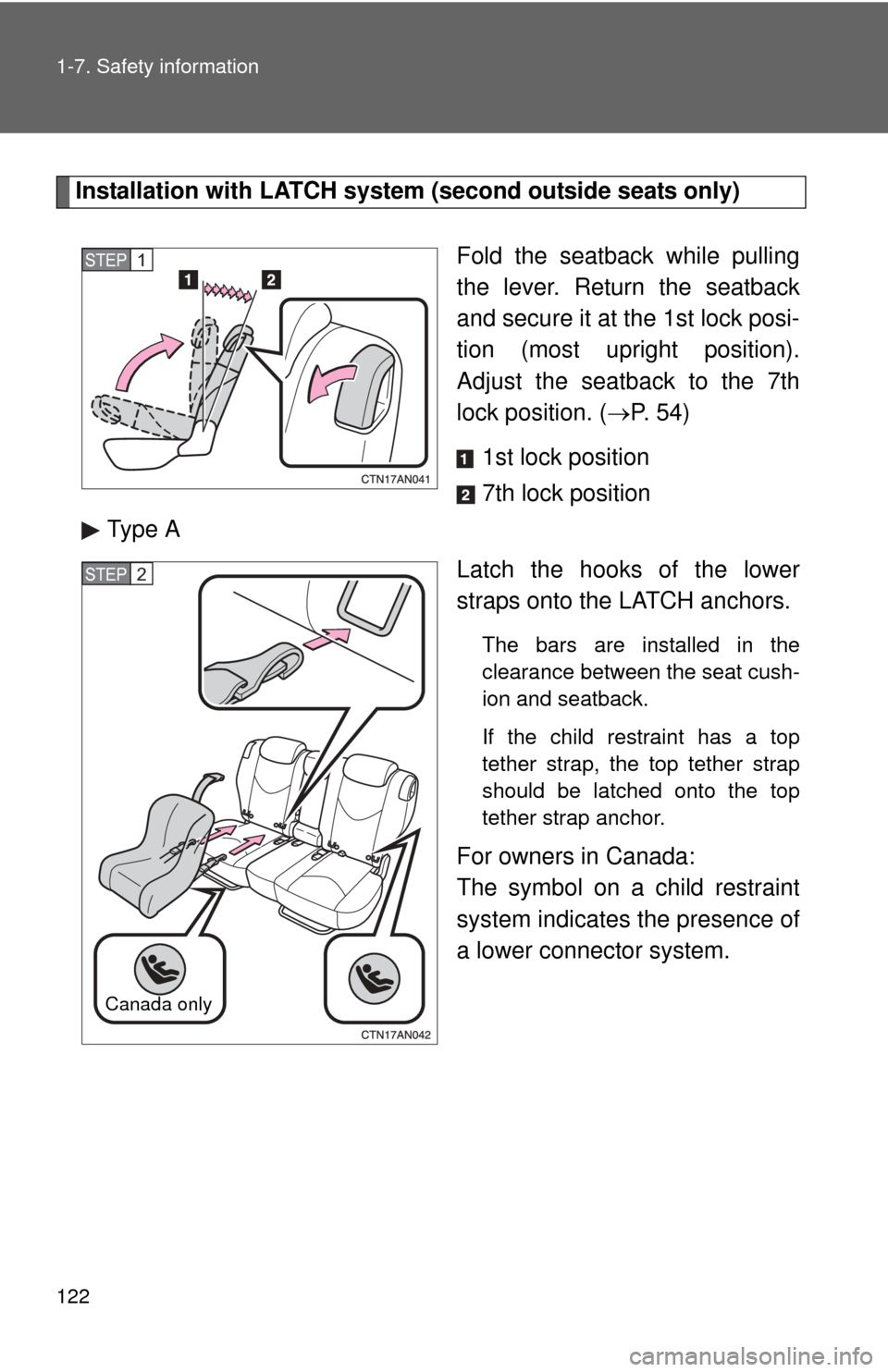
Installation with LATCH system (second outside seats only)
Fold the seatback while pulling
the lever. Return the seatback
and secure it at the 1st lock posi-
tion (most upright position).
Adjust the seatback to the 7th
lock position. ( P. 54)
1st lock position
7th lock position
Type A
Latch the hooks of the lower
straps onto the LATCH anchors.
The bars are installed in the
clearance between the seat cush-
ion and seatback.
If the child restraint has a top
tether strap, the top tether strap
should be latched onto the top
tether strap anchor.
For owners in Canada:
The symbol on a child restraint
system indicates the presence of
a lower connector system.
STEP 1
STEP 2
Canada only
Page 127 of 536
127
1-7. Safety information
1
Before driving
Removing a child restraint installed with a seat belt
Push the buckle release button
and fully retract the seat belt.
Second center seat: Release the
center seat belt as shown in the
illustration after removing the
child restraint.
Child restraint systems with a top tether strap (second seats
only)■ Outside seats
Remove the head restraint.
STEP 1
STEP 2
STEP 1
Page 128 of 536
128 1-7. Safety information
Slide the seats forward slightly if
it is in the rear-most position.
Secure the child restraint using
the seat belt. Latch the hook
onto the anchor bracket and
tighten the top tether strap.
Make sure the top tether strap is
securely latched.
Replace the head restraint.
Move the seats to the rear-most
lock position.
STEP 2
STEP 3 Front of vehicle
STEP 4
STEP 5
Page 130 of 536

130 1-7. Safety information
CAUTION
■When installing a booster seat
Do not fully extend the shoulder belt to prevent the belt from going to ALR
lock mode. ( P. 71)
ALR mode causes the belt to tighten only which could cause injury or dis-
comfort to the child.
■ When installing a child restraint system
Follow the directions given in the child restraint system installation manual
and fix the child restraint system securely in place.
If the child restraint system is not correctly fixed in place, the child or other
passengers may be seriously injured or even killed in the event of sudden
braking, sudden swerving or an accident.
●If the driver's seat interferes with the
child restraint system and prevents it
from being attached correctly, attach
the child restraint system to the right-
hand rear seat.
● Adjust the front passenger seat or sec-
ond seats so that it does not interfere
with the child restraint system.
● Only put a forward-facing or booster
child seat on the front seat when
unavoidable. When installing a forward-
facing or booster child seat on the front
passenger seat, move the seat as far
back as possible even if “AIR BAG
OFF” indicator light is illuminated. Fail-
ing to do so may result in death or seri-
ous injury if the airbags deploy (inflate).
Page 205 of 536

205
2-5. Driving information
2
When driving
As shown in the above example,
if the number of occupants
increases, the cargo and luggage load will be reduced by an amount
that equals the increased weight du e to the additional occupants. In
other words, if an increase in th e number of occupants causes an
excess of the total load capacity (combined weight of occupants plus
cargo and luggage load), you must reduce the cargo and luggage on
your vehicle.
CAUTION
■Things that must not be carried in the luggage compartment
The following things may cause a fire if loaded in the luggage compart-
ment.
●Receptacles containing gasoline
●Aerosol cans
■Storage precautions
Observe the following precautions.
Failing to do so may result in death or serious injury.
●Do not place cargo or luggage in or on the following locations as the
item may get under the brake or accelerator pedal and prevent the
pedals from being depressed properly, block the driver’s vision, or hit
the driver or passengers, causing an accident.
• Driver’s feet
• Front passenger or rear seats (when stacking items)
• Luggage cover
• Instrument panel
• Dashboard
• Auxiliary box or tray that has no lid
●Secure all items in the occupant compartment, as they may shift and
injure someone during sudden braking, sudden swerving or an acci-
dent.
●Never allow anyone to ride in the luggage compartment. It is not
designed for passengers. They should ride in their seats with their seat
belts properly fastened. Otherwise, they are much more likely to suffer
serious bodily injury, in the event of sudden braking, sudden swerving
or an accident.
Page 227 of 536
227
3-1. Using the air conditioning system
and defogger
3
Interior features
■Changing the air outlets
Set the air outlet selection di al to an appropriate position.
The positions between the air outlet selections shown below can be also
selected for more detailed adjustment.
Air flows to the upper body.
Air flows to the upper body and
feet.
: Vehicles with third seats Air flows mainly to the feet.
: Vehicles with third seats
Page 228 of 536
228 3-1. Using the air conditioning system and defogger
Air flows to the feet and the
windshield defogger operates.
The air intake is automatically
switched to outside air mode. It is
not possible to return to recircu-
lated air mode when the dial is set
at this position.
Pressing
to turn the air
conditioning on clears the wind-
shield and side windows faster.
: Vehicles with third seats
Air flows to the windshield and
side windows.
The air intake is automatically
switched to outside air mode. It is
not possible to return to recircu-
lated air mode when the dial is set
at this position.
Pressing
to turn the air
conditioning on clears the wind-
shield and side windows faster.
■ Switching between outside air and recirculated air modes
Press .
The mode switches between outside air mode (indicator off) and recircu-
lated air mode (indicator on) each time is pressed.
Page 232 of 536
232
3-1. Using the air conditioning system and defogger
Automatic air conditioning system
Using the automatic modePress .
The air conditioning system begins to operate. Air outlets and fan
speed are automatically adjusted according to the temperature set-
ting.
Press “” on to increase the temperature and “ ” to
decrease the temperature.
Air outlets and fan speed for the driver and passenger seats may be
set separately depending on the temperature setting.
Airflow and outlets are automatica lly adjusted according to the tem-
perature setting.
Fan speed Air conditioning
on/off switch
Changes the air outlets used
Off
Driver's side
temperature control
Automatic mode
Windshield defogger
Outside air or
recirculated air modeAir flow display
Micro dust and pollen filter Passenger’s side
temperature control
STEP 1
STEP 2
: If equipped