Page 186 of 536
186 2-4. Using other driving systems
To disable TRAC and/or VSC (2WD models)If the vehicle gets stuck in fres h snow or mud, TRAC and VSC may
reduce power from the engine to the wheels. You may need to turn
the system off to enable you to rock the vehicle in order to free it. The
AUTO LSD function is activated when the system is in TRAC off
mode.
■ Turning off TRAC
Quickly push and release the
button to turn off TRAC.
The “AUTO LSD” and VSC OFF
indicator lights should come on.
While the AUTO LSD function is
operating the slip indicator light
flashes.
Push the button again to turn the
system back on.
■Turning off TRAC and VSC
Push and hold the button while
the vehicle is stopped to turn off
TRAC and VSC.
The VSC OFF indicator light
should come on.
Push the button again to turn the
system back on.
Page 187 of 536
187
2-4. Using other
driving systems
2
When driving
To disable TRAC and/or VSC (4WD models)
If the vehicle gets stuck in fresh snow or mud, TRAC and VSC may
reduce power from the engine to the wheels. You may need to turn
the system off to enable you to rock the vehicle in order to free it.
■ Turning off TRAC
Quickly push and release the
button to turn off TRAC.
The “TRAC OFF” indicator light
should come on.
Push the button again to turn the
system back on.
■Turning off TRAC and VSC
Push and hold the button while
the vehicle is stopped to turn off
TRAC and VSC.
The “TRAC OFF” and VSC OFF
indicator lights should come on.
Push the button again to turn the
system back on.
Page 191 of 536

191
2-4. Using other driving systems
2
When driving
Hill-start assist control
■Hill-start assist control operating conditions
• The shift lever is in a position other than P.
• The parking brake is not applied.
• The accelerator pedal is not depressed.
■ Hill-start assist control
●While hill-start assist control is operating, the brakes remain automati-
cally applied after the driver releases the brake pedal. The stop lights and
the high mounted stoplight turn on.
● Hill-start assist control operates for about 2 seconds after the brake pedal
is released.
● If the slip indicator does not flash and the buzzer does not sound when
the brake pedal is further depressed, slightly reduce the pressure on the
brake pedal (do not allow the vehicl e to roll backward) and then firmly
depress it again. If the system still does not operate, check if the operat-
ing conditions explained above have been met.
Hill-start assist control helps to prevent the vehicle from rolling
backwards when starting on an incline or slippery slope.
To engage hill-start assist con-
trol, further depress the brake
pedal when the vehicle is
stopped completely.
A buzzer will sound once to
indicate the system is acti-
vated. The slip indicator will
also start flashing.
: If equipped
Page 194 of 536

194 2-4. Using other driving systems
■Conditions in which the downhill assi st control system does not oper-
ate or will stop operating
● In the following situations, the downhill assist control system indicator
flashes and the downhill assist control system does not operate or will
stop operating:
• The shift lever is not in L or R.
• The vehicle speed is higher than 15 mph (25 km/h).
● If the accelerate or brake pedal is depressed, the downhill assist control
system will stop operating with the downhill assist control system indica-
tor stayed on.
■ If the “DAC” switch is turned off while the downhill assist control sys-
tem is operating
The downhill assist control system gradually ceases operation. The downhill
assist control system indicator will flash during the canceling operation, and
then go off when the system is fully off.
■ Downhill assist control system operation sound
●A sound may be heard from the engine compartment while the downhill
assist control system is operating. This sound does not indicate a mal-
function.
● If the accelerator or brake pedal is depressed while the downhill assist
control system is operating, a sound caused by the release of system
operation may be heard, or you may feel the brake pedal push-back. This
does not indicate a malfunction.
■ When the downhill assist contro l system operates continuously
The brake actuator may overheat. In that case, the downhill assist control
system will stop operating, a buzzer will sound and the downhill assist con-
trol system indicator will start flashing. Refrain from using the system until
the downhill assist control system indicator stays on. (There is no problem
with continuing driving normally.)
■ If the slip indicator comes on
It may indicate a malfunction in the system. Contact your Toyota dealer.
Page 202 of 536
202
2-5. Driving information
Cargo and luggage
Adjusting the cross rail positionsTurn the knobs counterclockwise
to release the cross rails.
Take notice of the following information about storage precau-
tions, cargo capacity and load.
●Stow cargo and luggage in the luggage compartment whenever
possible. Be sure all item s are secured in place.
● Be careful to keep the vehicle level. Placing the weight as far for-
ward as possible helps maintain vehicle balance.
● For better fuel economy, do no t carry unnecessary weight.
■ Roof luggage carrier (if equipped)
Roof rails
Cross rails
STEP 1
Page 211 of 536

211
2-5. Driving information
2
When driving
Selecting tire chains
Use the correct tire chain size when mounting the snow chains.
Chain size is regulated for each tire size. Side chain
0.12 in. (3 mm) in diameter
0.39 in. (10 mm) in width
1.18 in. (30 mm) in length
Cross chain
0.16 in. (4 mm) in diameter
0.55 in. (14 mm) in width
0.98 in. (25 mm) in length
Regulations on the use of snow chains
● Regulations regarding the use of tire chains vary according to loca-
tion and type of road. Always check local regu lations before install-
ing chains.
● Install the chains on the front tires.
● Retighten the chains after drivi ng 1/4 - 1/2 mile (0.5 - 1.0 km).
■When driving the vehicle
Accelerate the vehicle slowly and drive at a reduced speed suit-
able to road conditions.
■ When parking the vehicle
Park the vehicle and move the shift lever to P without setting the
parking brake. The parking brak e may freeze up, preventing it
from being released. If necessary , block the wheels to prevent
inadvertent sliding or creeping.
Page 222 of 536
![TOYOTA RAV4 2011 XA30 / 3.G Owners Manual 222 2-5. Driving information
●Due to the added load of the trailer, your vehicles engine may
overheat on hot days (at temper atures over 85°F [30°C]) when
driving up a long or steep grade. If the](/manual-img/14/6695/w960_6695-221.png "TOYOTA RAV4 2011 XA30 / 3.G Owners Manual 222 2-5. Driving information
●Due to the added load of the trailer, your vehicles engine may
overheat on hot days (at temper atures over 85°F [30°C]) when
driving up a long or steep grade. If the")
222 2-5. Driving information
●Due to the added load of the trailer, your vehicle's engine may
overheat on hot days (at temper atures over 85°F [30°C]) when
driving up a long or steep grade. If the engine coolant temperature
gauge indicates overheating, immediately turn off the air condition-
ing (if in use), pull your vehicle off the road and stop in a safe spot.
( P. 466)
● Always place wheel blocks under both the vehicle and the trailer
wheels when parking. Apply the parking brake firmly, and put the
transmission in P. Avoid parking on a slope, but if unavoidable, do
so only after performing the following:
Apply the brakes and keep them applied.
Have someone place wheel bloc ks under both the vehicle and
trailer wheels.
When the wheel blocks are in place, release the brakes slowly
until the blocks absorb the load.
Apply the parking brake firmly.
Shift into P and turn off the engine.
● When restarting after parking on a slope:
With the transmission in P, start the engine. Be sure to keep
the brake pedal pressed.
Shift into a forward gear. If reversing, shift into R.
Release the parking brake and brake pedal, and slowly pull or
back away from the wheel blocks. Stop and apply the brakes.
Have someone retrieve the blocks.
STEP 1
STEP 2
STEP 3
STEP 4
STEP 5
STEP 1
STEP 2
STEP 3
STEP 4
Page 311 of 536
311
3
Interior features
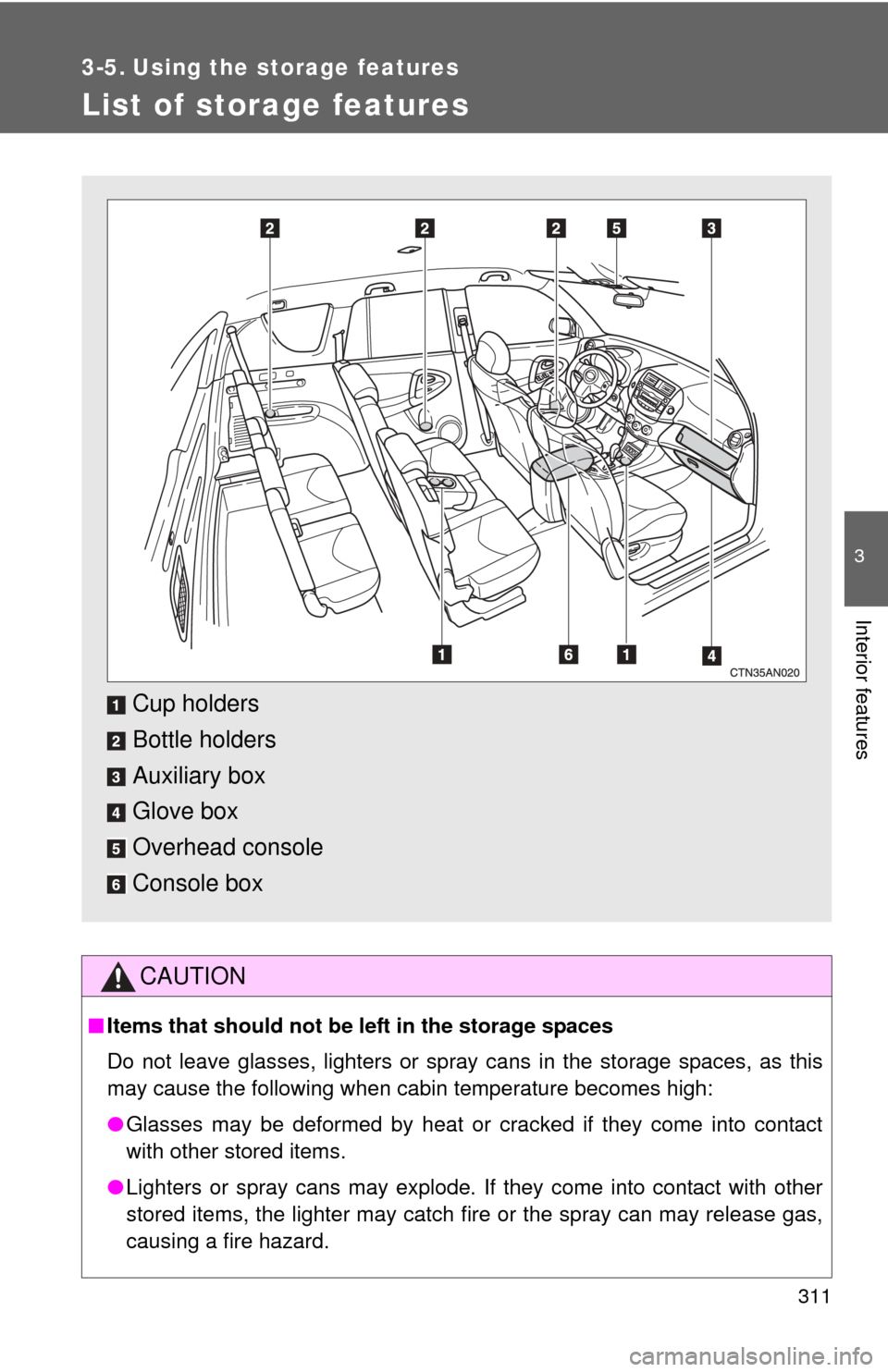
3-5. Using the storage features
List of storage features
CAUTION
■Items that should not be left in the storage spaces
Do not leave glasses, lighters or spray cans in the storage spaces, as this
may cause the following when cabin temperature becomes high:
● Glasses may be deformed by heat or cracked if they come into contact
with other stored items.
● Lighters or spray cans may explode. If they come into contact with other
stored items, the lighter may catch fire or the spray can may release gas,
causing a fire hazard.
Cup holders
Bottle holders
Auxiliary box
Glove box
Overhead console
Console box