Page 384 of 536

384
4-3. Do-it-yourself maintenance
Wheels
If a wheel is bent, cracked or heavily corroded, it should be
replaced.
Otherwise, the tire may separate from the wheel or cause loss of
handling control.
■Wheel selection
When replacing wheels, care should be taken to ensure that
they are equivalent to those removed in load capacity, diameter,
rim width, and inset*.
Replacement wheels are available at your Toyota dealer.
*: Conventionally referred to as “offset”.
Toyota does not recommend using:
●Wheels of different sizes or types
● Used wheels
● Bent wheels that have been straightened
■ Aluminum wheel precautions
●Use only Toyota wheel nuts and wrenches designed for use
with your aluminum wheels.
● When rotating, repairing or changing your tires, check that the
wheel nuts are still tight after driving 1000 miles (1600 km).
● Be careful not to damage the aluminum wheels when using
tire chains.
● Use only Toyota genuine balance weights or equivalent and a
plastic or rubber hammer when balancing your wheels.
Page 385 of 536

385
4-3. Do-it-yourself maintenance
4
Maintenance and care
■When replacing wheels (vehicles with a tire pressure warning sys-
tem)
The wheels of your Toyota are equipped with tire pressure warning
valves and transmitters that allow the tire pressure warning system to
provide advanced warning in the event of a loss in tire inflation pressure.
Whenever wheels are replaced, the tire pressure warning valves and
transmitters must be installed. (
P. 375)
CAUTION
■When replacing wheels
●Do not use wheels that are a different size from those recommended in
the Owner’s Manual, as this may re sult in loss of handling control.
●Never use an inner tube in a leaking wheel which is designed for a
tubeless tire. Doing so may result in an accident, causing serious
injury or death.
NOTICE
■Replacing tire pressure warning valves and transmitters (vehicles
with a tire pressure warning system)
●Because tire repair or replacement may affect the tire pressure
warning valves and transmitters, make sure to have tires serviced by
your Toyota dealer or other qualified service shop. In addition, make
sure to purchase your tire pressure warning valves and transmitters at
your Toyota dealer.
●Ensure that only genuine Toyota wheels are used on your vehicle.
Tire pressure warning valves and transmitters may not work properly
with non-genuine wheels.
Page 408 of 536
408 4-3. Do-it-yourself maintenance
Reinstalling the clip
■ Front fog lights (if equipped)
Turn the steering wheel in the
opposite direction of the front fog
light that you wish to replace.
For example, if you wish to
replace the front fog light on the
right side, turn the steering wheel
to the left.
Remove the clip using a flathead
screwdriver wrapped in a rag.
Move section “A” of the fender
liner to the inner side of the vehi-
cle, partly removing it and
thereby allowing access to the
front fog light.
STEP 1
STEP 2
STEP 3
Page 415 of 536
5
When trouble arises
415
5-1. Essential information
If your vehicle needs to be towed
Before towingThe following may indicate a problem with your transmission. Contact
your Toyota dealer before towing.
● The engine is running, but the vehicle will not move.
● The vehicle makes an abnormal sound.
If towing is necessary, we recommend having your vehicle towed by
your Toyota dealer or a commercial towing service, using a wheel-lift
type truck or a flat bed truck.
Use a safety chain system for all to wing, and abide by all state/pro-
vincial and local laws.
2WD models: If towing your vehicle with a wheel-lift type truck from
the front, the vehicle's rear wheels and axles must be in good condi-
tions. ( P. 418, 421)
If they are damaged, use a towing dolly or flat bed truck.
4WD models: If towing your vehicle with a wheel-lift type truck, use a
towing dolly. ( P. 418, 421)
Page 416 of 536
416 5-1. Essential information
Emergency towingIf a tow truck is not available, in an emergency your vehicle may be
temporarily towed using a cable or chain secured to the emergency
towing eyelet. This should only be attempted on hard surfaced roads
for short distances at low speeds.
A driver must be in the vehicle to steer and operate the brakes. The
vehicle’s wheels, drive train, axles, steering and brakes must be in
good condition.
Towing eyelet
Page 417 of 536
5
When trouble arises
417
5-1. Essential information
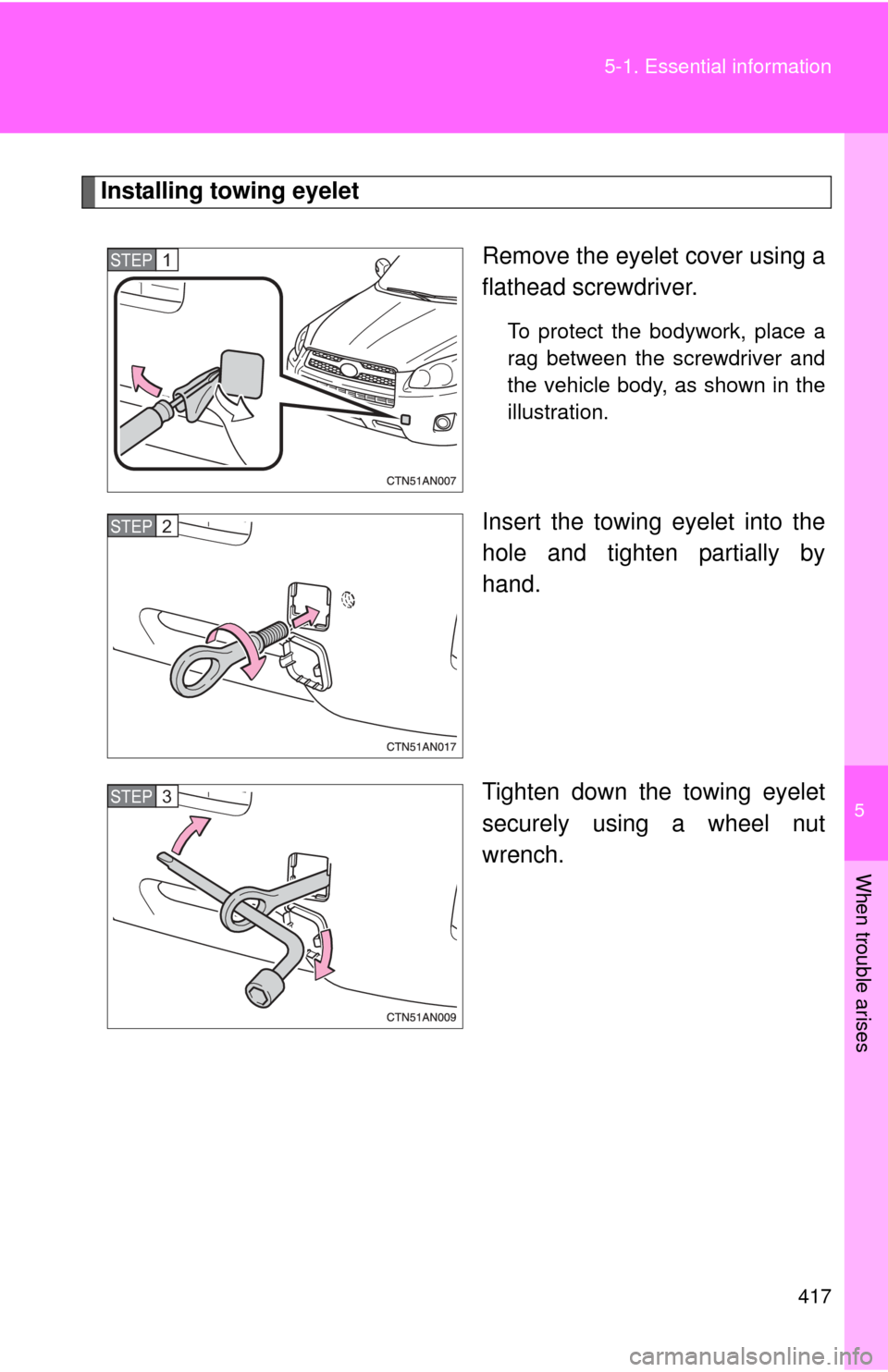
Installing towing eyelet
Remove the eyelet cover using a
flathead screwdriver.
To protect the bodywork, place a
rag between the screwdriver and
the vehicle body, as shown in the
illustration.
Insert the towing eyelet into the
hole and tighten partially by
hand.
Tighten down the towing eyelet
securely using a wheel nut
wrench.
STEP 1
STEP 2
STEP 3
Page 418 of 536
418 5-1. Essential information
Towing with a sling-type truckDo not tow with a sling-type truck
to prevent body damage.
Towing with a wheel-lift type truckFrom the front (2WD models) Release the parking brake.
From the front (4WD models) Use a towing dolly under the rear
wheels.
Page 419 of 536
5
When trouble arises
419
5-1. Essential information
From the rear
Use a towing dolly under the
front wheels.
Using a flat bed truck
If you use chains or cables to tie
down your vehicle, the angles
shaded in black must be 45.
Do not overly tighten the tie
downs or the vehicle may be
damaged.
■ Emergency towin g procedure
Release the parking brake.
Shift the shift lever to N.
Vehicles without smart key system: Turn the engine switch to “ACC”
(engine off) or “ON” (engine running) position.
Vehicles with smart key system: Turn the “ENGINE START STOP”
switch to ACCESSORY (engine off) or IGNITION ON (engine run-
ning) mode.
■ Location of the emer gency towing eyelet
The emergency towing eyelet is in the tool bag. ( P. 438)
STEP 1
STEP 2
STEP 3