127
2-1. Driving procedures
2
When driving
Automatic Transmission
: If equipped
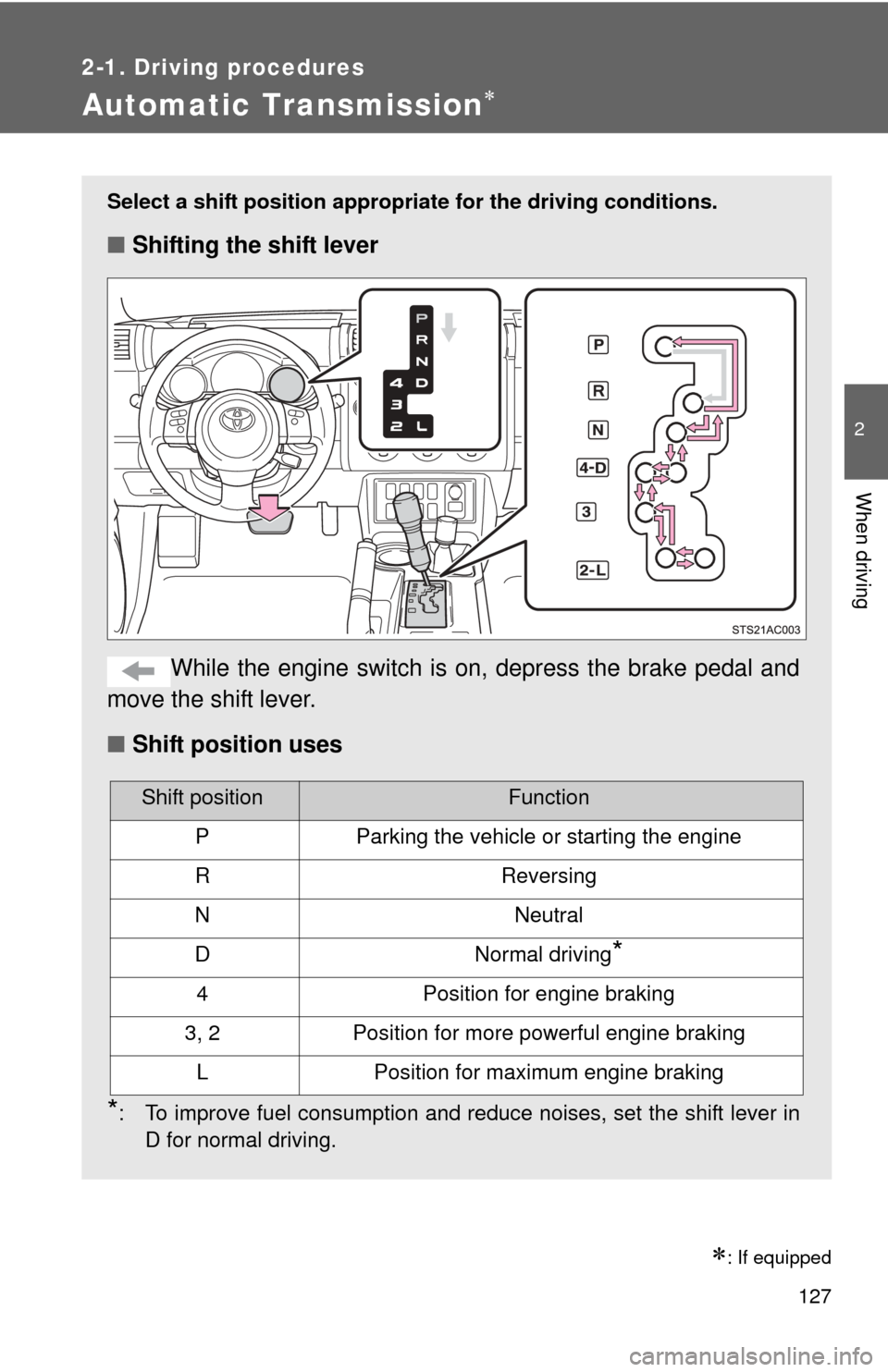
Select a shift position appropriate for the driving conditions.
■Shifting the shift lever
While the engine switch is on, depress the brake pedal and
move the shift lever.
■ Shift position uses
*: To improve fuel consumption and reduce noises, set the shift lever in
D for normal driving.
Shift positionFunction
PParking the vehicle or starting the engine
RReversing
NNeutral
DNormal driving*
4Position for engine braking
3, 2Position for more powerful engine braking
LPosition for maximum engine braking
166 2-4. Using other driving systems
CAUTION
■Caution while driving
●Never shift the front-wheel drive control lever from H2 to H4 if the wheels
are slipping.
Stop the slipping or spinning before shifting.
● For normal driving on dry and hard surface roads, use H2 position. Driving
on dry and hard surface roads in H4 or L4 position may cause drive com-
ponent oil leakage, seizure, or other problems resulting in an accident.
Further, it may cause tire wear and increased fuel consumption.
● Avoid turning suddenly in H4 or L4 position. If you do turn suddenly, the
difference in turning speeds between the front and rear wheels may have
a similar effect to braking, thus making driving difficult.
● Securely shift the front-wheel drive control lever to H4 or L4. Otherwise,
the transfer may disengage both the fr ont and rear driveshafts from the
powertrain and allow the vehicle to move regardless of the shift position.
If this happens, the vehicle may be free to roll even if the automatic t\
rans-
mission is in P.