Page 355 of 529
354 4-3. Do-it-yourself maintenance
Set the jack attachment on the
floor jack with the “FOR-
WARD” facing towards the
front of the vehicle, and place
the jack.
Before raising the vehicle,
make sure that the floor jack is
positioned so that the jack
point fits securely inside the
groove on the jack attach-
ment. STEP 2
Front of vehicle
STEP 3
Page 377 of 529

376 4-3. Do-it-yourself maintenance
CAUTION
■When inspecting or replacing tires
Observe the following precautions to prevent accidents. Failure to do so
may cause damage to parts of the drive train, as well as dangerous han-
dling characteristics, which may lead to an accident resulting in death or
serious injury.
●Do not mix tires of different makes, models or tread patterns.
Also, do not mix tires of remarkably different treadwear.
●Do not use tire sizes other than those recommended by Toyota.
●Do not mix differently constructed ti res (radial, bias-belted or bias-ply
tires).
●Do not mix summer, all season and winter tires.
●Do not tow the vehicle with the compact spare tire installed.
■When initializing the tire pressure warning system
Do not push the tire pressure warnin g reset switch without first adjusting
the tire inflation pressure to the spec ified level. Otherwise, the tire pres-
sure warning light may not come on ev en if the tire inflation pressure is
low, or it may come on when the tire inflation pressure is actually normal.
Page 414 of 529
When trouble arises5
413
5-1. Essential informationEmergency flashers ......... 414
If your vehicle needs to be towed ........................ 415
If you think something is wrong ............................. 420
Fuel pump shut off system ........................... 421
Event data recorder ......... 422 5-2. Steps to take in an
emergency
If a warning light turns on or a warning buzzer
sounds... ....................... 424
If you have a flat tire......... 436
If the engine will not start ................................ 448
If the shift lever cannot be shifted from P................. 450
If you lose your keys ........ 451
If the electronic key does not operate properly....... 452
If the battery is discharged ..................... 454
If your vehicle overheats ....................... 460
If the vehicle becomes stuck .............................. 463
If your vehicle has to be stopped in an
emergency ..................... 465
Page 416 of 529
5
When trouble arises
415
5-1. Essential information
If your vehicle needs to be towed
Before towingThe following may indicate a problem with your transmission. Contact
your Toyota dealer before towing.
● The engine is running, but the vehicle will not move.
● The vehicle makes an abnormal sound.
If towing is necessary, we recommend having your vehicle towed by
your Toyota dealer or a commerci al towing service, using a lift-type
truck or a flat bed truck.
Use a safety chain system for all to wing, and abide by all state/pro-
vincial and local laws.
If towing from the front, the vehic le's rear wheels and axles must be
in good condition. (P. 418)
If they are damaged, use a towing dolly or flat bed truck.
Page 417 of 529
416 5-1. Essential information
Emergency towingIf a tow truck is not available, in an emergency your vehicle may be
temporarily towed using a cable or chain secured to the emergency
towing eyelet. This should only be attempted on hard surfaced roads
for short distances at low speeds.
A driver must be in the vehicle to steer and operate the brakes. The
vehicle’s wheels, drive train, axles, steering and brakes must be in
good condition.
1.8 L 4-cylinder (2ZR-FE) engine Towing eyelet
2.4 L 4-cylinder (2AZ-FE) engine Towing eyelet
Page 418 of 529
5
When trouble arises
417
5-1. Essential information
■
Emergency towin g procedure
Release the parking brake.
Shift the shift lever to N. Vehicles with smart key system
Turn the “ENGINE START STOP” switch to ACCESSORY (engine
off) or IGNITION ON (engine running) mode.
Vehicles without smart key system
Turn the engine switch to the “ACC” (engine off) or “ON” (engine
running) position.
CAUTION
■ Caution while towing
●Use extreme caution when towing the vehicle.
Avoid sudden starts or erratic driving maneuvers which place excessive
stress on the emergency towing eyelet and the cables or chains. Always
be cautious of the surroundings and other vehicles while towing.
● If the engine is not running, the power assist for the brakes and steering
will not function, making steering and braking more difficult.
STEP 1
STEP 2
STEP 3
Page 419 of 529
418 5-1. Essential information
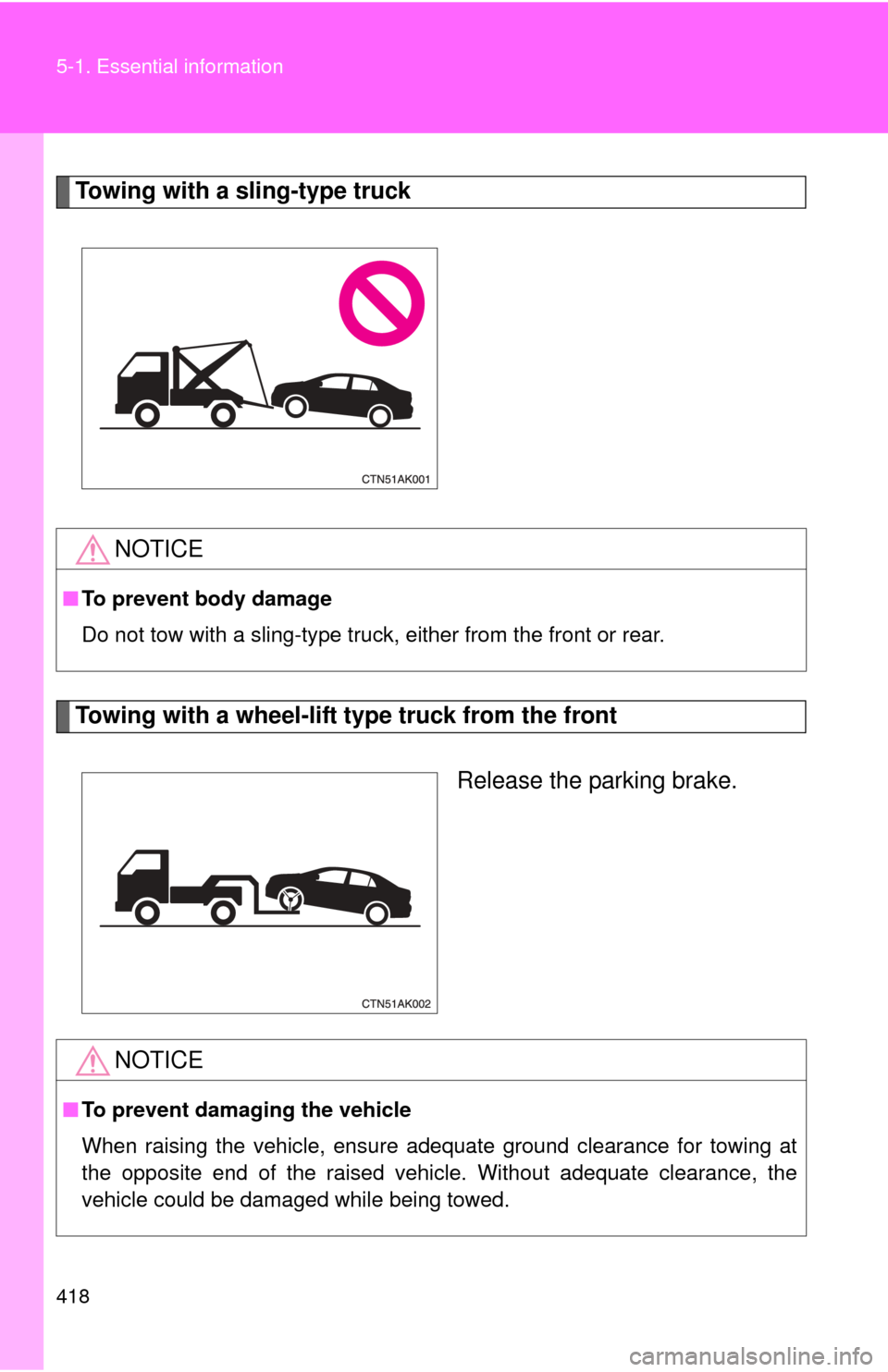
Towing with a sling-type truck
Towing with a wheel-lift type truck from the frontRelease the parking brake.
NOTICE
■To prevent body damage
Do not tow with a sling-type truck, either from the front or rear.
NOTICE
■To prevent damaging the vehicle
When raising the vehicle, ensure adequate ground clearance for towing at
the opposite end of the raised vehicle. Without adequate clearance, the
vehicle could be damaged while being towed.
Page 420 of 529
5
When trouble arises
419
5-1. Essential information
Towing with a wheel-lift type truck from the rear
Automatic transmission: Use a
towing dolly under the front
wheels.
Manual transmission: We recom-
mend to use a towing dolly under
the front wheels.
When not using a towing dolly,
turn the engine switch to the
“ACC” position and shift the shift
lever to N.
Using a flat bed truckIf you use chains or cables to tie
down your vehicle, the angles
shaded in black must be 45.
Do not overly tighten the tie
downs or the vehicle may be
damaged.
NOTICE
■ To prevent causing serious dama ge to the transmission
(automatic transmission)
Never tow this vehicle from the rear with the front wheels on the ground.
■ To prevent damaging the vehicle (manual transmission)
Do not tow the vehicle when the engine switch is in “LOCK” position or key
removed.
The steering lock mechanism is not strong enough to hold the front wheels
straight.