Page 416 of 529
5
When trouble arises
415
5-1. Essential information
If your vehicle needs to be towed
Before towingThe following may indicate a problem with your transmission. Contact
your Toyota dealer before towing.
● The engine is running, but the vehicle will not move.
● The vehicle makes an abnormal sound.
If towing is necessary, we recommend having your vehicle towed by
your Toyota dealer or a commerci al towing service, using a lift-type
truck or a flat bed truck.
Use a safety chain system for all to wing, and abide by all state/pro-
vincial and local laws.
If towing from the front, the vehic le's rear wheels and axles must be
in good condition. (P. 418)
If they are damaged, use a towing dolly or flat bed truck.
Page 417 of 529
416 5-1. Essential information
Emergency towingIf a tow truck is not available, in an emergency your vehicle may be
temporarily towed using a cable or chain secured to the emergency
towing eyelet. This should only be attempted on hard surfaced roads
for short distances at low speeds.
A driver must be in the vehicle to steer and operate the brakes. The
vehicle’s wheels, drive train, axles, steering and brakes must be in
good condition.
1.8 L 4-cylinder (2ZR-FE) engine Towing eyelet
2.4 L 4-cylinder (2AZ-FE) engine Towing eyelet
Page 418 of 529
5
When trouble arises
417
5-1. Essential information
■
Emergency towin g procedure
Release the parking brake.
Shift the shift lever to N. Vehicles with smart key system
Turn the “ENGINE START STOP” switch to ACCESSORY (engine
off) or IGNITION ON (engine running) mode.
Vehicles without smart key system
Turn the engine switch to the “ACC” (engine off) or “ON” (engine
running) position.
CAUTION
■ Caution while towing
●Use extreme caution when towing the vehicle.
Avoid sudden starts or erratic driving maneuvers which place excessive
stress on the emergency towing eyelet and the cables or chains. Always
be cautious of the surroundings and other vehicles while towing.
● If the engine is not running, the power assist for the brakes and steering
will not function, making steering and braking more difficult.
STEP 1
STEP 2
STEP 3
Page 419 of 529
418 5-1. Essential information
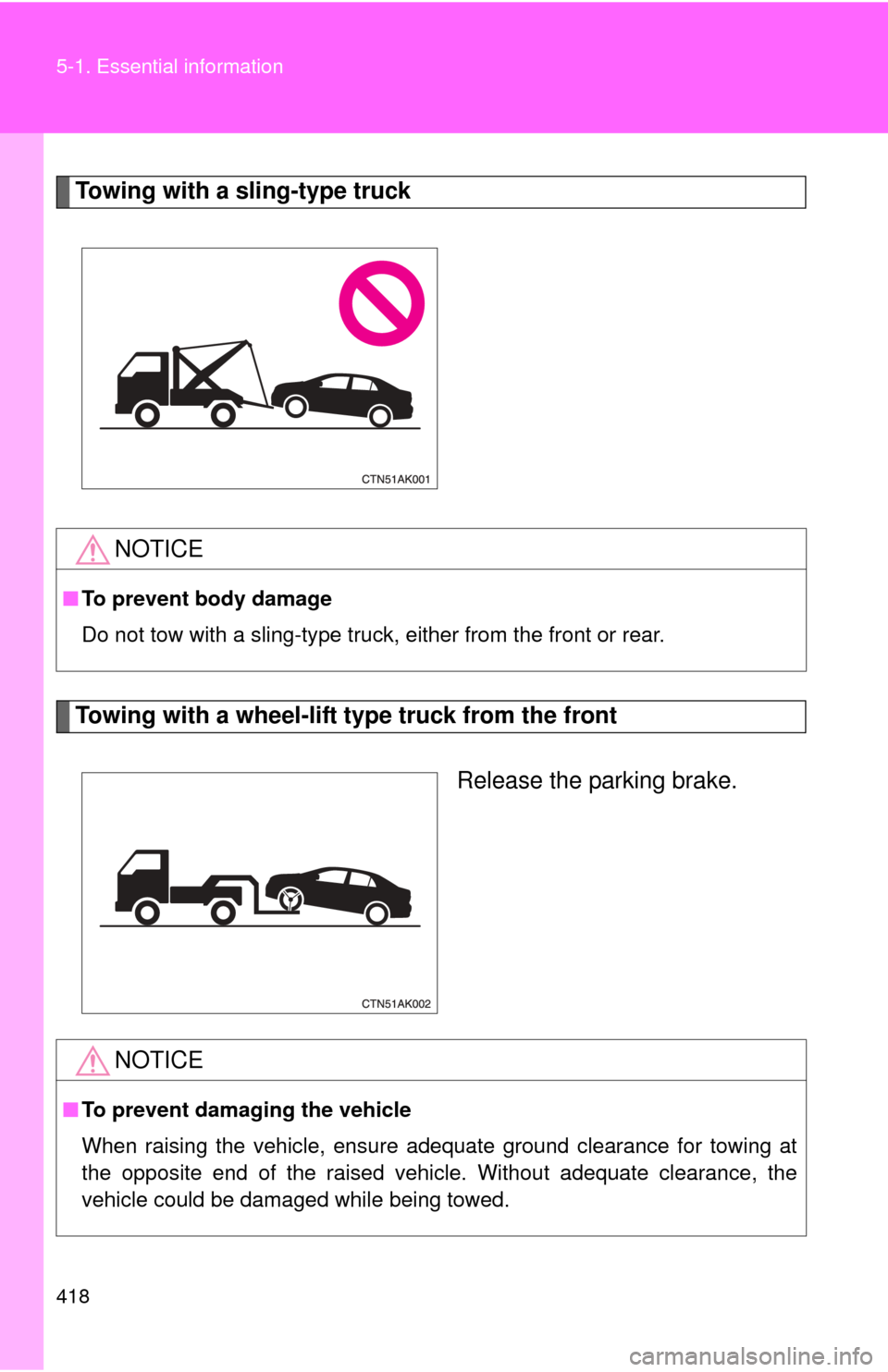
Towing with a sling-type truck
Towing with a wheel-lift type truck from the frontRelease the parking brake.
NOTICE
■To prevent body damage
Do not tow with a sling-type truck, either from the front or rear.
NOTICE
■To prevent damaging the vehicle
When raising the vehicle, ensure adequate ground clearance for towing at
the opposite end of the raised vehicle. Without adequate clearance, the
vehicle could be damaged while being towed.
Page 420 of 529
5
When trouble arises
419
5-1. Essential information
Towing with a wheel-lift type truck from the rear
Automatic transmission: Use a
towing dolly under the front
wheels.
Manual transmission: We recom-
mend to use a towing dolly under
the front wheels.
When not using a towing dolly,
turn the engine switch to the
“ACC” position and shift the shift
lever to N.
Using a flat bed truckIf you use chains or cables to tie
down your vehicle, the angles
shaded in black must be 45.
Do not overly tighten the tie
downs or the vehicle may be
damaged.
NOTICE
■ To prevent causing serious dama ge to the transmission
(automatic transmission)
Never tow this vehicle from the rear with the front wheels on the ground.
■ To prevent damaging the vehicle (manual transmission)
Do not tow the vehicle when the engine switch is in “LOCK” position or key
removed.
The steering lock mechanism is not strong enough to hold the front wheels
straight.
Page 465 of 529
464 5-2. Steps to take in an emergency
NOTICE
■To avoid damaging the transmission and other components
●Avoid spinning the wheels and do not rev the engine.
● If the vehicle remains stuck after trying these procedures, the vehicle may
require towing to be freed.
Page 469 of 529
468
6-1. Specifications
Maintenance data (fuel, oil level, etc.)
Dimensions and weights
*1: Unladen vehicles
*2: P195/65R15 tires
*3: P205/55R16 and P215/45R17 tires
*4: 2.4 L 4-cylinder (2AZ-FE) engine only
Vehicle identification■ Vehicle identification number
The vehicle identification number (VIN) is the legal identifier for
your vehicle. This is the primar y identification number for your
Toyota. It is used in registering the ownership of your vehicle.
This number is stamped on the
top left of the instrument panel.
Overall length 179.0 in. (4546 mm)
Overall width69.3 in. (1760 mm)
Overall height*157.7 in. (1465 mm)
Wheelbase102.4 in. (2600 mm)
Tread
Front60.3 in. (1531 mm)*2
59.8 in. (1519 mm)*3
Rear60.4 in. (1534 mm)*2
59.9 in. (1522 mm)*3
Vehicle capacity weight
(occupants + luggage) 825 lb. (370 kg)
Towing capacity*4
(trailer weight + cargo weight)1500 lb. (680 kg)
Page 519 of 529

518 Alphabetical index
CareExterior .................................. 336
Interior ................................... 338
Seat belts .............................. 339
Cargo capacity ......................... 170
CD changer ............................... 217
CD player .................................. 217
Chains ....................................... 174
Child restraint system
Booster seats, definition ........ 102
Booster seats, installation ..... 106
Convertible seats, definition ............................. 102
Convertible seats,
installation ........................... 106
Front passenger occupant classification system .............97
Infant seats, definition ........... 102
Infant seats, installation......... 106
Installing CRS with LATCH anchors ............................... 107
Installing CRS with seat belts ............................ 109
Installing CRS with top tether straps ........................ 113
Child safety
Airbag precautions ..................92
Battery precautions ....... 367, 458
Child restraint system............ 102
Child-protectors .......................40
How your child should wear the seat belt ..........................60
Installing child restraints ........ 106
Moon roof precautions ............74
Power window lock switch.......69
Power window precautions .....70
Removed key battery precautions ......................... 389
Seat belt comfort guide ........... 57
Seat belt extender precautions ...........................63 Seat belt precautions .............. 61
Seat heater precautions ........ 327
Trunk precautions ................... 47
Child-protectors ......................... 40
Cleaning Exterior.................................. 336
Interior ................................... 338
Seat belts .............................. 339
Clock ......................................... 323
Compass................................... 330
Condenser ................................ 363
Console box ............................. 314
Cooling system Engine overheating ............... 460
Cruise control .......................... 162
Cup holder ................................ 316
Curtain shield airbags ............... 85
Customizable features ............ 495
Daytime running light system .................................... 158
Defogger
Rear window ......................... 205
Side mirror ............................ 205
Dimension ................................ 468
Dinghy towing ................... 187,188
Display Trip information ..................... 154
Do-it-yourself maintenance .... 347
Doors Door lock ..................... 23, 34, 39
Door windows ......................... 69
Side mirrors............................. 67
Driver's seat belt reminder
light ......................................... 426
Driving Break-in tips .......................... 120
Correct posture ....................... 83
Procedures............................ 118
Winter driving tips ................. 174C
D