Page 103 of 554
103
1-7. Safety information
1
Before driving
Conditions and operation of the front passenger occupant classification system
■
Adult*1
■Child*3 or child restraint system*4
Indicator/
warning light
“AIR BAG ON” and “AIR BAG OFF” indicator
lights“AIR BAG ON”
SRS warning light Off
Front passenger’s seat belt reminder light Flashing
*2
Devices Front passenger airbag
Activated
Side airbag on the front
passenger seats
Curtain shield airbag in the front passenger side
Front passenger’s seat belt pretensioner
Indicator/
warning light
“AIR BAG ON” and “AIR BAG OFF” indicator
lights“AIR BAG OFF”*5
SRS warning light Off
Front passenger’s seat belt reminder light Flashing
*2
Devices Front passenger airbag
Deactivated
Side airbag on the front
passenger seats
Curtain shield airbag in the front passenger side Activated
Front passenger’s seat belt pretensioner
Page 104 of 554

104 1-7. Safety information
■Unoccupied
■ There is a malfunction in the system
*1: The system judges a person of adult size as an adult. When a
smaller adult sits in the front passenger seat, the system may rec-
ognize him/her as a child depending on his/her physique and pos-
ture.
*2: In the event the front passenger does not wear a seat belt.
*3: When a larger child who has outgrown a child restraint systemsits in the front passenger seat, the system may recognize him/
her as an adult depending on hi s/her physique or posture.
Indicator/
warning light
“AIR BAG ON” and “AIR BAG OFF” indicator
lights Not illuminated
SRS warning light
Off
Front passenger’s seat belt reminder light
Devices Front passenger airbag
Deactivated
Side airbag on the front
passenger seats
Curtain shield airbag in the front passenger side Activated
Front passenger’s seat belt pretensioner Deactivated
Indicator/
warning light
“AIR BAG ON” and “AIR BAG OFF” indicator
lights“AIR BAG OFF”
SRS warning light On
Front passenger’s seat belt reminder light Off
Devices Front passenger airbag
Deactivated
Side airbag on the front
passenger seats
Curtain shield airbag in the front passenger side Activated
Front passenger’s seat belt pretensioner
Page 106 of 554

106 1-7. Safety information
CAUTION
■Front passenger occupant cl assification system precautions
● Do not recline the front passenger seatback so far that it touches a rear
seat. This may cause the “AIR BAG OFF” indicator light to be illuminated,
which indicates that the passenger’s airbags will not deploy in the event of
a severe accident. If the seatback touches the rear seat, return the seat-
back to a position where it does not touch the rear seat. Keep the front\
passenger seatback as upright as possible when the vehicle is moving.
Reclining the seatback excessively may lessen the effectiveness of the
seat belt system.
● If an adult sits in the front passenger seat, the “AIR BAG ON” indicator
light is illuminated. If the “AIR BAG OFF” indicator is illuminated, ask the
passenger to sit up straight, well back in the seat, feet on the floor, and
with the seat belt worn correctly. If the “AIR BAG OFF” indicator still
remain illuminated, either ask the passenger to move to the rear seat, or if
that is not possible, move the front passenger seat fully rearward.
● When it is unavoidable to install the forward-facing child restraint system
on the front passenger seat, install the child restraint system on the front
passenger seat in the proper order. (P. 1 1 1 )
● Do not modify or remove the front seats.
● Do not kick the front passenger seat or subject it to severe impact. Other-
wise, the SRS warning light may come on to indicate a malfunction of the
detection system. In this case, contact your Toyota dealer immediately.
● Child restraint systems installed on the rear seat should not contact the
front seatbacks.
● Do not use a seat accessory, such as a cushion or seat cover, that covers
the seat cushion surface.
● Do not modify or replace the upholstery of the front seat.
Page 111 of 554
111
1
1-7. Safety information
Before driving
Installing child restraints
Follow the child restraint system manufacturer's instructions. Firmly
secure child restraints to the outside rear seats using the LATCH
anchors or a seat belt. Attach the to p tether strap when installing a
child restraint.
The lap/shoulder belt can be used if your child restraint system is
not compatible with the LATCH (Low er Anchors and Tethers for Chil-
dren) system.
Child restraint LATCH anchors
LATCH anchors are provided
for the outside rear seats. (But-
tons displaying the location of
the anchors are attached to the
seats.)
Seat belts equipped with a
child restraint locking mecha-
nism (ALR/ELR belts except
driver’s seat belt) ( P. 59)
Page 112 of 554
112 1-7. Safety information
Installation with LATCH systemVehicles with reclining type rear seat: Adjust the seatback as
upright as possible.
Type A
Widen the gap between
the seat cushion and
seatback slightly.
Latch the hooks of the
lower straps onto the
LATCH anchors.
If the child restraint has a
top tether strap, the top
tether strap should be
latched onto the top
tether strap anchor.
For owners in Canada:
A symbol on a child restraint sys-
tem indicates the presence of a
lower connector system.
Anchor bracket (for top tether
strap)
Anchor brackets are provided
for all rear seats.
STEP1
Canada only
STEP2
STEP3
STEP4
Page 181 of 554

181
2-5. Driving information
2
When driving
CAUTION
■Storage precautions
Observe the following precautions.
Failing to do so may result in death or serious injury.
●Vehicles with fold-down type rear
seat: To prevent cargo and luggage
from sliding forward during braking, do not stack anything in the
enlarged trunk. Keep cargo and luggage low, as close to the floor as
possible.
●Vehicles with fold-down type rear seat: Never allow anyone to ride in
the enlarged trunk. It is not design ed for passengers. They should ride
in their seats with their seat belts properly fastened. Otherwise, they
are much more likely to suffer death or serious bodily injury, in the
event of sudden braking, sudden swerving or an accident.
●Do not place cargo or luggage in or on the following locations as the
item may get under the clutch, brake or accelerator pedal and prevent
the pedals from being depressed properly, block the driver’s vision, or
hit the driver or passengers, causing an accident.
• Driver’s feet
• Front passenger or rear seats (when stacking items)
• Package tray
• Instrument panel
• Dashboard
●Secure all items in the occupant compartment, as they may shift and
injure someone during sudden braking, sudden swerving or an acci-
dent.
■Capacity and distribution
●Do not exceed the maximum axle weight rating or the total vehicle
weight rating.
●Even if the total load of occupant's weight and the cargo load is less
than the total load capacity, do not apply the load unevenly.
Improper loading may cause deterioration of steering or braking con-
trol which may cause death or serious injury.
Page 201 of 554
201
3-1. Using the air conditioning system
and defogger
3
Interior features
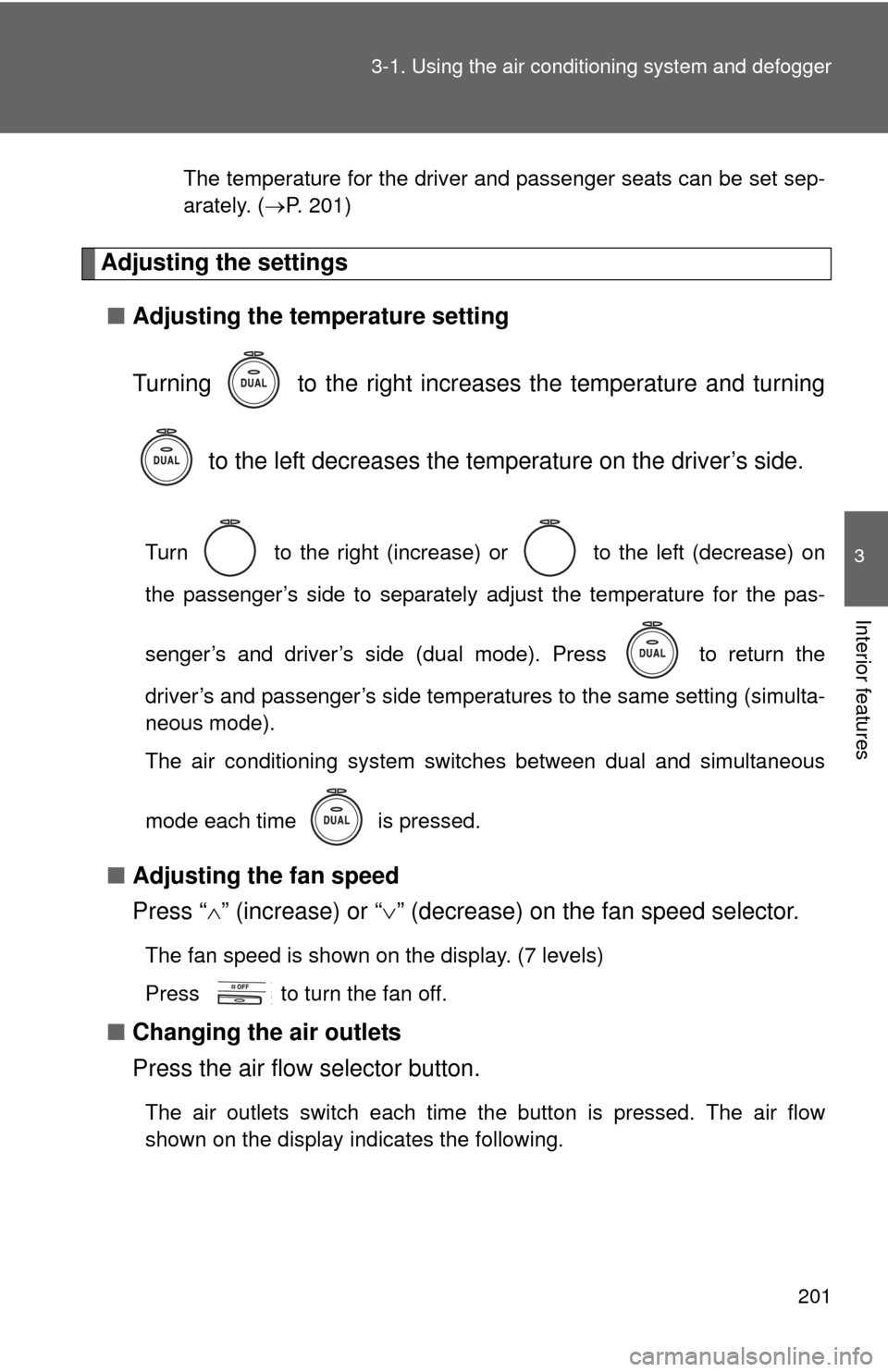
The temperature for the driver and passenger seats can be set sep-
arately. (P. 201)
Adjusting the settings
■ Adjusting the temperature setting
Turning to the right increases the temperature and turning
to the left decreases the temperature on the driver’s side.
Turn to the right (increase) or to the left (decrease) on
the passenger’s side to separately adjust the temperature for the pas-
senger’s and driver’s side (dual mode). Press to return the
driver’s and passenger’s side temperatures to the same setting (simulta-
neous mode).
The air conditioning system switches between dual and simultaneous
mode each time is pressed.
■ Adjusting the fan speed
Press “ ” (increase) or “ ” (decrease) on the fan speed selector.
The fan speed is shown on the display. (7 levels)
Press to turn the fan off.
■ Changing the air outlets
Press the air flow selector button.
The air outlets switch each time the button is pressed. The air flow
shown on the display indicates the following.
Page 363 of 554
363
4-2. Maintenance
4
Maintenance and care
Vehicle interior
ItemsCheck points
Accelerator pedal • Moves smoothly (without uneven
pedal effort or catching)?
Automatic transmission “Park”
mechanism • Can the vehicle be held securely
on an incline with the shift lever in
P?
Brake pedal • Moves smoothly?
• Does it have appropriate clear-
ance and correct amount of free
play?
Brakes • Not pull to one side when
applied?
• Loss of brake effectiveness?
• Spongy feeling brake pedal?
• Pedal almost touches floor?
Clutch pedal • Moves smoothly?
Head restraints • Move smoothly and lock
securely?
Indicators/buzzers • Function properly?
Lights • Do all the lights come on?
Parking brake • Moves smoothly?
• Can hold the vehicle securely on
an incline?
Seat belts • Does the seat belt system oper-
ate smoothly?
• Are the belts undamaged?
Seats • Do the seat controls operate
properly?
Steering wheel • Moves smoothly?
• Has correct free play?
• No strange noises?


