Page 354 of 772
354 2-5. Driving information
AVENSIS_EE (OM20B44E)
Guidance
Your vehicle will handle differently when towing a trailer. In order to
avoid accident, death or serious injury, keep the following in mind
when towing:
Checking connections between trailer and lights
Stop the vehicle and check the operation of the connection
between the trailer and lights after driving for a brief period as well
as before setting off.
Practicing driving with a coupled trailer
Get the feel for turning, stopping and reversing with the trailer
coupled by practicing in an area with no or light traffic.
When reversing with a coupled trailer, hold the section of the
steering wheel nearest to you and rotate clockwise to turn the
trailer left or counterclockwise to turn right. Always rotate gradu-
ally to prevent steering error. Have someone guide you when
reversing to lessen the risk of accident.
Increasing vehicle-to-vehicle distance
At a speed of 10 km/h (6 mph), the distance to the vehicle running
ahead of you should be equivalent to or greater than the combined
length of your vehicle and trailer. Avoid sudden braking that may
cause skidding. Otherwise, the vehicle may spin out of control.
This is especially true when driving on wet or slippery road sur-
faces.
Page 355 of 772
355 2-5. Driving information
2
When driving
AVENSIS_EE (OM20B44E)Sudden acceleration/steering input/cornering
Executing sharp turns when towing may result in the trailer collid-
ing with your vehicle. Decelerate well in advance when approach-
ing turns and take them slowly and carefully to avoid sudden
braking.
Important points regarding turning
The wheels of the trailer will travel closer to the inside of the curve
than the wheels of the vehicle. To make allowance for this, take the
turns wider than you would normally.
Important points regarding stability
Vehicle movement resulting from uneven road surfaces and strong
crosswinds will affect handling. The vehicle may also be rocked by
passing buses or large trucks. Frequently check behind when mov-
ing alongside such vehicles. As soon as such vehicle movement
occurs, immediately start to decelerate smoothly by slowly apply-
ing the brakes. Always steer the vehicle straight ahead while brak-
ing.
Passing other vehicles
Consider the total combined length of your vehicle and trailer, and
ensure that the vehicle-to-vehicle distance is sufficient before exe-
cuting lane changes.
Page 356 of 772
356 2-5. Driving information
AVENSIS_EE (OM20B44E)Transmission information
Multidrive or automatic transmission
To maintain engine braking efficiency, when using engine brak-
ing, do not use the transmission in “D”. Select an appropriate
gear in “M” mode.
Manual transmission
To maintain engine braking efficiency, when using engine brak-
ing, do not use the transmission in “6”.
If the engine overheats...
Towing a loaded trailer up a long steep incline in temperatures
exceeding 30C (85F) may result in the engine overheating. If the
engine coolant temperature gauge indicates that the engine is
overheating, turn the air conditioning off immediately, leave the
road and stop the vehicle in a safe place. (P. 710)
When parking the vehicle
Always place wheel chocks under the wheels of both the vehicle
and trailer. Firmly set the parking brake and shift the shift lever to
“P” for Multidrive or automatic transmission, and “1” or “R” for man-
ual transmission.
Page 357 of 772
357 2-5. Driving information
2
When driving
AVENSIS_EE (OM20B44E)
CAUTION
Vehicle speed in towing
Observe the legal maximum speeds for trailer towing.
Before descending hills or long declines
Reduce speed and downshift. However, never downshift suddenly while
descending steep or long downhill grades.
Operation of the brake
Do not hold the brake pedal depressed often or for long periods.
Doing so may result in the brake overheating or reduce braking effects.
Page 487 of 772
487 3-4. Using the storage features
3
Interior features
AVENSIS_EE (OM20B44E)
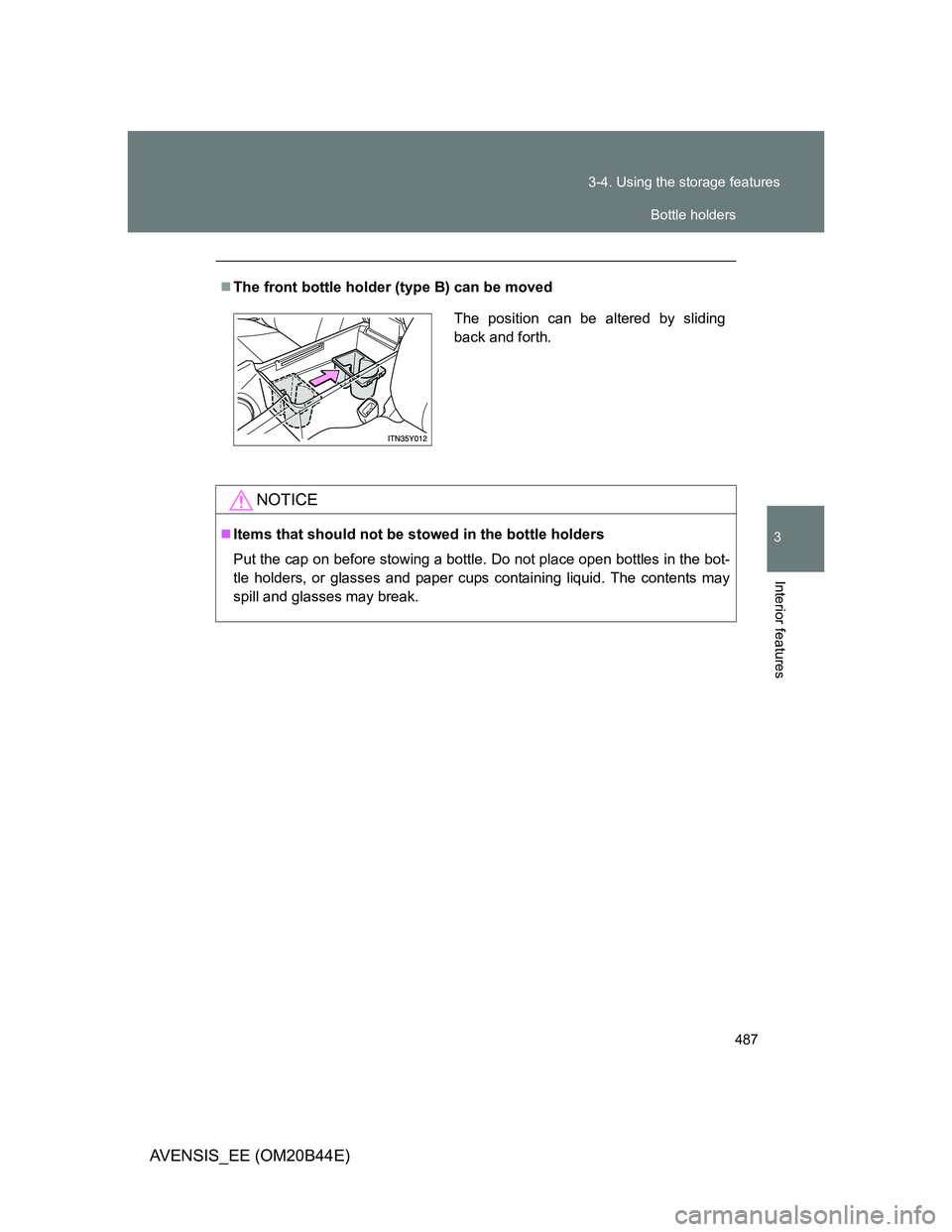
The front bottle holder (type B) can be moved
NOTICE
Items that should not be stowed in the bottle holders
Put the cap on before stowing a bottle. Do not place open bottles in the bot-
tle holders, or glasses and paper cups containing liquid. The contents may
spill and glasses may break.
The position can be altered by sliding
back and forth.
Bottle holders
Page 512 of 772
512 3-5. Other interior features
AVENSIS_EE (OM20B44E)
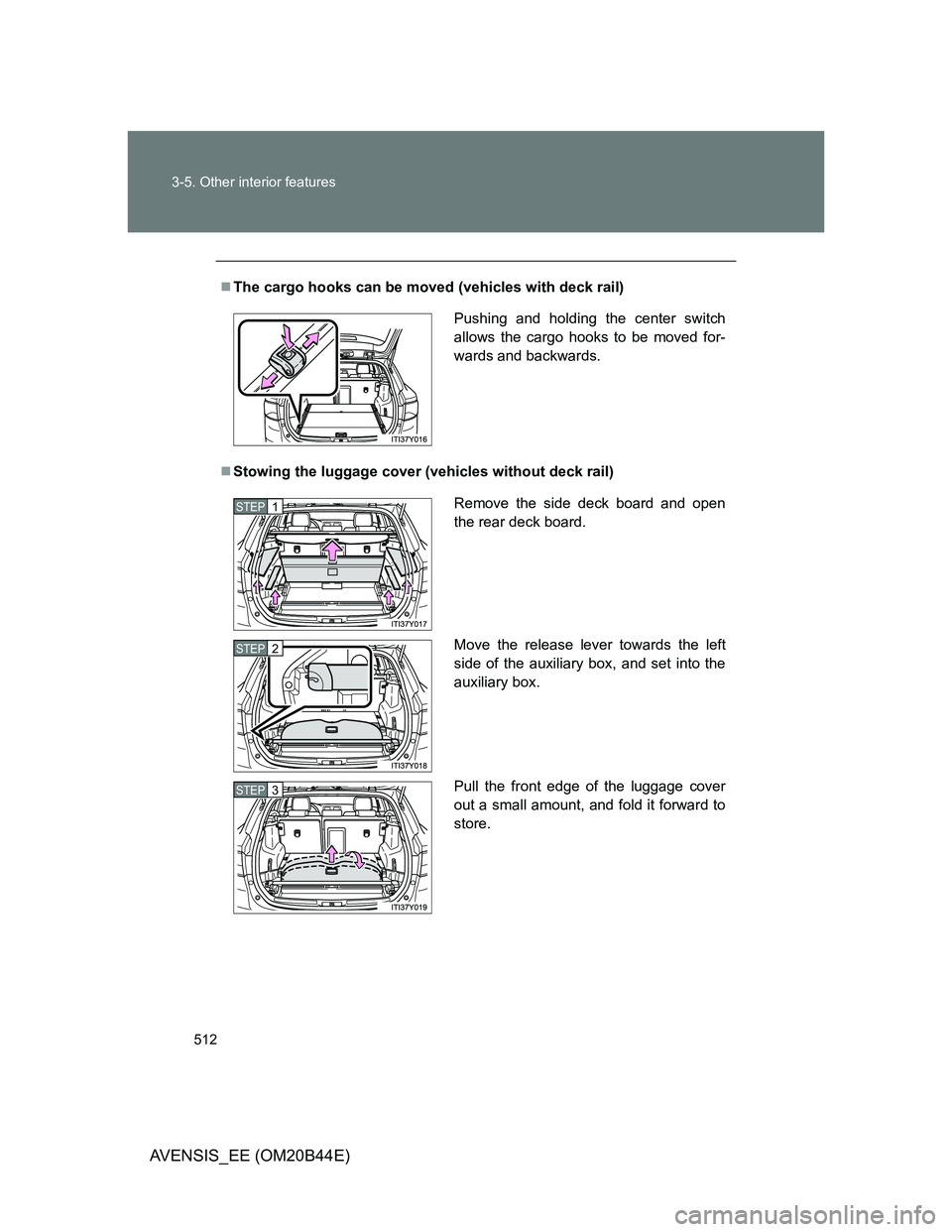
The cargo hooks can be moved (vehicles with deck rail)
Stowing the luggage cover (vehicles without deck rail)
Pushing and holding the center switch
allows the cargo hooks to be moved for-
wards and backwards.
Remove the side deck board and open
the rear deck board.
Move the release lever towards the left
side of the auxiliary box, and set into the
auxiliary box.
Pull the front edge of the luggage cover
out a small amount, and fold it forward to
store.STEP1
STEP2
STEP3
Page 513 of 772
513 3-5. Other interior features
3
Interior features
AVENSIS_EE (OM20B44E)
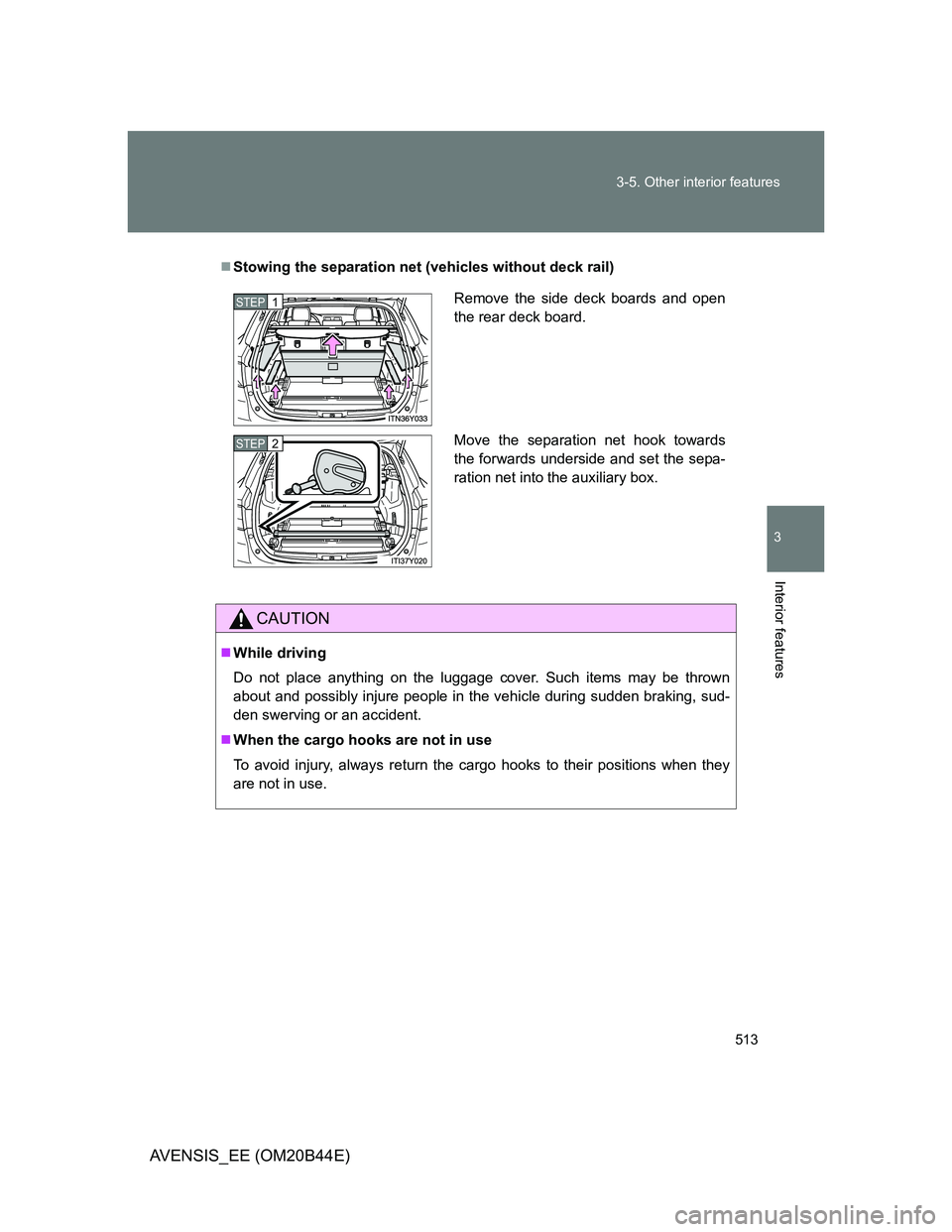
Stowing the separation net (vehicles without deck rail)
CAUTION
While driving
Do not place anything on the luggage cover. Such items may be thrown
about and possibly injure people in the vehicle during sudden braking, sud-
den swerving or an accident.
When the cargo hooks are not in use
To avoid injury, always return the cargo hooks to their positions when they
are not in use.
Remove the side deck boards and open
the rear deck board.
Move the separation net hook towards
the forwards underside and set the sepa-
ration net into the auxiliary box.STEP1
STEP2
Page 527 of 772
527
4
Maintenance and care
AVENSIS_EE (OM20B44E)
4-3. Do-it-yourself maintenance
Do-it-yourself ser vice precautions
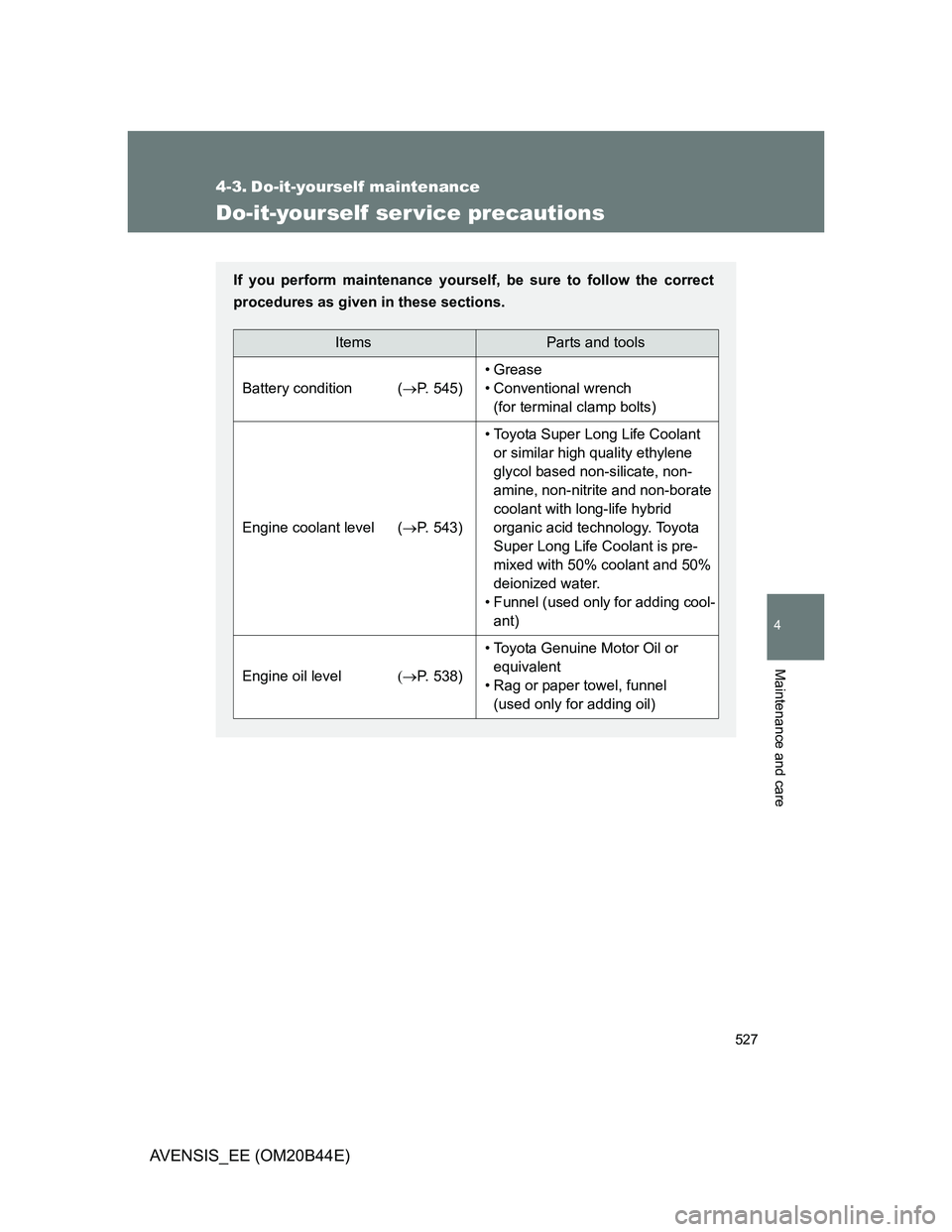
If you perform maintenance yourself, be sure to follow the correct
procedures as given in these sections.
ItemsParts and tools
Battery condition (P. 545)
• Grease
• Conventional wrench
(for terminal clamp bolts)
Engine coolant level (P. 543)
• Toyota Super Long Life Coolant
or similar high quality ethylene
glycol based non-silicate, non-
amine, non-nitrite and non-borate
coolant with long-life hybrid
organic acid technology. Toyota
Super Long Life Coolant is pre-
mixed with 50% coolant and 50%
deionized water.
• Funnel (used only for adding cool-
ant)
Engine oil levelP. 538)
• Toyota Genuine Motor Oil or
equivalent
• Rag or paper towel, funnel
(used only for adding oil)