Page 621 of 680

621
6-1. Specifications
6
Vehicle specifications
4RUNNER_U
Automatic transmission
*: The fluid capacity is a reference q
uantity. If replacement is necessary,
contact your Toyota dealer.
Brakes
*1: Minimum pedal clearance when depressed with a force of 110 lbf (490 N, 50 kgf) while the engine is running.
*2: Parking brake pedal travel when depressed with a force of 67 lbf (300 N, 30kgf).
Fluid capacity*
2.7 L 4-cylinder (2TR-FE) engine
10.5 qt. (9.9 L, 8.7 Imp. qt.)
4.0 L V6 (1GR-FE) engine
11.3 qt. (10.7 L, 9.4 Imp. qt.)
Fluid typeToyota Genuine ATF WS
NOTICE
■ Transmission fluid type
Using transmission fluid other than “Toyota Genuine ATF WS” may cause
deterioration in shift quality, locking up of the transmission accompanied by
vibration and, ultimately, damage to the vehicle’s transmission.
Pedal clearance *13.62 in. (92 mm) Min.
Pedal free playLess than 0.04 0.24 in. (1 6 mm)
Brake pad wear limit0.04 in. (1.0 mm)
Parking brake lining wear limit0.04 in. (1.0 mm)
Parking brake pedal travel *25 7 clicks
Fluid typeSAE J1703 or FMVSS No. 116 DOT 3
Page 623 of 680
623
6-1. Specifications
6
Vehicle specifications
4RUNNER_U
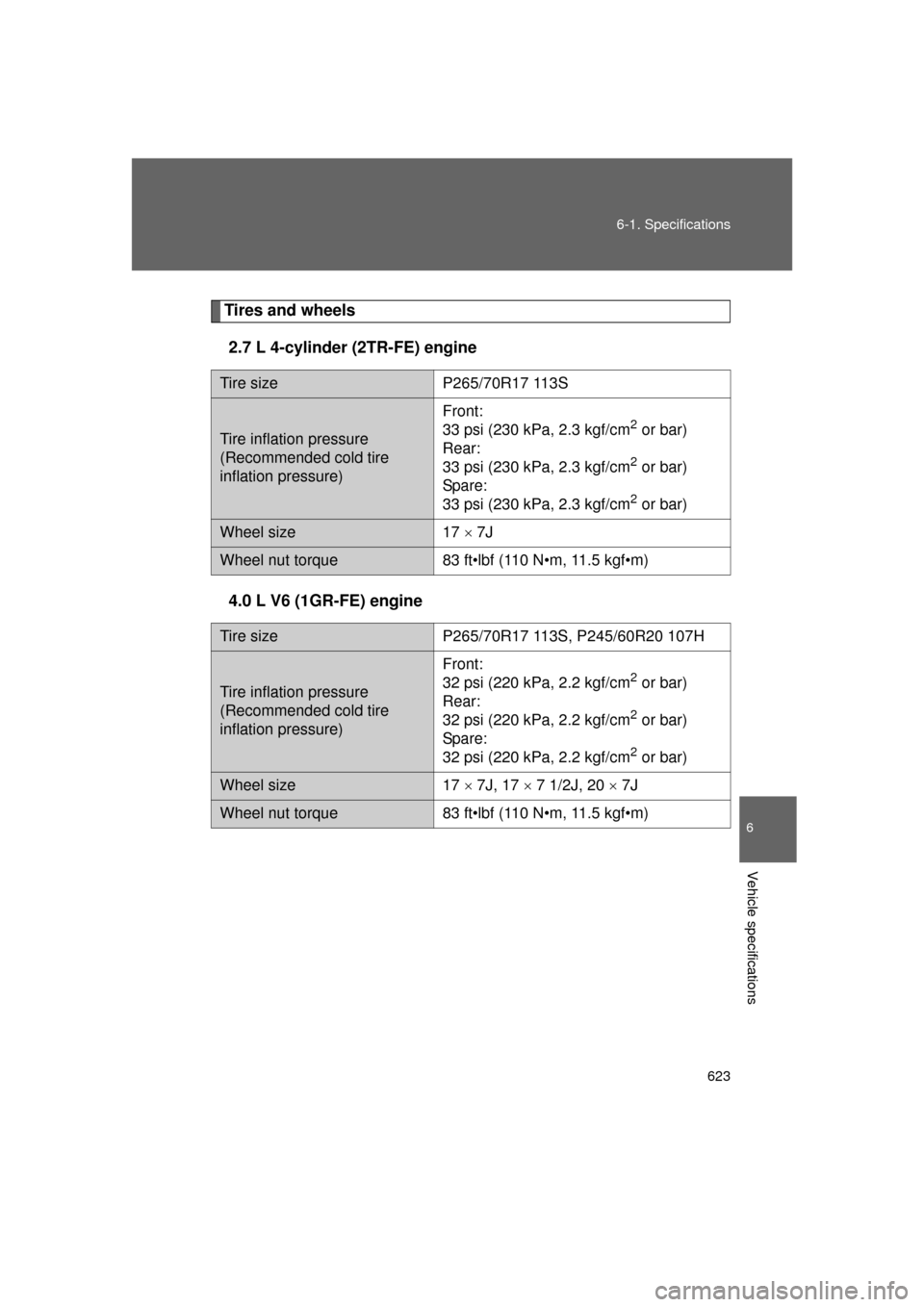
Tires and wheels
2.7 L 4-cylinder (2TR-FE) engine
4.0 L V6 (1GR-FE) engine
Tire sizeP265/70R17 113S
Tire inflation pressure
(Recommended cold tire
inflation pressure)
Front:
33 psi (230 kPa, 2.3 kgf/cm2 or bar)
Rear:
33 psi (230 kPa, 2.3 kgf/cm
2 or bar)
Spare:
33 psi (230 kPa, 2.3 kgf/cm
2 or bar)
Wheel size17 7J
Wheel nut torque83 ft•lbf (110 N•m, 11.5 kgf•m)
Tire sizeP265/70R17 113S, P245/60R20 107H
Tire inflation pressure
(Recommended cold tire
inflation pressure)
Front:
32 psi (220 kPa, 2.2 kgf/cm2 or bar)
Rear:
32 psi (220 kPa, 2.2 kgf/cm
2 or bar)
Spare:
32 psi (220 kPa, 2.2 kgf/cm
2 or bar)
Wheel size17 7J, 17 7 1/2J, 20 7J
Wheel nut torque83 ft•lbf (110 N•m, 11.5 kgf•m)
Page 625 of 680
625
6-1. Specifications
6
Vehicle specifications
4RUNNER_U
Fuel infor mation
■Fuel tank opening fo r unleaded gasoline
To help prevent incorrect fueling, your Toyota has a fuel tank opening that
only accommodates the special nozzle on unleaded fuel pumps.
■ Gasoline quality
In very few cases, driveability problems may be caused by the brand of gas-
oline you are using. If driveability problems persist, try changing the brand of
gasoline. If this does not correct the problem, consult your Toyota dealer.
You must only use unleaded gasoline in your vehicle.
Select octane rating 87 (Research Octane Number 91) or higher. Use
of unleaded gasoline with an octane rating lower than 87 may result
in engine knocking. Persistent kno cking can lead to engine damage.
At minimum, the gasoline you use should meet the specifications
of ASTM D4814 in the U.S.A. and CGSB3.5-M93 in Canada.
Page 626 of 680

626 6-1. Specifications
4RUNNER_U
■Gasoline quality standards
● Automotive manufacturers in the U.S.A., Europe and Japan have devel-
oped a specification for fuel quality called the World-Wide Fuel Charter
(WWFC), which is expected to be applied worldwide.
● The WWFC consists of four categories that are based on required emis-
sion levels. In the U.S., category 4 has been adopted.
● The WWFC improves air quality by lowering emissions in vehicle fleets,
and improves customer satisfaction through better performance.
■ Recommendation of the use of gaso line containing detergent additives
● Toyota recommends the use of gasoline that contains detergent additives
to avoid the build-up of engine deposits.
● All gasoline sold in the U.S.A. contains detergent additives to clean and/
or keep clean intake systems.
■ Recommendation of the use of cleaner burning gasoline
Cleaner burning gasoline, including reformulated gasoline that contains oxy-
genates such as ethanol or MTBE (Methyl Tertiary Butyl Ether) is available in
many areas.
Toyota recommends the use of cleaner burning gasoline and appropriately
blended reformulated gasoline. These types of gasoline provide excellent
vehicle performance, reduce vehicle emissions and improve air quality.
■ Non-recommendation of the use of blended gasoline
● Toyota allows the use of oxygenate blended gasoline where the oxygen-
ate content is up to 10% ethanol or 15% MTBE.
● If you use gasohol in your vehicle, be sure that it has an octane rating no
lower than 87.
● Toyota does not recommend the use of gasoline containing methanol.
Page 627 of 680

627
6-1. Specifications
6
Vehicle specifications
4RUNNER_U
■
Non-recommendation of the use of gasoline containing MMT
Some gasoline contains an octane enhancing additive called MMT (Methyl-
cyclopentadienyl Manganese Tricarbonyl).
Toyota does not recommend the use of gasoline that contains MMT. If fuel
containing MMT is used, your emission control system may be adversely
affected.
The malfunction indicator lamp on the instrument cluster may come on. If
this happens, contact your Toyota dealer for service.
■ If your engine knocks
● Consult your Toyota dealer.
● You may occasionally notice light knocking for a short time while acceler-
ating or driving uphill. This is normal and there is no need for concern.
NOTICE
■Notice on fuel quality
● Do not use improper fuels. If improper fuels are used, the engine will be
damaged.
● Do not use leaded gasoline.
Leaded gasoline can cause damage to your vehicle’s three-way catalytic
converters causing the emission control system to malfunction.
● Do not use gasohol other than the type previously stated.
Other gasohol may cause fuel system damage or vehicle performance
problems.
● Using unleaded gasoline with an octane number or rating lower than the
level previously stated will cause persistent heavy knocking.
At worst, this will lead to engine damage.
■ Fuel-related poor driveability
If poor driveability is encountered after using a different type of fuel (poor hot
starting, vaporization, engine knocking, etc.), discontinue the use of that type
of fuel.
■ When refueling with gasohol
Take care not to spill gasohol. It can damage your vehicle’s paint.
Page 633 of 680

633
6-1. Specifications
6
Vehicle specifications
4RUNNER_U
Warning: The temperature grades of a tire assume that it is properly
inflated and not overloaded.
Excessive speed, underinflation, or
excessive loading, either sepa-
rately or in combination, can caus e heat buildup and possible tire fail-
ure.
Glossary of tire terminology
Tire related termMeaning
Cold tire inflation
pressure Tire pressure when the vehicle has been
parked for three hours or more, or has not
been driven more than 1 mile or 1.5 km under
that condition
Maximum inflation
pressure The maximum cold inflated
pressure to which a
tire may be inflated, s hown on the sidewall of
the tire
Recommended
inflation pressure Cold tire inflation pressure recommended by a
manufacturer.
Accessory weight The combined weight (in excess of those stan-
dard items which may be replaced) of auto-
matic transmission, power steering, power
brakes, power windows, power seats, radio
and heater, to the extent that these items are
available as factory-installed equipment
(whether installed or not)
Curb weight The weight of a motor vehicle with standard
equipment, including the maximum capacity of
fuel, oil and coolant, and if so equipped, air
conditioning and additional weight optional
engine
Maximum loaded
vehicle weight The sum of:
(a) Curb weight
(b) Accessory weight
(c) Vehicle capacity weight
(d) Production options weight
Page 642 of 680
642 6-2. Customization
4RUNNER_U
Illumination
(P. 413) Time period before
lights turn off
15 seconds7.5 seconds
30 seconds
Vehicles without a
smart key system:
Operation after the
engine switch is turned
to the “LOCK” position
Vehicles with a smart
key system: Operation
after the “ENGINE
START STOP” switch is
turned OFF On Off
Operation when the
doors are unlocked On Off
Vehicles with a smart
key system: Operation
when you approach the
vehicle with the elec-
tronic key on your per-
son (When the interior
light switch [ON/DOOR/
OFF] is DOOR) On Off
Footwell lights On Off
Overhead courtesy light On Off
Interior light control On Off
Interior light dimmer
control while driving On Off
ItemFunctionDefault settingCustomized
setting
Page 646 of 680
646
4RUNNER_U
6-3. Initialization
Items to initialize
ItemWhen to initializeReference
Engine oil mainte-
nance data After changing engine oil P. 501
The following item must be initia
lized for normal system operation in
cases such as after the battery is reconnected, or maintenance is
performed on the vehicle.