Page 492 of 680
492 4-3. Do-it-yourself maintenance
4RUNNER_U
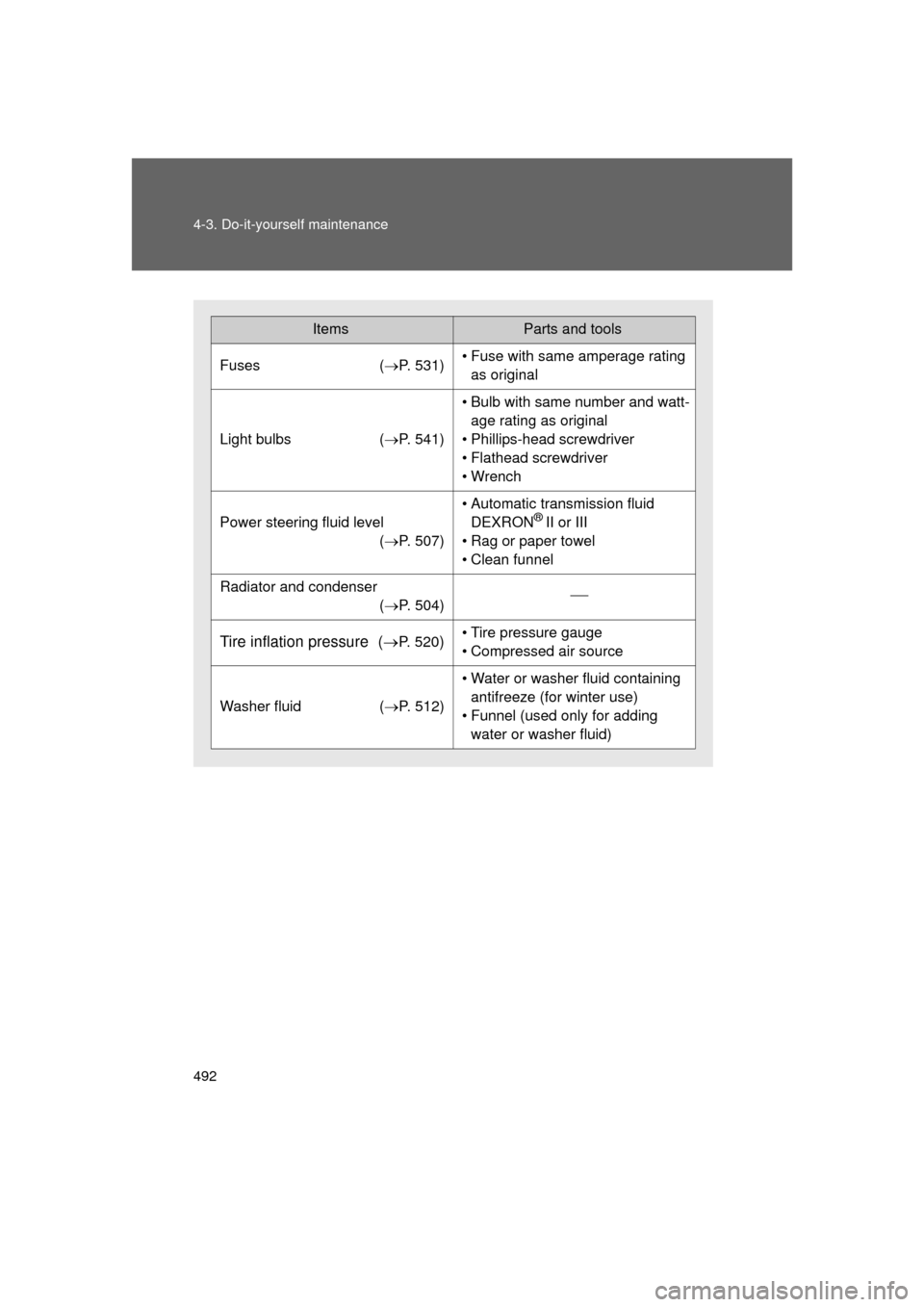
ItemsParts and tools
Fuses(P. 531)• Fuse with same amperage rating
as original
Light bulbs (P. 541)
• Bulb with same number and watt-
age rating as original
• Phillips-head screwdriver
• Flathead screwdriver
• Wrench
Power steering fluid level (P. 507)
• Automatic transmission fluid
DEXRON® II or III
• Rag or paper towel
• Clean funnel
Radiator and condenser (P. 504)
Tire inflation pressure ( P. 520)• Tire pressure gauge
• Compressed air source
Washer fluid (P. 512)
• Water or washer fluid containing
antifreeze (for winter use)
• Funnel (used only for adding water or washer fluid)
Page 494 of 680
494
4-3. Do-it-yourself maintenance
4RUNNER_U
Hood
CAUTION
■Pre-driving check
Check that the hood is fully closed and locked.
If the hood is not locked properly, it may open while the vehicle is in motion
and cause an accident, which may result in death or serious injury.
Release the lock from the inside of the vehicle to open the hood.
Pull the hood release lever.
The hood will pop up slightly.
Pull up the auxiliary catch
lever and lift the hood.
CTH43AS009
STEP 1
CTH43AS087
STEP 2
Page 506 of 680
506 4-3. Do-it-yourself maintenance
4RUNNER_U
■Brake fluid can absorb moisture from the air
Excess moisture in the brake fluid can cause a dangerous loss of braking
efficiency. Use only newly opened brake fluid.
CAUTION
■When filling the reservoir
Take care as brake fluid can harm your hands and eyes and damage painted
surfaces.
If fluid gets on your hands or in your eyes, flush the affected area with clean
water immediately.
If you still experience discomfort, see a doctor.
NOTICE
■If the fluid level is low or high
It is normal for the brake fluid level to go down slightly as the brake pads
wear out or when the fluid level in the accumulator is high.
If the reservoir needs frequent refilling, there may be a serious proble\
m.
Page 507 of 680
507
4-3. Do-it-yourself maintenance
4
Maintenance and care
4RUNNER_U
Power steering fluid
■ Fluid level
The fluid level should be within the appropriate range.
2.7 L 4-cylinder (2TR-FE) engine
Full (when cold)
Add fluid (when cold)
Full (when hot)
Add fluid (when hot)
4.0 L V6 (1GR-FE) engine Full (when cold)
Add fluid (when cold)
Full (when hot)
Add fluid (when hot)
Hot: Vehicle has been driven around 50 mph (80 km/h) for 20 minutes, or slightly longer in frigid temperatures. (Fluid tem-
perature, 140°F - 175°F [60°C - 80°C]).
Cold: Engine has not been run for about 5 hours. (Room tempera- ture, 50°F - 85°F [10°C - 30°C]).
CTH43AS130
CTH43AS016
Page 510 of 680

510 4-3. Do-it-yourself maintenance
4RUNNER_U
■After recharging/reconnecting the battery (vehicles with smart key sys-
tem)
● Unlocking the doors using the smart key system may not be possible
immediately after reconnecting the battery. If this happens, use the wire-
less remote control or the mechanical key to lock/unlock the doors.
● Start the engine with the “ENGINE START STOP” switch in ACCES-
SORY mode. The engine may not start with the “ENGINE START STOP”
switch turned OFF. However, the engine will operate normally from the
second attempt.
● The “ENGINE START STOP” switch mode is recorded by the vehicle. If
the battery is reconnected, the vehicle will return the “ENGINE START
STOP” switch mode to the status it was in before the battery was discon-
nected. Make sure to turn off the engine before disconnect the battery.
Take extra care when connecting the battery if the “ENGINE START
STOP” switch mode prior to discharge is unknown.
If the system will not start even after multiple attempts, contact your Toyota
dealer.
CAUTION
■ Chemicals in the battery
Batteries contain poisonous and corrosive sulfuric acid and may produce
hydrogen gas which is flammable and explosive. To reduce the risk of death
or serious injury, take the following precautions while working on or near the
battery:
● Do not cause sparks by touching the battery terminals with tools.
● Do not smoke or light a match near the battery.
● Avoid contact with eyes, skin and clothes.
● Never inhale or swallow electrolyte.
● Wear protective safety glasses when working near the battery.
● Keep children away from the battery.
Page 512 of 680
512 4-3. Do-it-yourself maintenance
4RUNNER_U
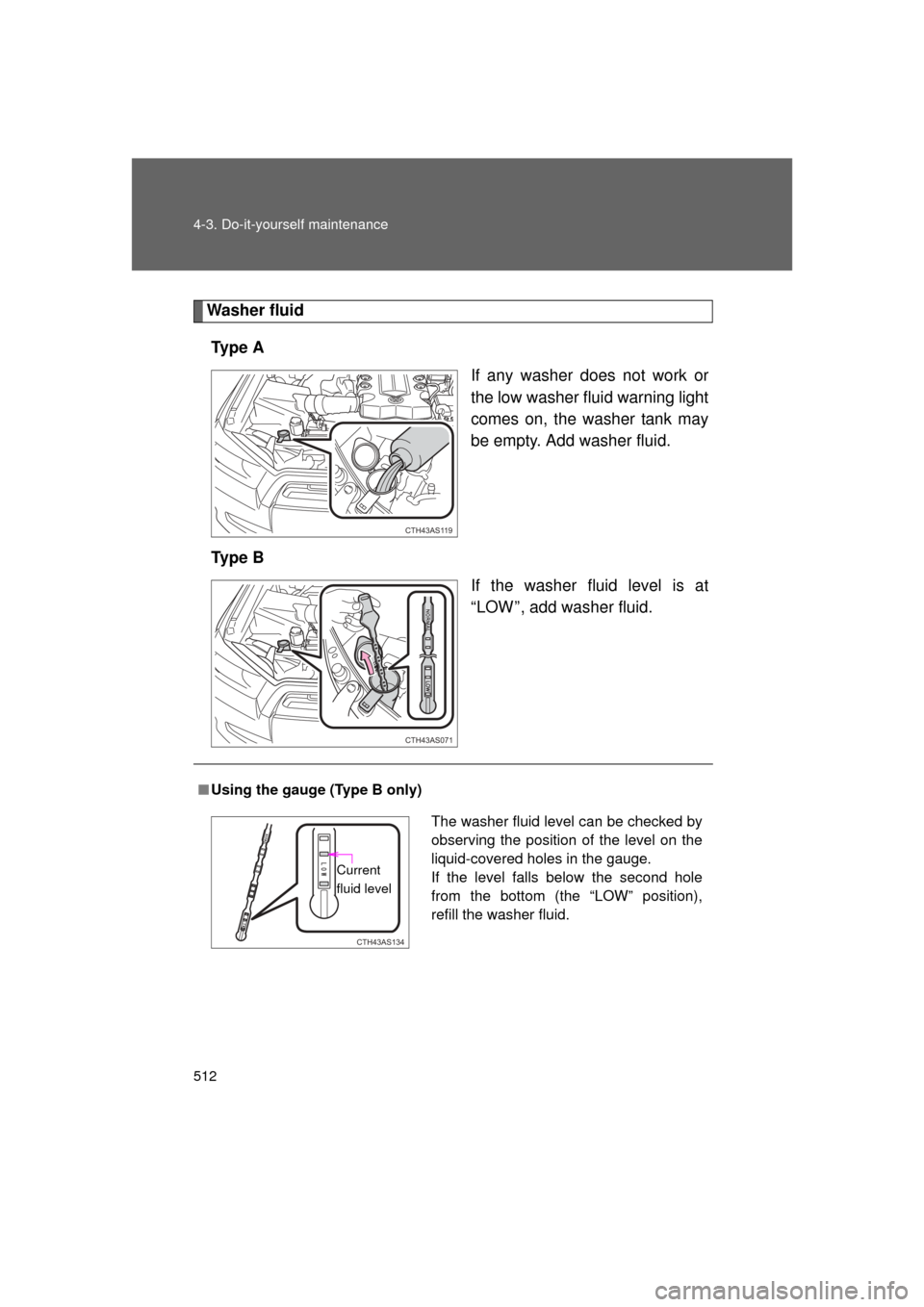
Washer fluidTy p e A If any washer does not work or
the low washer fluid warning light
comes on, the washer tank may
be empty. Add washer fluid.
Ty p e B If the washer fluid level is at
“LOW ” , add washer fluid.
CTH43AS119
CTH43AS071
■Using the gauge (Type B only)
The washer fluid level can be checked by
observing the position of the level on the
liquid-covered holes in the gauge.
If the level falls below the second hole
from the bottom (the “LOW” position),
refill the washer fluid.
CTH43AS134
Current
fluid level
Page 516 of 680

516 4-3. Do-it-yourself maintenance
4RUNNER_U
■When to replace your vehicle’s tires
Tires should be replaced if:
●You have tire damage such as cuts, splits, cracks deep enough to
expose the fabric, and bulges indicating internal damage
●A tire goes flat repeatedly or cannot be properly repaired due to the
size or location of a cut or other damage
If you are not sure, consult with your Toyota dealer.
■Replacing tires and wheels
If the ID code of the tire pressure warning valve and transmitter is not
registered, the tire pre ssure warning system will not work properly. After
driving for about 20 minutes, the ti re pressure warning light comes on
after blinking for 1 minute to indicate a system malfunction.
■Tire life
Any tire over 6 years old must be checked by a qualified technician even
if they have seldom or never been used or damage is not obvious.
■Routine tire inflation pressure checks
The tire pressure warning system doe s not replace routine tire inflation
pressure checks. Make sure to check tire inflation pressure as part of
your routine of daily vehicle checks.
■Maximum load of tire
Check that the number given by di viding the maximum load by 1.10 of
the replacement tire is greater than 1/2 of the Gross Axle Weight Ratings
(GAWR) of either the front axle or the rear axle, whichever is greater.
For the GAWR, see the Certification
Label. For the maximum load of the
tire, see the load limit at maximum cold
tire inflation pressure mentioned on the
sidewall of the tire. (P. 628)
CTH43AS081
Page 535 of 680
535
4-3. Do-it-yourself maintenance
4
Maintenance and care
4RUNNER_U
Fuse layout and amperage ratings
■ Engine compartment
FuseAmpereCircuit
1PTC HTR NO.330 A
PTC heater
2DEF30 ARear window defogger
3DEICER 20 A
Windshield wiper de-icer
4PTC HTR NO.230 APTC heater
5SUB BATT30 ATrailer sub battery
6PTC HTR NO.150 A
PTC heater
7MIR HTR10 AOutside rear view mirror defog-
gers
8TOWING TAIL30 A
Trailer tail light
9A/C COMP10 AAir conditioning system
10STOP10 A
Stop/tail lights
11IG220 AINJ, IGN, GAUGE fuses
12HORN10 AHorn(s)
13EFI 25 AMultiport fuel injection system/
sequential multiport fuel injec-
tion system
14A/F20 A
A/F sensor
CTH43AS079