2011 SUBARU TRIBECA Transmission
[x] Cancel search: TransmissionPage 323 of 422
9-18In case of emergency
CAUTION
. If transmission failure occurs,
transport your vehicle on a flat-
bed truck.
. Do not run the engine while being
towed using this method. Trans-
mission damage could result if
the vehicle is towed with the
engine running.
. The traveling speed must be
limited to less than 20 mph (30
km/h) and the traveling distance
to less than 31 miles (50 km). For
greater speeds and distances,
transport your vehicle on a flat-
bed truck.
1. Release the parking brake and put the
transmission in neutral.
2. The ignition switch should be in the “ Acc ”position while the vehicle is being
towed.
3. Take up slack in the towline slowly to
prevent damage to the vehicle. Rear gate
–if the rear gate
cannot be unlocked
In the event that you cannot unlock the
rear gate by operating the power door
locking switches or the remote keyless
entry system, you can unlock it from inside
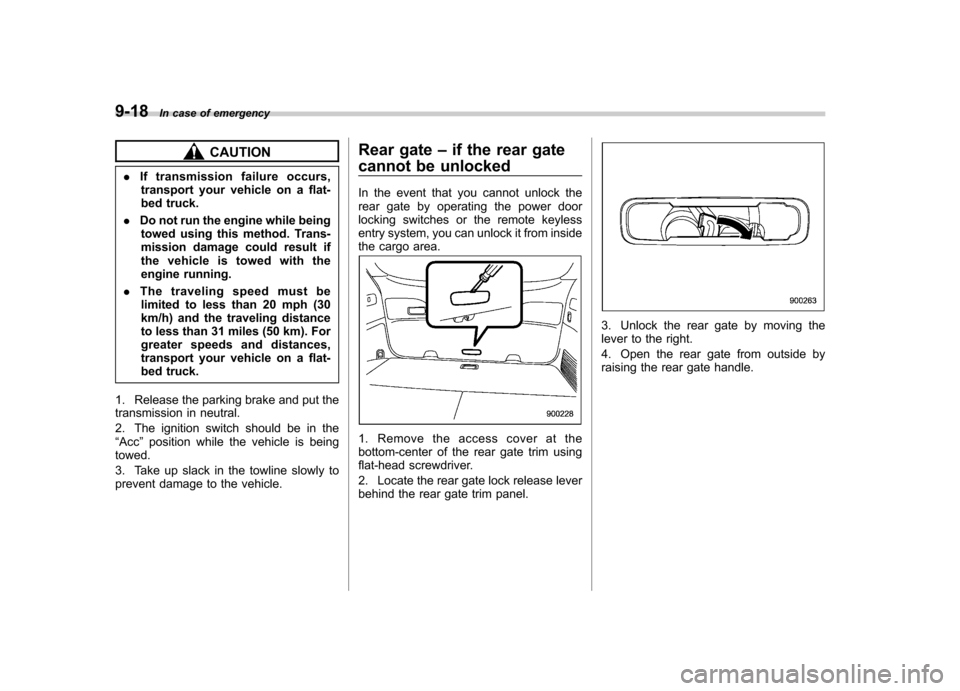
the cargo area.
1. Remove the access cover at the
bottom-center of the rear gate trim using
flat-head screwdriver.
2. Locate the rear gate lock release lever
behind the rear gate trim panel.
3. Unlock the rear gate by moving the
lever to the right.
4. Open the rear gate from outside by
raising the rear gate handle.
Page 332 of 422

Maintenance schedule....................................... 11-3
Maintenance precautions ................................... 11-3
Before checking or servicing in the engine compartment .................................................... 11-4
When you do checking or servicing in the engine compartment while the engine is running .......... 11-4
Engine hood ....................................................... 11-4
Engine compartment overview .......................... 11-6
Engine oil ............................................................ 11-7
Checking the oil level ......................................... 11-7
Changing the oil and oil filter .............................. 11-8
Recommended grade and viscosity .................... 11-9
Synthetic oil ....................................................... 11-9
Cooling system ................................................ 11-10
Hose and connections ...................................... 11-10
Engine coolant ................................................. 11-10
Air cleaner element .......................................... 11-13
Replacing the air cleaner element ..................... 11-13
Spark plugs ...................................................... 11-14
Recommended spark plugs .............................. 11-14
Drive belts ........................................................ 11-14
Automatic transmission fluid .......................... 11-15
Checking the fluid level .................................... 11-15
Recommended fluid ......................................... 11-16
Front differential gear oil ................................. 11-16
Checking the oil level ....................................... 11-16
Recommended grade and viscosity .................. 11-17
Rear differential gear oil .................................. 11-17
Recommended grade and viscosity .................. 11-17Power steering fluid
........................................ 11-17
Checking the fluid level .................................... 11-17
Recommended fluid ......................................... 11-18
Brake fluid ........................................................ 11-18
Checking the fluid level .................................... 11-18
Recommended brake fluid ............................... 11-19
Brake booster .................................................. 11-19
Brake pedal ...................................................... 11-20
Checking the brake pedal free play .................. 11-20
Checking the brake pedal reserve distance....... 11-20
Replacement of brake pad and lining ............ 11-20
Breaking-in of new brake pads and linings ....... 11-21
Parking brake stroke ....................................... 11-21
Tires and wheels .............................................. 11-22
Types of tires ................................................... 11-22
Tire pressure monitoring system (TPMS) .......... 11-22
Tire inspection ................................................. 11-23
Tire pressures and wear .................................. 11-24
Wheel balance ................................................. 11-26
Wear indicators ............................................... 11-26
Tire rotation direction mark .............................. 11-26
Tire rotation ..................................................... 11-27
Tire replacement .............................................. 11-27
Wheel replacement .......................................... 11-28
Aluminum wheels ............................................ 11-28
Windshield washer fluid .................................. 11-29
Replacement of wiper blades ......................... 11-30
Windshield wiper blade assembly ..................... 11-31
Windshield wiper blade rubber . ........................ 11-31
Rear window wiper blade assembly .................. 11-32
Maintenance and service
11
Page 334 of 422
Maintenance schedule
The scheduled maintenance items re-
quired to be serviced at regular intervals
are shown in the“Warranty and Main-
tenance Booklet ”.
For details of your maintenance schedule,
read the separate “Warranty and Main-
tenance Booklet ”. Maintenance precautions
When maintenance and service are re-
quired, it is recommended that all work be
done by an authorized SUBARU dealer.
If you perform maintenance and service
by yourself, you should familiarize yourself
with the information provided in this
section on general maintenance and
service for your SUBARU.
Incorrect or incomplete service could
cause improper or unsafe vehicle opera-
tion. Any problems caused by improper
maintenance and service performed by
you are not eligible for warranty coverage.
WARNING
. Testing of an All-Wheel Drive
model must NEVER be per-
formed on a single two-wheel
dynamometer or similar appara-
tus. Attempting to do so will
result in transmission damage
and in uncontrolled vehicle
movement and may cause an
accident or injuries to persons
nearby.
. Always select a safe area when
performing maintenance on yourvehicle. .
Always be very careful to avoid
injury when working on the vehi-
cle. Remember that some of the
materials in the vehicle may be
hazardous if improperly used or
handled, for example, batteryacid.
. Your vehicle should only be ser-
viced by persons fully competent
to do so. Serious personal injury
may result to persons not experi-
enced in servicing vehicles.
. Always use the proper tools and
make certain that they are wellmaintained.
. Never get under the vehicle sup-
ported only by a jack. Always use
a safety stands to support thevehicle.
. Never keep the engine running in
a poorly ventilated area, such as
a garage or other closed areas.
. Do not smoke or allow open
flames around the fuel or battery.
This will cause a fire.
. Because the fuel system is under
pressure, replacement of the fuel
filter should be performed only
by your SUBARU dealer.
. Wear adequate eye protection to Maintenance and service
11-3
– CONTINUED –
Page 337 of 422
11-6Maintenance and service
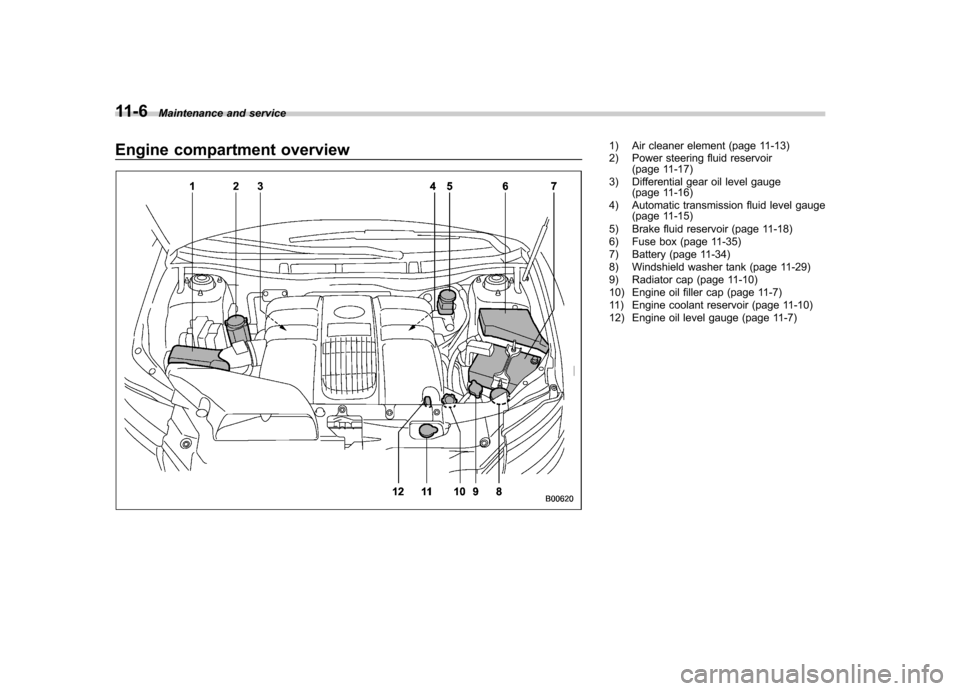
Engine compartment overview1) Air cleaner element (page 11-13)
2) Power steering fluid reservoir
(page 11-17)
3) Differential gear oil level gauge (page 11-16)
4) Automatic transmission fluid level gauge (page 11-15)
5) Brake fluid reservoir (page 11-18)
6) Fuse box (page 11-35)
7) Battery (page 11-34)
8) Windshield washer tank (page 11-29)
9) Radiator cap (page 11-10)
10) Engine oil filler cap (page 11-7)
11) Engine coolant reservoir (page 11-10)
12) Engine oil level gauge (page 11-7)
Page 346 of 422

Automatic transmission fluid &Checking the fluid level
The automatic transmission fluid expands
largely as its temperature rises; the fluid
level differs according to fluid temperature.
Therefore, there are two different scales
for checking the level of hot fluid and cold
fluid on the level gauge.
Though the fluid level can be checked
without warming up the fluid on the“ COLD ”range, we recommend checking
the fluid level when the fluid is at operatingtemperature. ! Checking the fluid level when the
fluid is hot
Check the fluid level monthly.
1. Drive the vehicle several miles to raise
the temperature of the transmission fluid
up to normal operating temperature; 158
to 176 8F (70 to 80 8C) is normal.
2. Park the vehicle on a level surface and
set the parking brake.
3. First shift the select lever in each
position. Then shift it in the “P ” position,
and run the engine at idling speed.
1) Yellow handle
1) HOT range
2) COLD range
3) Upper level
4) Lower level
4. Pull out the level gauge and check the fluid level on the gauge. If it is below the
lower level on the
“HOT ”range, add the
recommended automatic transmission
fluid up to the upper level. ! Checking the fluid level when the
fluid is cold
When the fluid level has to be checked
without time to warm up the automatic
transmission, check to see that the fluid
level is between the lower level and upper
level on the “COLD ”range. If it is below
that range, add fluid up to the upper level.
Be careful not to overfill.
CAUTION
Be careful not to spill automatic
transmission fluid when adding it.
If automatic transmission fluid
touches the exhaust pipe, it may
cause a bad smell, smoke, and/or a
fire. If automatic transmission fluid
gets on the exhaust pipe, be sure to
wipe it off. Maintenance and service
11-15
– CONTINUED –
Page 347 of 422
11-16Maintenance and service
&Recommended fluid
Refer to “Fluids ”F 12-7.
NOTE
Using any non-specified type of auto-
matic transmission fluid could result in
damage inside the transmission. When
replacing the automatic transmission
fluid, be sure to use the specified type. Front differential gear oil &
Checking the oil level
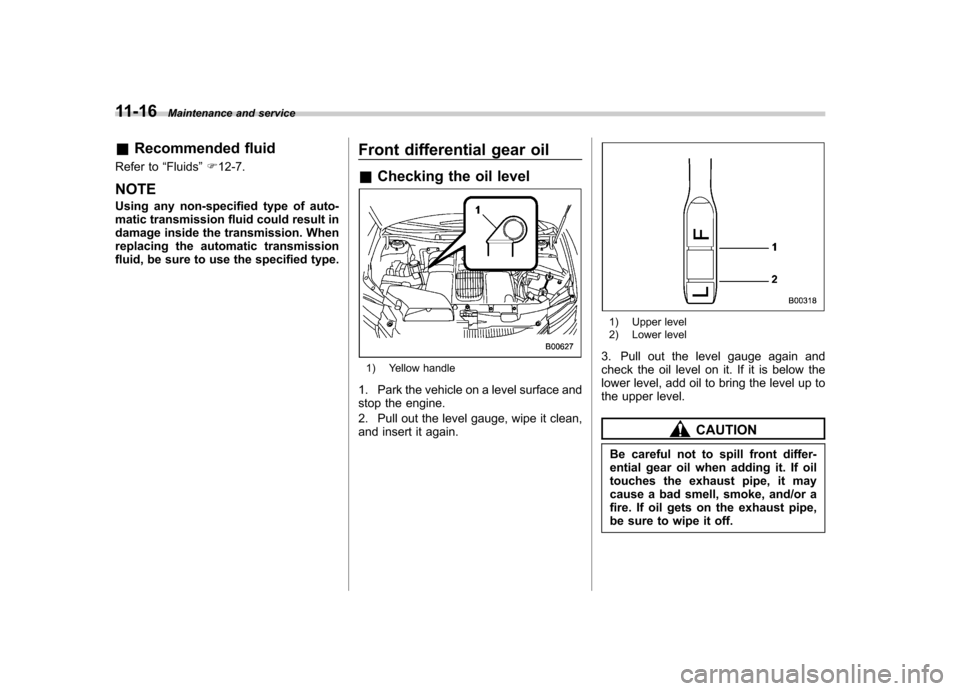
1) Yellow handle
1. Park the vehicle on a level surface and
stop the engine.
2. Pull out the level gauge, wipe it clean,
and insert it again.
1) Upper level
2) Lower level
3. Pull out the level gauge again and
check the oil level on it. If it is below the
lower level, add oil to bring the level up to
the upper level.
CAUTION
Be careful not to spill front differ-
ential gear oil when adding it. If oil
touches the exhaust pipe, it may
cause a bad smell, smoke, and/or a
fire. If oil gets on the exhaust pipe,
be sure to wipe it off.
Page 384 of 422

&Fluids
Fluid Fluid type*
1Fluid capacity*2Remarks*3
Automatic transmission fluid· SUBARU ATF
· IDEMITSU ATF HP
10.4 US qt (9.8 liters, 8.6 Imp qt)“
Automatic transmission fluid ”F 11 -
15
Power steering fluid · SUBARU ATF
· IDEMITSU ATF HP ·
“Dexron III ”Type Automatic
Transmission Fluid 0.95 US qt (0.9 liters, 0.79 Imp qt)
·
“Power steering ”F 7-18
· “Power steering fluid ”F 11-17
Brake fluid FMVSS No. 116, fresh DOT 3 or DOT 4
brake fluid –
“
Brake fluid ”F 11-18
*1: Use one of the indicated types of fluid.
*2: The indicated fluid quantity is only a guideline. The necessary quantity for replacement may differ slightly depending on the temperature and otherfactors.
*3: For more details about maintenance and service, refer to the indicated section.
& Engine coolant
Coolant type Coolant capacity
SUBARU Super Coolant 8.0 US qt (7.6 liters, 6.7 Imp qt)
The indicated coolant quantity is only a guideline. The necessary quantity for replacement may differ slightly depending on the temperature and other
factors. For more details about maintenance and service, refer to “Cooling system ”F 11-10.
& Electrical system
Battery type and capacity (5HR) 75D23L (12V-52AH)
Alternator 12V-130A
Spark plugs SILFR6C11 (NGK)Specifications
12-7
– CONTINUED –
Page 387 of 422
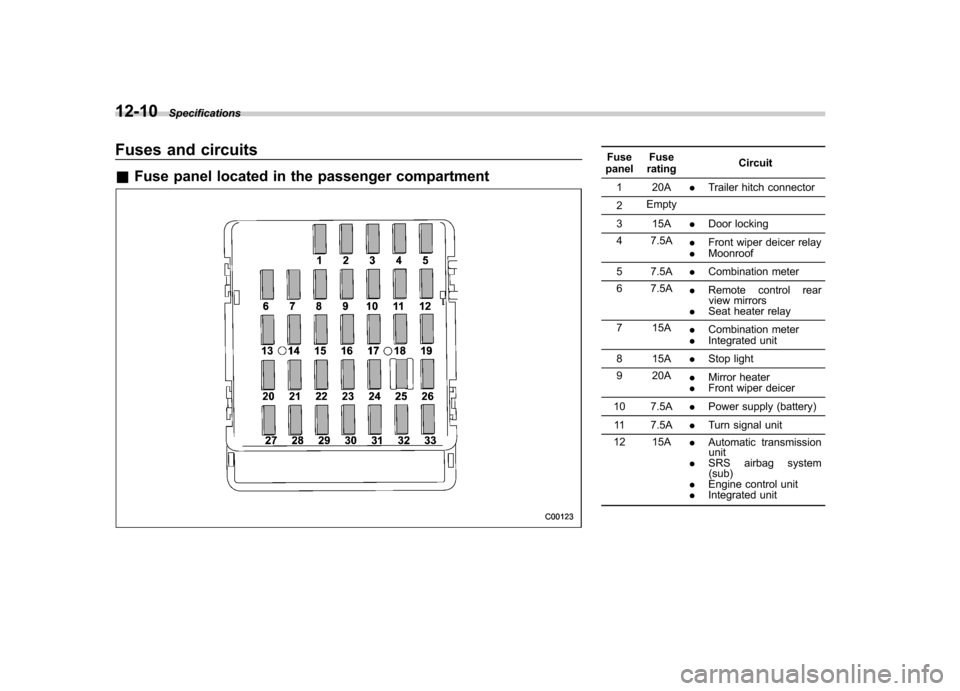
12-10Specifications
Fuses and circuits &Fuse panel located in the passenger compartmentFuse
panel Fuse
rating Circuit
1 20A .Trailer hitch connector
2 Empty
3 15A .Door locking
4 7.5A .Front wiper deicer relay
. Moonroof
5 7.5A .Combination meter
6 7.5A .Remote control rear
view mirrors
. Seat heater relay
7 15A .Combination meter
. Integrated unit
8 15A .Stop light
9 20A .Mirror heater
. Front wiper deicer
10 7.5A .Power supply (battery)
11 7.5A .Turn signal unit
12 15A .Automatic transmission
unit
. SRS airbag system
(sub)
. Engine control unit
. Integrated unit