2011 SUBARU FORESTER oil change
[x] Cancel search: oil changePage 357 of 446

11-10Maintenance and service
Turbo models
1) Notch
2) Upper level
3) Lower level
4) Approximately 1.1 US qt (1.0 liter, 0.9
Imp qt) from lower level to upper levelNon-turbo models
1) Upper level
2) Lower level
3) Approximately 1.1 US qt (1.0 liter, 0.9
Imp qt) from lower level to upper level
4. Pull out the level gauge again and
check the oil level on it. If it is below the
lower level, add oil to bring the level up to
the upper level.
CAUTION
. Use only engine oil with the
recommended grade and vis-
cosity.
. Be careful not to spill engine oil
when adding it. If oil touches the
exhaust pipe, it may cause a bad
smell, smoke, and/or a fire. If engine oil gets on the exhaust
pipe, be sure to wipe it off.
If you check the oil level just after stopping
the engine, wait a few minutes for the oil to
drain back into the oil pan before checking
the level.
Just after driving or while the engine is
warm, the engine oil level reading may be
in a range between the upper level and
the notch mark. This is caused by thermal
expansion of the engine oil.
To prevent overfilling the engine oil, do not
add any additional oil above the upper
level when the engine is cold. & Changing the oil and oil filter
Change the oil and oil filter according to
the maintenance schedule in the “War-
ranty and Maintenance Booklet ”.
The engine oil and oil filter must be
changed more frequently than listed in
the maintenance schedule when driving
on dusty roads, when short trips are
frequently made, or when driving in
extremely cold weather.
NOTE
Changing the engine oil and oil filter
should be performed by a properly-
trained expert. It is recommended that
you have this service performed by
Page 360 of 446

&Synthetic oil
You should use synthetic engine oil that
meets the same requirements given for
conventional engine oil. When using
synthetic oil, you must use oil of the same
classification, viscosity and grade shown
in this Owner ’s Manual. Refer to “Engine
oil ”F 12-5. Also, you must follow the oil
and filter changing intervals shown in the
Warranty and Maintenance booklet. NOTE
Synthetic oil of the grade and viscosity
noted in chapter 12 is the required
engine oil for optimum engine perfor-
mance. Conventional oil may be used if
synthetic oil is unavailable. Cooling system
WARNING
Never attempt to remove the radia-
tor cap until the engine has been
shut off and has cooled down
completely. Since the coolant is
under pressure, you may suffer
serious burns from a spray of boil-
ing hot coolant when the cap isremoved.
CAUTION
. Vehicles are filled at the factory
with SUBARU Super Coolant that
does not require the first change
for 11 years/137,500 miles (11
years/220,000 km). This coolant
should not be mixed with any
other brand or type of coolant
during this period. Mixing with a
different coolant will reduce the
life of the coolant. Should it be
necessary to top up the coolant
for any reason, use only
SUBARU Super Coolant.
If the SUBARU Super Coolant is
diluted with another brand or
type, the maintenance interval is shortened to that of the mixingcoolant.
. Do not splash the engine coolant
over painted parts. The alcohol
contained in the engine coolant
may damage the paint surface.
& Cooling fan, hose and con- nections
Your vehicle employs an electric cooling
fan which is thermostatically controlled to
operate when the engine coolant reaches
a specific temperature.
If the radiator cooling fan does not operate
even when the following conditions occur,
the cooling fan circuit may be defective. . The engine coolant temperature gauge
exceeds the normal operating range (if
equipped). Refer to “Temperature gauge
(models with type A combination meter) ”
F 3-11.
. The coolant temperature high warning
light blinks or illuminates in RED(if
equipped). Refer to “Coolant temperature
low indicator light/Coolant temperature
high warning light ”F 3-16.
Check the fuse and replace it if necessary.
If the fuse is not blown, have the cooling
system checked by your SUBARU dealer. Maintenance and service
11-13
– CONTINUED –
Page 361 of 446

11-14Maintenance and service
Refer to“Fuses ”F 11-45 and “Fuse panel
located in the engine compartment ”F 12-
13.
If frequent addition of coolant is neces-
sary, there may be a leak in the engine
cooling system. It is recommended that
the cooling system and connections be
checked for leaks, damage, or looseness.
& Engine coolant
! Checking the coolant level
1) “FULL ”level mark
2) “LOW ”level mark
Check the coolant level at each fuel stop.
1. Check the coolant level on the outside
of the reservoir while the engine is cool.
2. If the level is close to or lower than the “
LOW ”level mark, add coolant up to the
“ FULL ”level mark. If the reserve tank is
empty, remove the radiator cap and refill
as required.
3. After refilling the reserve tank and the
radiator, reinstall the caps and check that
the rubber gaskets inside the radiator cap
are in the proper position.
CAUTION
. Be careful not to spill engine
coolant when adding it. If coolant
touches the exhaust pipe, it may
cause a bad smell, smoke, and/or
a fire. If engine coolant gets on
the exhaust pipe, be sure to wipe
it off.
. Do not splash the engine coolant over painted parts. The alcohol
contained in the engine coolant
may damage the paint surface.
! Changing the coolant
WARNING
Never attempt to remove the radia-
tor cap until the engine has been
shut off and has cooled down
completely. Since the coolant is
under pressure, you may suffer
serious burns from a spray of boil-
ing hot coolant when the cap isremoved.
Always add genuine SUBARU cooling
system conditioner whenever the coolant
is replaced.
Change the engine coolant and add
genuine SUBARU cooling system condi-
tioner using the following procedures
according to the maintenance schedule.
1. Remove the under cover.
Page 385 of 446

11-38Maintenance and service
!Installing the wheel cover
Align the valve with the valve hole in the
cover, then fit the cover on the wheel by
tapping your hand evenly around the
circumference of the cover. Aluminum wheels
Aluminum wheels can be scratched and
damaged easily. Handle them carefully to
maintain their appearance, performance,
and safety. .
When any of the wheels are removed
and replaced for tire rotation or to change
a flat tire, always check the tightness of
the wheel nuts after driving approximately
600 miles (1,000 km). If any nut is loose,
tighten it to the specified torque. . Never apply oil to the threaded parts,
wheel nuts, or tapered surface of the wheel. . Never let the wheel rub against sharp
protrusions or curbs.. When wheel nuts, balance weights, or
the center cap is replaced, be sure to
replace them with genuine SUBARU parts
designed for aluminum wheels. Windshield washer fluidIf you spray washer fluid on the windshield
but the supply of washer fluid appears to
diminish, check the level of washer fluid in
the tank.
Page 405 of 446
12-6Specifications
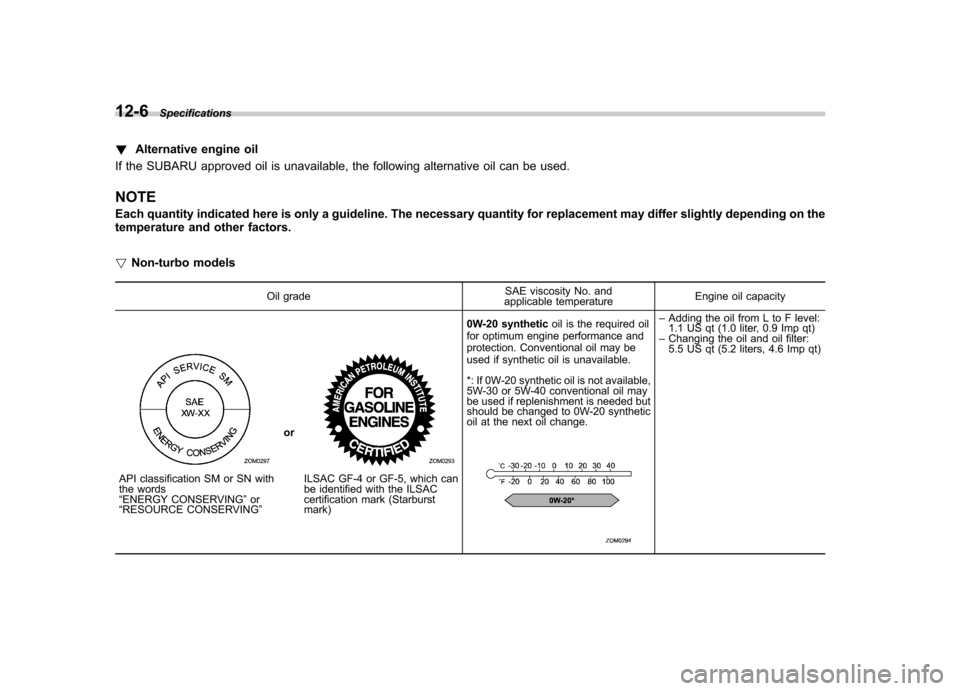
!Alternative engine oil
If the SUBARU approved oil is unavailable, the following alternative oil can be used. NOTE
Each quantity indicated here is only a guideline. The necessary quantity for replacement may differ slightly depending on the
temperature and other factors. ! Non-turbo models
Oil grade SAE viscosity No. and
applicable temperature Engine oil capacity
API classification SM or SN with
the words “
ENERGY CONSERVING ”or
“ RESOURCE CONSERVING ”orILSAC GF-4 or GF-5, which can
be identified with the ILSAC
certification mark (Starburst mark) 0W-20 synthetic
oil is the required oil
for optimum engine performance and
protection. Conventional oil may be
used if synthetic oil is unavailable.
*: If 0W-20 synthetic oil is not available,
5W-30 or 5W-40 conventional oil may
be used if replenishment is needed but
should be changed to 0W-20 synthetic
oil at the next oil change.
– Adding the oil from L to F level:
1.1 US qt (1.0 liter, 0.9 Imp qt)
– Changing the oil and oil filter:
5.5 US qt (5.2 liters, 4.6 Imp qt)
Page 406 of 446

!Turbo models
Oil grade SAE viscosity No. and
applicable temperature Engine oil capacity
API classification SM or SN with
the words “
ENERGY CONSERVING ”or
“ RESOURCE CONSERVING ”orILSAC GF-4 or GF-5, which can
be identified with the ILSAC
certification mark (Starburst mark) 5W-30 synthetic
oil is required for
optimum engine performance and pro-
tection. Conventional oil may be used if
synthetic oil is unavailable.
*: If 5W-30 synthetic oil is not available,
5W-30 or 5W-40 conventional oil may
be used if replenishment is needed but
should be changed to 5W-30 synthetic
oil at the next oil change.
– Adding the oil from L to F level:
1.1 US qt (1.0 liter, 0.9 Imp qt)
– Changing the oil and oil filter:
4.4 US qt (4.2 liters, 3.7 Imp qt) Specifications
12-7
– CONTINUED –
Page 438 of 446

Hood.................................................................... 11-5
Oil................................................................ 11-9, 12-5 Overheating .......................................................... 9-13
Starting ................................................................... 7-7
Stopping ................................................................. 7-9
Exterior care .............................................................. 10-2
F
Flat tires ..................................................................... 9-6
Floor mat .................................................................. 6-12
Fluid level
Automatic transmission .......................................... 11-21
Brake .................................................................. 11-25
Clutch .................................................................. 11-26
Power steering ..................................................... 11-24
Fog light Indicator light ......................................................... 3-25
Switch .................................................................. 3-32
Folding mirror switch .................................................. 3-44
Front Differential gear oil ........................................ 11-22, 12-8
Fog light ............................................................... 3-32
Fog light indicator light ............................................ 3-25
Seatbelt pretensioners ............................................ 1-20
Turn signal light .................................................... 11-50
Front seats .................................................................. 1-2
Forward and backward adjustment ............................. 1-3
Head restraint adjustment ......................................... 1-5
Power seat .............................................................. 1-4
Reclining ................................................................. 1-3
Seat height adjustment (driver ’s seat) ......................... 1-4 Fuel
........................................................................... 7-2
Consumption indicator ............................................. 3-26
Economy hints ........................................................ 8-2
Filler lid and cap ...................................................... 7-3
Gauge ................................................................... 3-10
Requirements ................................................. 7-2, 12-4
Fuses ..................................................................... 11-45
Main fuse ............................................................ 11-46
Fuses and circuits .................................................... 12-11
G
GAWR (Gross Axle Weight Rating) .. ............................. 8-13
Glove box ................................................................... 6-5
GVWR (Gross Vehicle Weight Rating) ........................... 8-13
H
Hands-free system. ..................................................... 5-43
Hazard warning flasher .......................................... 3-5, 9-2
Head restraint adjustment
Front seat ............................................................... 1-5
Rear seat ............................................................... 1-8
Headlight Beam lever ............................................................ 3-31
Bulb replacing ...................................................... 11-47
Bulb wattage ........................................................ 12-15
Control switch ........................................................ 3-29
Flasher .................................................................. 3-30
Indicator light ......................................................... 3-25
Heater operation (manual climate control system) ... ......... 4-5
High beam indicator light ............................................. 3-25
High/low beam change (dimmer) .................................. 3-30Index
14-5