2011 SKODA YETI ECU
[x] Cancel search: ECUPage 211 of 252

The vehicle tool kit and the lifting jack, on which a sign is affixed, are stowed in a
box in the luggage compartment
⇒
fig. 164; there is also space here for the de-
tachable ball head of the towing device. The box is secured with a strap. The
placement of the vehicle tool kit can vary depending on the vehicle equipment.
The vehicle tool kit contains the following parts (depending on equipment fitted):
● Tyre repair kit
● Wire clamps for removing the full wheel trims,
● Wheel wrench,
● Towing eye,
● Adapter for the wheel bolts lock,
● Replacement lamp,
● Torx screwdriver.
Before placing the lifting jack back in its storage area, screw in the arm of the lift-
ing jack fully. WARNING
● The factory-supplied lifting jack is only intended for your model of vehicle.
On no account attempt to lift a heavier vehicle or other loads - risk of injury!
● Ensure that the vehicle tool kit is safely attached in the luggage compart-
ment. Note
Ensure that the box is always secured with the strap.
Spare wheel Fig. 165 Luggage compartment: Spare
wheelThe spare wheel is stowed in the luggage compartment in the area below the var-
iable loading floor and is secured with a special screw
⇒ fig. 165.
One should check the inflation pressure in the spare wheel (at best when general-
ly checking the tyre air pressures - see sign on the fuel filler flap ⇒ page 201) to
ensure that the spare wheel is always ready to use.
Temporary spare wheel
A yellow warning label is displayed on the rim of the temporary spare wheel.
Please observe the following notes when driving with a temporary spare wheel:
● The warning label must not be covered after installing the wheel.
● Do not drive faster than 80 km/h with this spare wheel and pay particular at-
tention while driving. Avoid accelerating at full throttle, sharp braking and fast
cornering.
● The inflation pressure for this spare wheel is identical to the maximum infla-
tion pressure of the standard tyres.
● Use this spare wheel only to reach the nearest specialist garage as it is not in-
tended for continuous use.
Changing a wheel Preliminary work The following steps should be carried out before actually changing the wheel.
– If it is necessary to change a wheel, park the vehicle as far away as possible
from the traffic flow. The place you choose should be level.
– Have all the occupants get out. While changing a tyre, the occupants of the
vehicle should not stand on the road (instead they should remain behind a
crash barrier, for example).
– Apply the handbrake firmly.
– Engage 1st gear or if your vehicle is fitted with an automatic gearbox, position
the selector lever into position P .
– If a trailer is coupled, uncouple it.
– Take the vehicle tool kit ⇒ page 208
and the spare wheel ⇒ page 209 out of
the luggage compartment. £ 209
Breakdown assistance Using the system Safety Driving Tips General Maintenance Breakdown assistance Technical data
Page 212 of 252

WARNING
● If you find yourself in flowing traffic switch on the hazard warning lights
system and place the warning triangle on the side of the road at the prescri-
bed distance from your vehicle. Comply with the national legal regulations. In
this way you are protecting not only yourself but also other road users.
● Never start the engine with the vehicle sitting on the raised jack - danger
of suffering injury. CAUTION
If you have to change a wheel on a slope first block the opposite wheel with a
stone or similar object in order to secure the vehicle from unexpectedly rolling
away. Note
Comply with the national legal regulations.
Changing a wheel Always change a wheel on a level surface as far as possible.
–
Take off the full wheel trim ⇒ page 210 or the wheel trim cap ⇒ page 211 or
the caps ⇒ page 211.
– In the case of light alloy wheels remove the wheel trim cap ⇒
page 211.
– First of all slacken the safety wheel bolt and afterwards the other wheel bolts
⇒ page 211.
– Jack up the vehicle until the wheel to be changed is clear of the ground
⇒ page 212.
– Unscrew the wheel bolts and place them on a clean surface (cloth, paper etc.).
– Take off the wheel.
– Fit on the spare wheel and tighten the wheel bolts slightly.
– Lower the car.
– Tighten the wheel bolts firmly, alternately and diagonally using the wheel
wrench (crosswise) and lastly the wheel safety bolt ⇒
page 211.
– Mount the full wheel trim/wheel trim cap or the caps. Note
● All bolts must be clean and must turn easily.
● You must never grease or oil the wheel bolts!
● When fitting on unidirectional tyres, ensure that the tyres rotate in the correct
direction ⇒ page 201
.
Subsequent steps After changing the wheel, you must perform the following steps.
–
Stow and attach the replaced wheel in the spare wheel well using a special
screw ⇒ fig. 165 .
– Stow the vehicle tool kit in the space provided.
– Check the tyre pressure on the spare wheel just mounted as soon as possible.
– Have the tightening torque of the wheel bolts checked with a torque wrench
as soon as possible. Steel and light alloy wheels must be tightened to a tight-
ening torque of 120
Nm.
– Change the damaged wheel or consult a specialist garage about possibilities
for getting repairs done. WARNING
It is necessary to observe the guidelines given on ⇒
page 203 if the vehicle is
subsequently fitted with tyres which are different to those it was fitted with
at the works. Note
● If you find, when changing the wheel, that the wheel bolts are corroded and
difficult to turn, the bolts must be replaced before checking the tightening torque.
● Drive cautiously and only at a moderate speed to a workshop where the tight-
ening torque can be checked.
Full wheel trim Pulling off
–
Hook the clamp found in the vehicle tool kit into the reinforced edge of the full
wheel trim. £210
Breakdown assistance
Page 215 of 252

WARNING (Continued)
● Secure the base plate of the lifting jack with suitable means to prevent
possible moving. A soft and slippery ground under the base plate may move
the lifting jack, causing the vehicle to fall down. It is therefore always neces-
sary to place the lifting jack on a solid surface or use a wide and stable base.
Use a non-slip base (e.g. a rubber foot mat) if the
surface is smooth, such as
cobbled stones, a tiled floor, etc.
● Attach the lifting jack only at the attachment points provided for this pur-
pose.
Securing wheels against being stolen You need a special adapter for loosening the safety wheel bolts.
Fig. 171 Illustration image: Safety wheel
bolt with adapter
– Pull off the full wheel trim/cap from the wheel hub or cap from the safety
wheel bolt.
– Insert the adapter B with its toothed side into the inner toothing of the head
of the safety wheel bolt A
⇒
fig. 171 .
– Insert the wheel wrench fully onto the adapter B .
– Slacken the wheel bolt, or tighten it firmly ⇒ page 211.
– Reinstall the full wheel trim/wheel cap after removing the adapter or place the
cap onto the safety wheel bolt.
– Have the tightening torque checked with a torque wrench as soon as possi-
ble. Steel and light alloy wheels must be tightened to a tightening torque of
120
Nm. The safety wheel bolts on vehicles fitted with them (one safety wheel bolt per
wheel) can only be loosened or tighten up by using the adapter provided.
It is meaningful to note the code number hammered into the rear side of the
adapter or the rear side of the safety wheel bolts. You can obtain a replacement
adapter from an authorised
ŠKODA Service Partner, if necessary, by quoting this
number.
We recommend that you always carry the adapter for the wheel bolts with you in
the vehicle. It should be stowed in the vehicle tool kit. CAUTION
Damage can occur to the adapter and safety wheel bolt if the safety wheel bolt is
tightened up too much. Note
The set of safety wheel bolts can be obtained from an authorised ŠKODA Service
Partner.
Tyre repair kit General information The tyre repair kit is located in a box under the carpet in the luggage compart-
ment.
Use the tyre repair kit to reliably repair tyre damage caused by foreign bodies or a
puncture with diameters up to 4 mm. Do not remove foreign bodies, e.g. screws or
nails, from the tyre!
The repair can be undertaken on the vehicle immediately.
The repair with the tyre repair kit is not at all intended to replace a permanent
repair on the tyre, this repair only serves to reach the next specialist garage.
Do not use the tyre repair kit:
● to repair wheel damage,
● in outside temperatures of less than -20 °C (-4 °F),
● with tears or punctures greater than 4 mm in size,
● to repair damage to the tyre wall,
● when driving with very low tyre pressure or with a completely flat tyre,
● if the use-by-date (see inflation bottle) has passed. £ 213
Breakdown assistance Using the system Safety Driving Tips General Maintenance Breakdown assistance Technical data
Page 227 of 252
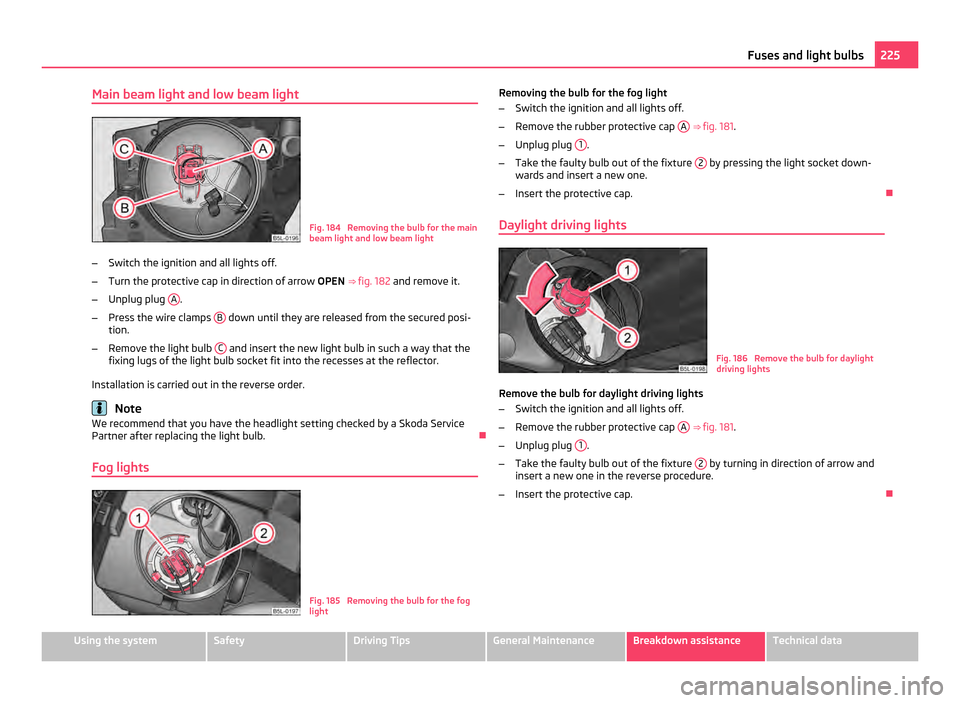
Main beam light and low beam light
Fig. 184 Removing the bulb for the main
beam light and low beam light
– Switch the ignition and all lights off.
– Turn the protective cap in direction of arrow OPEN ⇒ fig. 182 and remove it.
– Unplug plug A .
– Press the wire clamps B down until they are released from the secured posi-
tion.
– Remove the light bulb C and insert the new light bulb in such a way that the
fixing lugs of the light bulb socket fit into the recesses at the reflector.
Installation is carried out in the reverse order. Note
We recommend that you have the headlight setting checked by a Skoda Service
Partner after replacing the light bulb.
Fog lights Fig. 185 Removing the bulb for the fog
light Removing the bulb for the fog light
–
Switch the ignition and all lights off.
– Remove the rubber protective cap A ⇒ fig. 181
.
– Unplug plug 1 .
– Take the faulty bulb out of the fixture 2 by pressing the light socket down-
wards and insert a new one.
– Insert the protective cap.
Daylight driving lights Fig. 186 Remove the bulb for daylight
driving lights
Remove the bulb for daylight driving lights
– Switch the ignition and all lights off.
– Remove the rubber protective cap A
⇒ fig. 181 .
– Unplug plug 1 .
– Take the faulty bulb out of the fixture 2 by turning in direction of arrow and
insert a new one in the reverse procedure.
– Insert the protective cap. 225
Fuses and light bulbs Using the system Safety Driving Tips General Maintenance Breakdown assistance Technical data
Page 228 of 252

Rear light unit
Fig. 187 Removing the rear light unit/disconnecting the plug connection
– Open the boot lid/luggage compartment door.
– Unscrew the light with the aid of the Torx wrench from the vehicle tool kit.
The shorter side of the wrench is used for loosening the screws and the longer
side for screwing the screws out completely 1
⇒ fig. 187.
– Grasp the light at the top and bottom part and pull it slightly to the rear.
– Disconnect the plug connection by pressing the catches in direction of arrow
2 and by pulling them in direction of arrow
3
⇒
fig. 187.
Changing light bulbs in the rear light unit Fig. 188 Remove the middle part of the light/rear light unit: Fitting position of the bulbs
–
Unscrew the securing screw A with the aid of the Torx wrench and press the
three catches in direction of arrow ⇒ fig. 188 .
– Remove the plastic lamp holder. –
Replace the defective light bulb.
– In order to replace a bulb for the brake light, reversing light, rear fog or turn
signal light, turn the fixture of the bulb to the left up to the stop and take the
bulb out of the housing or pull the bulb for the parking light out of the fixture
⇒ fig. 188 .
– Change the bulb, install again the fixture with the bulb in the housing and turn
it to the right up to the stop or insert it.
– Insert the plastic lamp holder into the illumination unit until the interlocks are
heard to engage and screw in the securing screw with the aid of the Torx
wrench ⇒
fig. 188 .
– Reconnect the plug connector and insert the bulb in the original position.
– Screw on the bulb ⇒
fig. 187 - left.
Fitting position of the light bulbs in the rear light unit ⇒ fig. 188
1 - Brake lights
2 - Reversing light
3 - Rear fog light
4 - Turn signal lights
5 - parking lights
Licence plate light Fig. 189 Licence plate light
– Unscrew the glass cover of the light ⇒
fig. 189 .
– Take the defective bulb out of the holder and insert a new one. £226
Fuses and light bulbs
Page 245 of 252

Operation in winter
Battery . . . . . . . . . . . . . . . . . . . . . . . . . . . . . . . . . . . . . 198
Biodiesel . . . . . . . . . . . . . . . . . . . . . . . . . . . . . . . . . . . 187
De-icing windows . . . . . . . . . . . . . . . . . . . . . . . . . . . 182
Outside temperature . . . . . . . . . . . . . . . . . . . . . . . . . . . 15
Overview of the engine compartment . . . . . . . . . . . 191
P Paint . . . . . . . . . . . . . . . . . . . . . . . . . . . . . . . . . . . . . . . . 182
Paint damage . . . . . . . . . . . . . . . . . . . . . . . . . . . . . . . . 182
Panoramic sliding roof . . . . . . . . . . . . . . . . . . . . . . . . . 42
Park Assist . . . . . . . . . . . . . . . . . . . . . . . . . . . . . . . . . . 105
Parking . . . . . . . . . . . . . . . . . . . . . . . . . . . . . . . . . . . . . 103
Parking aid Front and rear . . . . . . . . . . . . . . . . . . . . . . . . . . . . . . 104
rear . . . . . . . . . . . . . . . . . . . . . . . . . . . . . . . . . . . . . . . . 103
Parking light . . . . . . . . . . . . . . . . . . . . . . . . . . . . . . . . . 47
Parking the vehicle . . . . . . . . . . . . . . . . . . . . . . . . . . 103
Passive Safety . . . . . . . . . . . . . . . . . . . . . . . . . . . . . . . 128
Payload . . . . . . . . . . . . . . . . . . . . . . . . . . . . . . . . . . . . . 228
Pedals . . . . . . . . . . . . . . . . . . . . . . . . . . . . . . . . . . . 70, 102
Petrol . . . . . . . . . . . . . . . . . . . . . . . . . . . . . . . . . . . . . . . 186
Petrol engines Starting the engine . . . . . . . . . . . . . . . . . . . . . . . . . 101
Polishing . . . . . . . . . . . . . . . . . . . . . . . . . . . . . . . . . . . . 182
Power steering . . . . . . . . . . . . . . . . . . . . . . . . . . . . . . 158 Warning light . . . . . . . . . . . . . . . . . . . . . . . . . . . . . . . . 25
Power windows . . . . . . . . . . . . . . . . . . . . . . . . . . . . . . . 39 Button in the driver's door . . . . . . . . . . . . . . . . . . . 39
Button in the front passenger door and in therear doors . . . . . . . . . . . . . . . . . . . . . . . . . . . . . . . . . 40
Operational faults . . . . . . . . . . . . . . . . . . . . . . . . . . . . 42
with central locking system . . . . . . . . . . . . . . . . . . . 41
R Radiator fan . . . . . . . . . . . . . . . . . . . . . . . . . . . . . . . . . 195 Rear-view mirror
Exterior mirror . . . . . . . . . . . . . . . . . . . . . . . . . . . . . . 58
Interior mirror . . . . . . . . . . . . . . . . . . . . . . . . . . . . . . . 58
Rear armrest . . . . . . . . . . . . . . . . . . . . . . . . . . . . . . . . . 69
Rear fog light . . . . . . . . . . . . . . . . . . . . . . . . . . . . . . . . . 49 Warning light . . . . . . . . . . . . . . . . . . . . . . . . . . . . . . . . 24
Rear interior lighting . . . . . . . . . . . . . . . . . . . . . . . . . . 52
Rear seats . . . . . . . . . . . . . . . . . . . . . . . . . . . . . . . . . . . . 66
Rear window Heater . . . . . . . . . . . . . . . . . . . . . . . . . . . . . . . . . . . . . . 53
Rear window heater . . . . . . . . . . . . . . . . . . . . . . . . . . . 53
Recharge battery . . . . . . . . . . . . . . . . . . . . . . . . . . . . 198
Recommendation for changing gears . . . . . . . . . . . 14
Refuelling . . . . . . . . . . . . . . . . . . . . . . . . . . . . . . . . . . . 187
Remote control . . . . . . . . . . . . . . . . . . . . . . . . . . . . . . . 37 Synchronisation . . . . . . . . . . . . . . . . . . . . . . . . . . . . . 38
Removing seats . . . . . . . . . . . . . . . . . . . . . . . . . . . . . . . 67
Replacement of parts . . . . . . . . . . . . . . . . . . . . . . . . 207
Replacing fuses . . . . . . . . . . . . . . . . . . . . . . . . . . . . . . 220
Replacing the wiper blades . . . . . . . . . . . . . . . . . . . . 57
Roof aerial . . . . . . . . . . . . . . . . . . . . . . . . . . . . . . . . . . . 181
Roof luggage rack system . . . . . . . . . . . . . . . . . . . . . 76
Running in . . . . . . . . . . . . . . . . . . . . . . . . . . . . . . . . . . 162
S
Safe securing . . . . . . . . . . . . . . . . . . . . . . . . . . . . . . . . . 34
Safety . . . . . . . . . . . . . . . . . . . . . . . . . . . . . . . . . . . . . . 128
Safety information Engine compartment . . . . . . . . . . . . . . . . . . . . . . . 190
Safety wheel bolts . . . . . . . . . . . . . . . . . . . . . . . . . . . 213
Saving electrical energy . . . . . . . . . . . . . . . . . . . . . . 163
Seat belt height adjuster Seat belts . . . . . . . . . . . . . . . . . . . . . . . . . . . . . . . . . . 134
Seat belts . . . . . . . . . . . . . . . . . . . . . . . . . . . . . . . . . . . 132 Belt tensioners . . . . . . . . . . . . . . . . . . . . . . . . . . . . . 135
Cleaning . . . . . . . . . . . . . . . . . . . . . . . . . . . . . . . . . . . . 185
fastening . . . . . . . . . . . . . . . . . . . . . . . . . . . . . . . . . . . 134
Safety information . . . . . . . . . . . . . . . . . . . . . . . . . . 133 taking off . . . . . . . . . . . . . . . . . . . . . . . . . . . . . . . . . . . 135
Warning light . . . . . . . . . . . . . . . . . . . . . . . . . . . . . . . 28
Seat belt warning light . . . . . . . . . . . . . . . . . . . . . . . 134
Seat heating . . . . . . . . . . . . . . . . . . . . . . . . . . . . . . . . . . 69
Selector lever . . . . . . . . . . . . . . . . . . . . . . . . . . . . . . . . . 113
Selector lever-emergency unlocking . . . . . . . . . . . . 116
Selector lever lock Warning light . . . . . . . . . . . . . . . . . . . . . . . . . . . . . . . . 27
Selector lever positions . . . . . . . . . . . . . . . . . . . . . . . . 113
Service reminder indicator . . . . . . . . . . . . . . . . . . . . . 12
Setting temperature Heating . . . . . . . . . . . . . . . . . . . . . . . . . . . . . . . . . . . . 88
Setting the clock . . . . . . . . . . . . . . . . . . . . . . . . . . . . . . 13
Shifting . . . . . . . . . . . . . . . . . . . . . . . . . . . . . . . . . . . . . 102
Side airbag . . . . . . . . . . . . . . . . . . . . . . . . . . . . . . . . . . . 141
Side lights . . . . . . . . . . . . . . . . . . . . . . . . . . . . . . . . . . . . 45
Snow chains . . . . . . . . . . . . . . . . . . . . . . . . . . . . . . . . . 205
Spare wheel . . . . . . . . . . . . . . . . . . . . . . . . . . . . . . . . . 209
Speedometer . . . . . . . . . . . . . . . . . . . . . . . . . . . . . . . . . . 11
Stabilisation system . . . . . . . . . . . . . . . . . . . . . . . . . . 153
START-STOP . . . . . . . . . . . . . . . . . . . . . . . . . . . . . . . . . 110
Starting the engine . . . . . . . . . . . . . . . . . . . . . . . . . . 100 after fuel tank has run empty . . . . . . . . . . . . . . . . 101
Diesel engines . . . . . . . . . . . . . . . . . . . . . . . . . . . . . . 101
Petrol engines . . . . . . . . . . . . . . . . . . . . . . . . . . . . . . 101
Static separation net . . . . . . . . . . . . . . . . . . . . . . . . . . 73
Steering active driver-steering recommendation . . . . . . . 155
Steering force assistance . . . . . . . . . . . . . . . . . . . . . 158
Storage compartment Lighting . . . . . . . . . . . . . . . . . . . . . . . . . . . . . . . . . . . . . 52
Storage compartments . . . . . . . . . . . . . . . . . . . . . . . . 80
Storage facilities . . . . . . . . . . . . . . . . . . . . . . . . . . . . . . 80
Sun . . . . . . . . . . . . . . . . . . . . . . . . . . . . . . . . . . . . . . . . . . 54
Switching off the engine . . . . . . . . . . . . . . . . . . . . . . 101
Switch off Anti-spin regulation (ASR) Warning light . . . . . . . . . . . . . . . . . . . . . . . . . . . . . . . . 27 243
Index Using the system Safety Driving Tips General Maintenance Breakdown assistance Technical data