2011 SKODA YETI warning
[x] Cancel search: warningPage 198 of 252

CAUTION
Brake fluid damages the paintwork of the vehicle. For the sake of the environment
Due to issues with disposal, the special tools and knowledge required, we recom-
mend you have the brake fluid replaced by an authorised Service Partner ŠKODA.
Battery General information Improper handling of the vehicle battery can cause damage. We therefore recom-
mend you have work on the vehicle battery carried out by an authorised ŠKODA
Service Partner.
There is a risk of injuries, scalding, accidents and burns when carrying out any
work on the battery and on the electrical system. For this reason, it is essential to
comply with the warning instructions ⇒ stated below and with the general ap-
plicable rules of safety. WARNING
● The battery acid is strongly corrosive and must, therefore, be handled with
the greatest of care. Always wear protective gloves, eye and skin protection
when handling batteries. Corrosive fumes in the air irritate the air passages
and lead to conjunctivitis and inflammation of the air passages in the lungs.
Battery acid corrodes dental enamel and creates deep wounds after contact
with the skin which take a long time to heal. Repeated contact with diluted
acids causes skin diseases (inflammations, ulcers, slin cracks). Acids coming in-
to contact with water are diluted accompanied by significant development of
heat.
● Do not tilt the battery otherwise battery electrolyte may flow out of the
battery vent openings. Protect the eyes with safety glasses or a shield! There
is the danger of suffering blindness! If any battery electrolyte gets into your
eye, rinse out your eye immediately with clear water for several minutes. Con-
tact a doctor without delay. WARNING (Continued)
● Splashes of acid on your skin or clothes should be neutralised as soon as
possible using soap suds and then rinsed with plenty of water. If acid was
swallowed, seek immediate medical attention.
● Keep batteries out of the reach of children.
● Hydrogen is released when you charge a battery and a highly explosive gas
mixture is produced. An explosion can be caused through sparkling over dur-
ing unclamping or loosening of the cable plug while the ignition is on.
● Bridging of the poles will create a short circuit (e.g. through metal objects,
cables). Possible consequences of a short circuit: Melting of lead struts, explo-
sion and burning of the battery, jets of acid spurting out.
● It is prohibited to work with a naked flame and light, to smoke or to carry
out any activities which produce sparks. Avoid creating sparks when working
with cables and electrical devices. Strong sparking represents a risk of injury.
● Before carrying out any work on the electrical system, switch off the en-
gine, the ignition as well as all electrical components and disconnect the neg-
ative cable (-) on the battery. If you wish to replace a bulb it is sufficient to
switch off the appropriate light.
● Never charge a frozen or thawed battery - risk of explosion and caustic
burns! Replace a frozen battery.
● Never jump-start the batteries which have a too low electrolyte level - risk
of explosion and caustic burns!
● Never use a battery which is damaged - risk of explosion! Immediately re-
place a damaged battery. CAUTION
● You must only disconnect the battery if the ignition is switched off, otherwise
the electrical system (electronic components) of the vehicle may be damaged.
When disconnecting the battery from the electrical system of the vehicle, first dis-
connect the negative terminal (-) of the battery. Then disconnect the positive ter-
minal (+).
● When reconnecting the battery, first connect the positive terminal (+) and only
then the negative terminal (-) of the battery. You must on no account connect the
cables wrongly - risk of a cable fire.
● Ensure that battery acid does not come into contact with the vehicle body oth-
erwise damage could occur to the paintwork. £196
Inspecting and Replenishing
Page 200 of 252

Operation in winter
The battery has to provide greater amounts of electricity during the winter. It also
has only part of the initial power output at low temperatures that it has at normal
temperatures.
A discharged battery may already freeze at temperatures just below 0 °C.
We therefore recommend that you have the battery checked by a specialist ga-
rage before the start of winter and recharged if necessary. WARNING
Never charge a frozen or thawed battery - risk of explosion and caustic burns.
Replace a frozen battery.
Charging the battery A properly charged battery is essential for reliably starting the en-
gine.
– Read the warning notes ⇒ in General information on page 196 and
⇒ .
– Switch the ignition and all electrical components off.
– Only for “quick-charging”: Disconnect both battery cables (first of all “nega-
tive
”, then “positive”).
– Carefully attach the terminal clamps of the charger to the battery terminals
(red = “positive
”, black = “negative”).
– You can now plug the mains cable of the charger into the power socket and
switch on the charger.
– When charging is completed: switch the charger off and unplug the mains ca-
ble from the power socket.
– Only then should you disconnect the terminal clamps of the charger.
– Reconnect the cables to the battery (first of all “positive”, then “negative”).
It is not normally necessary to disconnect the cables of the battery if you recharge
the battery using low amperages (as for example from a mini-charger). Please al-
so refer to the instructions from the charger manufacturer.
A charging current of 0.1 of the total battery capacity (or lower) is that which
should be used until full charging is achieved. It is, however, necessary to disconnect both cables before charging the battery
with high amperages, so-called
“quick-charging ”.
“Quick-charging” a battery is dangerous ⇒ in General information on page 196.
It requires a special charger and specialist knowledge. We recommend having the
quick charging of vehicle batteries undertaken by a specialist garage.
A discharged battery may already freeze at temperatures just below 0
°C ⇒ . We
recommend that you no longer use a battery which has thawed out because the
casing of the battery may be cracked through the formation of ice and this would
allow battery electrolyte to flow out.
The vent plugs of the battery should not be opened for charging. WARNING
● Never charge a frozen or thawed battery - risk of explosion and caustic
burns. Replace a frozen battery.
● Never charge a battery which has a too low electrolyte level - risk of explo-
sion and caustic burns. CAUTION
On vehicles with the “START/STOP” system, the pole terminal of the charger must
not be connected directly to the negative terminal of the vehicle battery, but only
to the engine earth ⇒ fig. 174.
Disconnecting and reconnecting the battery On disconnecting and reconnecting the battery the following functions are initially
deactivated or are no longer able to operate fault-free.
Operation Operating measure
Electrical power window (operational faults) ⇒ page 42
Enter the car stereo/radio navigation system
code number see operating instructions for the
car stereo/radio navigation sys-
tem
Setting the clock ⇒ page 13
Data in the multi-functional indicator are de-
leted. ⇒ page 14
We recommend having the vehicle checked by an authorised ŠKODA Service Part-
ner to ensure full functionality of all electrical systems.
198
Inspecting and Replenishing
Page 201 of 252
Replacing the battery
When replacing a battery, the new new battery must have the same capacity,
voltage (12
V), amperage and be the same size. Suitable types of vehicle battery
are available from an authorised ŠKODA Service Partner.
We recommend you have a battery change carried out by an authorised ŠKODA
Service Partner, who will properly install the new battery and dispose of the origi-
nal one. CAUTION
Vehicles with a “START-STOP” system are fitted with a special battery type which
allows the battery control unit to check the energy level for recurring engine start.
This battery must only be replaced by a battery of the same type. For the sake of the environment
Batteries contain poisonous substances such as sulphuric acid and lead. For this
reason, it must be disposed of properly. Under no circumstances must it be dis-
posed of in the communal rubbish.
Automatic consumer shut-off Under heavy load on the vehicle battery, the vehicle electrical system manage-
ment automatically takes various measures to avoid draining the vehicle battery.
●
The idling speed is raised to allow the generator to deliver more electricity to
the electrical system.
● If necessary, some electrical consumers are limited in their performance or are
temporarily switched off completely. Note
Despite such intervention by the vehicle electric system management, the vehicle
battery may be drained. For example, when the ignition is switched on a long time
with the engine turned off or the side or parking lights are turned on during lon-
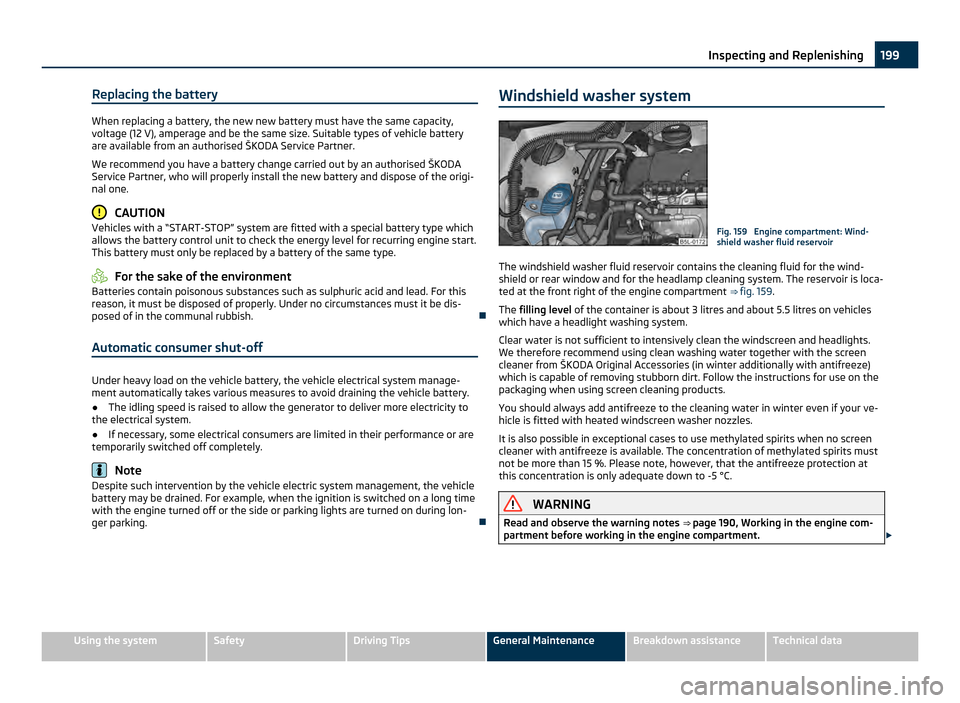
ger parking. Windshield washer system Fig. 159 Engine compartment: Wind-
shield washer fluid reservoir
The windshield washer fluid reservoir contains the cleaning fluid for the wind-
shield or rear window and for the headlamp cleaning system. The reservoir is loca-
ted at the front right of the engine compartment ⇒ fig. 159 .
The filling level of the container is about 3 litres and about 5.5 litres on vehicles
which have a headlight washing system.
Clear water is not sufficient to intensively clean the windscreen and headlights.
We therefore recommend using clean washing water together with the screen
cleaner from
ŠKODA Original Accessories (in winter additionally with antifreeze)
which is capable of removing stubborn dirt. Follow the instructions for use on the
packaging when using screen cleaning products.
You should always add antifreeze to the cleaning water in winter even if your ve-
hicle is fitted with heated windscreen washer nozzles.
It is also possible in exceptional cases to use methylated spirits when no screen
cleaner with antifreeze is available. The concentration of methylated spirits must
not be more than 15 %. Please note, however, that the antifreeze protection at
this concentration is only adequate down to -5 °C. WARNING
Read and observe the warning notes ⇒ page 190
, Working in the engine com-
partment before working in the engine compartment. £ 199
Inspecting and Replenishing Using the system Safety Driving Tips General Maintenance Breakdown assistance Technical data
Page 203 of 252

Wheels and Tyres
Wheels
General information ●
New tyres do not offer optimal grip at first. They should therefore be run in for
about 500 km at a moderate speed and an appropriately cautious style of driving.
You will also profit from longer tyre life.
● The tread depth of new tyres may differ because of design features and the
configuration of the tread (depending on the type of tyre and the manufacturer).
● Drive over curbs on the side of the road and other such obstacles slowly and,
where possible, at a right angle in order to avoid damage to tyres and wheel trims.
● We recommend you Inspect your tyres and rims from time to time for damage
(punctures, cuts, splits and bulges). Remove foreign bodies from the tyre profile.
● Damage to tyres is frequently not visible. Unusual vibrations or pulling of the
vehicle to one side could be a sign of tyre damage. Please reduce your speed im-
mediately and stop if you suspect that a wheel is damaged. Inspect the tyres for
signs of damage (bulges, splits, etc.) If no visible damage is present, please drive
at an appropriately slow speed and carefully to the nearest specialist garage in or-
der to have your vehicle inspected.
● Also protect your tyres from contact with oil, grease and fuel.
● Immediately replace any dust caps of the valves which have got lost.
● Mark wheels before removing them so that their previous direction of running
can be maintained when mounted them again.
● Always store wheels or tyres which been removed in a cool, dry and, where
possible, dark place. Tyres which are not fixed to a wheel trim should be stored
upright.
Unidirectional tyres
The direction of rotation of the tyres is marked by arrows on the wall of the tyre.
This indicates the direction of rotation of the tyre, and it is essential that the tyres
are fitted on to run in this direction. Only then are the tyres able to provide the
optimal properties in terms of grip, low noise, wear-and-tear and aquaplaning.
Further information concerning the use of unidirectional tyres ⇒
page 205. WARNING
● New tyres during the first approximately 500 km do not offer optimal grip
and should therefore be run appropriately - risk of accident!
● Never drive with damaged tyres - risk of accident! Note
Please observe the various differing legal requirements regarding tyres.
Tyre life Fig. 160 An opened fuel filler flap with a
tyre size and tyre inflation pressure ta-
ble
The life of your tyres very much depends on the following points:
Tyre pressure
The working life of tyres will be shortened considerably if the tyres are insuffi-
ciently or over-inflated and this will have an adverse effect on the handling of
your vehicle.
Correctly inflated tyres are of particular importance when travelling at high
speeds . It is therefore good to check the tyre pressure, including that of the spare
wheel, at least once a month and also before setting off on a long trip.
The tyre inflation pressures for summer tyres are indicated on the inside of the
fuel filler flap ⇒ fig. 160 . The inflation pressures for winter tyres are 20 kPa
(0.2
bar) higher than those for summer tyres ⇒ page 204. £ 201
Wheels and Tyres Using the system Safety Driving Tips General Maintenance Breakdown assistance Technical data
Page 204 of 252

The tyre inflation pressure for tyres of the tyre size 205/50 R17 or 205/55 R16,
which are intended to be used with snow chains, is identical to the tyre inflation
pressure for tyres of size 225/45
R17 or 215/60 R16, see ⇒ fig. 160.
The tyre pressure should be at the highest pressure specified for your vehicle at
all times.
Always check the inflation pressure of tyres when cold. Do not reduce the higher
pressure of warm tyres. Adapt the inflation pressure of the tyres accordingly if
your vehicle is carrying a significantly higher payload.
Driving style
Fast cornering, sharp acceleration and braking (squealing tyres) increase wear-
and-tear on your tyres.
Balancing wheels
The wheels of a new vehicle are balanced. There are a wide range of influences
when driving which may result in an imbalance and which makes themselves felt
through vibration in the steering.
You should have the wheels rebalanced since any imbalance increases wear-and-
tear on the steering, the suspension and tyres. A wheel must also be rebalanced
when a new tyre is fitted and each time a tyre is repaired.
Wheel alignment errors
Incorrect wheel alignment at the front and rear will not only increase wear-and-
tear on the tyres but will also has an adverse effect on vehicle safety. Contact
your specialist garage if you notice any unusual tyre wear. WARNING
● If the inflation pressure is too low, the tyre must perform a higher rolling
resistance. At higher speeds the tyre will warm up as a result of this. This can
result in tread separation and even a tyre blowout.
● Immediately replace the damaged rims or tyres.
● Tyres which are 6 years old or more should only be fitted in exceptional ca-
ses and when adopting an appropriately cautious style of driving. For the sake of the environment
Tyres which are insufficiently inflated increase your fuel consumption. Wear indicators
Fig. 161 Tyre tread with wear indicators
The base of the tread of the original tyres has wear indicators 1.6 mm high, instal-
led at right angles to the direction of travel. These wear indicators are located at 6
- 8 points depending on the make and are evenly spaced around the circumfer-
ence of the tyre ⇒ fig. 161 . Markings on the walls of the tyres through the letters
“TWI”, triangular symbols or other symbols identify the position of the wear indi-
cators.
A remaining tread of just 1.6 mm, measured in the grooves of the tread next to the
wear indicators, means that your tyres have reached their legally permissible mini-
mum tread depth. WARNING
● You must have your tyres replaced with new ones at the latest when the
wear indicators have been worn down. The legally permissible minimum tread
depth should be observed.
● Worn tyres do not provide the necessary adhesion to the road surface at
high speeds on wet roads. One could experience “
aquaplaning” (uncontrolled
movements of the vehicle - “swimming” on a wet road surface). 202
Wheels and Tyres
Page 206 of 252

WARNING
● Only use those tyres or wheel rims which have been approved for your
model of ŠKODA vehicle. Failure to observe this instruction will adversely af-
fect the road safety of your vehicle - risk of accident! Approval and licensing of
your vehicle on public roads may also become void as a result.
● You must on no account drive at a higher speed than is permissible for
your tyres - risk of an accident resulting from tyre damage and loss of control
over your vehicle.
● Tyres which are 6 years old or more should only be fitted in exceptional ca-
ses and when adopting an appropriately cautious style of driving.
● Never fit tyres which have already been used without having adequate
knowledge of their previous history. Tyres age even if they have not been
used at all or only very little. A spare tyre must only be used in exceptional ca-
ses and only then when adopting an appropriately cautious style of driving.
● Do not, where possible, replace individual tyres but at least replace them
on both wheels of a given axle at the same time. Always fit the tyres with the
deeper tread depth to the front wheels. For the sake of the environment
Old tyres must be disposed of in conformity with the appropriate regulations. Note
It is not normally possible to fit wheels from other models of cars for technical
reasons. This may also apply in certain circumstances to the wheels of the same
type of vehicle.
Wheel bolts Wheels and
wheel bolts are matched to each other in terms of design. Each time
you fit other wheels - e.g. light alloy wheels or wheels with winter tyres - you
must therefore also use the matching wheel bolts of the correct length and shape
of spherical cap. This is essential to ensure that the wheels are tightly fitted and
that the brake system operates properly.
If you retrofit wheel trims (or have this done), please also ensure that an ade-
quate flow of air remains assured for cooling the brake system.
Authorised
ŠKODA Service Partners are instructed in the technical possibilities
which exist regarding converting or retrofitting tyres, wheels and wheel trims. WARNING
● In case of incorrect treatment of the wheel bolts, the wheel can loosen
when the car is moving - risk of accident!
● The wheel bolts must be clean and must turn easily. However, they must
never be treated with grease or oil.
● If the wheel bolts are tightened to a too low tightening torque, the rim can
lossen when the car is moving - risk of accident! A tightening torque which is
too high can damage the bolts and threads and this can result in permanent
deformation of the contact surfaces on the rim. CAUTION
The prescribed tightening torque of the wheel bolts for steel and light alloy
wheels is 120 Nm.
Winter tyres The handling of your vehicle will be significantly improved when driving on wintry
roads if you fit winter tyres. Summer tyres do not offer the same grip on ice, snow
and at temperatures below 7 °C because of their construction (width, rubber
blend, tread pattern). This particularly applies to vehicles which are equipped with
low-profile tyres
or high-speed tyres (code index H or V on wall of tyre).
Winter tyres must be mounted on all four wheels to obtain the best handling
characteristics.
You must only fit those types of winter tyre which are approved for your vehicle.
The permissible sizes of winter tyres are stated in your vehicle documents. Ap-
provals may differ because of national legislation.
Please remember that the tyres should be inflated to 20
kPa (0.2 bar) more than is
the case for summer tyres ⇒ page 201.
Winter tyres no longer offer the same winter performance once the tyre tread has
worn down to a depth of about 4 mm.
Ageing also causes winter tyres to lose most of their winter performance proper-
ties - even in cases where the remaining tread depth is still clearly more than 4
mm.
Speed restrictions apply to winter tyres as well as to summer tyres ⇒ page 203,
⇒ .
£204
Wheels and Tyres
Page 207 of 252

You can fit winter tyres of a lower speed category to your vehicle provided that
you also do not drive faster than the permissible maximum speed for such tyres,
even if the possible maximum speed of your vehicle is higher. The corresponding
tyre category can damage the tyres when exceeding the permissible maximum
speed.
Please pay attention to the notes if you decide to fit winter tyres
⇒
page 201.
You can also fit so-called “all-year tyres” instead of winter tyres.
Please contact your specialist garage if there are any points which are not clear
who will be able to provide you with information regarding the maximum speed
for your tyres. WARNING
You must on no account drive your car at more than the permissible maximum
speed for your winter tyres - risk of an accident resulting from tyre damage
and loss of control over your car. For the sake of the environment
Fit your summer tyres on again in good time since summer tyres offer you better
grip and handling on roads which are free of snow and ice as well as ar tempera-
tures below 7 °C - the braking distance is shorter, there is less tyre noise, tyre
wear is reduced and fuel consumption is reduced. Note
Please observe the various differing legal requirements regarding tyres.
Unidirectional tyres The direction of rotation of the tyres is marked by arrows on the wall of the tyre
.
This indicates the direction of rotation of the tyre, and it is essential that the tyres
are fitted on to run in this direction. Only then are the tyres able to provide the
optimal properties in terms of grip, low noise, wear-and-tear and aquaplaning.
Should it be necessary to fit on a spare wheel in exceptional cases with a tyre not
dedicated to the running direction or in opposite running direction, please adopt a
cautious style of driving as the tyre is no longer able to provide optimal grip and
handling in such a situation. This particularly important on wet roads. Please refer
to the additional instructions ⇒ page 209
, Spare wheel.
You should have the defective tyre replaced as soon as possible and restore the
correct direction of rotation on all tyres Snow chains When driving on wintry roads, snow chains improve not only traction, but also the
braking performance.
The use of snow chains on vehicles with front-wheel drive and on vehicles with
four-wheel drive differs.
Valid for vehicles with front-wheel drive
Snow chains can only be mounted on the front wheels.
For technical reasons, it is only permissible to fit snow chains with the following
wheel/tyre combinations: Wheel size Depth (D) Tyre size
6J x 16 50 mm 205/55
7J x 16 45 mm 205/55
6J x 17 45 mm 205/50
Valid for vehicles with four-wheel drive
Snow chains can be used on the front wheels as on vehicles with front-wheel
drive.
⇒ page 205
, Valid for vehicles with front-wheel drive.
In order to increase the traction (start-up properties), the use of snow chains is al-
so technically permissible on the rear axle (this means on the front and rear axle
at the same time) for the following wheel/tyre combinations: Wheel size Depth (D) Tyre size
6J x 16 50 mm 205/55
7J x 16 45 mm 205/55
6J x 17 45 mm 205/50
The use of snow chains is only technically permissible on the rear axle for the fol-
lowing standard wheel/tyre combinations:
Wheel size Depth (D) Tyre size
7J x 16 45 mm 215/60
7J x 17 45 mm 225/50
When fitting snow chains on the front and rear axle at the same time, the maxi-
mum speed is limited to
50 km/h.
Only fit snow chains with links and locks not larger than 12 mm. £ 205
Wheels and Tyres Using the system Safety Driving Tips General Maintenance Breakdown assistance Technical data
Page 208 of 252

Remove the full wheel trims
before installing the snow chains.
Observe the different national legal regulations relating to the use of snow chains
and the maximum vehicle speed with snow chains. WARNING
Please pay attention to the information in the supplied fitting instructions of
the snow chain manufacturer. CAUTION
You must take the chains off as soon as you drive on roads which are free of
snow. They adversely affect the handling of your vehicle, damage the tyres and
are rapidly destroyed. Note
We recommend that you use snow chains from ŠKODA Original Accessories. 206
Wheels and Tyres