2011 SKODA YETI remove seats
[x] Cancel search: remove seatsPage 80 of 252

Note holder
Fig. 70 Windscreen: Note holder
The parking ticket holder is designed e.g. for attaching a car park ticket in parking
areas.
The attached note has to always be removed before starting off in order not to
restrict the driver's vision.
Ashtray Front ashtray Fig. 71 Centre console: Front ashtray
Removing ashtray
– Remove the ashtray ⇒ fig. 71 upwards. When removing do not hold the ashtray
at the cover - risk of breakage. Replacing ashtray
–
Insert the ashtray vertically. WARNING
Never lay flammable objects in the ashtray basin - risk of fire!
Rear ashtray - low centre console Fig. 72 Low centre console: Rear ash-
tray
Opening ashtray
– Grasp the ashtray cover at the lower edge A and fold it open in the direction
of arrow ⇒ fig. 72.
Removing ashtray
– Grasp the ashtray at the handle B and pull it out in an upward direction.
Replacing ashtray
– Insert the ashtray into the console and press it in. WARNING
Never lay flammable objects in the ashtray basin - risk of fire! CAUTION
The ashtray in the rear part of the centre console must be closed (otherwise it
could get damaged) before folding forward the rear middle seat. 78
Seats and Stowage
Page 81 of 252
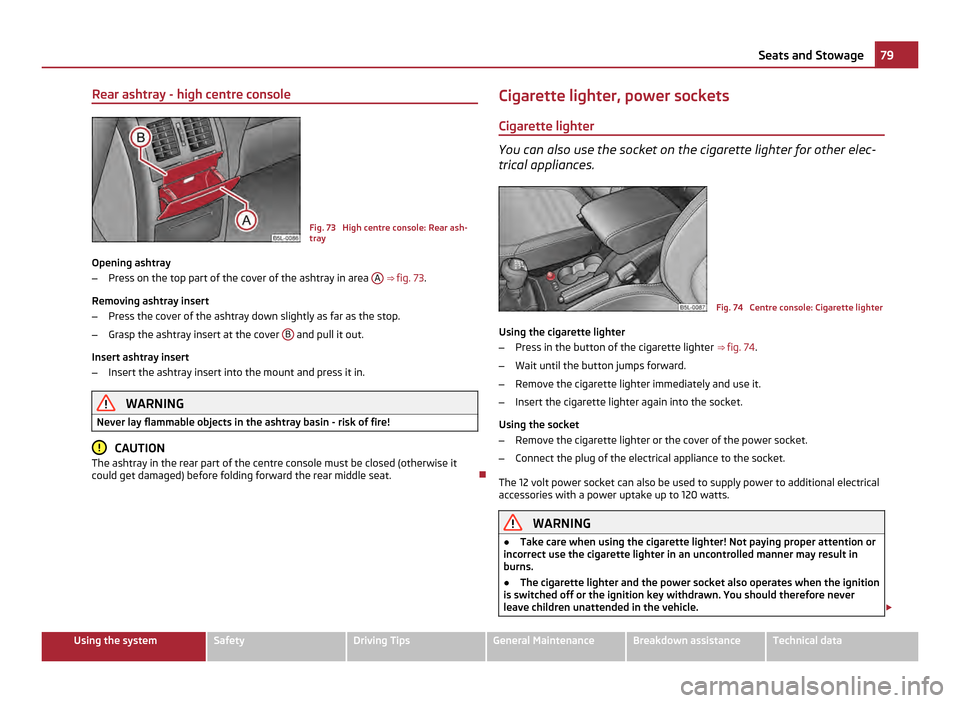
Rear ashtray - high centre console
Fig. 73 High centre console: Rear ash-
tray
Opening ashtray
– Press on the top part of the cover of the ashtray in area A
⇒ fig. 73.
Removing ashtray insert
– Press the cover of the ashtray down slightly as far as the stop.
– Grasp the ashtray insert at the cover B and pull it out.
Insert ashtray insert
– Insert the ashtray insert into the mount and press it in. WARNING
Never lay flammable objects in the ashtray basin - risk of fire! CAUTION
The ashtray in the rear part of the centre console must be closed (otherwise it
could get damaged) before folding forward the rear middle seat. Cigarette lighter, power sockets
Cigarette lighter You can also use the socket on the cigarette lighter for other elec-
trical appliances.
Fig. 74 Centre console: Cigarette lighter
Using the cigarette lighter
– Press in the button of the cigarette lighter ⇒ fig. 74.
– Wait until the button jumps forward.
– Remove the cigarette lighter immediately and use it.
– Insert the cigarette lighter again into the socket.
Using the socket
– Remove the cigarette lighter or the cover of the power socket.
– Connect the plug of the electrical appliance to the socket.
The 12 volt power socket can also be used to supply power to additional electrical
accessories with a power uptake up to 120 watts. WARNING
● Take care when using the cigarette lighter! Not paying proper attention or
incorrect use the cigarette lighter in an uncontrolled manner may result in
burns.
● The cigarette lighter and the power socket also operates when the ignition
is switched off or the ignition key withdrawn. You should therefore never
leave children unattended in the vehicle. £ 79
Seats and Stowage Using the system Safety Driving Tips General Maintenance Breakdown assistance Technical data
Page 86 of 252

Stowage compartment in rear centre console
Fig. 84 Centre console at rear: Storage
compartment
The storage compartment is equipped with a removable insert.
– Open the storage compartment by pulling on the upper edge of the storage
compartment A in the direction of arrow
⇒ fig. 84 . WARNING
The storage compartment is not a substitute for the ashtray and must also
not be used for such purposes - risk of fire! CAUTION
The storage compartment in the rear part of the centre console must be closed
(otherwise it could get damaged) before folding forward the rear middle seat.
Storage compartments in the luggage compartment Fig. 85 Luggage compartment: Storage compartments Storage compartments are located on both sides of the luggage compartment.
The removable storage compartment
A ⇒ fig. 85
on the left side is suitable for
stowing small objects weighing up to 1.5 kg.
The storage compartment B ⇒
fig. 85 on the right side is suitable for stowing
small objects weighing up to 0.5 kg.
Flexible storage compartment Fig. 86 Flexible storage compartment
A flexible storage compartment is located on the right side of the luggage com-
partment.
Removing
– Take hold of the flexible storage compartment at both upper corners.
– Press the upper corners to the inside and release the storage compartment by
pulling upwards.
– Remove by pulling towards you.
Install
– Insert both ends of the flexible storage compartment into the openings of the
right side trim panel of the luggage compartment and push it downwards until
it locks. CAUTION
The storage compartment is designed for storing small objects with a maximum
total weight of 8 kg. 84
Seats and Stowage
Page 129 of 252

WARNING
● If there are passengers of both of the rear seats, the DVD player holder
must not be used alone (without the DVD player) - risk of injury!
● The inclination of the holder can be adjusted to three preset positions.
Risk of finger injuries between the holder and the backrest in case of changes
in the position of the DVD player holder.
● Do not use the DVD player holder when the rear seat backrest or the rear
seat is folded forward or has been removed completely. Note
Follow the instructions given in the operating instructions of the DVD player/DVD
player holder. 127
Communication Using the system Safety Driving Tips General Maintenance Breakdown assistance Technical data
Page 135 of 252

The speed of the vehicle is, nevertheless, the most important factor. Doubling the
speed of the vehicle from 25 km/h up to 50 km/hour increases the kinetic energy
four times.
The common opinion that it is possible to support your body in a minor accident
with your hands, is incorrect. Even in a collision at only a low speed, the forces
acting on the body are such that it is no longer possible to support your body.
Even if you only drive at a speed within the range from 30 km/hour to 50 km/hour,
the forces which are produced on your body in the event of an accident can easily
exceed 10.000 N (Newton). This equals a weight of one tonne (1 000 kg).
In the event of a frontal collision, occupants of the vehicle not wearing a seat belt
are thrown forward and strike in an uncontrolled way parts of the interior of the
vehicle, such as steering wheel, dash panel, windshield ⇒ fig. 117 - left. The occu-
pants of a vehicle who have not fastened their seat belts may even be thrown out
of the vehicle. This can result in fatal injuries.
It is also important that rear seat occupants fasten their seat belts as they will
otherwise be thrown through the vehicle in an uncontrolled manner in the event
of an accident A rear seat passenger who has not fastened the seat belt is a dan-
ger not only to himself but also for those seated at the front ⇒
fig. 117 - right.
Important safety information regarding the use of
seat belts The correct use of the seat belts considerably reduces the risk of
injury! WARNING
● The belt webbing must not be jammed in-between at any point or twisted,
or chafe against any sharp edges.
● It is important that the belt webbing is properly routed if the seat belts are
to offer their maximum protection ⇒ page 134.
● No two persons (also not children) should ever use a single seat belt to-
gether.
● The maximum protection which seat belts can offer is only achieved if you
are correctly seated ⇒
page 129, Correct seated position. WARNING (Continued)
● The belt webbing must not run across solid or fragile objects (e.g. specta-
cles, ball-point pens, keys etc.) as this may be a cause of injuries.
● Many layers of clothing and loose clothing (e. g. a winter coat over a jacket)
do not allow you to be correctly seated and impairs proper operation of the
seat belts.
● It is prohibited to use clamps or other objects to adjust seat belts (e. g. for
shortening the belts for smaller persons).
● The lock tongue should only be inserted into the lock which is the correct
one for your seat. Wrong use of the safety belt will reduce its capacity to pro-
tect and the risk of injury increases.
● The seat backrests of the front seats must not be tilted too far to the rear
otherwise the seatbelts can lose their effectiveness.
● The belt webbing must always be kept clean. Soiled belt webbing may im-
pair proper operation of the inertia reel ⇒
page 185, Seat belts.
● The slot of the belt tongue must not be blocked by paper or similar objects
otherwise the belt tongue will not lock in place properly.
● Inspect the seat belts regularly to ensure they are in good condition. If you
find seat belts which have damage to the belt, the seat belt connections, to
the inertia reel or to the lock, the relevant seat belt must be replaced by a
specialist garage.
● The seat belts must not be removed or changed in any way. Do not make
an attempt to repair the seat belts yourself.
● Damaged seat belts which have been subjected to stress in an accident
and were therefore stretched, must be replaced - this is best done by a spe-
cialist garage. The anchorage points of the belts must also be inspected. The
anchorage points for the belts should also be checked.
● In certain countries it is possible to use seat belts which differ in terms of
their operation from the seat belts which are described on the pages which
follow. 133
Seat belts Using the system Safety Driving Tips General Maintenance Breakdown assistance Technical data
Page 144 of 252

The load of the occupants is cushioned when plunging into the fully inflated air-
bag and the risk of injury to the entire upper body (chest, stomach and pelvis) is
reduced on the side facing the door.
Important safety information on the side airbag Correct use of the airbag system considerably reduces the risk of
injury! WARNING
● It is essential to always switch off ⇒ page 144 , Deactivating an airbag the
front passenger front airbag when attaching a child safety seat on the front
passenger seat where the child is seated with its back facing in direction of
travel (in some countries also when the child is facing the direction of travel).
If this is not done, there is a risk of the child suffering severe or even fatal in-
juries if the front passenger front airbag is deployed. When transporting a
child on the front passenger seat, please comply with the appropriate national
regulations regarding the use of child safety seats.
● Your head should never be positioned in the deployment area of the side
airbag. You might suffer severe injuries in the event of an accident. This ap-
plies in particular to children who are transported without using a suitable
child safety seat ⇒ page 148, Child safety and side airbag
.
● If children adopt an incorrect seated position when travelling, they may be
exposed to an increased risk of injury in the event of an accident. This can re-
sult in serious injuries ⇒ page 146
, What you should know about transporting
children!.
● There must not be any further persons, animals as well as objects posi-
tioned between the occupants and the deployment area of the airbag. No ac-
cessories, such as a can holder, should be attached to the doors.
● The airbag control unit operates together with the pressure sensors,
which are attached in the front doors. For this reason no adjustments must be
carried out at the doors as well as at the door panels (for example additional
installation of loudspeakers). Resulting damages can have a negative affect
on the operation of the airbag system. All work on the front doors and their
panels must only be carried out by a specialist garage. WARNING (Continued)
● In the event of a side collision, the side airbags will not function properly, if
the sensors cannot measure the increasing air pressure inside the doors, be-
cause the air can escape through large, non-sealed openings in the door pan-
el.
–Never drive with removed inner door panels.
– Never drive, if parts of the inner door panel have been removed and the
remaining openings have not been properly sealed.
– Never drive, if the loudspeakers in the doors have been removed, only if
the loudspeaker openings have been properly sealed.
– Always make sure that the openings are covered or filled, if additional
loudspeakers or other equipment parts are installed in the inner door pan-
els.
– Always work with an authorised ŠKODA Service Partner or have it car-
ried out by a competent specialist workshop.
● Only hang light items of clothing on the clothes hooks to the vehicle. Nev-
er leave any heavy or sharp-edged objects in the pockets of the items of cloth-
ing.
● Ensure that there are no excessive forces, such as violent knocks, kicks
etc., impact on the backrests of the seats otherwise the system may be dam-
aged. The side airbags would not be deployed in such a case!
● Any seat or protective covers which you fit to the driver or front passenger
seats must only be of the type expressly authorized by ŠKODA. In view of the
fact that the airbag inflates out of the backrest of the seat, use of non-ap-
proved seat or protective covers would considerably impair the protective
function of the side airbag.
● Any damage to the original seat covers in the area of the side airbag mod-
ule must be repaired without delay by your specialist garage.
● The airbag modules in the front seats must not display any damage, cracks
or deep scratches. It is not permissible to use force in order to open the mod-
ules.
● Any work on the side airbag system including removing and installing sys-
tem components because of other repair work (e.g. removing seats) must only
be carried out by a specialist garage. 142
Airbag system
Page 186 of 252

Protection of hollow spaces
All the cavities of your vehicle which are at risk from corrosion are protected for
life by a layer of protective wax applied in the factory.
This wax protection does not require to be inspected or re-treated. Please remove
any small amount of wax which flows out of the cavities at high temperatures
with a plastic scraper and clean the stains using petroleum cleaner. WARNING
Safety and environmental protection regulations should observed when using
petroleum cleaner to remove wax - a risk of fire!
Care of the interior of vehicle Plastic parts, artificial leather and cloths You can clean plastic parts and artificial leather with a moist cloth. You should on-
ly treat such parts with special solvent-free plastic cleaning and care products it
does prove to be adequate.
Upholstery cloth and cloth trim on the doors, luggage compartment cover, head-
liner etc. are best treated with special cleaning products, using if necessary a dry
foam and a soft sponge or brush. CAUTION
Solvent-free cleaners attack the material and can damage it.
Fabric covers of electrically heated seats Do not clean
the seat covers moist as this may result in damage to the seat heat-
ing system.
Clean such covers using special agents, for example dry foam. Natural leather Natural leather requires quite particular care and attention.
Leather should be treated from time to time according the following guidelines
depending on how much it is used.
Normal cleaning
– Clean soiled areas of the leather with slightly moistened cotton or woollen
cloth.
Severe soiling
– Clean severely soiled areas with a cloth dipped in a mild soapy solution (2
spoonfuls of natural soap to 1 litre of water).
– Ensure that the leather is not soaked through at any point and that no water
gets into the stitching of the seams.
– Dry off the leather with a soft, dry cloth.
Removing stains
– Remove fresh stains which are water-based (e.g. coffee, tea, juices, blood etc.)
with an absorbent cloth or household paper or use the cleaner from the care
set for a stain which has already dried in.
– Remove fresh stains on a fat base (e.g. butter, mayonnaise, chocolate etc.)
with an absorbent cloth or household cleaning paper or with the cleaner from
the care set if the stain has not yet penetrated into the surface.
– Use a grease dissolver for grease stains which have dried in .
– Eliminate special stains (e.g. ball-point pens, felt pen, nail varnish, dispersion
paint, shoe cream etc.) with a special stain remover suitable for leather.
Leather care
– Treat the leather every six months with a special leather care product.
– Apply only a small amount of the care product.
– Dry the leather off with a soft cloth £184
Taking care of your vehicle and cleaning the vehicle