2011 SKODA YETI mirror
[x] Cancel search: mirrorPage 55 of 252
Switching on the interior lighting
–
Press the cover glass in the area of the symbol ⇒ fig. 33.
Switching off the interior lighting
– Press the cover glass in the area of the symbol O.
Operating the lights with the door contact switch
– Position the cover glass into middle position .
Front door warning light Fig. 34 Front door: Warning light
The warning light is located in the door trim panel below ⇒ fig. 34.
The warning light goes on every time the door is opened. The light goes out about
10 minutes after opening the door in order to avoid discharging the battery of the
vehicle.
There is a reflector installed on some vehicles instead of the warning light.
Entry lighting The lighting is positioned on the bottom edge of the exterior mirror.
The light beam is directed towards the entry area of the front door.
The light comes on after the doors have been locked or on opening the boot lid.
The light goes out after switching on the ignition or up to 30 seconds after closing
all the doors and the boot lid.
If a door or the boot lid remains open, the light goes out within 2 minutes if the
ignition is switched off. WARNING
If the entry light comes on, do not touch its cover - risk of burns!
Luggage compartment light The lighting comes on automatically when the boot lid is opened. If the lid remains
open for more than about 10 minutes, the luggage compartment lighting switches
off automatically.
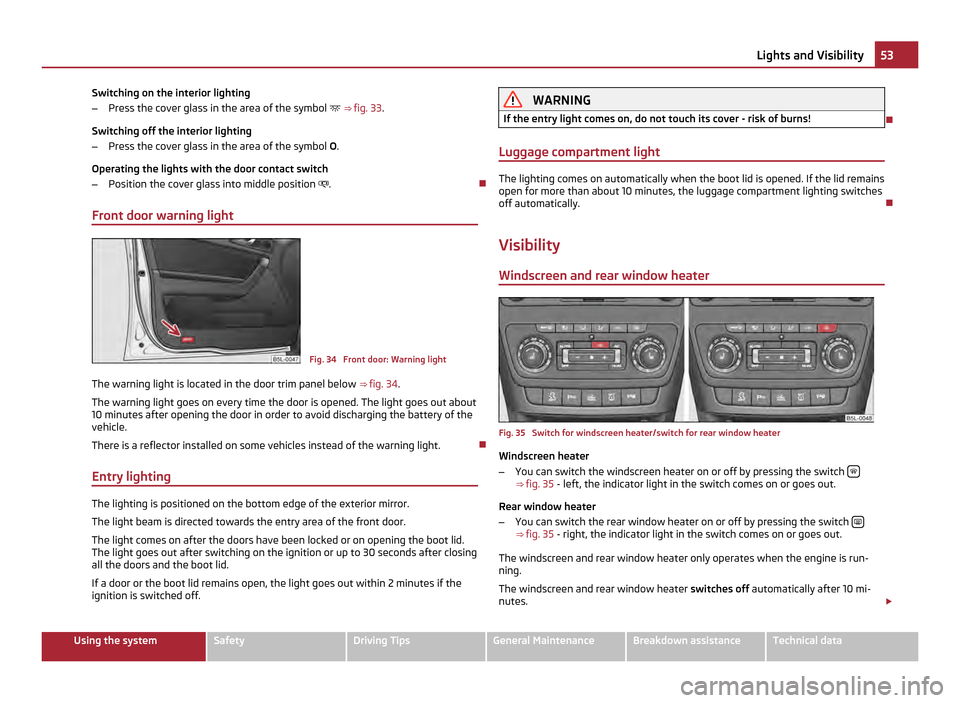
Visibility Windscreen and rear window heater Fig. 35 Switch for windscreen heater/switch for rear window heater
Windscreen heater
– You can switch the windscreen heater on or off by pressing the switch ⇒
fig. 35 - left, the indicator light in the switch comes on or goes out.
Rear window heater
– You can switch the rear window heater on or off by pressing the switch ⇒
fig. 35 - right, the indicator light in the switch comes on or goes out.
The windscreen and rear window heater only operates when the engine is run-
ning.
The windscreen and rear window heater switches off automatically after 10
mi-
nutes. £ 53
Lights and Visibility Using the system Safety Driving Tips General Maintenance Breakdown assistance Technical data
Page 56 of 252

For the sake of the environment
As soon as the window is de-iced or free from mist, the heating should be switch-
ed off. The reduced current consumption will have a favourable effect on fuel
economy ⇒ page 166
, Saving electricity.Note
● If the on-board voltage drops, the front and rear window heater switches off
automatically, in order to provide sufficient electrical energy for the engine con-
trol.
● The position and the shape of the switch can differ depending on equipment
installed in the vehicle.
Sun visors Fig. 36 Sun visor: Swivelling out/double sun visor
You can pull the sun visor for the driver or front passenger out of the fixture and
swivel it toward the door in the direction of the arrow
1
⇒
fig. 36 .
The vanity mirrors in the sun visors are provided with covers. Push the cover in di-
rection of arrow 2 .
On vehicles which are equipped with double sun visor, you can also unfold the
auxiliary visor in direction of arrow 3 after swivelling the sun visor.
WARNING
The sun visors must not be swivelled to the side windows into the deploy-
ment area of the head airbags if any objects, such as ball-point pens etc. are
attached to them. This might result in injuries to the occupants if the head air-
bag is deployed. Windshield wiper and wash system
Windshield wiper You can operate the windscreen wipers and automatic wipe/wash
using the windscreen wiper lever. Fig. 37 Windscreen wiper lever
The windscreen wiper lever ⇒
fig. 37 has the following positions:
Finger-operated wiping
– If you wish to wipe the windscreen only briefly, push the lever into the sprung
position 4 . If you hold the lever in the lower position for more than 1 second,
the wiper wipes faster.
Intermittent wiping
– Position the lever up into position 1 .
– Set with the switch A the desired break between the individual wiper
strokes.
Slow wipe
– Position the lever up into position 2 .
Fast wipe
– Position the lever up into position 3 .
£54
Lights and Visibility
Page 60 of 252

–
With the other hand unlock the locking button 1 and remove the wiper blade
in the direction of arrow 2 .
Attaching the wiper blade
– Push the wiper blade until it locks up to the stop.
– Check whether the wiper blade is correctly attached.
– Fold the windscreen wiper arm back onto the windscreen.
The same remarks apply here as for ⇒ page 57.
Rear-view mirror Manual dimming interior rear-view mirror Basic setting
–
Pull the lever on the bottom edge of the mirror forward.
Dimming mirror
– Pull the lever on the bottom edge of the mirror back.
Automatic dimming interior mirror Fig. 40 Automatic dimming interior mir-
ror
Switching on the automatic dimming
– Press the button B
⇒ fig. 40 , the warning light A lights up.
Switching off the automatic dimming
– Press again the button B - the warning light goes out
A .If the automatic dimming is switched on, the mirror dims
automatically depending
on the light striking the mirror from the rear. The mirror has no lever on the bot-
tom edge of the mirror. After the reverse gear is engaged, the mirror always
moves back into the normal position.
Do not attach external navigation devices on the windshield or in the vicinity of
the automatic dimming interior mirror ⇒
.
WARNING
The display lighting of the external navigation device may cause malfunction
of the automatic dimming interior mirror – risk of accident. Note
● Automatic mirror dimming operates only properly if the light striking the rear
of the interior rear-view mirror is not affected by other objects.
● Do not affix any stickers in front of the light sensor, so that you do not impair
the automatic dimming function or put it out of operation.
● If you switch off the automatic dimming interior rear-view mirror, also the ex-
terior mirror dimming is switched off.
Exterior mirror You can adjust the exterior mirrors electrically.
Fig. 41 Inner part of door: Rotary knob
Adjust the rear mirror before commencing to drive so that there is a clear view to
the rear.
Heating of the external mirror
– Turn the rotary knob to position
⇒
fig. 41. £58
Lights and Visibility
Page 61 of 252

The exterior mirror heater only operates when the engine is running and up to an
outside temperature of +20 °C.
Adjusting left and right exterior mirrors simultaneously
– Turn the rotary knob to position . The movement of the mirror surface is iden-
tical to the movement of the rotary knob.
The adjustment of both mirrors simultaneously or each individual mirror is possi-
ble in the Information display ⇒
table on page 20 in the menu point Mirror adjust.
(Mirror adjust.).
Adjusting the right-hand exterior mirror
– Turn the rotary knob to position . The movement of the mirror surface is iden-
tical to the movement of the rotary knob.
Switching off operating control
– Turn the rotary knob to position .
Folding in both exterior mirrors
– Turn the rotary knob to position .
Fold in the exterior mirrors using the remote control key
– If all the windows are closed, press the unlock button 3 on the radio remote
control ⇒ fig. 17 for approx. 2 seconds.
Tilting surface of front passenger exterior mirror
On vehicles fitted with a memory for the driver seat, the surface of the mirror tilts
down slightly when the rear gear is engaged and the rotary knob is in the posi-
tion ⇒ fig. 41 . This provides an aid in seeing the kerb of the pavement when park-
ing the car.
The mirror returns into its initial position, after the rotary knob is moved out of the
position and put into another position or if the speed is more than 15 km/h.
Memory for exterior mirrors
On vehicles fitted with a memory for the driver seat, the relevant setting of the
exterior mirror is also stored automatically when the seat position is stored
⇒ page 63. WARNING
● Convex (curved outward) or a spherical exterior mirrors increase the vision
field. They do, however, make objects appear smaller in the mirror. These mir-
rors are only of limited use, therefore, for estimating distances to the follow-
ing vehicles.
● Use whenever possible the interior rear mirror, for estimating the distan-
ces to the following vehicles. Note
● If the exterior mirrors are folded in using the remote control of the vehicle key,
these are folded back into the driving position after opening the door or switching
on the ignition.
● If the exterior mirrors are folded in using the rotary knob ⇒
fig. 41, they can on-
ly be folded back into the driving position using the rotary knob.
● If the exterior mirrors were folded in using the remote control of the vehicle
key and if the rotary knob was in the fold-in position before switching on the igni-
tion, the mirrors remain in the fold-in position the next time the ignition is switch-
ed on. Folding back into the driving position is performed by actuating the rotary
knob in a different position from the fold-in position.
● Do not touch the surfaces of the exterior mirrors if the exterior mirror heater is
switched on.
● You can set the exterior mirrors by hand, if the power setting function fails at
any time, by pressing on the edge of the mirror surface.
● Contact your specialist garage if a fault exists with the power setting of the
exterior mirrors.
Automatic dimming exterior mirror on the driver's side The exterior mirror on the driver's side is dimmed together with the interior mirror.
If the automatic dimming is switched on, the mirror dims automatically depending
on the light striking the mirror from the rear.
When the interior lights are switched on or the reverse gear is engaged, the mirror
always moves back into the basic position (not dimmed). £ 59
Lights and Visibility Using the system Safety Driving Tips General Maintenance Breakdown assistance Technical data
Page 62 of 252

Note
● Automatic mirror dimming operates only properly if the light striking the rear
of the interior rear-view mirror is not affected by other objects.
● Do not affix any stickers in front of the light sensor, so that you do not impair
the automatic dimming function or put it out of operation.
● If you switch off the automatic dimming interior rear-view mirror, also the ex-
terior mirror dimming is switched off. 60
Lights and Visibility
Page 66 of 252

Storing setting
Fig. 46 Driver seat: Memory buttons
and SET button
Storing seat and exterior mirror settings for driving forward
– Switch on the ignition.
– Adjust the seat ⇒ page 63.
– Adjust both exterior mirrors ⇒
page 58.
– Press button SET A
⇒ fig. 46 .
– Press one of the memory buttons B within 10 seconds after pressing the but-
ton SET - an acknowledgement signal confirms that the seat setting is stored..
Storing exterior mirror setting for reversing
– Switch on the ignition.
– Turn the exterior mirror control to position ⇒
page 58.
– Engage reverse gear.
– Move the right exterior mirror into the desired position ⇒
page 58.
– Take the vehicle out of gear. The set position of the exterior mirror is stored.
Memory buttons
Memory for the seat offers the possibility to store the individual driver seat and
external mirror position. An individual position can be allocated to each of the
three memory buttons B
⇒ fig. 46 , that is three in total. After pressing the corre-
sponding memory button B , the seat and the exterior mirror are automatically
moved into the positions which have been allocated to this button ⇒
page 64. Emergency Off
You can interrupt the setting operation at any time, if you operate any button of
the driver seat. Note
● For safety reasons, it is not possible to store this position if the inclination an-
gle of the seat backrest is more than 102° in relation to the seat cushion.
● When storing settings with the memory buttons, we recommend that you be-
gin with the front button and assign a memory button to each additional driver.
● Each new setting stored with the same button erases the previous setting.
● Each time you store the seat and exterior mirror settings for driving forward
you also have to re-store the individual setting of the exterior mirror on the pas-
senger side for reversing.
Assigning the remote control key to the memory buttons After storing the settings of the seat and exterior mirrors, you have 10 seconds in
order to assign the remote control to the appropriate memory button.
– Withdraw the ignition key.
– Press the unlock button ⇒
page 37, after the successful assignment an audible
signal will sound. The setting is stored with the memory button which you
have selected.
If you wish to be able to retrieve the settings which are stored in the memory by
also using the remote control, you have to assign the remote control to a memory
button in each case.
If you wish, you can obtain an additional remote control key from an authorised
ŠKODA Service partner and then assign the remote control key to another memo-
ry button. Note
● If the remote control had previously been assigned to another memory button,
this setting is then erased by the new assignment.
● If you assign the remote control to a memory button which has already been
assigned to a remote control, the old assignment is also replaced by a new assign-
ment in this case. £64
Seats and Stowage
Page 67 of 252

●
The assignment of the radio remote control to a memory button is retained,
however, after reassigning the seats and exterior mirrors.
● After the successful assignment, the turn signal lights flash and an audible
signal will sound as a confirmation. The setting is stored with the memory button
which you have selected.
Retrieving settings of the seat and mirrors You can retrieve the stored settings either with the memory but-
tons or with the remote control.
Retrieving settings with memory buttons
– In order to retrieve the stored setting, you have two possibilities:
– By briefly pressing:Briefly press the desired memory button B
⇒ fig. 46 . The
seat and exterior mirror are moved automatically into the stored positions (this
applies only if the ignition is switched on and the speed is less than 5 km/h).
– By pressing for a long period of time: press and hold the desired memory but-
ton B pressed long enough until the seat and the exterior mirrors are moved
into the stored positions.
Retrieving settings with remote control
– If the driver door is closed and the ignition is switched off, briefly press the un-
lock button of the remote control ⇒ page 37 and then open the driver door.
– The seat and exterior mirrors now move automatically into the stored posi-
tions.
Retrieving setting of exterior mirror for reversing
– Turn the rotary knob for the exterior mirror setting into the position
⇒ page 58
before engaging the reverse gear.
The mirror returns into its initial position, after the rotary knob is moved out of the
position and put into another position or if the speed is more than 15 km/h.
Emergency Off
You can interrupt the setting operation at any time, if you operate any button of
the driver seat. Head restraints
Fig. 47 Head restraint: Adjusting/pulling out
Best protection is achieved if the top edge of the head restraint is at the same
level as the upper part of your head.
Adjusting the height of a head restraint
–
Grasp the side of the head restraint with both hands and push it in upward di-
rection as desired ⇒ fig. 47 - left.
– Move the head restraint downwards if required by pressing and holding the
safety button with one hand ⇒ fig. 47 - right and by pressing with the other
hand the head restraint downwards.
Removing and installing a head restraint
– Pull the head restraint out of the seat backrest as far as the stop.
– Press the locking button in the direction of arrow ⇒
fig. 47 - right and pull the
head restraint out.
– To re-insert the head restraint, push it down into the seat backrest far enough
until you hear the locking button engage.
The position of the front and rear outer head restraints is adjustable in height.
The middle rear head restraint is adjustable in two positions.
The head restraints must be adjusted to match the size of the seat occupant. Cor-
rectly adjusted head restraints together with the seat belts offer effective protec-
tion for the occupants ⇒ page 129, Correct seated position
.£ 65
Seats and Stowage Using the system Safety Driving Tips General Maintenance Breakdown assistance Technical data
Page 131 of 252

●
Safely attach the items of luggage ⇒ page 70, Loading the luggage compart-
ment .
● Ensure that no objects can obstruct the pedal.
● Adjust the mirror, the front seat and the head restraint to match your body
size.
● Point out to your occupants that the head restraints must be adjusted to
match their body size.
● Protect the children in suitable child seats with correctly fastened seat belts
⇒ page 146, Transporting children safely
.
● Adopt the correct seated position ⇒
page 129, Correct seated position. Also
inform your occupants to adopt the correct seated position.
● Fasten the seat belt correctly. Also inform your occupants to properly fasten
the seat belts ⇒
page 134, How are seat belts correctly fastened?.
What influences the driving safety? The driving safety is primarily determined by the style of driving
and the personal behaviour of all the occupants.
The driver is fully responsible for himself and his occupants. If your driving safety
is effected, you place yourself and the oncoming traffic at risk. Please refer to the
following guidelines.
● Do not get distracted from concentrating on the traffic situation, e.g. by your
occupants or mobile phone calls.
● Never drive when your driving ability is impaired, e.g. through medication, alco-
hol, drugs.
● Keep to the traffic regulations and the permissible speed limit.
● Adjust the driving speed at all times to the road condition as well as to the
traffic and weather conditions.
● Take regular breaks on long journeys - at the latest every two hours. Correct seated position
Correct seated position for the driver Correct seated position for the driver is important for safe and re-
laxed driving.
Fig. 115 The correct distance of the driver from the steering wheel and the gear lever/The
correct head restraint adjustment for the driver
For your own safety and to reduce the risk of injury in the event of an accident, we
recommend the following setting.
● Position the steering wheel so that there is a gap of at least 25 cm between
the steering wheel and the chest, and the distance between the legs and the gear
lever at the height of the knee airbag is at least 10
cm ⇒ fig. 115 - left.
● Position the driver seat in the forward/back direction so that you are able to
press the pedals with your legs at a slight angle, and the distance between the
knee and the gear lever is at least 10
cm.
● Adjust the seat backrest so that you are able to reach the highest point of the
steering wheel with your arms at a slight angle.
● Adjust the head restraint so that the top edge of the head restraint is at the
same level as the upper part of your head ⇒
fig. 115 - right.
● Fasten the seat belt correctly ⇒
page 134, How are seat belts correctly fas-
tened?.
Manual driver seat adjustment ⇒ page 61, Adjusting the front seats.
Electrical driver seat adjustment ⇒ page 63, Adjusting front seats electrically. £ 129
Passive Safety Using the system Safety Driving Tips General Maintenance Breakdown assistance Technical data