2011 SKODA YETI interior lights
[x] Cancel search: interior lightsPage 49 of 252

Note
● Do not affix any stickers in front of the light sensor, so that you do not impair
its function or put it out of operation.
● The same principles as for using the automatic light control also apply to the
light which is switched on manually ⇒
page 45.
Cornering lights The cornering lights are used to illuminate the curves by means of the cone of
light swivelling together with the front headlight with Xenon lights. This function
is active when the speed of the car increases to more than 10km/h.
The swivelling function of the headlights can be switched off/on via the menu
point Assistants in the main menu of the information display ⇒ page 18
.WARNING
If the cornering lights are defective, the headlights are automatically lowered
to the emergency position, which prevents a possible dazzling of oncoming
traffic. Thus the illuminated length of the road is shortened. Drive carefully
and have the car inspected immediately by a specialist garage.
Parking light Parking light
– Switch off the ignition.
– Pull the turn signal light lever ⇒
fig. 30 upwards or downwards - the parking
light on the right and left side of the vehicle will be switched on respectively.
The parking light only operates if the ignition is switched off.
If you have switched on the right or left turn signal light and you switch off the
ignition, the parking light is not automatically switched on.
Parking light on both sides
– Turn the light switch into the position
and lock the vehicle. Coming Home Function The function makes it possible to switch on the lights in the darkness for a short
time after leaving the vehicle.
Switching on Coming Home Function
– The light switch is in the position automatic driving lamp control and the
low beam illuminates.
– Switch off the ignition.
– After opening the driver's door, the function Coming Home is switched on.
– Close all the doors and the boot lid and lock the vehicle. After a short time,
switch all lights off.
Depending on equipment fitted the function Coming Home switches on the fol-
lowing lights:
● Parking lights,
● Low beam,
● Entry lighting in the exterior mirrors,
● Licence plate light.
Coming Home Function
The lights go out 10 seconds after closing all the doors and the boot lid.
If a door or the boot lid remains open, the lights go out 60 seconds after switching
off the ignition.
The function Coming Home is controlled with the light sensor in the mount of the
interior rear mirror. If the light intensity is higher than the set value of the light
sensor, the Coming Home Function is not switched on after switching off the igni-
tion. Note
● If the Coming Home Function is switched on constantly, the battery will be
heavily discharged particularly in short-haul traffic.
● The switching on of the described lights should only be undertaken in accord-
ance with the legal requirements.
● You can change the illumination period for the Leaving Home Function by
means of the Information display. 47
Lights and Visibility Using the system Safety Driving Tips General Maintenance Breakdown assistance Technical data
Page 50 of 252

Leaving Home Function
This function makes it possible to switch on the lights when approaching the ve-
hicle.
Switching on Leaving Home Function
– The light switch is in the position automatic driving lamp control .
– Unlock the vehicle with the radio remote control - the lights come on.
Depending on equipment fitted the function Leaving Home switches on the fol-
lowing lights:
● Parking lights,
● Low beam,
● Entry lighting in the exterior mirrors,
● Licence plate light.
Leaving Home Function
The function Leaving Home is controlled with the light sensor in the mount of the
interior rear mirror. If the light intensity is higher than the set value of the light
sensor, the Leaving Home Function is not switched on after unlocking the vehicle
with the radio remote control.
After unlocking the vehicle with the radio remote control, the lights come on for
10 seconds. The Leaving Home Function is also switched off after the ignition is
switched on and after locking the vehicle.
If no door is opened within 30 seconds, the lights go out and the vehicle is locked
automatically. Note
● If the Leaving Home Function is switched on constantly, the battery will be
heavily discharged particularly in short-haul traffic.
● The switching on of the described lights should only be undertaken in accord-
ance with the legal requirements.
● You can change the illumination period for the Leaving Home Function by
means of the Information display. Tourist light Xenon headlight
This mode makes it possible to drive in countries with opposing traffic system,
driving on the left/right, without dazzling the oncoming vehicles. When the mode
“tourist light
” is active, the side to side swivel of the headlights is deactivated.
The mode “tourist light” is activated/deactivated via the Information display in the
menu:
■ Settings
■ Lights & Vision
■ Travel mode
■ Off
■ Switched on
Halogen headlight
When using Halogen headlights, it is necessary to stick a sticker over a certain
part of the headlights in order to prevent the dazzling of oncoming traffic.
You can purchase headlight stickers from the range of the ŠKODA Original Acces-
sories.
Fog lights Fig. 26 Dash panel: Light switch
Switch on the front fog lamp
– First of all turn the light switch into position or ⇒
fig. 26 .
– Pull the light switch into position 1 .
£48
Lights and Visibility
Page 54 of 252

Interior lighting
Vehicle interior lighting front and rear Fig. 31 Front vehicle interior lighting
Fig. 32 Reading lights
Switching on the interior lighting
–
Press the switch at the point of the symbol
⇒ fig. 31.
Switching off the interior lighting
– Press the switch at the point of the symbol O.
Operating the lights with the door contact switch
– Position the switch into middle position. On vehicles without interior monitor,
the middle position is marked with a symbol
⇒ fig. 31 - left.
Reading lights
– Press switch
⇒ fig. 32 to switch the reading lights on/off. If operating lights with the door contact switch is enabled, the light will come on
when:
●
the vehicle is unlocked,
● one of the doors is opened,
● or the ignition key is removed.
If operating lights with the door contact switch is enabled, the light will go off
when:
● the vehicle is locked,
● the ignition is switched on,
● about 30 seconds after all the doors have been closed.
If a door remains open, or if switch is in position the inter lighting goes out af-
ter 10 minutes to prevent the battery from discharging. Note
We recommend having these bulbs replaced by a specialist garage.
Lighting of the storage compartment on front passenger side –
When opening the flap of the storage compartment on the front passenger
side the lighting in the storage compartment comes on.
– The light switches on automatically when the parking light is switched on and
goes out when the flap is closed.
Rear vehicle interior lighting Fig. 33 Rear vehicle interior lighting
£52
Lights and Visibility
Page 55 of 252
Switching on the interior lighting
–
Press the cover glass in the area of the symbol ⇒ fig. 33.
Switching off the interior lighting
– Press the cover glass in the area of the symbol O.
Operating the lights with the door contact switch
– Position the cover glass into middle position .
Front door warning light Fig. 34 Front door: Warning light
The warning light is located in the door trim panel below ⇒ fig. 34.
The warning light goes on every time the door is opened. The light goes out about
10 minutes after opening the door in order to avoid discharging the battery of the
vehicle.
There is a reflector installed on some vehicles instead of the warning light.
Entry lighting The lighting is positioned on the bottom edge of the exterior mirror.
The light beam is directed towards the entry area of the front door.
The light comes on after the doors have been locked or on opening the boot lid.
The light goes out after switching on the ignition or up to 30 seconds after closing
all the doors and the boot lid.
If a door or the boot lid remains open, the light goes out within 2 minutes if the
ignition is switched off. WARNING
If the entry light comes on, do not touch its cover - risk of burns!
Luggage compartment light The lighting comes on automatically when the boot lid is opened. If the lid remains
open for more than about 10 minutes, the luggage compartment lighting switches
off automatically.
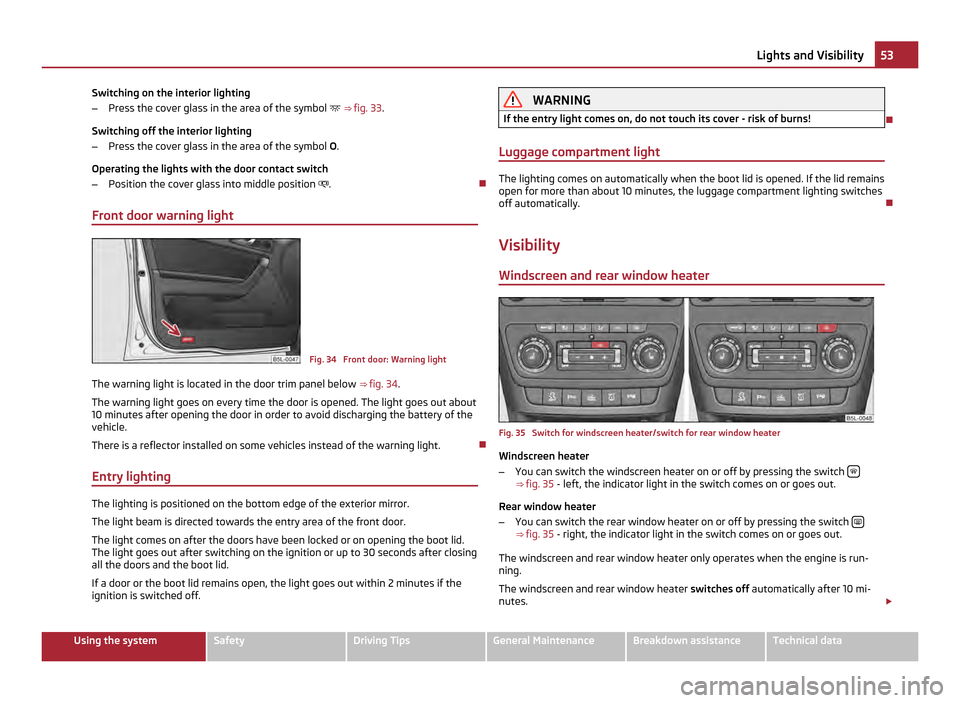
Visibility Windscreen and rear window heater Fig. 35 Switch for windscreen heater/switch for rear window heater
Windscreen heater
– You can switch the windscreen heater on or off by pressing the switch ⇒
fig. 35 - left, the indicator light in the switch comes on or goes out.
Rear window heater
– You can switch the rear window heater on or off by pressing the switch ⇒
fig. 35 - right, the indicator light in the switch comes on or goes out.
The windscreen and rear window heater only operates when the engine is run-
ning.
The windscreen and rear window heater switches off automatically after 10
mi-
nutes. £ 53
Lights and Visibility Using the system Safety Driving Tips General Maintenance Breakdown assistance Technical data
Page 60 of 252

–
With the other hand unlock the locking button 1 and remove the wiper blade
in the direction of arrow 2 .
Attaching the wiper blade
– Push the wiper blade until it locks up to the stop.
– Check whether the wiper blade is correctly attached.
– Fold the windscreen wiper arm back onto the windscreen.
The same remarks apply here as for ⇒ page 57.
Rear-view mirror Manual dimming interior rear-view mirror Basic setting
–
Pull the lever on the bottom edge of the mirror forward.
Dimming mirror
– Pull the lever on the bottom edge of the mirror back.
Automatic dimming interior mirror Fig. 40 Automatic dimming interior mir-
ror
Switching on the automatic dimming
– Press the button B
⇒ fig. 40 , the warning light A lights up.
Switching off the automatic dimming
– Press again the button B - the warning light goes out
A .If the automatic dimming is switched on, the mirror dims
automatically depending
on the light striking the mirror from the rear. The mirror has no lever on the bot-
tom edge of the mirror. After the reverse gear is engaged, the mirror always
moves back into the normal position.
Do not attach external navigation devices on the windshield or in the vicinity of
the automatic dimming interior mirror ⇒
.
WARNING
The display lighting of the external navigation device may cause malfunction
of the automatic dimming interior mirror – risk of accident. Note
● Automatic mirror dimming operates only properly if the light striking the rear
of the interior rear-view mirror is not affected by other objects.
● Do not affix any stickers in front of the light sensor, so that you do not impair
the automatic dimming function or put it out of operation.
● If you switch off the automatic dimming interior rear-view mirror, also the ex-
terior mirror dimming is switched off.
Exterior mirror You can adjust the exterior mirrors electrically.
Fig. 41 Inner part of door: Rotary knob
Adjust the rear mirror before commencing to drive so that there is a clear view to
the rear.
Heating of the external mirror
– Turn the rotary knob to position
⇒
fig. 41. £58
Lights and Visibility
Page 61 of 252

The exterior mirror heater only operates when the engine is running and up to an
outside temperature of +20 °C.
Adjusting left and right exterior mirrors simultaneously
– Turn the rotary knob to position . The movement of the mirror surface is iden-
tical to the movement of the rotary knob.
The adjustment of both mirrors simultaneously or each individual mirror is possi-
ble in the Information display ⇒
table on page 20 in the menu point Mirror adjust.
(Mirror adjust.).
Adjusting the right-hand exterior mirror
– Turn the rotary knob to position . The movement of the mirror surface is iden-
tical to the movement of the rotary knob.
Switching off operating control
– Turn the rotary knob to position .
Folding in both exterior mirrors
– Turn the rotary knob to position .
Fold in the exterior mirrors using the remote control key
– If all the windows are closed, press the unlock button 3 on the radio remote
control ⇒ fig. 17 for approx. 2 seconds.
Tilting surface of front passenger exterior mirror
On vehicles fitted with a memory for the driver seat, the surface of the mirror tilts
down slightly when the rear gear is engaged and the rotary knob is in the posi-
tion ⇒ fig. 41 . This provides an aid in seeing the kerb of the pavement when park-
ing the car.
The mirror returns into its initial position, after the rotary knob is moved out of the
position and put into another position or if the speed is more than 15 km/h.
Memory for exterior mirrors
On vehicles fitted with a memory for the driver seat, the relevant setting of the
exterior mirror is also stored automatically when the seat position is stored
⇒ page 63. WARNING
● Convex (curved outward) or a spherical exterior mirrors increase the vision
field. They do, however, make objects appear smaller in the mirror. These mir-
rors are only of limited use, therefore, for estimating distances to the follow-
ing vehicles.
● Use whenever possible the interior rear mirror, for estimating the distan-
ces to the following vehicles. Note
● If the exterior mirrors are folded in using the remote control of the vehicle key,
these are folded back into the driving position after opening the door or switching
on the ignition.
● If the exterior mirrors are folded in using the rotary knob ⇒
fig. 41, they can on-
ly be folded back into the driving position using the rotary knob.
● If the exterior mirrors were folded in using the remote control of the vehicle
key and if the rotary knob was in the fold-in position before switching on the igni-
tion, the mirrors remain in the fold-in position the next time the ignition is switch-
ed on. Folding back into the driving position is performed by actuating the rotary
knob in a different position from the fold-in position.
● Do not touch the surfaces of the exterior mirrors if the exterior mirror heater is
switched on.
● You can set the exterior mirrors by hand, if the power setting function fails at
any time, by pressing on the edge of the mirror surface.
● Contact your specialist garage if a fault exists with the power setting of the
exterior mirrors.
Automatic dimming exterior mirror on the driver's side The exterior mirror on the driver's side is dimmed together with the interior mirror.
If the automatic dimming is switched on, the mirror dims automatically depending
on the light striking the mirror from the rear.
When the interior lights are switched on or the reverse gear is engaged, the mirror
always moves back into the basic position (not dimmed). £ 59
Lights and Visibility Using the system Safety Driving Tips General Maintenance Breakdown assistance Technical data
Page 62 of 252

Note
● Automatic mirror dimming operates only properly if the light striking the rear
of the interior rear-view mirror is not affected by other objects.
● Do not affix any stickers in front of the light sensor, so that you do not impair
the automatic dimming function or put it out of operation.
● If you switch off the automatic dimming interior rear-view mirror, also the ex-
terior mirror dimming is switched off. 60
Lights and Visibility
Page 91 of 252

Set-up Setting of the control dial
Button
1 Air outlet vents 4
A B C
Defrosting the windscreen and side
windows To the right up to the
stop 3
Do not switch on Open and align with the side win-
dowFree windscreen and side windows
from mist
Desired temperature 2 or 3
Do not switch on Open and align with the side win-
dowThe fastest heating To the right up to the
stop 3
Briefly switched on Opening
Comfortable heating Desired temperature 2 or 3
Do not switch on Opening
Fresh air mode - ventilation To the left up to the
stop Desired position
Do not switch on Opening
Note
● Controls A ,
B ,
C and the button
1 ⇒ fig. 90
.
● Air outlet vents 4 ⇒ fig. 88 .
● We recommend that you leave the air outlet vents 3 ⇒ fig. 88
in the opened
position.
Recirculated air mode In recirculated air mode air is sucked out of the interior of the vehi-
cle and then fed back into the interior.
Recirculated air mode prevents polluted air outside the vehicle from getting into
the vehicle, for example when driving through a tunnel or when standing in a traf-
fic jam.
Switching recirculated air mode on
– Press the button - the warning light lights up in the button
⇒ fig. 90 .
Switching recirculated air mode off
– Press again the button - the warning light in the button goes out.
The recirculated air mode is switched off automatically if the air distribution con-
trol C is in position
⇒
fig. 90 . You can also switch recirculated air mode on
again from this setting by repeatedly pressing pushbutton . WARNING
You should not leave recirculated air mode on over a longer period of time, as
“stale
” air may result in fatigue in the driver and occupants, divert your atten-
tion and also cause the windows to mist up. The risk of having an accident in-
creases. Switch recirculated air mode off as soon as the windows begin mist-
ing up.
Air conditioning system (manual air conditioning
system) Description The air conditioning system is a combined cooling and heating sys-
tem. It makes it possible to optimally control the air temperature at
any season of the year.
Description of the air conditioning system
It is important for your safety and for your driving comfort that the air conditioning
system is operating properly. £ 89
Heating and air conditioning system Using the system Safety Driving Tips General Maintenance Breakdown assistance Technical data