2011 SKODA SUPERB coolant
[x] Cancel search: coolantPage 194 of 252

ReplenishingRead and observe
and on page 189 first.
›
Check the oil level » page 190.
›
Unscrew the cap of the engine oil filler opening » Fig. 164 on page 188 .
›
Replenish the oil in portions of 0.5 litres in accordance with the correct speci-
fications » page 189 .
›
Check the oil level » page 190.
›
Carefully screw on the oil filler opening cap and push the dipstick in fully.
Coolant
Introduction
This chapter contains information on the following subjects:
Capacity
191
Checking the coolant level
192
Replenishing
192
The coolant consists of water with coolant additive. This mixture guarantees
antifreeze protection, protects the cooling/heater system against corrosion
and prevents lime formation.
Vehicles exported to countries with a mild climate are already factory-filled
with a coolant which offers antifreeze protection down to about -25 ℃. In
these countries, the concentration of coolant additive should be at least 40%.
Vehicles exported to countries with a cold climate are already factory-filled
with a coolant which offers antifreeze protection down to about -35 °C. In
these countries, the concentration of coolant additive should be at least 50%.
If a higher concentration of antifreeze is required for climatic reasons, the con-
centration of coolant additive can be increased up to a maximum of 60% (anti-
freeze protection down to approx. -40 °C).
When refilling, only use the same antifreeze identified on the coolant expan-
sion vessel » Fig. 167 on page 192 .
WARNINGThe engine compartment of your car is a hazardous area. The following
warning instructions must be followed at all times when working in the en- gine compartment » page 186.
CAUTION
■
Do not continue if for some reason it is not possible to fill with coolant un-
der the current circumstances! Switch off the engine and seek assistance from
a specialist garage.■
If the expansion tank is empty, do not top up with coolant. The system could
ventilate - there is a risk of engine damage,
do not continue driving! Switch
off the engine and seek assistance from a specialist garage.
■
The concentration of coolant additive in the coolant must never be under
40%.
■
Over 60% of coolant additive in the coolant reduces the antifreeze protec-
tion and cooling effect.
■
A coolant additive that does not comply with the correct specifications can
significantly reduce the corrosion protection.
■
Any faults resulting from corrosion may cause a loss of coolant and can con-
sequently result in major engine damage!
■
Do not fill the coolant above the mark
A
» Fig. 167 on page 192 .
■
If a fault causes the engine to overheat, we recommend visiting a specialist
garage, as otherwise serious engine damage may occur.
■
Additional headlights and other attached components in front of the air inlet
impair the cooling efficiency of the coolant.
■
Never cover the radiator - there is a risk of the engine overheating.
Capacity
Read and observe
and on page 191 first.
Coolant capacity (in litres) 1)
Petrol enginesCapacity1.4 l/92 kW TSI7.71.8 l/112 kW TSI
1.8 l/118 kW TSI8.6 1)
The coolant capacity is approximately 1 Litre greater on vehicles that are fitted with an auxiliary heater
(auxiliary heating and ventilation).
191Inspecting and replenishing
Page 195 of 252
Petrol enginesCapacity2.0 l/147 kW TSI8.63.6 l/191 kW FSI9.0Diesel enginesCapacity1.6 l/77 kW TDI CR8.42.0 l/103 kW TDI CR8.42.0 l/125 kW TDI CR8.4
Checking the coolant level
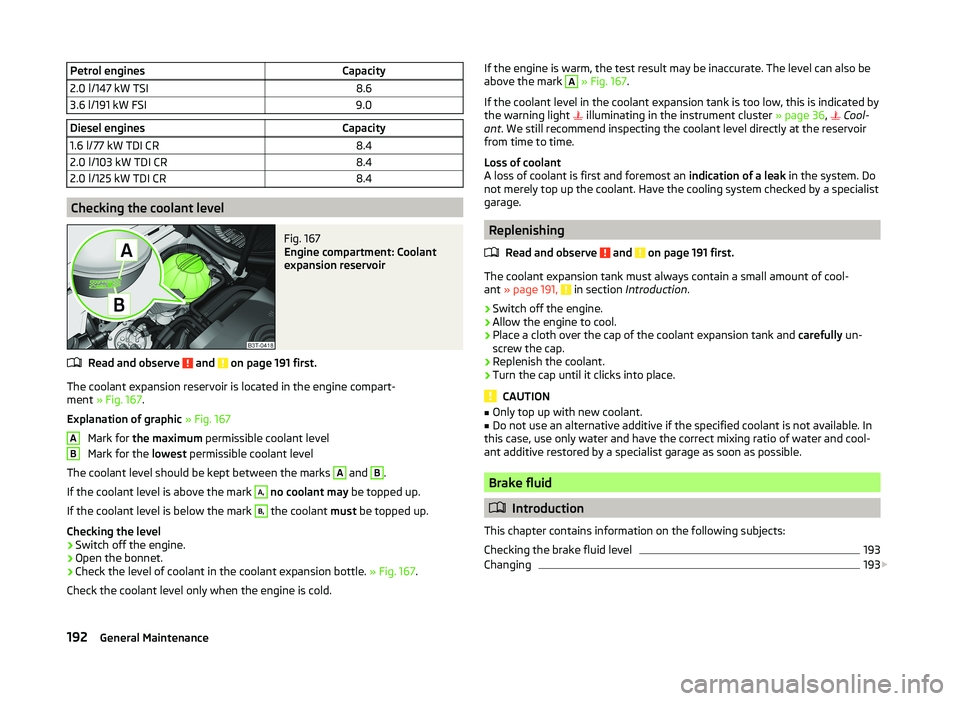
Fig. 167
Engine compartment: Coolant
expansion reservoir
Read and observe and on page 191 first.
The coolant expansion reservoir is located in the engine compart-
ment » Fig. 167 .
Explanation of graphic » Fig. 167
Mark for the maximum permissible coolant level
Mark for the lowest permissible coolant level
The coolant level should be kept between the marks
A
and
B
.
If the coolant level is above the mark
A,
no coolant may be topped up.
If the coolant level is below the mark
B,
the coolant must be topped up.
Checking the level
›
Switch off the engine.
›
Open the bonnet.
›
Check the level of coolant in the coolant expansion bottle. » Fig. 167.
Check the coolant level only when the engine is cold.
ABIf the engine is warm, the test result may be inaccurate. The level can also be
above the mark A » Fig. 167 .
If the coolant level in the coolant expansion tank is too low, this is indicated by
the warning light
illuminating in the instrument cluster » page 36,
Cool-
ant . We still recommend inspecting the coolant level directly at the reservoir
from time to time.
Loss of coolant
A loss of coolant is first and foremost an indication of a leak in the system. Do
not merely top up the coolant. Have the cooling system checked by a specialist
garage.
Replenishing
Read and observe
and on page 191 first.
The coolant expansion tank must always contain a small amount of cool-
ant » page 191, in section Introduction .
›
Switch off the engine.
›
Allow the engine to cool.
›
Place a cloth over the cap of the coolant expansion tank and carefully un-
screw the cap.
›
Replenish the coolant.
›
Turn the cap until it clicks into place.
CAUTION
■ Only top up with new coolant.■Do not use an alternative additive if the specified coolant is not available. In
this case, use only water and have the correct mixing ratio of water and cool-
ant additive restored by a specialist garage as soon as possible.
Brake fluid
Introduction
This chapter contains information on the following subjects:
Checking the brake fluid level
193
Changing
193
192General Maintenance
Page 225 of 252

Fuses in the engine compartmentFig. 200
Cover for the fuse box in the en-
gine compartment
Read and observe and on page 220 first.
On some vehicles, the battery cover must be removed before removing the
cover for the fuse box » page 195.
Replacing fuses
›
Move the safety catch of the cover of the fuse box
A
» Fig. 200 in the direc-
tion of the arrow.
The symbol is displayed behind the catches. .
›
Remove the cover.
›
Replace the appropriate fuse.
›
Place the cover on top of the fuse box.
›
Turn the securing bracket
A
in opposite direction of the arrow.
The symbol is displayed behind the catches .
The cover is locked into position.
CAUTION
The cover for the fuse box in the engine compartment must always be applied
correctly. Water may get into the fuse box if the cover is not replaced properly
- there is a risk of damage to the vehicle!Assignment of fuses in the engine compartmentFig. 201
Fuses: Type A / Type B
Read and observe
and on page 220 first.
Fuse assignment in the engine compartment - version A
No.Consumer1Front right main headlight, right tail light2Valves for ABS3-4Not assigned5Horn6-12Not assigned13Control unit for automatic gearbox14Not assigned15Coolant pump16Not assigned17Instrument cluster, windscreen wiper lever, and turn signal lever18Audio amplifier (sound system)19Radio20 - 22Not assigned23Engine control unit24Data bus control unit25 - 26Not assigned27Fuel dosage valve28Engine control unit 222Do-it-yourself
Page 226 of 252

No.Consumer29Main relay30Auxiliary heating and ventilation control unit31Windscreen wipers32 - 37Not assigned38Radiator fan, valves39Clutch/brake pad sensor40Lambda probe41AKF valve42Lambda probe43Ignition44 - 46Not assigned47Front left main headlight, left tail light48Pump for ABS49Power supply for terminal 15 (ignition on)50 - 51Not assigned52Power supply relay - terminal Xa)53Power to the internal fuse carrier54Not assigneda)
In order not to drain the battery unnecessarily when starting the engine, the electrical components of
this terminal are automatically switched off.
Fuse assignment in the engine compartment - version B
No.Consumer1Not assigned2Control unit for automatic gearbox DSG3Measuring circuit4Valves for ABS5Control unit for automatic gearbox DSG6Not assigned7Power supply relay - terminal X a)8Radio9Not assigned10Engine control unit, Main relayNo.Consumer11Auxiliary heating and ventilation control unit12Data bus control unit13Engine control unit14Ignition15Lambda probe (petrol engine), glow plug system relay and fuel
pump (diesel engine)16Front right main headlight, right tail light17Horn18Audio amplifier (sound system)19Windscreen wipers20Valve for metering fuel, coolant pump, high-pressure pump21Lambda probe22Clutch pedal switch23Coil of the coolant pump relay valves, high-pressure pump24Radiator fan25Pump for ABS26Front left main headlight, left tail light27Control unit for glow plug system28Windscreen heater29Power to the internal fuse carrier30Power supply for terminal 15 (ignition on)a)
In order not to drain the battery unnecessarily when starting the engine, the electrical components of
this terminal are automatically switched off.
Replacing bulbs
Introduction
This chapter contains information on the following subjects:
Headlights
224
Replacing the low beam bulb
224
Replacing bulb for main beam and daytime running lights
225
Replacing bulb for main beam
225
Replacing the bulb for the fog light
225
223Fuses and light bulbs
Page 240 of 252

BootAutomatic retraction (Superb Combi)101
Extending variable loading floor105
Folding hook99
Non-closable side pocket (Superb Combi)102
Removable Light (Superb Combi)103
Roll up boot cover (Superb Combi)101
Side compartment with battery102
Boot cover (Superb Combi)101
Boot lid57
automatic locking58
Warning light36
(Superb Combi)58
Brake booster144
Brake fluid192
Checking193
Information messages35
specification193
Brake linings warning light
41
Brakes Brake assist systems
154
Brake booster144
Brake fluid193
Handbrake144
Information messages35
Running in149
Warning light35
Braking Information on braking
143
Break recommendation See Fatigue detection
165
Button in the driver's door Electrical power windows
61
C
Car care
173
Jack180
Car computer See multifunction display
44
Car park ticket holder89
Carrier Roof rack
108
Cavity protection180
CD changer136
Central locking50
Central locking button55
Changing brake fluid
193
bulbs223
Wheels205
Changing a wheel Follow-up work
206
Preliminary work206
Remove and attaching a wheel206
Changing brake fluid
193
Charging a vehicle battery196
Check Fit ball head properly
168
Checking Battery electrolyte level
195
Brake fluid193
Coolant192
Engine oil190
Oil level190
Windscreen washer fluid188
Checks Statutory checks
173
Children and safety22
Child safety Side airbag
24
Child safety lock55
Child seat Classification
25
ISOFIX25
on the front passenger seat23
TOP TETHER27
Use of child seats25
Use of ISOFIX child seats26
Chrome parts refer to Taking care of your vehicle178
Cigarette lighter91
Cleaning Alcantara
182
Covers of electrically heated seats182
Fabrics182
Headlight lenses179
Natural leather181
Plastic parts178
Synthetic leather182
Wheels180
Cleaning the vehicle Towing device
180
Cleaning vehicle176
Climatronic115
Air recirculation117
automatic mode116
Control elements115
Controlling blower118
Cooling system116
Defrosting windscreen118
Setting the temperature116
Clothes hook94
Cockpit 12-Volt power outlet
92
Ashtray91
Cigarette lighter91
General view29
Lighting73
Practical features88
Storage compartments88
Comfort control window
63
COMING HOME72
Compartments88
Components of the puncture repair kits209
Computer See multifunction display
44
237Index
Page 241 of 252

Convenience operationsliding / tilting roof65
sliding / tilting roof (Superb Estate)67
Convenience turn signal70
Coolant191
Checking192
Messages36
Replenishing192
Temperature gauge31
Warning light36
CORNER See Fog lights with CORNER function
71
Correct seated position9
Driver9
Front passenger10
Instructions11
Rear seats11
Counter for distance driven32
Cruise control system Activating/deactivating
161
Changing the stored speed162
Storing and maintaining speed162
Switching off temporarily162
Warning light41
Cruise Control System161
Cup holders90
D
DAY LIGHT see Daylight running lights
69
Daylight running lights69
De-icing the windscreen and rear window75
Deactivating an airbag21
Decorative films179
Delayed locking of the boot lid see boot lid
58
Diesel refer to Fuel
185
diesel - particulate filter39
Diesel fuel Operation in winter
185
Diesel particulate filter warning light
39
Digital Clock Time
32
Dipstick190
Display31
Compass points48
Coolant temperature31
Fuel supply32
Gear changes43
Service intervals48
Display a low temperature43
Display of the second speed33
Distance driven32
Door Child safety lock
55
Closing52
Emergency locking217
Emergency locking the driver's door216
Opening52
Warning light for open door36
Door open Warning light
36
Driver Steering Recommendation (DSR)155
Driving Abroad
153
Driving through water on streets152
Emissions229
Fuel consumption229
Driving economically Economical gear changing
149
Driving through water152
DSR155
DVD-preinstallation136
E
Economical and environmentally friendly driv- ing
149
Economical driving Ballast
151
Driving at full throttle150
Idling150
Looking ahead149
Regular maintenance151
Saving energy151
Short distances150
Tyre pressure150
EDL Operation
155
Electrical power windows63
Button in the driver's door61, 62
Button in the rear doors63
Operational faults64
Electric boot lid Force limit
59
Manual operation59
Electric luggage compartment lid Acoustic signals
61
Adjusting the top lid position61
Deleting the top lid position61
Malfunctions61
Operating59
Electric sliding/tilting roof64
Electronic Differential Lock (EDL)155
Electronic immobilizer139
Electronic Stability Control (ESC)154
Emergency Activation of the sliding/tilting roof
218
Changing a wheel205
Hazard warning light system72
jump-starting211
Jump-starting211
Locking the door without a locking cylinder217
Locking the driver's door216
238Index
Page 242 of 252

Selector lever-unlocking217
Sliding/tilting roof218
Start engine - KESSY142
Switching off the ignition –KESSY143
Towing the vehicle213
Towing the vehicle using the tow hitch214
tyre repair209
Unlocking the boot lid217
Unlocking the driver's door216
Emergency equipment Fire extinguisher
204
First-aid kit 204
Jack205
Vehicle tool kit205
Warning triangle204
Emissions229
Engine Running in
148
Engine compartment186
Brake fluid193
Coolant191
Overview188
Vehicle battery193
Engine number228
Engine oil189
Capacity189
Checking190
Note messages36
Replenishing191
Specifications189
Engine oil level Warning light
37
Engine oil pressure Warning light
36
Entry lighting75
Environment149
Environmental compatibility151
Environmentally friendly driving149
EPC Warning light
39
ESCFunction154
Warning light37
Exhaust inspection system Warning light
38
Extendable variable loading floor Fixing set
106
Extending variable loading floor105
Divide boot105
Movable lashing eyes107
Partial extension105
F
Fastening elements
99
Fatigue detection165
Function165
Information messages165
Films179
Fire extinguisher204
First-aid kit 204
Floor covering Fixing
100
Fog lights71
Warning light41
Fog lights with CORNER function71
Folding hook99
Fold in passenger's mirror80
Footmats145
see Footmats145
Force limit Electric boot lid (Superb Combi)
59
Power windows63
Sliding/tilting roof64
Sliding/tilting roof (Superb Combi)66
Front airbag17
Front door warning light74
Front interior light73
Fuel183
Diesel185
Fuel gauge32
refer to Fuel183
Refuelling184
Unleaded petrol184
Fuel consumption149, 229
Fuel reserve Warning light
39
Fuses Assignment
220
Colour coding220
Fuse assignment in the engine compartment222
Replacing220
G
Gearbox Warning messages
33
Gear change Gear recommendation
43
Information on the selected gear43
Gear changing Gear stick
144
General view Cockpit
29
Generator Indicator light
35
Genuine parts174
Glasses storage box93
Glow plug system Warning light
38
GSM124, 126
H
Handbrake
144
Warning light35
Hands-free system Voice control
131
Hazard warning light system72
239Index
Page 245 of 252

Park Assistautomatic emergency braking160
Operation158
Parking Park assist
157
Parking aid156
Parking aid156
Function157
Parking light68
Part replacement173
Passive safety Before setting off
8
Driving safety8
Safety equipment8
Passive Safety8
Payload229
Pedals145
Footmats145
Petrol refer to Fuel
184
Polishing the paintwork See Taking care of your vehicle
178
Power outlet 12 V
92
Power Steering / steering lock (KESSY system) warning light
36
Power windows Button in the front passenger door
63
Practical features88
12 Volt power outlet92
Ashtray91
Car park ticket holder89
Cigarette lighter91
Clothes hook94
Cup holders90
Glasses storage box93
Removable ski bag97
Seat backrest with long cargo channel96
Storage compartment for umbrella95
Storage compartment in rear centre console95
Storage compartment in the front centre con- sole90
Storage compartment on passenger side94
Storage compartment on the driver's side89
Storage compartments in the doors90
Storage compartment under passenger seat94
Storage compartment under the front armrest 92
Storage net in front centre console
93
Storage pockets on the front seats95
Puncture set209
R
Radiator fan
188
Radio4
Radio reception See windows
179
Radio remote control Auxiliary heating
120
Raise vehicle207
Rear-view mirror Exterior mirrors
80
Fold in passenger mirror80
Synchronous adjustment of the rear-view mir- ror
80
Rear fog light71
Warning light38
Rear interior light74
Rear mirror79
Interior mirror79
Rear seats Seat folded forward Combi
88
Rear window - heater75
Recirculated air mode Manual air conditioning
114
Refuelling184
Fuel184
Remote control Locking
52
Replacing the battery215
Synchronisation process215
Unlocking52
Remote control key Replacing the battery
215
Removable lights (Superb Combi) Changing rechargeable light batteries
103
Removable Light (Superb Combi) Remove light
103
Removable ski bag97
Removable variable loading floor Fit and remove
106
Repairs and technical alterations173
Replacing Bulb for main beam
225
Bulb for main beam and daytime running lights 225
Bulb for the fog light
225
Bulb for the licence plate light226
Bulb in rear light (Superb Combi)227
Fuses220
Fuses in the dash panel220
Fuses in the engine compartment222
Low beam bulb224
Vehicle battery196
Wiper blades219
Replenishing Coolant
192
Engine oil191
Windscreen washer fluid188
Revolution counter31
Roof luggage rack Attachment points
109
Roof rack108
Roof rack system Roof load
109
Running in Brake pads
149
Engine148
The first 1,500 km148
Tyres149
242Index