2011 SKODA ROOMSTER height
[x] Cancel search: heightPage 124 of 212
Child seats in which the child is facing with its back towards the direction of
travel should not be used on the front passenger seat when the vehicle is fitted
with a front passenger airbag
⇒
page 119, Use of child safety seats on the front
passenger seat. WARNING
● It is essential to always switch off the front passenger front airbag at a
specialist garage or with the switch for front passenger airbag when attaching
in exceptional circumstances a child safety seat on the front passenger seat
where the child is seated with its back facing in direction of travel ⇒
page 117.
● Please comply with any differing national legal regulations regarding the
use of child safety seats.
● If this is not done, a child seated on the front passenger seat may suffer
severe or even fatal injuries if the front passenger airbag or airbags are de-
ployed.
● You should have the front passenger airbag (or airbags) reactivated just as
soon as you no longer use a child safety seat on the front passenger seat.
Child safety seats in Group 2 Fig. 109 Child seat in Group 2 installed
on the rear seat facing the direction of
travel
For children up to about 7 years of age weighing between 15 and 25 kg the opti-
mal solution is a child safety seat in combination with the three-point seat belt
⇒ fig. 109 . WARNING
● When transporting a child on the front passenger seat, please comply with
the appropriate national regulations regarding the use of child safety seats.
Switch off the front passenger airbag if necessary at a specialist garage or
switch it off with the switch for front passenger airbag ⇒
page 117.
● The shoulder part of the seat belt must run approximately across the mid-
dle of the shoulder and fit snugly against the chest. It must on no account run
across the neck. The lap part of the seat belt must run across the pelvis and
fits snugly; it must not run over the belly. Tighten the belt webbing over your
hip if necessary.
● Please comply with any differing national legal regulations regarding the
use of child safety seats.
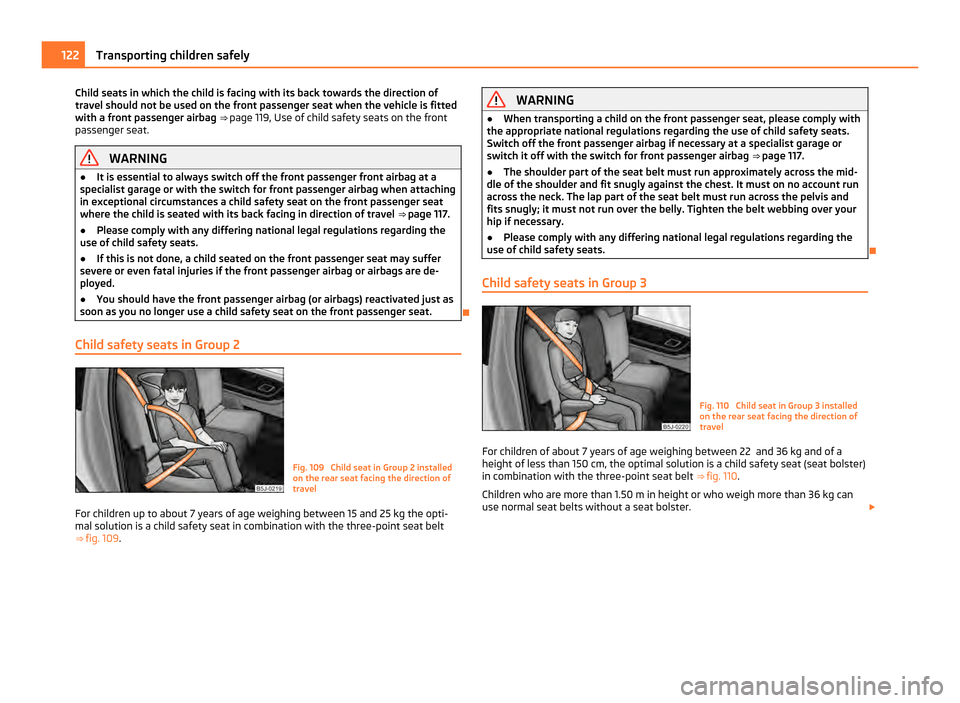
Child safety seats in Group 3 Fig. 110 Child seat in Group 3 installed
on the rear seat facing the direction of
travel
For children of about 7 years of age weighing between 22 and 36 kg and of a
height of less than 150
cm, the optimal solution is a child safety seat (seat bolster)
in combination with the three-point seat belt ⇒ fig. 110 .
Children who are more than 1.50 m in height or who weigh more than 36 kg can
use normal seat belts without a seat bolster. £122
Transporting children safely
Page 141 of 212

Towing a trailer
Towing a trailer
Technical requirements Your vehicle is designed primarily for transporting persons and luggage. It can,
however, also be used for towing a trailer - provided certain technical equipment
is fitted.
If your vehicle has been
factory-fitted with a towing device or has a towing device
from
ŠKODA Original Accessories, the towing device satisfies all technical and le-
gal requirements.
Your vehicle is fitted with a 13-pin power socket for the electrical connection be-
tween the vehicle and trailer. If the trailer which you wish to tow has a 7-pin con-
nector , you can use a suitable adapter from ŠKODA Original Accessories.
This work must be carried out in accordance with the manufacturer's specifica-
tions if a towing device is retrofitted.
Authorised ŠKODA Service Partners can provide detailed information about retro-
fitting a towing device and for any necessary modifications to the cooling system. WARNING
We recommend that you have the towing device from ŠKODA Original Acces-
sories installed by an authorised
ŠKODA Service Partner. He is familiar with all
the relevant details relating to retrofitting such equipment. There is a risk of
an accident if the towing device is not properly fitted!
General Maintenance Trailer load
The permissible trailer load must on no account be exceeded.
You can negotiate appropriately steeper inclines and descents if you do not make
full use of the permissible trailer load.
The trailer loads specified only apply for
altitudes up to 1000 metres above mean
sea level. The fact that the engine power output drops with increasing height due
to a lowering of air pressure and thus the ability to climb, means that the towed
weight must be reduced by 10 % for every further increase of 1 000 metres in height above sea level. The towed weight is the weight of the (laden) vehicle and
the (laden) trailer together. One should take this into account before driving up to
higher altitudes.
The trailer and drawbar load information on the type plate of the towing device
are merely test data for the towing device The data relating to your vehicle,
which is often less than this test data, can be found in your vehicle registration
documents.
Distribution of the load
Distribute the load in the trailer in such a way that any heavy items are located as
close as possible to the axle. Secure the items to prevent them slipping.
Tyre pressure
Correct the tyre inflation pressure on your vehicle for that of
“fully laden”
⇒ page 161. The inflation pressure of the tyres fitted to the trailer adjust in ac-
cordance with the manufacturer's recommendation.
Exterior mirrors
You have to have additional exterior mirrors fitted if you are not able to see the
traffic behind the trailer with the standard rear-view mirrors. Both exterior mirrors
should be attached to folding arms. Adjust the mirrors so that they provide you
with an adequate field of view to the rear.
Headlights
Before starting off with a hitched trailer, also check the setting of the headlights.
Alter the setting as necessary with the aid of the headlight beam adjuster
⇒ page 42.
Detachable ball head
The ball head is detachable on vehicles with towing device and can be obtained
from ŠKODA Original Accessories. It is stowed together with separate fitting in-
structions in the spare wheel well in the luggage compartment of the vehicle. Note
● We recommend that you also have your vehicle inspected between service in-
tervals if you tow a trailer frequently.
● The handbrake on the towing vehicle must be put on when coupling and de-
coupling the trailer. 139
Towing a trailer Using the system Safety Driving Tips General Maintenance Breakdown assis-
tance Praktik Technical data
Page 152 of 212

Inspecting and Replenishing
Engine compartment
Bonnet remote release Fig. 121 Bonnet release lever
Bonnet remote release
– Pull the unlocking lever below the dash panel on the left-hand side ⇒ fig. 121.
The bonnet jumps out of its lock as a result of the spring force.
Opening and closing the bonnet. Fig. 122 Radiator grille: Locking lever/securing the bonnet with the bonnet support
Opening the bonnet
–
Unlock the bonnet ⇒
fig. 121. –
Ensure that the arms of the windshield wipers are correctly in place against
the windshield before opening the bonnet, otherwise damage could occur to
the paintwork.
– Pull on the locking lever ⇒ fig. 122 - left, the bonnet is then unlocked.
– Grip the bonnet and lift it up.
– Take the bonnet support out of its holder and set it in the opening designed
for it ⇒ fig. 122 - right.
Closing the bonnet
– Lift the bonnet slightly and unhook the bonnet support. Press the bonnet sup-
port into the holder designed to hold it.
– Allow the bonnet to drop from a height of about 20 cm into the lock - bonnet
do not press down on it! WARNING
● Never open the bonnet if you see that steam or coolant is flowing out of
the engine compartment - risk of scalding! Wait long enough until the steam
or coolant has stopped escaping.
● For safety reasons, the bonnet must always be properly closed when driv-
ing. One should therefore check that the lock has in fact engaged properly af-
ter closing the bonnet.
● Stop your vehicle immediately while driving if you notice that the lock is
not properly engaged and close the bonnet properly - risk of an accident!
Working in the engine compartment Particular care is required when carrying out any work in the en-
gine compartment!
There is a risk of injuries, scalding, accidents and fire when working in the en-
gine compartment, e.g. inspecting and replenishing oil and other fluids. For this
reason, it is essential to comply with the warning instructions stated below and
with the general applicable rules of safety. The engine compartment of your car
is a hazardous area ⇒
.
£150
Inspecting and Replenishing
Page 165 of 212

WARNING
● You must have your tyres replaced with new ones at the latest when the
wear indicators have been worn down. The legally permissible minimum tread
depth should be observed.
● Worn tyres do not provide the necessary adhesion to the road surface at
high speeds on wet roads. One could experience “ aquaplaning” (uncontrolled
movements of the vehicle - “swimming” on a wet road surface).
Changing wheels around If significantly greater wear is present on the front tyres, we recommend changing
the front wheels around with the rear wheels. You will then obtain approximately
the same life for all the tyres.
It may be advantageous to swap the tyres over
“crosswise” when uneven wear
characteristic arise on the running surfaces of the tyres (but not in the case of uni-
directional tyres). We recommend that you contact an authorised ŠKODA Service
Partner. They have extensive knowledge about the possible combinations.
We recommend that you change the wheels around every 10 000 km in order to
achieve even wear on all wheels and to obtain optimal tyre life.
New tyres and wheels Tyres and wheel rims are important design elements. One should therefore use
the tyres and wheel rims which have been released for use by
ŠKODA. They are
exactly matched to the vehicle type and therefore contribute significantly to good
road holding and safe driving characteristics ⇒ .
Only fit radial tyres of the same type on all 4 wheels, size (rolling circumference)
and, if possible, the same tread pattern on one axle.
Authorised
ŠKODA Service Partners have access to the most current information
about which tyres we have released for use on your vehicle.
We recommend that you have any work relating to tyres or wheels carried out by
an authorised ŠKODA Service Partner. Authorised ŠKODA Service Partners have all
of the necessary special tools and replacement parts available plus the required
specialist knowledge and are also in a position to properly dispose of the old tyres.
A large number of authorised ŠKODA Service Partners also have an attractive
range of tyres and wheels available. The tyre/wheel combinations which are approved for your vehicle are indicated in
your vehicle documents. Approval and licensing may differ according to the legis-
lation prevailing in individual countries.
Proper knowledge of the tyre data makes it easier for you to select the correct
type of tyre. Tyres do, for example, have the following inscription on their walls:
185/65 R 14 86 T
What this means is: 185 Tyre width in mm
65 Height/width ratio in %
R Code letter for the type of tyre -
Radial 14 Diameter of wheel in inches
86 Load index
T Speed symbol
The following speed restrictions apply to tyres.
Speed symbol Permissible maximum speed
Q 160 km/h
R 170 km/h
S 180 km/h
T 190 km/h
U 200 km/h
H 210 km/h
V 240 km/h
W 270 km/h
The date of manufacture
is also stated on the tyre wall (possibly only on the in-
side of wheel).
DOT ... 20 11...
means, for example, that the tyre was manufactured in the 20th week of the year
20011.
Any spare wheel which differs from the tyres fitted to the vehicle (e.g. winter
tyres or low-profile tyres) should only be used only for a short time in the event of
a puncture and when adopting an appropriately cautious style of driving. It should
be replaced as quickly as possible by a normal wheel. £ 163
Wheels and Tyres Using the system Safety Driving Tips General Maintenance Breakdown assis-
tance Praktik Technical data
Page 195 of 212

Dimensions
Dimensions (mm)
ROOMSTER PRAKTIK SCOUT
Length 4214 4213 4240
Width 1684 1684 1695
Width including exterior mirror 1882 1882 1882
Height 1607 1607 1650
Clearance 140 140 141
Wheel base 2620 2620 2620
Track gauge front/rear 1436/1500
(1420/1484) a) 1436/1500
(1420/1484) a) 1427/1494
a)
Valid for vehicles, which have factory-fitted 15" wheels. 193
Technical data Using the system Safety Driving Tips General Maintenance Breakdown assis-
tance Praktik Technical data
Page 208 of 212

Parking aid . . . . . . . . . . . . . . . . . . . . . . . . . . . . . . . . . . . 82
Parking light . . . . . . . . . . . . . . . . . . . . . . . . . . . . . . . . . 43
Parking ticket holder . . . . . . . . . . . . . . . . . . . . . . . . . . 63
Passive Safety . . . . . . . . . . . . . . . . . . . . . . . . . . . . . . . . 101
Payload . . . . . . . . . . . . . . . . . . . . . . . . . . . . . . . . . . . . . . 191
Pedals . . . . . . . . . . . . . . . . . . . . . . . . . . . . . . . . . . . . 55, 81
Petrol . . . . . . . . . . . . . . . . . . . . . . . . . . . . . . . . . . . . . . . 147
Petrol engines Starting the engine . . . . . . . . . . . . . . . . . . . . . . . . . 80
Polishing . . . . . . . . . . . . . . . . . . . . . . . . . . . . . . . . . . . . 143
Power socket . . . . . . . . . . . . . . . . . . . . . . . . . . . . . . . . . 64
Power steering . . . . . . . . . . . . . . . . . . . . . . . . . . . . . . 129 Warning light . . . . . . . . . . . . . . . . . . . . . . . . . . . . . . . . 22
Power windows . . . . . . . . . . . . . . . . . . . . . . . . . . . . . . . 36 Central locking system . . . . . . . . . . . . . . . . . . . . . . . 37
Operational faults . . . . . . . . . . . . . . . . . . . . . . . . . . . 38
R
Radiator fan . . . . . . . . . . . . . . . . . . . . . . . . . . . . . . . . . 155
Raise vehicle . . . . . . . . . . . . . . . . . . . . . . . . . . . . . . . . . 171
Range . . . . . . . . . . . . . . . . . . . . . . . . . . . . . . . . . . . . . . . . 16
Rear-view mirror Interior mirror . . . . . . . . . . . . . . . . . . . . . . . . . . . . . . . 48
Rear armrest . . . . . . . . . . . . . . . . . . . . . . . . . . . . . . . . . 54
Rear fog light . . . . . . . . . . . . . . . . . . . . . . . . . . . . . . . . . 41 Warning light . . . . . . . . . . . . . . . . . . . . . . . . . . . . . . . . 21
Rear mirror . . . . . . . . . . . . . . . . . . . . . . . . . . . . . . . . . . . 48
Rear seats . . . . . . . . . . . . . . . . . . . . . . . . . . . . . . . . . . . . 52
Rear window heater . . . . . . . . . . . . . . . . . . . . . . . . . . . 45
Recharge battery . . . . . . . . . . . . . . . . . . . . . . . . . . . . 159
Recommendation for changing gears . . . . . . . . . . . 13
Refuelling . . . . . . . . . . . . . . . . . . . . . . . . . . . . . . . . . . . 148
Remote control . . . . . . . . . . . . . . . . . . . . . . . . . . . . . . . 34 Synchronisation . . . . . . . . . . . . . . . . . . . . . . . . . . . . . . 35
Removing seats . . . . . . . . . . . . . . . . . . . . . . . . . . . . . . . 53
Replacement of parts . . . . . . . . . . . . . . . . . . . . . . . . 166
Replacing bulbs . . . . . . . . . . . . . . . . . . . . . . . . . . . . . . 183
Replacing fuses . . . . . . . . . . . . . . . . . . . . . . . . . . . . . . 179 Replacing the wiper blades . . . . . . . . . . . . . . . . . . . . 47
Roof aerial
. . . . . . . . . . . . . . . . . . . . . . . . . . . . . . . . . . 142
Roof luggage rack system . . . . . . . . . . . . . . . . . . . . . 62
Running in the vehicle . . . . . . . . . . . . . . . . . . . . . . . . 132
S
Safe securing . . . . . . . . . . . . . . . . . . . . . . . . . . . . . . . . . 30
Safety . . . . . . . . . . . . . . . . . . . . . . . . . . . . . . . . . . . . . . . 101
Safety information Engine compartment . . . . . . . . . . . . . . . . . . . . . . . . 150
Saving electrical energy . . . . . . . . . . . . . . . . . . . . . . 133
Seat belt height adjuster . . . . . . . . . . . . . . . . . . . . . 107
Seat belts . . . . . . . . . . . . . . . . . . . . . . . . . . . . . . . . . . . 105 Cleaning . . . . . . . . . . . . . . . . . . . . . . . . . . . . . . . . . . . . 146
fastening . . . . . . . . . . . . . . . . . . . . . . . . . . . . . . . . . . . 107
Height adjustment . . . . . . . . . . . . . . . . . . . . . . . . . . 107
Safety information . . . . . . . . . . . . . . . . . . . . . . . . . 106
taking off . . . . . . . . . . . . . . . . . . . . . . . . . . . . . . . . . . 108
Warning light . . . . . . . . . . . . . . . . . . . . . . . . . . . . . . . . 27
Seat belt warning light . . . . . . . . . . . . . . . . . . . . . . . 107
Seats . . . . . . . . . . . . . . . . . . . . . . . . . . . . . . . . . . . . . . . . 50 Heating . . . . . . . . . . . . . . . . . . . . . . . . . . . . . . . . . . . . . 51
Selector lever . . . . . . . . . . . . . . . . . . . . . . . . . . . . . . . . . 89
Selector lever-emergency unlocking . . . . . . . . . . . . 91
Selector lever lock Indicator light . . . . . . . . . . . . . . . . . . . . . . . . . . . . . . . . 25
Selector lever positions . . . . . . . . . . . . . . . . . . . . . . . . 89
Service reminder indicator . . . . . . . . . . . . . . . . . . . . . 12
Setting temperature Air conditioning system . . . . . . . . . . . . . . . . . . . . . . . 72
Heating . . . . . . . . . . . . . . . . . . . . . . . . . . . . . . . . . . . . 70
Setting the clock . . . . . . . . . . . . . . . . . . . . . . . . . . . . . . 13
Shifting . . . . . . . . . . . . . . . . . . . . . . . . . . . . . . . . . . . . . . 81
Side airbag . . . . . . . . . . . . . . . . . . . . . . . . . . . . . . . . . . . 113
Side lights . . . . . . . . . . . . . . . . . . . . . . . . . . . . . . . . . . . . 39
Snow chains . . . . . . . . . . . . . . . . . . . . . . . . . . . . . . . . . 165
Spare wheel . . . . . . . . . . . . . . . . . . . . . . . . . . . . . . . . . 168
Speedometer . . . . . . . . . . . . . . . . . . . . . . . . . . . . . . . . . . 11
Stability system . . . . . . . . . . . . . . . . . . . . . . . . . . . . . . 125 Start-stop . . . . . . . . . . . . . . . . . . . . . . . . . . . . . . . . . . . . 85
Starting the engine
. . . . . . . . . . . . . . . . . . . . . . . . . . . 79
Diesel engines . . . . . . . . . . . . . . . . . . . . . . . . . . . . . . 80
Petrol engines . . . . . . . . . . . . . . . . . . . . . . . . . . . . . . 80
Static separation net . . . . . . . . . . . . . . . . . . . . . . . . . . 58
Steering force assistance . . . . . . . . . . . . . . . . . . . . . 129
Storage compartment Lighting . . . . . . . . . . . . . . . . . . . . . . . . . . . . . . . . . . . . 44
Storage compartments . . . . . . . . . . . . . . . . . . . . . . . . 64
Storage facilities . . . . . . . . . . . . . . . . . . . . . . . . . . . . . . 64
Sun visors . . . . . . . . . . . . . . . . . . . . . . . . . . . . . . . . . . . . 45
Switching off the engine . . . . . . . . . . . . . . . . . . . . . . 80
Switch off Anti-spin regulation (ASR) Warning light . . . . . . . . . . . . . . . . . . . . . . . . . . . . . . . . 24
Systems Start-stop . . . . . . . . . . . . . . . . . . . . . . . . . . . . . . . . . . 85
T Tailgate Lighting . . . . . . . . . . . . . . . . . . . . . . . . . . . . . . . . . . . . 44
Taking care of your vehicle . . . . . . . . . . . . . . . . . . . . . 141
TCS . . . . . . . . . . . . . . . . . . . . . . . . . . . . . . . . . . . . . . . . . 126 Warning light . . . . . . . . . . . . . . . . . . . . . . . . . . . . . . . . 25
Telephone . . . . . . . . . . . . . . . . . . . . . . . . . . . . . . . . . . . . 94
Temperature outside . . . . . . . . . . . . . . . . . . . . . . . . . . . . . . . . . . . . . . 15
The first 1 500 kilometres . . . . . . . . . . . . . . . . . . . . . 132
Tiptronic . . . . . . . . . . . . . . . . . . . . . . . . . . . . . . . . . . . . . 87
Tool . . . . . . . . . . . . . . . . . . . . . . . . . . . . . . . . . . . . . . . . 167
Top Tether . . . . . . . . . . . . . . . . . . . . . . . . . . . . . . . . . . 124
Tourist light . . . . . . . . . . . . . . . . . . . . . . . . . . . . . . . . . . 40
Towing . . . . . . . . . . . . . . . . . . . . . . . . . . . . . . . . . . . . . . 176
Towing a trailer . . . . . . . . . . . . . . . . . . . . . . . . . . . . . . 139
Towing eye front . . . . . . . . . . . . . . . . . . . . . . . . . . . . . . . . . . . . . . . 177
rear . . . . . . . . . . . . . . . . . . . . . . . . . . . . . . . . . . . . . . . . 178
Towing protection monitoring . . . . . . . . . . . . . . . . . . 36
Traction control system (TCS) . . . . . . . . . . . . . . . . . 126 Warning light . . . . . . . . . . . . . . . . . . . . . . . . . . . . . . . . 25206
Index