2011 SKODA OCTAVIA height
[x] Cancel search: heightPage 139 of 248

How are seat belts correctly fastened?
Fastening three-point seat belts Fasten your seat belt before starting!
Fig. 119 Routing of belt webbing over the shoulders and the lap belt/Routing of belt webbing
for an expectant mother
–
Correctly adjust the front seat and the head restraint before fastening your
seat belt ⇒
page 132, Correct seated position.
– Slowly pull the belt webbing at the tongue of the lock over your chest and pel-
vis ⇒ .
– Insert the tongue of the lock into the seat belt buckle belonging to the seat
until it is heard to lock in place.
– Pull on the seat belt to check that it has also reliably engaged in the lock.
Each three-point seat belt is equipped with an inertia reel. This inertia reel offers
you complete freedom of movement if the belt is unreeled slowly. If the brakes
are applied suddenly, the inertia reel will block. The belts also block when the car
accelerates, when driving downhill and when cornering.
Expectant mothers must also wear the seat belt ⇒ . WARNING
● The shoulder part of the seat belt must never run across your neck but
must run approximately over the middle of the shoulder and fit snugly against
the chest. The lap part of the belt must run across the hip and must never be
routed across the stomach. It must always fit snugly ⇒
fig. 119 - left. Adjust the
belt webbing as required.
● The lap part of the belt should be positioned as low as possible at the pel-
vis of an expectant mother in order to avoid exerting any pressure on the low-
er abdomen ⇒ fig. 119 - right.
● Always ensure that the webbing of the seat belts is properly routed. Seat
belts which are not correctly adjusted can themselves cause injuries even in
minor accidents.
● A seat belt which is hanging too loose can result in injuries as your body is
moved forward by the kinetic energy produced in an accident and is then sud-
denly held firm by the belt.
● Only insert the lock tongue into the lock which is the correct one for your
seat. This will affect the protection which the belt offers and increase the risk
of an injury.
Seat belt height adjuster on the front seats Fig. 120 Front seat: Seat belt height ad-
juster
The seat belt height adjuster makes it possible for you to adapt the routing of the
front three-point seat belt in the area of the shoulder to match your body size.
– Press and move the height adjuster in the desired direction up or down
⇒ fig. 120 .
– Then pull firmly on the belt to ensure that the seat belt height adjuster has
correctly locked in place. £ 137
Seat belts Using the system Safety Driving Tips General Maintenance Breakdown assistance Technical data
Page 140 of 248

WARNING
Adjust the height of the belt in such a way that the shoulder part of the belt is
positioned approximately across the middle of your shoulder - on no account
across your neck.
Taking seat belts off Fig. 121 Releasing lock tongue from belt
lock
– Press the red button in the belt lock ⇒ fig. 121. The spring force causes the
tongue of the lock to jump out.
– Guide the seat belt back with your hand to enable the inertia reel to wind up
the belt webbing more easily.
A plastic knob in the belt webbing holds the belt tongue in a position which is
easy to get hold of.
Belt tensioners Safety for the driver and front passenger
wearing their seat belts is enhanced by
the belt tensioners fitted to the inertia reels of the front three-point seat belts, in
addition to the protection afforded by the airbag system.
The three-point seat belts are automatically tensioned in the event of a frontal
collision of a certain severity. The belt tensioners can also be deployed if the seat
belts are not fastened.
The fastened three-point seat belts are automatically tensioned in the event of a
frontal or side collision of a certain severity. Belt tensioners are not activated in the event of minor frontal collisions, side and
rear-end collisions, in the case of a rollover and also not in accidents in which no
major forces are produced from the front. WARNING
● Any work on the system including removal and installation of system com-
ponents because of other repair work, must only be carried out by a specialist
garage.
● The protective function of the system is only adequate for a single acci-
dent. If the belt tensioners have been deployed, it is then necessary to replace
the entire system.
● The seller must pass on this Owner's manual to the buyer upon purchase
of the vehicle. Note
● Smoke is generated when the belt tensioners are deployed. This is not an indi-
cation of a fire in the vehicle.
● It is essential to pay attention to relevant safety regulations if the vehicle or
individual parts of the system are scrapped. Specialist garages are familiar with
these regulations and will be able to provide you with detailed information in this
respect.
● When disposing of vehicle or parts of the system, it is important to comply
with the national legal requirements. 138
Seat belts
Page 149 of 248

Transporting children safely
What you should know about transporting children! An introduction to the subject Accident statistics have revealed that children are generally more
safely transported on the rear seats than on the front passenger
seat.
Children who are less than 1.50 m in height and who weigh less than 36 kg should,
under normal circumstances, sit on the rear seat (take note of any national legal
provisions which differ from this). They should be secured there by means of a
child restraint system or by using the existing seat belts depending on their body
size and weight. The child seat should be mounted behind the front passenger
seat for safety reasons.
The physical principle of an accident does, of course, also apply to children
⇒
page 135, The physical principle of a frontal collision. They differ from adults in
that their muscles and bone structure of children are not yet fully developed. Thus
children are exposed to increased risk of injury.
Children should be transported by using special child safety seats in order to re-
duce this risk of injury.
Only use child safety seats which are officially approved, suitable for children and
which comply with the standard ECE-R 44, which classifies child safety seats into
5 groups ⇒ page 149, Classification of child seats into groups. Child restraint sys-
tems which have been tested for conformity to ECE-R 44 standard have a non-de-
tachable test seal (a large E within a circle and below this the test number) attach-
ed to the seat.
We recommend that you use child safety seats from the ŠKODA Original Accesso-
ries range. These child seats were developed and also tested for use in ŠKODA
vehicles. They fulfil the ECE-R 44 standard. WARNING
Always comply with national legal provisions and instructions from the rele-
vant child safety seat manufacturer when installing and using a child seat
⇒
page 147. Note
National legal provisions, which deviate from the information contained in these
operating instructions, take precedence over the information contained in the op-
erating instructions.
Important safety information regarding the use of child safety
seats Correct use of child safety seats considerably reduces the risk of in-
jury!
WARNING
● All the occupants of the car - in particular children - must wear a seat belt
when the car is moving.
● Children who are less than 1.50 m in height and who weigh less than 36 kg
must not use a normal seat belt without a child restraint system, otherwise
this may result in injuries to the stomach and neck areas. Comply with the na-
tional legal requirements.
● One should never carry children, and also not babies! - on one's lap.
● You can transport a child safely in a suitable child safety seat ⇒
page 149,
Child seat!
● Only one child may be fastened with a seat belt into a child safety seat.
● Never leave the child sitting unattended in the seat.
● Certain outside climatic conditions can cause life-threatening tempera-
tures in the vehicle.
● Never allow your child to be transported in a vehicle without the use of a
suitable restraint system.
● Children should also never stand up in a vehicle or kneel on the seats
when the vehicle is moving. In the event of an accident the child will be
thrown through the vehicle and may as a result suffer fatal injuries, and also
injure other occupants. £ 147
Transporting children safely Using the system Safety Driving Tips General Maintenance Breakdown assistance Technical data
Page 152 of 248
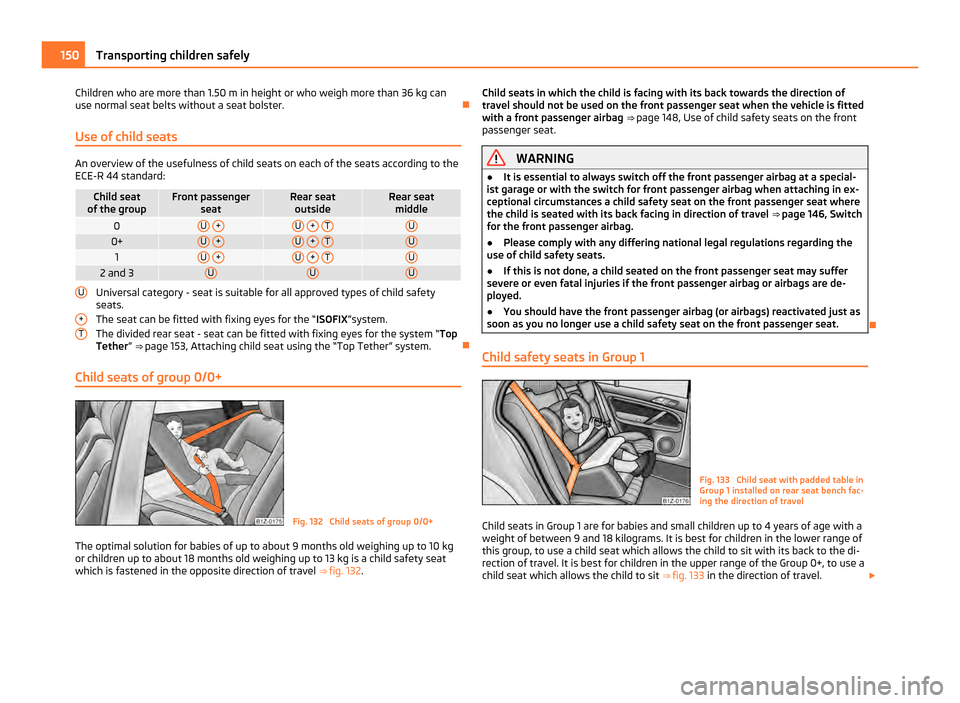
Children who are more than 1.50 m in height or who weigh more than 36 kg can
use normal seat belts without a seat bolster.
Use of child seats An overview of the usefulness of child seats on each of the seats according to the
ECE-R 44 standard: Child seat
of the group Front passenger
seat Rear seat
outside Rear seat
middle 0 U
+ U
+
T U
0+ U
+ U
+
T U
1 U
+ U
+
T U
2 and 3 U U U
Universal category - seat is suitable for all approved types of child safety
seats.
The seat can be fitted with fixing eyes for the
“ISOFIX ”system.
The divided rear seat - seat can be fitted with fixing eyes for the system “ Top
Tether” ⇒ page 153, Attaching child seat using the “Top Tether” system.
Child seats of group 0/0+ Fig. 132 Child seats of group 0/0+
The optimal solution for babies of up to about 9 months old weighing up to 10 kg
or children up to about 18 months old weighing up to 13 kg is a child safety seat
which is fastened in the opposite direction of travel ⇒
fig. 132.
U +
T Child seats in which the child is facing with its back towards the direction of
travel should not be used on the front passenger seat when the vehicle is fitted
with a front passenger airbag
⇒
page 148, Use of child safety seats on the front
passenger seat. WARNING
● It is essential to always switch off the front passenger airbag at a special-
ist garage or with the switch for front passenger airbag when attaching in ex-
ceptional circumstances a child safety seat on the front passenger seat where
the child is seated with its back facing in direction of travel ⇒
page 146, Switch
for the front passenger airbag.
● Please comply with any differing national legal regulations regarding the
use of child safety seats.
● If this is not done, a child seated on the front passenger seat may suffer
severe or even fatal injuries if the front passenger airbag or airbags are de-
ployed.
● You should have the front passenger airbag (or airbags) reactivated just as
soon as you no longer use a child safety seat on the front passenger seat.
Child safety seats in Group 1 Fig. 133 Child seat with padded table in
Group 1 installed on rear seat bench fac-
ing the direction of travel
Child seats in Group 1 are for babies and small children up to 4 years of age with a
weight of between 9 and 18 kilograms. It is best for children in the lower range of
this group, to use a child seat which allows the child to sit with its back to the di-
rection of travel. It is best for children in the upper range of the Group 0+, to use a
child seat which allows the child to sit ⇒ fig. 133 in the direction of travel. £150
Transporting children safely
Page 153 of 248

Child seats in which the child is facing with its back towards the direction of
travel should not be used on the front passenger seat when the vehicle is fitted
with a front passenger airbag
⇒
page 148, Use of child safety seats on the front
passenger seat. WARNING
● It is essential to always switch off the front passenger airbag at a special-
ist garage or with the switch for front passenger airbag when attaching in ex-
ceptional circumstances a child safety seat on the front passenger seat where
the child is seated with its back facing in direction of travel ⇒
page 146, Switch
for the front passenger airbag.
● Please comply with any differing national legal regulations regarding the
use of child safety seats.
● If this is not done, a child seated on the front passenger seat may suffer
severe or even fatal injuries if the front passenger airbag or airbags are de-
ployed.
● You should have the front passenger airbag (or airbags) reactivated just as
soon as you no longer use a child safety seat on the front passenger seat.
Child safety seats in Group 2 Fig. 134 Child seat in Group 2 installed
on the rear seat facing the direction of
travel
For children up to about 7 years of age weighing between 15 and 25 kg the opti-
mal solution is a child safety seat in combination with the three-point seat belt
⇒ fig. 134. WARNING
● When transporting a child on the front passenger seat, please comply with
the appropriate national regulations regarding the use of child safety seats.
Switch off the front passenger airbag if necessary at a specialist garage or
switch it off with the switch for front passenger airbag ⇒
page 146, Switch for
the front passenger airbag.
● The shoulder part of the seat belt must run approximately across the mid-
dle of the shoulder and fit snugly against the chest. It must on no account run
across the neck. The lap part of the seat belt must run across the pelvis and
fits snugly; it must not run over the belly. Tighten the belt webbing over your
hip if necessary.
● Please comply with any differing national legal regulations regarding the
use of child safety seats.
Child safety seats in Group 3 Fig. 135 Child seat in Group 3 installed
on the rear seat facing the direction of
travel
For children of about 7 years of age weighing between 22 and 36 kg and of a
height of less than 150
cm, the optimal solution is a child safety seat (seat bolster)
in combination with the three-point seat belt ⇒ fig. 135 .
Children who are more than 1.50 m in height or who weigh more than 36 kg can
use normal seat belts without a seat bolster. £ 151
Transporting children safely Using the system Safety Driving Tips General Maintenance Breakdown assistance Technical data
Page 170 of 248

Towing a trailer
Technical requirements Your vehicle is designed primarily for transporting persons and luggage. It can,
however, also be used for towing a trailer - provided certain technical equipment
is fitted.
If your vehicle has been
factory-fitted with a towing device or has a towing device
from ŠKODA Original Accessories, then the towing device satisfies all technical
and legal requirements.
Your vehicle is fitted with a 13-pin power socket for the electrical connection be-
tween the vehicle and trailer. If the trailer which you wish to tow has a 7-pin con-
nector, you can use a suitable adapter from
ŠKODA Original Accessories.
This work must be carried out in accordance with the manufacturer's specifica-
tions if a towing device is retrofitted.
Authorised ŠKODA Service Partners can provide detailed information about retro-
fitting a towing device and for any necessary modifications to the cooling system. WARNING
We recommend that you have the towing device from ŠKODA Original Acces-
sories installed by an authorised
ŠKODA Service Partner. He is familiar with all
the relevant details relating to retrofitting such equipment. There is a risk of
an accident if the towing device is not properly fitted!
General Maintenance Trailer load
The permissible trailer load must on no account be exceeded.
You can negotiate appropriately steeper inclines and descents if you do not make
full use of the permissible trailer load.
The trailer loads specified only apply for
altitudes up to 1000 metres above mean
sea level. The fact that the engine power output drops with increasing height due
to a lowering of air pressure and thus the ability to climb, means that the towed
weight must be reduced by 10 % for every further increase of 1 000 metres in height above sea level. The towed weight is the weight of the (laden) vehicle and
the (laden) trailer together. One should take this into account before driving up to
higher altitudes.
The trailer and drawbar load information on the type plate of the towing device
are merely test data for the towing device The data relating to your vehicle,
which is often less than this test data, can be found in your vehicle registration
documents.
Distribution of the load
Distribute the load in the trailer in such a way that any heavy items are located as
close as possible to the axle. Secure the items to prevent them slipping.
Tyre pressure
Correct the tyre inflation pressure on your vehicle for that of
“fully laden”
⇒ page 192. The inflation pressure of the tyres fitted to the trailer adjust in ac-
cordance with the manufacturer's recommendation.
Exterior mirrors
You have to have additional exterior mirrors fitted if you are not able to see the
traffic behind the trailer with the standard rear-view mirrors. Both exterior mirrors
should be attached to folding arms. Adjust the mirrors so that they provide you
with an adequate field of view to the rear.
Headlights
Before starting off with a hitched trailer, also check the setting of the headlights.
Alter the setting as necessary with the aid of the headlight beam adjuster
⇒ page 49.
Detachable ball head
The ball head is detachable on vehicles with towing device and can be obtained
from ŠKODA Original Accessories. It is stowed together with separate fitting in-
structions in the spare wheel well in the luggage compartment of the vehicle. Note
● We recommend that you also have your vehicle inspected between service in-
tervals if you tow a trailer frequently.
● The handbrake on the towing vehicle must be put on when coupling and de-
coupling the trailer. 168
Towing a trailer
Page 182 of 248

Inspecting and Replenishing
Engine compartment
Bonnet remote release Fig. 148 Bonnet release lever
Bonnet remote release
– Pull the unlocking lever below the dash panel on the driver's side ⇒ fig. 148 .
The bonnet jumps out of its lock as a result of the spring force. A locking lever ap-
pears at the same time in the radiator grille.
Opening and closing the bonnet. Fig. 149 Radiator grille: Locking lever/securing the bonnet with the bonnet support
Opening the bonnet
–
Unlock the bonnet ⇒
fig. 148 . –
Ensure that the arms of the windscreen wipers are correctly in place against
the windscreen before opening the bonnet otherwise damage could occur to
the paintwork.
– Pulling on the locking lever in direction of arrow 1 ⇒
fig. 149
will unlock the
bonnet.
– Grip with the hand under the radiator grille and lift up the bonnet.
– Take the bonnet support out of its holder and set it in the opening 2 de-
signed for it.
Closing the bonnet
– Lift the bonnet slightly and unhook the bonnet support. Press the bonnet sup-
port into the holder designed to hold it.
– Allow the bonnet to drop from a height of about 20 cm into the lock - bonnet
do not press down on it!
– Check whether the bonnet is properly closed. WARNING
● Never open the bonnet if you see that steam or coolant is flowing out of
the engine compartment - risk of scalding! Wait long enough until the steam
or coolant has stopped escaping.
● For safety reasons, the bonnet must always be properly closed when driv-
ing. One should therefore check that the lock has in fact engaged properly af-
ter closing the bonnet.
● Stop your vehicle immediately while driving if you notice that the lock is
not properly engaged and close the bonnet properly - risk of an accident! CAUTION
Never open the bonnet using the locking lever - danger of causing damage. 180
Inspecting and Replenishing
Page 196 of 248

Changing wheels around
Fig. 159 Changing wheels around
If significantly greater wear is present on the front tyres, we recommend changing
the front wheels around with the rear wheels as shown in the diagram ⇒
fig. 159 .
You will then obtain approximately the same life for all the tyres.
It may be advantageous to swap the tyres over “crosswise” when uneven wear
characteristic arise on the running surfaces of the tyres (but not in the case of uni-
directional tyres). We recommend that you contact an authorised ŠKODA Service
Partner. They have extensive knowledge about the possible combinations.
We recommend that you change the wheels around every 10 000 km in order to
achieve even wear on all wheels and to obtain optimal tyre life.
New tyres and wheels Tyres and wheel rims are important design elements. One should therefore use
the tyres and wheel rims which have been released for use by
ŠKODA. They are
exactly matched to the vehicle type and therefore contribute significantly to good
road holding and safe driving characteristics ⇒ .
Only fit radial tyres of the same type on all 4 wheels, size (rolling circumference)
and, if possible, the same tread pattern on one axle.
Authorised
ŠKODA Service Partners have access to the most current information
about which tyres we have released for use on your vehicle.
We recommend that you have any work relating to tyres or wheels carried out by
an authorised ŠKODA Service Partner. Authorised ŠKODA Service Partners have
all of the necessary special tools and replacement parts available plus the re-
quired specialist knowledge and are also in a position to properly dispose of the
old tyres. A large number of authorised ŠKODA Service Partners also have an at-
tractive range of tyres and wheels available. The tyre/wheel combinations which are approved for your vehicle are indicated in
your vehicle documents. Approval and licensing may differ according to the legis-
lation prevailing in individual countries.
Proper knowledge of the tyre data makes it easier for you to select the correct
type of tyre. Tyres do, for example, have the following inscription on their walls:
195/65 R 15 91 T
What this means is: 195 Tyre width in mm
65 Height/width ratio in %
R Code letter for the type of tyre -
Radial 15 Diameter of wheel in inches
91 Load index
T Speed symbol
The following speed restrictions apply to tyres.
Speed symbol Permissible maximum speed
S 180 km/h
T 190 km/h
U 200 km/h
H 210 km/h
V 240 km/h
W 270 km/h
Y 300 km/h
The date of manufacture
is also stated on the tyre wall (possibly only on the in-
side of wheel):
DOT ... 20 11...
means, for example, that the tyre was manufactured in the 20th week of the year
2011.
Any spare wheel which differs from the tyres fitted to the vehicle (e.g. winter
tyres or low-profile tyres) should only be used only for a short time in the event of
a puncture and when adopting an appropriately cautious style of driving. It should
be replaced as quickly as possible by a normal wheel. £194
Wheels and Tyres