2011 SKODA FABIA ignition
[x] Cancel search: ignitionPage 121 of 220

WARNING (Continued)
● There must not be any other persons (e.g. children) or animals between
the car occupant and the deployment area of the head airbag. In addition,
none of the occupants should lean their head out of the window when driving,
or extend their arms and hands out of the window.
● The sun visors must not be swivelled to the side windows into the deploy-
ment area of the head airbags if any objects, such as ball-point pens etc. are
attached to them. This might result in injuries to the occupants if the head air-
bag is deployed.
● Installing impermissible accessories in the area of the head airbags may
considerably impair the protection offered by the head airbag in the event of it
being deployed. When the deployed head airbag is inflated, parts of the acces-
sories fitted may in certain circumstances be thrown into the interior of the
car and cause injuries to the occupants ⇒ page 169.
● Any work on the head airbag system including installing and removing sys-
tem components because of other repair work (e.g. removing headliner) must
only be carried out by a specialist garage.
Deactivating airbags Deactivating airbags If any airbags have been deactivated, switch them on again as
soon as possible so that they are able to again provide their proper
protection.
There is the technical means installed within your vehicle to switch off the front,
side or head airbag (take out of commission).
This is why you should have the deactivation of the airbags carried out by a spe-
cialist garage.
On vehicles equipped with the switch for deactivation of the airbags, you can de-
activate the front passenger front airbag by means of this switch ⇒ page 120.Deactivation of airbags is envisaged only for particular instances, such as if:
●
You must in exceptional cases use a child seat on the front passenger seat
where the child is seated with its back to the direction of travel (in some countries
this must be in the direction of travel due to other legal regulations applying)
⇒ page 121, Important safety information regarding the use of child safety seats ;
● you are not able to maintain the distance of at least 25 cm between middle of
steering wheel and chest, despite the driver seat being correctly adjusted;
● special attachments are required in the area of the steering wheel because of
a physical disability;
● you have installed other seats (e.g. orthopaedic seats without side airbags).
Monitoring the airbag system
The functionality of the airbag system is also monitored electronically when one
airbag has been switched off.
If the airbag was switched off using diagnostic equipment:
● The airbag indicator light lights up for 3 seconds each time the ignition is
switched on and then flashes after that for about 12 seconds.
If the airbag was switched off using the airbag switch on the side of the dash
panel:
● the airbag indicator light in the instrument cluster comes on for about 3 sec-
onds each time the ignition is switched on;
● switching off the airbag is indicated by the lighting up of the indicator light in
the display in the middle of the dash panel ⇒ fig. 109 - right. Note
Your authorised ŠKODA Service Partner will be able to advise you whether nation-
al legislation in your country allows airbags in your vehicle to be deactivated, and
which ones. 119
Airbag system Using the system Safety Driving Tips General Maintenance Breakdown assistance Technical data
Page 122 of 220

Switch for the front passenger front airbag
Fig. 109 Switch for the front passenger airbag/indicator light for a switched off front seat
passenger airbag
Only the front passenger front airbag is deactivated with the switch.
Deactivating an airbag
– Switch off the ignition.
– Turn the slot of the airbag switch using the ignition key in the direction of the
arrow to the position OFF ⇒ fig. 109
- left.
– Check whether the airbag indicator light in the display in
the middle of the dash panel lights up when the ignition is switched on
⇒ fig. 109 - right.
Switching on an airbag
– Switch off the ignition.
– Turn the slot of the airbag switch using the ignition key in the opposite direc-
tion of the arrow to the position ON ⇒ fig. 109 - left.
– Check whether the airbag indicator light in the display
in
the middle of the dash panel does not light up when the ignition is switched
on ⇒ fig. 109 - right.
The airbag should only be switched off under exceptional circumstances
⇒ page 119.
Indicator light in display
(airbag switched off)
The airbag indicator light is located in the middle of the dash panel ⇒ fig. 109 -
right. If the airbag is
switched on, the airbag indicator light comes on for a few seconds
after switching on the ignition.
In cases where the front passenger airbag is switched off the airbag indicator
light comes on for a few seconds after switching on the ignition, goes out for
about a second and then comes on again.
There is a system fault present in the airbag switch off ⇒ if the indicator light
flashes. WARNING
● The driver is responsible for whether the airbag is switched on or switched
off.
● Only switch off the airbag when the ignition is switched off! Otherwise a
fault can occur in the system for the airbag deactivation.
● If the warning light
(airbag switched off) flashes:
– Front passenger airbag is not deployed in the event of an accident!
– It is also important to have the system inspected without delay by a
specialist garage. 120
Airbag system
Page 130 of 220

Driving Tips
Intelligent Technology Electronic stability programme (ESP)
General General
The ESP aids you in maintaining control of your vehicle in situations in which the
vehicle is driving at its dynamic limits, such as entering a curve fast. The risk of
skidding is reduced and your car thus offers greater driving stability depending on
the conditions of the road surface. The system operates at all speeds.
The following systems are integrated into the electronic stability programme:
●
Electronic Differential Lock (EDL),
● Traction control system (TCS),
● Antilock brake system (ABS),
● Brake Assist,
● Uphill Start Assist.
Operating principle
The ESP switches on automatically when the engine is started and then conducts
a self-test. The ESP control unit processes data from the individual systems. It al-
so processes additional measurement data which are supplied by highly sensitive
sensors: the rotational velocity of the vehicle about its vertical axis, the lateral ac-
celeration of the vehicle, the braking pressure and the steering angle.
The direction which the driver wishes to take is determined based on the steering
angle and the speed of the vehicle and is constantly compared with the actual be-
haviour of the vehicle. If differences exist, such as the car beginning to skid, the
ESP will automatically brake the appropriate wheel.
The car is stabilised again by the forces which take effect when the wheel is
braked. Intervention into the brake system takes place primarily on the outer front
wheel of a vehicle which tends to oversteer (tendency for the rear of the vehicle
to break away) while occurs this is on the inner rear wheel of a vehicle which
tends to understeer (tendency to shift out of the curve). This braking control cycle
is accompanied by noises. During an intervention of the system, the warning light
flashes quickly in the
instrument cluster.
The ESP system cannot be switched off, only the TCS system can be switched off
by pressing the button ⇒ fig. 118 . The warning light
⇒ page 24 lights up if the
TCS system is switched off.
The warning light lights up permanently if there is a fault in the ESP system.
The fact that the ESP system operates together with the ABS means that the ESP
warning light will also come on if the ABS system is not operating properly.
If the warning light comes on immediately after starting the engine, the ESP
system can be switched off for technical reasons. In this case, the ESP system can
be switched on again by switching the ignition on and off. If the warning light
goes out, the ESP system is fully functional again. WARNING
It is also not possible for the ESP to overcome the physical limits of the vehi-
cle. Even if a vehicle fitted with ESP you should still always adapt your style of
driving to the condition of the road surface and the traffic situation. This par-
ticularly applies when driving on slippery and wet roads. The increased safety
offered must not tempt you to take greater risks than otherwise - risk of an
accident! Note
● All four wheels must be fitted with the same tyres in order to achieve prob-
lem-free operation of the ESP. Differing rolling circumferences of the tyres can
lead to an undesirable reduction in the engine output.
● Changes to vehicle (e.g. on engine, on the brakes, on chassis or another combi-
nation of tyres and wheels) can influence the function of the ESP ⇒ page 169,
Accessories, changes and replacement of parts
.128
Intelligent Technology
Page 135 of 220
The uphill start assist is active as of a 3 % slope, if the driver door is closed. It is
always active on slopes when in forward or reverse start off. When driving down-
hill, it is inactive.
Electrohydraulic power steering The power steering enables you to steer the vehicle with less physical force.
The steering characteristics can be changed by a specialist garage.
You will place great stresses on the power steering system if the steering is
turned to full lock when the vehicle is stationary. Turning the steering to full lock
in such a situation will be accompanied by noises.
It is still possible to fully steer the vehicle if the power steering fails or if the en-
gine is not running (vehicle being towed in). The only difference is that greater
physical effort is required.
It is possible that the hydraulic pump of the power steering will not run due to the
low vehicle network voltage if the battery has gone flat and the engine must star-
ted with the help off jump leads. This condition will be indicated by lighting up of
the warning light.
The power steering operates again if the battery is charged to a specific range
when engine is running. It also operates again, if the engine can be started with
its own battery.
If there is a fault in the power steering, the warning light lights up in the instru-
ment cluster
⇒ page 20. WARNING
Contact your specialist garage if the power steering is defective. CAUTION
Never leave the steering wheel at full lock for more than 15 seconds when the en-
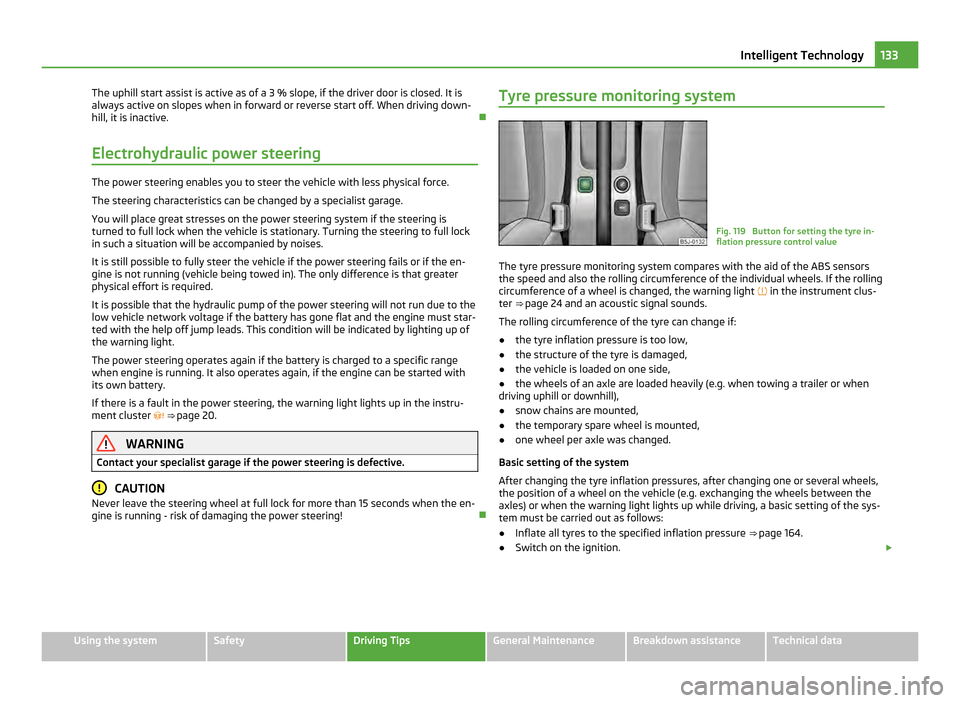
gine is running - risk of damaging the power steering! Tyre pressure monitoring system Fig. 119 Button for setting the tyre in-
flation pressure control value
The tyre pressure monitoring system compares with the aid of the ABS sensors
the speed and also the rolling circumference of the individual wheels. If the rolling
circumference of a wheel is changed, the warning light in the instrument clus-
ter ⇒ page 24 and an acoustic signal sounds.
The rolling circumference of the tyre can change if:
● the tyre inflation pressure is too low,
● the structure of the tyre is damaged,
● the vehicle is loaded on one side,
● the wheels of an axle are loaded heavily (e.g. when towing a trailer or when
driving uphill or downhill),
● snow chains are mounted,
● the temporary spare wheel is mounted,
● one wheel per axle was changed.
Basic setting of the system
After changing the tyre inflation pressures, after changing one or several wheels,
the position of a wheel on the vehicle (e.g. exchanging the wheels between the
axles) or when the warning light lights up while driving, a basic setting of the sys-
tem must be carried out as follows:
● Inflate all tyres to the specified inflation pressure ⇒ page 164.
● Switch on the ignition. £ 133
Intelligent Technology Using the system Safety Driving Tips General Maintenance Breakdown assistance Technical data
Page 138 of 220

–
For vehicles with petrol engine only refuel with unleaded petrol ⇒ page 150,
Unleaded petrol.
– Never run the fuel tank completely empty.
– Do not switch off the ignition while you are driving the vehicle.
– Do not pour too much oil into the engine ⇒ page 156, Replenishing engine oil
.
If you drive your vehicle in a country in which unleaded petrol is not available, you
must have the catalytic converter replaced later when driving the vehicle into a
country in which use of a catalytic converter is mandatory. WARNING
● In view of the high temperatures which may be produced in the catalytic
converter, one should always park a vehicle in such a way that the catalytic
converter cannot come into contact with easily flammable materials below the
vehicle - a risk of fire!
● Never use additional underbody protection or corrosion-protection agents
for the exhaust pipes, catalytic converters or heat shields. Such substances
might ignite when driving - risk of fire! CAUTION
● On vehicles fitted with a catalytic converter, never let the fuel tank run com-
pletely empty. An irregular fuel supply can result in poor ignition or misfiring. Un-
burnt fuel may get into the exhaust system and damage the catalytic converter.
● Filling the tank even only once with leaded petrol will result in the catalytic
converter being destroyed.
● If you detect misfiring, a drop in performance or irregular engine running when
driving, reduce your speed immediately and have the vehicle inspected by the
nearest specialist garage. The symptoms described may be caused by a fault in
the ignition system. Unburnt fuel may get into the exhaust system and damage
the catalytic converter. For the sake of the environment
Even if the exhaust system is operating properly, a sulphur-like exhaust odour
may be produced under certain operating conditions of the engine. This depends
on the sulphur content of the fuel. It is often sufficient to refuel with unleaded
premium-grade petrol of a different brand or at a different filling station. Driving in an economical and environmentally
conscious manner
General Your personal style of driving is a major factor.
Your fuel consumption, any pollution of the environmental and the wear-and-tear
to the engine, brakes and tyres, depend essentially on three factors:
● your personal style of driving,
● the conditions under which your vehicle is operated,
● technical aspects.
You can easily improve your fuel economy by 10 - 15 percent by driving in an eco-
nomical way with foresight. This section is intended to provide you with a number
of tips on how to protect the environment and at the same time save money.
The fuel consumption can naturally also be influenced by factors which are be-
yond the driver's control. It is, for example, normal for the fuel consumption to in-
crease in winter and under worsened conditions such as poor road conditions,
towing a trailer, etc.
The technical requirements for low fuel usage and economic efficiency of the ve-
hicle have already been built into the vehicle at the works. Special attention has
been given to minimising negative effects on the environment. It is necessary to
take note of the guidelines given in this chapter in order to make best use of
these characteristics and to maintain their effectiveness.
The optimal engine speed should be obtained when accelerating, in order to avoid
a high fuel consumption and resonance of the vehicle.
Looking ahead when driving A vehicle's highest fuel consumption occurs it accelerates.
Avoid accelerating and braking unnecessarily. If you drive with forsight you will
not need to brake so often and will also then not have to accelerate so much. Let
your vehicle coast to a stop, for example, if this is possible, when you see that the
next set of traffic lights is at red. 136
Driving and the Environment
Page 147 of 220

Automatic vehicle wash systems
The paintwork of the vehicle is sufficiently resistant that the vehicle can be wash-
ed normally in automatic vehicle wash plants without any problem. The actual
stress to which the paintwork is subjected, however, depends greatly on the de-
sign of the vehicle wash system, the filtering of the water and the type of wash-
ing and care products used. If the paintwork of your vehicle appears mat after be-
ing washed or even has scratches, point this out to the operator of the vehicle
wash plant. Use a different vehicle wash plant, if necessary.
There are no particular points to note before washing your vehicle in an automatic
vehicle wash system other than the usual precautionary measures (closing the
windows, unscrewing the aerial, etc.).
If you have any particular attached parts fitted to your car - such as spoiler, roof
rack system, two-way radio aerial - it is best to first of all consult the operator of
the car wash plant.
It is important to degrease the lips of the windscreen wiper rubbers after passing
through the automatic vehicle wash system.
Washing vehicle by hand It is important to first soften the dirt with plenty of water and rinse it off as thor-
oughly as possible before washing your vehicle by hand.
One should then clean the vehicle using a soft
washing sponge, washing glove or
a washing brush and only slight pressure. Work from the top to the bottom - be-
ginning with the roof. Only place slight pressure on the vehicle paintwork during
cleaning Only use a car shampoo for stubborn dirt.
Wash out the sponge or washing glove thoroughly at short intervals.
Clean wheels, door sills and similar parts last. Use a second sponge for such areas.
Rinse off the vehicle well after giving it a wash and dry it off using a chamois
leather. WARNING
● The ignition should always be switched off when you wash your vehicle -
risk of accident!
● Protect your hands and arms from sharp-edged metal parts when you are
cleaning the underfloor, the inside of the wheel housings or the wheel trims -
risk of cuts. CAUTION
● Do not wash your vehicle in bright sunlight - risk of paint damage.
● Ensure that the jet of water is not aimed directly at the locking cylinders or at
the door and panel joints if you spray your vehicle in winter down with a hose -
risk of freezing.
● Do not use any insect sponges, rough kitchen sponges or similar cleaning
products - risk of damage to the surface of paintwork. For the sake of the environment
Only wash your vehicle at washing bays specifically reserved for this purpose. This
ensures that no water which may be contaminated by oil flows into the sewage
system. It is not even permitted to wash your vehicle in certain areas except at
such specific washing bays.
Washing with a high-pressure cleaner When you wash your vehicle with a high-pressure cleaner, it is essential to comply
with the instructions for use of the cleaning equipment. This applies in particular
to the pressure
used and to the spraying distance. Maintain a sufficiently large
distance to soft materials such as rubber hoses or insulation material.
On no account use circular spray nozzles or so-called dirt cutters! WARNING
It is particularly important that you do not clean tyres with circular spray jets.
Damage may occur even at a relatively large spraying distance and if sprayed
only for a short time. CAUTION
The wash water must be no hotter than 60 °C, otherwise the vehicle can be dam-
aged.
Wax treatment Good wax treatment is an effective way of protecting the paintwork from harmful
environmental influences and minor mechanical damage.
The vehicle must be treated with a high-quality hard wax polish at the latest,
when no more drops form on the clean paintwork.
£ 145
Taking care of your vehicle and cleaning the vehicle Using the system Safety Driving Tips General Maintenance Breakdown assistance Technical data
Page 153 of 220

Diesel
Diesel fuel Your vehicle can only be operated with
diesel fuel, which complies with the stand-
ard EN 590 (standard DIN 51628 in Germany, standard ÖNORM C
1590 in Austria,
GOST R 52368-2005/EN 590:2004 in Russia).
Fuel additives
You must not use fuel additives, so-called “flow improvers” (petrol and similar
products) in diesel fuel.
You can find information on refuelling ⇒ page 151, Refuelling.CAUTION
● Your vehicle can only be operated with diesel fuel, which complies with the
standard EN 590 (standard DIN 51628 in Germany, standard ÖNORM C
1590 in
Austria, GOST R 52368-2005/EN 590:2004 in Russia). Filling the tank even only
once with diesel fuel which does not comply with the standard, can result in dam-
age to the engine parts, the lubrication system, the fuel and exhaust system.
● If by mistake you have refuelled with a different fuel other than the diesel fuel
which complies to the above mentioned standards (e. g. petrol), do not start the
engine or switch on the ignition! Severe damage damage is possible! Contact a
specialist garage and have the fuel system of the engine cleaned.
● Water which has collected in the fuel filter can result in engine problems.
● Your vehicle is not adapted for use of biofuel (RME), therefore this fuel must
not be refuelled and driven. The use of biofuel (RME) can lead to damage to the
engine or the fuel system.
Operation in winter Winter-grade diesel fuel
A different grade of diesel fuel is available at filling stations in winter than during
the summer. Using
“
summer-grade diesel fuel” at temperatures below 0°C can re-
sult in operational problems because the diesel becomes viscous as a result of
paraffin separation. It is therefore the case that the standard
EN 590 (standard DIN 51628 in Germany,
standard ÖNORM C 1590
in Austria, GOST R 52368-2005/EN 590:2004 in Russia)
is the diesel fuel class prescribed for certain periods of the year which can also be
purchased at the corresponding time during the year. “Winter-grade diesel fuel”
will still operate properly even at a temperature of -20°C.
It is often the case in countries with different climatic conditions that diesel fuels
available have a different temperature characteristic. The authorised ŠKODA Serv-
ice Partners and filling stations in the country concerned will be able to provide
you with information regarding the diesel fuels available.
Prewarming fuel
The vehicle is fitted with a fuel filter prewarming system. This secures operation
of a vehicle using diesel fuel down to an environmental temperature of -25°C. CAUTION
It is not permitted to add the various fuel additives on the market, including pet-
rol, to diesel fuel in order to improve its flow properties.
Refuelling Fig. 125 Right rear side of the vehicle: Fuel filler flap/fuel filler flap with cap unscrewed
Opening the fuel filler cap
–
Open the fuel filler flap with the hand ⇒ fig. 125
- left.
– Hold the fuel tank cap of the fuel filler tube with one hand and unlock it by
turning with the vehicle key to the left.
– Unscrew the fuel filler cap anti-clockwise and place the fuel filler cap from
above on the fuel filler flap ⇒ fig. 125 - right. £ 151
Fuel Using the system Safety Driving Tips General Maintenance Breakdown assistance Technical data
Page 156 of 220

WARNING
● Never open the bonnet if you see that steam or coolant is flowing out of
the engine compartment - risk of scalding! Wait long enough until the steam
or coolant has stopped escaping.
● Switch off the engine and pull out the ignition key.
● Apply the handbrake firmly.
● If your vehicle is fitted with a manual gearbox, move the gearshift lever in-
to Neutral, or if it is fitted with automatic gearbox, move the selector lever in-
to position P
.
● Allow the engine to cool down.
● Keep children clear of the engine compartment.
● Do not touch any hot engine parts - risk of burns!
● Never spill oil and other fluids over the hot engine. Such fluids (e.g. the an-
tifreeze contained in the coolant) may ignite!
● Avoid short circuits in the electrical system - particularly on the battery.
● Never place your hand into the radiator fan as long as the engine is still
warm. The fan might suddenly start running!
● Never open the cap of the coolant expansion reservoir so long as the en-
gine is still warm. The cooling system is pressurized!
● Cover over the cap of the reservoir with a large cloth when opening it as
protection for your face, hands and arms from hot steam or hot coolant.
● Do not let objects, such as e.g cleaning cloth or tools lie in the engine com-
partment.
● If you wish to work under the vehicle, you must secure the vehicle from
rolling away and support it with suitable supporting blocks: the car jack is not
sufficient for this - risk of injury! WARNING (Continued)
● In cases where it be necessary to carry out inspection work when the en-
gine is running there is an additional risk from rotating parts (e.g. the V-ribbed
belt, alternator, radiator fan) and from the high-voltage ignition system.
Please observe in addition the following:
–Never touch the electrical cables of the ignition system.
– Absolutely avoid any jewellery, loose items of clothing or long hair from
getting into the rotating parts of the engine - Hazard! Therefore remove
any jewellery beforehand, tie up your hair and wear tight fitting clothing.
● Please also comply with the warning instructions stated below when car-
rying out any essential work on the fuel system or on the electrical system:
–Always separate the car battery from the electrical system.
– Do not smoke.
– Never carry out any work close to naked flames.
– Always keep a working fire extinguisher at hand. CAUTION
When replenishing fluids in the engine, always ensure that the fluids are on no ac-
count mixed up. This may result in major operating problems and also vehicle
damage!
Overview of the engine compartment The main inspection points.
Fig. 128 Diesel engine 1.6 ltr./77 kW
£154
Inspecting and Replenishing