Page 112 of 280

110Lights and visibility
Automatic anti-dazzle interior mirror*
The automatic anti-dazzle function can be switched on and
off as desired.
Fig. 67 Automatic anti-
dazzle interior mirror.
Switching off the anti-dazzle function
– Press button A
⇒ fig. 67. Indicator lamp B goes off.
Switching on the anti-dazzle function
– Press button A
⇒ fig. 67. Warning lamp is lit.
Anti-dazzle function
The anti-dazzle function is activated every time the ignition is switched on.
The green indicator lamp lights up in the mirror housing.
When the anti-dazzle function is enabled, the interior mirror will darken au-
tomatically according to the amount of light it receives. The anti-dazzle
function is cancelled if reverse gear is engaged.
Note
● The automatic anti-dazzle function will only work properly if the sun
blind* for the rear window is retracted and there are no other objects pre-
venting light from reaching the rear view mirror.
● If you have to stick any type of sticker on the windscreen, do not do so in
front of the sensors. Doing so could prevent the anti-dazzle function from
working well or even from working at all.
Folding in the exterior mirrors
The exterior mirrors of the vehicle may be folded in. For this, press the mir-
ror housing towards the vehicle.
Note
Before washing the vehicle with an automatic car wash, fold in the mirrors
to avoid damage.
Page 113 of 280

111
Lights and visibility
Electric exterior mirrors*
The exterior mirrors can be adjusted using the rotary knob
in the driver door.
Fig. 68 Controls of exte-
rior mirrors
Basic setting of exterior mirrors
1. Turn knob ⇒ fig. 68 to position L (left exterior mirror ).
2. Turn the rotary knob to position the mirror so that you have a good view to the rear of the vehicle.
3. Turn knob to position R (right exterior mirror ).
4. Swivel the rotary knob to position the mirror so that you have a good view to the rear of the vehicle ⇒
.
Heated exterior mirrors*
– Press the demisting button
⇒
fig. 58 –
The mirrors demist for some minutes to prevent draining the
battery.
– If necessary, press the button again to repeat the function.
– The exterior mirror heating is not activated with temperatures
above 20 °C.
Folding in exterior mirrors*
– Turn the control ⇒ fig. 68 to position to fold in the exterior
mirrors. You should always fold in the exterior mirrors if you are
driving through an automatic car wash. This will help prevent
damage.
Folding exterior mirrors back out to the extended position*
– Turn the knob to position L or R to fold the exterior mirrors back
out ⇒
.
WARNING
● Convex or aspheric mirrors increase the field of vision however the
objects appear smaller and further away in the mirrors. If you use these
mirrors to estimate the distance to vehicles behind you when changing
lane, you could make a mistake. Risk of accident.
● If possible, use the rear view mirror to estimate distances to vehicles
behind you.
● Make sure that you do not get your finger trapped between the mirror
and the mirror base when folding back the mirrors. Risk of injury!
For the sake of the environment
The exterior mirror heating should be switched off when it is no longer nee-
ded. Otherwise, it is an unnecessary fuel waste.
Safety FirstOperating InstructionsPractical TipsTechnical Specifications
Page 114 of 280
112Lights and visibility
Note
● If the electrical adjustment ever fails to operate, the mirrors can be ad-
justed by hand by lightly pressing the edge of the mirror glass.
● In vehicles with electric exterior mirrors, the following points should be
observed: if, due to an external force (e.g. a knock while manoeuvring), the
adjustment of the mirror housing is altered, the mirror will have to be com-
pletely folded electrically. Do not readjust the mirror housing by hand, as
this will interfere with the mirror adjuster function.
● The rear view mirrors can be adjusted separately or simultaneously, as
described before.
● The fold-in function on the exterior mirrors is not active at speeds over
40 km/h.
Page 119 of 280
117
Seats and storage compartments
Heated seats*
The front seat cushions and backrests can be heated electri-
cally.
Fig. 73 Front seats heat-
ing switch
– Press the corresponding switch ⇒ fig. 73 to switch on the seat
heating.
– Press once to connect the heating at a maximum force. Two
LEDs will light up ⇒ fig. 73. After 15 min. of high intensity, the
upper LED goes out, the system is deactivated for 2 min. and is
then reactivated at low intensity (lower LED remains on perma-
nently).
– Press the switch again to set the heating to minimum force.
(The lower LED lights up).
– To disconnect the heating, press the switch again.
CAUTION
To avoid damaging the heating elements, please do not kneel on the seat or
apply sharp pressure at a single point to the seat cushion and backrest.
Note
The seats are only heated electrically when the engine is running.
Safety FirstOperating InstructionsPractical TipsTechnical Specifications
Page 125 of 280
123
Seats and storage compartments
Rear drink holder*
Fig. 84 Cup holder in the
centre console
On the rear part of the centre console, behind the hand brake, there is a cup
holder installed* ⇒ fig. 84.
This drink holder has a capacity of a bottle of up to 1 litre. Ashtrays, cigarette lighter and power socket
Ashtray*
Fig. 85 Ashtray
Opening and closing the ashtray
– To open the ashtray, lift the cover ⇒ fig. 85.
– To close, push the cover down.
Emptying the ashtray
– Extract the ashtray and empty it.
WARNING
Never put paper in the ashtray. Hot ash could ignite the paper in the ash-
tray and cause a fire.
Safety FirstOperating InstructionsPractical TipsTechnical Specifications
Page 126 of 280
124Seats and storage compartments
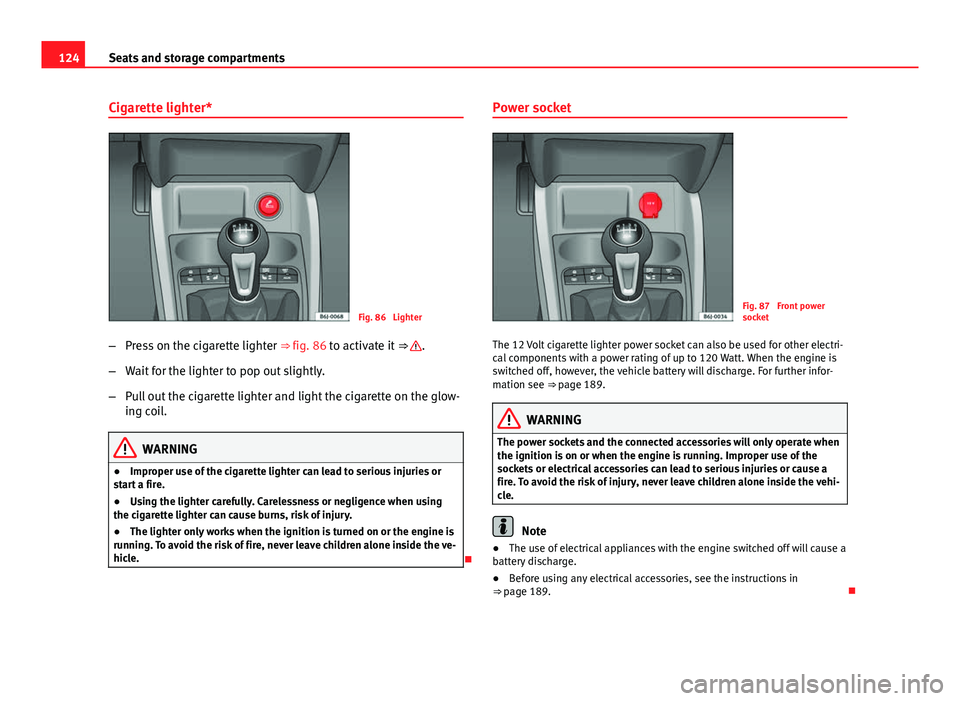
Cigarette lighter*
Fig. 86 Lighter
– Press on the cigarette lighter ⇒ fig. 86 to activate it ⇒
.
– Wait for the lighter to pop out slightly.
– Pull out the cigarette lighter and light the cigarette on the glow-
ing coil.
WARNING
● Improper use of the cigarette lighter can lead to serious injuries or
start a fire.
● Using the lighter carefully. Carelessness or negligence when using
the cigarette lighter can cause burns, risk of injury.
● The lighter only works when the ignition is turned on or the engine is
running. To avoid the risk of fire, never leave children alone inside the ve-
hicle.
Power socket
Fig. 87 Front power
socket
The 12 Volt cigarette lighter power socket can also be used for other electri-
cal components with a power rating of up to 120 Watt. When the engine is
switched off, however, the vehicle battery will discharge. For further infor-
mation see ⇒ page 189.
WARNING
The power sockets and the connected accessories will only operate when
the ignition is on or when the engine is running. Improper use of the
sockets or electrical accessories can lead to serious injuries or cause a
fire. To avoid the risk of injury, never leave children alone inside the vehi-
cle.
Note
● The use of electrical appliances with the engine switched off will cause a
battery discharge.
● Before using any electrical accessories, see the instructions in
⇒ page 189.
Page 131 of 280

129
Seats and storage compartments
Luggage net*
The luggage net can be used to secure and retain light items
in the luggage compartment.
Fig. 95 Stretched lug-
gage net
Luggage net
– Secure the luggage net to the four fastening rings -arrows-
⇒ fig. 95.
The luggage net can be attached to the fastening rings in the bottom of the
luggage compartment panel.
WARNING
The luggage net should only be used to hold objects weighing up to 5 kg.
Heavier objects cannot be safely secured (risk of injury).
Rear shelf
Fig. 96 Rear shelf
Removing the shelf
– Unhook the loops ⇒ fig. 96 B
from housings A
–
With the half open position, pull the shelf upwards.
WARNING
Do not place heavy or hard objects on the rear shelf, because they will
endanger the vehicle occupants in case of sudden braking.
CAUTION
● Before closing the tailgate, ensure that the rear shelf is correctly fitted.
● An overloaded luggage compartment could mean that the rear shelf is
not correctly seated and it may be bent or damaged.
● If the luggage compartment is overloaded, remove the tray.
Safety FirstOperating InstructionsPractical TipsTechnical Specifications
Page 133 of 280

131
Seats and storage compartments
Note
● Ensure that, when placing items of clothing on the luggage compart-
ment cover, rear visibility is not reduced.
● If your vehicle has a storage compartment*, only place light objects in-
side.
Roof rack*
Please observe the following points if you intend to carry loads on the roof:
● For safety reasons, only luggage racks and accessories approved by
SEAT should be used.
● It is essential that you follow the assembly instructions included with
the bars exactly, being especially careful to position the front and rear lug-
gage compartment cover bars on the special housings on the longitudinal
bars. You must also respect their position according to the direction of trav-
el indicated in the assembly manual. Not following these instructions may
cause marks on the longitudinal bars.
● Distribute the load evenly. A maximum load of 40 kg only is permitted
for each roof rack system support bar, the load must be distributed evenly
along the entire length. However, the maximum load permitted for the en-
tire roof (including the support system) of 75 kg must not be exceeded nor
should the total weight of the vehicle be exceeded. See the Technical Data
section.
● When transporting heavy or large objects on the roof, any change in the
normal vehicle behaviour due to a change in the centre of gravity or an in-
creased wind resistance must be taken into account. For this reason, a suit-
able speed and driving style must be used.
● For those vehicles fitted with a sliding/tilting sunroof*, ensure that it
does not interfere with the load on the roof rack system when opened.
Safety FirstOperating InstructionsPractical TipsTechnical Specifications


