2011 Seat Ibiza 5D charging
[x] Cancel search: chargingPage 74 of 278

72Cockpit
If the warning lamp lights up again after driving on for a short distance,
stop the vehicle and switch the engine off . Contact an Authorised Service
Centre or a specialised workshop.
Coolant level too low
If the warning light comes on, stop the vehicle, switch off the engine and
wait for it to cool down . First check the coolant level. If the level of the cool-
ant is below the “MIN” mark, top up with coolant liquid ⇒
.
WARNING
● If your vehicle is immobilised for technical reasons, move it to a safe
distance from traffic. Turn the engine off, turn the hazard lights on and
place the warning triangle.
● Never open the bonnet if you can see or hear steam or coolant escap-
ing from the engine compartment. Risk of scalding. Wait until you can no
longer see or hear escaping steam or coolant.
● The engine compartment is a dangerous area! Before carrying out any
work in the engine compartment, switch off the engine and allow it to
cool down. Always note the corresponding warnings ⇒ page 194.
Alternator
This warning lamp signals a fault in the alternator.
The warning lamp lights up when the ignition is switched on. It should
go out when the engine has started running.
If the warning lamp lights up while driving, the alternator is no longer
charging the battery. You should immediately drive to the nearest special-
ised workshop. You should avoid using electrical equipment that is not absolutely necessa-
ry because this will drain the battery.
If the indicator flashes the voltage is insufficient for normal vehicle opera-
tion.
Turn signals
The indicator lamp flashes when the turn signals are in op-
eration.
Depending on which turn signal is operating, either the left or right
turn signal lamp flashes. Both indicator lamps will flash at the same time
when the hazard warning lights are switched on.
If any of both turn signals fails, the indicator lamp will start flashing twice
faster than normal.
For further information on the turn signals, please see ⇒ page 101.
Electronic immobiliser* “Safe”
This warning lamp flashes if an unauthorised key is used.
Inside the key there is a chip that deactivates the electronic immobiliser au-
tomatically when the key is inserted into the ignition. The immobiliser will
be activated again automatically as soon as you pull the key out of the igni-
tion lock.
The instrument panel displays the following message 1)
: SAFE. The vehicle
cannot be started in this case
1)
Depending on the version of the model.
Page 105 of 278

103
Lights and visibility
Note
If not all the vehicle doors are closed, the interior lights will be switched off
after approx. 10 minutes, providing the key has been removed and the cour-
tesy light position selected. This prevents the battery from discharging.
Front reading light*
Fig. 62 Front reading
light
Switching on the reading light
Press the corresponding button B
⇒ fig. 62 to switch on the reading light.
Switching the reading lights off
Press the corresponding button to switch the reading light off. Luggage compartment light*
The light is activated when the tailgate is open, even when the ignition and
lights are turned off. For this reason, ensure that the tailgate is always
closed.
Glove compartment light
When opening the glove compartment on the passenger side, the glove
compartment light will automatically turn on and will turn off upon closure.
Visibility Sun visors
Fig. 63 Sun visor on the
driver side
Safety FirstOperating InstructionsPractical TipsTechnical Specifications
Page 142 of 278

140Driving
Starting diesel engines
The engine can only be started using a genuine SEAT key
with its correct code.
– Move the gear lever to the neutral position and depress the
clutch pedal thoroughly and hold it in this position for the start-
er to turn the engine on.
– Turn the ignition key to the starting position.
– Turn the ignition key to position ⇒ fig. 99 2
. The indicator
lamp will light for engine pre-heating.
– When the warning lamp turns off, turn the key to position 3
to
start the engine. Do not press the accelerator.
– Let go of the ignition key as soon as the engine starts, the start-
er motor must not be allowed to run on with the engine.
When starting a very cold engine, it may be a little noisy for the first few sec-
onds until oil pressure has built up in the hydraulic valve compensators.
This is quite normal, and no cause for concern.
If there are problems starting the engine, see the ⇒ page 240.
Glow plug system for the diesel engine
To avoid unnecessary discharging of the battery, do not use any other major
electrical equipment while the glow plugs are pre-heating.
Start the engine as soon as the glow plug warning lamp goes out.
Starting the engine after the fuel tank has been completely run dry
If the fuel tank has been completely run dry, it may take longer than normal
(up to one minute) to start the engine after refuelling with diesel fuel. This is
because the system must eliminate air first.
WARNING
● Never start or run the engine in unventilated or closed rooms. The ex-
haust fumes contain carbon monoxide, an odourless and colourless poi-
sonous gas. Risk of fatal accidents. Carbon monoxide can cause loss of
consciousness. It can also cause death.
● Never leave the vehicle unattended if the engine is running.
● Never use “cold start sprays”, they could explode or cause the engine
to run at high revs. Risk of injury.
CAUTION
● When the engine is cold, you should avoid high engine speeds, driving
at full throttle and over-loading the engine. Risk of engine damage.
● The vehicle should not be pushed or towed more than 50 metres to start
the engine. Unburnt fuel could enter the catalytic converter and damage it.
● Before attempting to push-start or tow a vehicle in order to start it, you
should first try to start it using the battery of another vehicle. Note and fol-
low the instructions in ⇒ page 240, Jump-starting.
For the sake of the environment
Do not warm-up the engine by running the engine with the vehicle station-
ary. You should drive off as soon as you start the engine. This helps the en-
gine reach operating temperature faster and reduces emissions.
Switching off the engine
– Stop the vehicle.
– Turn the ignition key to position ⇒ fig. 99 1
.
After switching the engine off, the radiator fan may run on for up to 10 mi-
nutes. It is also possible that the fan turns itself on once more if the coolant
Page 211 of 278

209
Checking and refilling levels
CAUTION
● Never disconnect the battery if the ignition is switched on or if the en-
gine is running. This could damage the electrical system or electronic com-
ponents.
● Do not expose the battery to direct sunlight over a long period of time,
as the intense ultraviolet radiation can damage the battery housing.
● If the vehicle is left standing in cold conditions for a long period, protect
the battery from freezing. If it freezes it will be damaged.
Checking the electrolyte level
The electrolyte level should be checked regularly in high-
mileage vehicles, in hot countries and in older batteries. – Open the engine bonnet and the battery cover ⇒
in Safety in-
structions on working in the engine compartment on page 195
⇒
in Warnings on handling the battery on page 208. For vehi-
cles with the battery under the spare wheel, open the tailgate
and lift the floor covering. The battery is located next to the
spare wheel.
– Check the colour display in the "magic eye" on the top of the
battery.
– If there are air bubbles in the window, tap the window gently
until they disperse.
The position of the battery is shown in the corresponding engine compart-
ment diagram ⇒ page 250. The location of the battery in the luggage com-
partment can be seen in ⇒ fig. 174.
The “magic eye” indicator, located on the top of the battery changes colour,
depending on the charge state and electrolyte level of the battery. There are two different colours:
●
Black: correct charge status.
● Transparent/clear yellow: the battery must be replaced. Contact a spe-
cialist workshop.
Charging and changing the vehicle battery
The battery is maintenance-free and is checked during the
inspection service. All work on the vehicle battery requires
specialist knowledge.
If you often drive short distances or if the vehicle is not driven for long peri-
ods, the battery should be checked by a specialised workshop between the
scheduled services.
If the battery has discharged and you have problems starting the vehicle,
the battery might be damaged. If this happens, we recommend you have
the vehicle battery checked by an Authorised Service Centre where it will be
re-charged or replaced.
Charging the battery
The vehicle battery should be charged by a specialised workshop only, as
batteries using special technology have been installed and they must be
charged in a controlled environment.
Replacing a vehicle battery
The battery has been developed to suit the conditions of its location and
has special safety features.
Genuine SEAT batteries fulfil the maintenance, performance and safety
specifications of your vehicle.
Safety FirstOperating InstructionsPractical TipsTechnical Specifications
Page 269 of 278
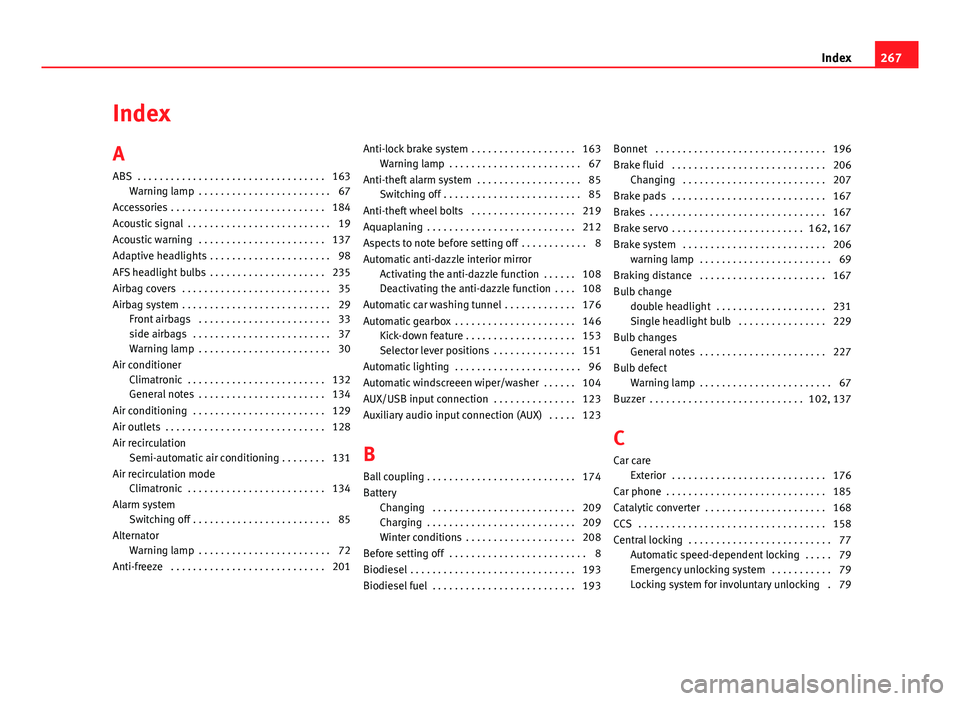
Index
A
ABS . . . . . . . . . . . . . . . . . . . . . . . . . . . . . . . . . . 163Warning lamp . . . . . . . . . . . . . . . . . . . . . . . . 67
Accessories . . . . . . . . . . . . . . . . . . . . . . . . . . . . 184
Acoustic signal . . . . . . . . . . . . . . . . . . . . . . . . . . 19
Acoustic warning . . . . . . . . . . . . . . . . . . . . . . . 137
Adaptive headlights . . . . . . . . . . . . . . . . . . . . . . 98
AFS headlight bulbs . . . . . . . . . . . . . . . . . . . . . 235
Airbag covers . . . . . . . . . . . . . . . . . . . . . . . . . . . 35
Airbag system . . . . . . . . . . . . . . . . . . . . . . . . . . . 29 Front airbags . . . . . . . . . . . . . . . . . . . . . . . . 33
side airbags . . . . . . . . . . . . . . . . . . . . . . . . . 37
Warning lamp . . . . . . . . . . . . . . . . . . . . . . . . 30
Air conditioner Climatronic . . . . . . . . . . . . . . . . . . . . . . . . . 132
General notes . . . . . . . . . . . . . . . . . . . . . . . 134
Air conditioning . . . . . . . . . . . . . . . . . . . . . . . . 129
Air outlets . . . . . . . . . . . . . . . . . . . . . . . . . . . . . 128
Air recirculation Semi-automatic air conditioning . . . . . . . . 131
Air recirculation mode Climatronic . . . . . . . . . . . . . . . . . . . . . . . . . 134
Alarm system Switching off . . . . . . . . . . . . . . . . . . . . . . . . . 85
Alternator Warning lamp . . . . . . . . . . . . . . . . . . . . . . . . 72
Anti-freeze . . . . . . . . . . . . . . . . . . . . . . . . . . . . 201 Anti-lock brake system . . . . . . . . . . . . . . . . . . . 163
Warning lamp . . . . . . . . . . . . . . . . . . . . . . . . 67
Anti-theft alarm system . . . . . . . . . . . . . . . . . . . 85 Switching off . . . . . . . . . . . . . . . . . . . . . . . . . 85
Anti-theft wheel bolts . . . . . . . . . . . . . . . . . . . 219
Aquaplaning . . . . . . . . . . . . . . . . . . . . . . . . . . . 212
Aspects to note before setting off . . . . . . . . . . . . 8
Automatic anti-dazzle interior mirror Activating the anti-dazzle function . . . . . . 108
Deactivating the anti-dazzle function . . . . 108
Automatic car washing tunnel . . . . . . . . . . . . . 176
Automatic gearbox . . . . . . . . . . . . . . . . . . . . . . 146 Kick-down feature . . . . . . . . . . . . . . . . . . . . 153
Selector lever positions . . . . . . . . . . . . . . . 151
Automatic lighting . . . . . . . . . . . . . . . . . . . . . . . 96
Automatic windscreeen wiper/washer . . . . . . 104
AUX/USB input connection . . . . . . . . . . . . . . . 123
Auxiliary audio input connection (AUX) . . . . . 123
B
Ball coupling . . . . . . . . . . . . . . . . . . . . . . . . . . . 174
Battery Changing . . . . . . . . . . . . . . . . . . . . . . . . . . 209
Charging . . . . . . . . . . . . . . . . . . . . . . . . . . . 209
Winter conditions . . . . . . . . . . . . . . . . . . . . 208
Before setting off . . . . . . . . . . . . . . . . . . . . . . . . . 8
Biodiesel . . . . . . . . . . . . . . . . . . . . . . . . . . . . . . 193
Biodiesel fuel . . . . . . . . . . . . . . . . . . . . . . . . . . 193 Bonnet . . . . . . . . . . . . . . . . . . . . . . . . . . . . . . . 196
Brake fluid . . . . . . . . . . . . . . . . . . . . . . . . . . . . 206
Changing . . . . . . . . . . . . . . . . . . . . . . . . . . 207
Brake pads . . . . . . . . . . . . . . . . . . . . . . . . . . . . 167
Brakes . . . . . . . . . . . . . . . . . . . . . . . . . . . . . . . . 167
Brake servo . . . . . . . . . . . . . . . . . . . . . . . . 162, 167
Brake system . . . . . . . . . . . . . . . . . . . . . . . . . . 206 warning lamp . . . . . . . . . . . . . . . . . . . . . . . . 69
Braking distance . . . . . . . . . . . . . . . . . . . . . . . 167
Bulb change double headlight . . . . . . . . . . . . . . . . . . . . 231
Single headlight bulb . . . . . . . . . . . . . . . . 229
Bulb changes General notes . . . . . . . . . . . . . . . . . . . . . . . 227
Bulb defect Warning lamp . . . . . . . . . . . . . . . . . . . . . . . . 67
Buzzer . . . . . . . . . . . . . . . . . . . . . . . . . . . . 102, 137
C
Car care Exterior . . . . . . . . . . . . . . . . . . . . . . . . . . . . 176
Car phone . . . . . . . . . . . . . . . . . . . . . . . . . . . . . 185
Catalytic converter . . . . . . . . . . . . . . . . . . . . . . 168
CCS . . . . . . . . . . . . . . . . . . . . . . . . . . . . . . . . . . 158
Central locking . . . . . . . . . . . . . . . . . . . . . . . . . . 77 Automatic speed-dependent locking . . . . . 79
Emergency unlocking system . . . . . . . . . . . 79
Locking system for involuntary unlocking . 79
267
Index