2011 Seat Exeo ST ABS
[x] Cancel search: ABSPage 195 of 319

193
Intelligent technology
Note
If the ABS warning lamp lights up, this can also mean there is a fault in the
EDL. Take the vehicle to a specialised workshop as soon as possible.
Traction control system (TCS)
The traction control system prevents the drive wheels from
spinning when the vehicle is accelerating. General notes
The traction control system (TCS) is one of the functions incorporated in the
Electronic Stability Programme (ESP).
The traction control system (TCS) helps the vehicle to start moving, acceler-
ate or climb a gradient in slippery conditions where this may otherwise be
difficult or even impossible.
How it works
The TCS acts automatically, without the driver's intervention. With the aid of
the ABS sensors ⇒ page 191, the TCS monitors the speed of the drive
wheels. If the wheels start to spin, the engine speed is reduced automati-
cally to match the amount of grip available. The system is active across the
entire speed range.
The TCS works in conjunction with the ABS. If a malfunction occurs in the
ABS, the TCS will also be inoperative.
Note
To ensure that the TCS works properly, all four wheels must be fitted with
identical tyres. The difference in size of the wheels may lead to an unde-
sired reduction in engine power. Also see ⇒ page 247.Brakes
General notes
New brake pads
New brake pads do not provide optimal performance during the first 200
km; first they must be “run in”. However, the reduced braking capacity may
be compensated by pressing on the brake pedal a little harder. Avoid over-
loading the brakes during run-in.
Wear
The rate of wear on the brake pads depends a great deal on how you drive
and the conditions in which the vehicle is operated. Negative factors are, for
instance, city traffic, frequent short trips or hard driving with abrupt starts
and stops.
Wet roads or road salt
In certain conditions, such as in heavy rain, or after washing the vehicle or
driving through water, the full braking effect can be delayed by moisture (or
in winter by ice) on the discs and brake pads. In this case the brakes should
be dried by pressing the brake pedal several times.
When the speed is over 80 km/h and the windscreen wipers are on, the
brake system moves the pads towards the brake discs for a few seconds.
This occurs - without the driver knowing - at regular intervals and allows a
faster response from the brakes when driving on wet roads.
The effectiveness of the brakes can also be temporarily reduced if the vehi-
cle is driven for some distance without using the brakes when there is a lot
of salt on the road in winter. In this case, the layer of salt on the brake discs
and pads has to wear off before braking.
Corrosion
There may be a tendency for corrosion to form on the discs and dirt to build
up on the brake pads if the vehicle is used infrequently or the brakes are
not used very often.
Safety FirstOperating InstructionsPractical TipsTechnical Specifications
Page 239 of 319

237
Checking and refilling levels
Topping up and changing the brake fluid
It is best to have the brake fluid changed by a professional. Brake fluid absorbs moisture. Therefore, in the course of time it will absorb
water from the air. If the water content in the brake fluid is too high, the
brake system could corrode. In addition, the boiling point of the brake fluid
will be considerably reduced. This could adversely affect the braking ability
in certain circumstances.
For this reason the brake fluid must be changed periodically.
Your vehicle's Service Plan will tell you when the brake fluid has to be re-
newed.
We recommend you have the brake fluid changed as part of a regular In-
spection Service at a workshop. They are familiar with the procedure and
have the necessary special tools and spare parts as well as the proper facili-
ties for disposing of the old fluid.
Use only approved brake fluid. Specialised workshops are informed about
the factory-approved brake fluid -DOT 4-. The brake fluid must be new.
WARNING
● Brake fluid must always be kept closed in its original container. Keep
out of the reach of children. Failure to comply could result in poisoning.
● If the brake fluid is left in the system for too long and the brakes are
subjected to heavy use, vapour bubbles may form in the brake system.
This would seriously affect the efficiency of the brakes and the safety of
the vehicle, leading to the risk of accident.
CAUTION
Please note that brake fluid will attack the paintwork on contact.
For the sake of the environment
The brake pads and fluid must be collected and disposed of according the
applicable regulations. The SEAT Technical Service network has the neces-
sary equipment and qualified personnel for collecting and disposing of this
waste material.
Vehicle battery General notes
All work on batteries requires specialist knowledge.
The battery is virtually maintenance-free and is checked in the Inspection
Services.
We recommend replacing the battery after 5 years.
Disconnecting the battery
If the battery is disconnected, some of the vehicle's functions will become
inoperative (e.g. electric windows). These functions will require resetting af-
ter the battery is reconnected. For this reason, the battery should only be
disconnected from the vehicle's electrical system when absolutely necessa-
ry.
Long periods of non-use
The battery will gradually lose its charge because certain electrical equip-
ment continues to draw current even when the ignition is off. If you park the
vehicle for long periods of time in winter you should take the battery out of
the vehicle and store it in a place protected from frost. This way it will not
freeze and become damaged. At warm outside temperatures it is sufficient
to disconnect the negative terminal of the battery. Even when the battery is
not connected you should charge it from time to time.
Safety FirstOperating InstructionsPractical TipsTechnical Specifications
Page 245 of 319
243
Wheels and tyres
Significant tyre pressure loss
The tyre symbol is displayed and indicates that the tyre pressure
of at least one tyre is insufficient.
– Stop the vehicle.
– Switch the engine off.
– Check the tyre(s).
– Change the wheel if necessary.
Tyre pressure monitoring (RKA+)*
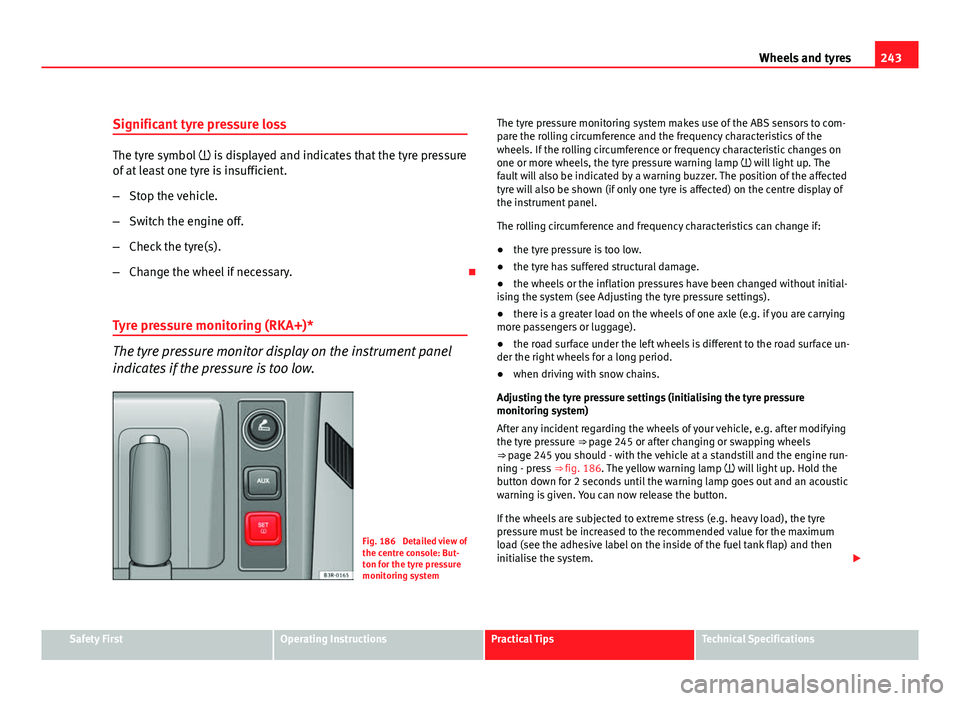
The tyre pressure monitor display on the instrument panel
indicates if the pressure is too low.
Fig. 186 Detailed view of
the centre console: But-
ton for the tyre pressure
monitoring system The tyre pressure monitoring system makes use of the ABS sensors to com-
pare the rolling circumference and the frequency characteristics of the
wheels. If the rolling circumference or frequency characteristic changes on
one or more wheels, the tyre pressure warning lamp will light up. The
fault will also be indicated by a warning buzzer. The position of the affected
tyre will also be shown (if only one tyre is affected) on the centre display of
the instrument panel.
The rolling circumference and frequency characteristics can change if:
●
the tyre pressure is too low.
● the tyre has suffered structural damage.
● the wheels or the inflation pressures have been changed without initial-
ising the system (see Adjusting the tyre pressure settings).
● there is a greater load on the wheels of one axle (e.g. if you are carrying
more passengers or luggage).
● the road surface under the left wheels is different to the road surface un-
der the right wheels for a long period.
● when driving with snow chains.
Adjusting the tyre pressure settings (initialising the tyre pressure
monitoring system)
After any incident regarding the wheels of your vehicle, e.g. after modifying
the tyre pressure ⇒ page 245 or after changing or swapping wheels
⇒ page 245 you should - with the vehicle at a standstill and the engine run- ning - press ⇒ fig. 186. The yellow warning lamp will light up. Hold the
button down for 2 seconds until the warning lamp goes out and an acoustic
warning is given. You can now release the button.
If the wheels are subjected to extreme stress (e.g. heavy load), the tyre
pressure must be increased to the recommended value for the maximum
load (see the adhesive label on the inside of the fuel tank flap) and then
initialise the system.
Safety FirstOperating InstructionsPractical TipsTechnical Specifications
Page 271 of 319

269
If and when
Changing the dipped beam headlight bulb
The procedure for changing the bulb is the same on both
sides.
Fig. 207 Dipped beam
headlights
Fig. 208 Dipped beam
headlights
– Switch off the ignition and the lights. –
Raise the bonnet.
– Move the brace ⇒ fig. 207 1
in the direction of the arrow and
remove the rigid cover, separating the brace side and then re-
moving the two tabs from the other end of the cover.
– Pull the connector ⇒ fig. 208 2
from the bulb.
– Unclip the retainer spring ⇒ fig. 208 3
pressing inwards to the
right.
– Remove the bulb and fit the new one in the headlight casing
with the tab upwards, starting to position it from below.
– Clip on the spring, raising it and pressing it slightly while turn-
ing it anti-clockwise. To ensure correct lighting, the filament
must be vertical. When changing the bulb, you can check the
position of the bulb through the headlight glass.
– Connect the connector to the bulb.
– Fit the cover, first inserting the side tabs and then closing the
cover and the brace. Make sure that the gasket sits well on the
casing cover during the operation.
– Check whether the new bulb is working.
– Have the headlight settings checked as soon as possible.
Safety FirstOperating InstructionsPractical TipsTechnical Specifications
Page 272 of 319

270If and when
Changing the side light bulb (outside of vehicle)
The procedure for changing the bulb is the same on both
sides.
Fig. 209 Side light bulb
(outside of vehicle)
Fig. 210 Side light bulb
(outside of vehicle)
– Switch off the ignition and the lights. –
Raise the bonnet.
– Move the brace ⇒ fig. 209 1
in the direction of the arrow and
remove the rigid cover, separating the brace side and then re-
moving the two tabs from the other end of the cover.
– Gently press on the bulb holder tabs ⇒ fig. 210 and pull the
cover upwards (it can also be removed by pulling on the bulb
holder wires).
– Separate the bulb from the bulb holder by pulling both pieces
anti-clockwise.
– Fit the new bulb by pressing on the bulb holder.
– Insert the bulb into the socket and press on the bulb holder. Fit
the cover, first inserting the side tabs and then closing the cov-
er and the brace. Make sure that the gasket sits well on the cas-
ing cover during the operation.
– Check whether the new bulb is working.
Page 273 of 319
271
If and when
Changing the side light bulb (inside of vehicle)
The procedure for changing the bulb is the same on both
sides.
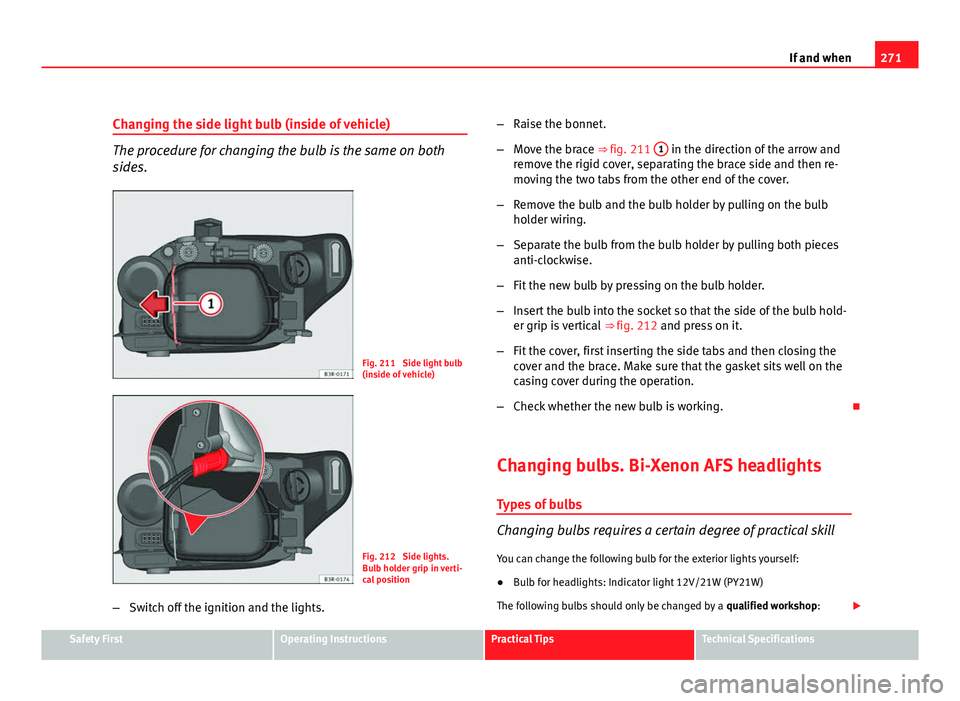
Fig. 211 Side light bulb
(inside of vehicle)
Fig. 212 Side lights.
Bulb holder grip in verti-
cal position
– Switch off the ignition and the lights. –
Raise the bonnet.
– Move the brace ⇒ fig. 211 1
in the direction of the arrow and
remove the rigid cover, separating the brace side and then re-
moving the two tabs from the other end of the cover.
– Remove the bulb and the bulb holder by pulling on the bulb
holder wiring.
– Separate the bulb from the bulb holder by pulling both pieces
anti-clockwise.
– Fit the new bulb by pressing on the bulb holder.
– Insert the bulb into the socket so that the side of the bulb hold-
er grip is vertical ⇒ fig. 212 and press on it.
– Fit the cover, first inserting the side tabs and then closing the
cover and the brace. Make sure that the gasket sits well on the
casing cover during the operation.
– Check whether the new bulb is working.
Changing bulbs. Bi-Xenon AFS headlights Types of bulbs
Changing bulbs requires a certain degree of practical skill
You can change the following bulb for the exterior lights yourself:
● Bulb for headlights: Indicator light 12V/21W (PY21W)
The following bulbs should only be changed by a qualified workshop:
Safety FirstOperating InstructionsPractical TipsTechnical Specifications
Page 279 of 319

277
If and when
Remove the bulb holder
When changing a bulb, you must first remove the bulb hold-
er.
Fig. 222 Retaining tabs
on reverse side of tail
light
There are four securing tabs on the inside of the tail light unit.
– Release the retaining tabs A
⇒ fig. 222.
– Lift the bulb carrier off in direction of the arrow B
.
– Change the defective bulb ⇒ page 277 ⇒ page 278.
WARNING
If a bulb is replaced in a tail light assembly with LED, do not pull too hard
on the bulb holder. This may damage the wiring of the LED module.
Changing bulbs
All bulbs can be changed easily in the bulb holder.
Fig. 223 Position of the
bulbs in the bulb holder:
Example: Outer left tail
light
The bulbs are secured with a bayonet fastener. The table below
gives an overview of the bulb positions.
– Lightly press the defective bulb into the bulb holder, then turn it
to the left and remove it.
– Fit the new bulb, pressing it into the bulb holder and turn it to
the right as far as it will go.
– Use a cloth to remove any fingerprints from the glass part of the
bulb.
– Check whether the new bulb is working.
– Re-install the bulb holder ⇒ page 278.
Safety FirstOperating InstructionsPractical TipsTechnical Specifications
Page 281 of 319

279
If and when
– Position the bulb holder on the tail light and align it so that it is
securely seated.
– Press the bulb holder into the tail light until it engages.
– Check that all four retaining tabs ⇒ fig. 225 -arrows- have en-
gaged.
– Re-install the tail light unit ⇒ page 279.
Fitting the tail light unit
The tail light unit is easy to fit.
Fig. 226 Fitting the tail
light unit
Fig. 227 Luggage com-
partment: Location of the
bolt securing the tail
light unit
– First place the tail light unit in ⇒ fig. 226 arrow 1
in the hous-
ing.
– Gently press the tail light unit against the housing, first in posi-
tion 2
and then in position 3, until that the clips engage firm-
ly in the rubber mountings.
– Apply gentle pressure to the upper part of the tail light unit and
secure using the screwdriver, from the luggage compartment
⇒ fig. 227 1
.
– Try to move the tail light sideways to ensure it is correctly fitted.
– Fit the cover back onto the screw, with the notch pointing to the
rear 2
.
– Make sure that all bulbs for the tail lights are working.
Safety FirstOperating InstructionsPractical TipsTechnical Specifications