2011 Seat Altea seat adjustment
[x] Cancel search: seat adjustmentPage 26 of 317

Seat belts
24•Fasten your seat belt before every trip - even when driving in town. The
o t h e r pass e n ge rs m u s t al s o w ea r t h e s ea t b e l ts a t all t i m e s , o t h e r w is e t h e y
run the risk of being injured.•The seat belt cannot offer its full protection if the seat belt is not posi-
tioned correctly.•Never allow two passengers (even children) to share the same seat belt.•Ke e p b o t h fe e t i n t h e fo o t w e ll i n f ro n t o f yo u r s ea t as l o n g as t h e ve h ic l e
is in motion.•Never unbuckle a seat belt while the vehicle is in motion. Risk of fatal
injury.•The seat belt must never be twisted while it is being worn.•The seat belt should never lie on hard or fragile objects (such as glasses
or pens, etc.) because this can cause injuries.•Do not allow the seat belt to be damaged or jammed, or to rub on any
sharp edges.•Never wear the seat belt under the arm or in any other incorrect posi-
tion.•Loose, bulky clothing (such as an overcoat over a jacket) impairs the
proper fit and function of the belts, reducing their capacity to protect.•The slot in the seat belt buckle must not be blocked with paper or other
objects, as this can prevent the latch plate from engaging securely.•Never use seat belt clips, retaining rings or similar instruments to alter
the position of the belt webbing.•Frayed or torn seat belts or damage to the connections, belt retractors
or parts of the buckle could cause severe injuries in the event of an acci-
dent. Therefore, you must check the condition of all seat belts at regular
intervals.•Seat belts which have been worn in an accident and stretched must be
replaced by a specialised workshop. Renewal may be necessary even if
there is no apparent damage. The belt anchorage should also be checked.
•Do not attempt to repair a damaged seat belt yourself. The seat belts
must not be removed or modified in any way.•The belts must be kept clean, otherwise the retractors may not work
properly ⇒page 223.
Seat beltsSeat belt adjustment
The seat belts for the front and rear occupants are locked into
position by a latch.The seat belt cannot offer its full protection if the seat belt is not
positioned correctly.
WARNING (continued)
WARNING (continued)
Fig. 12 Belt buckle and
latch plate of seat belt
Altea_EN.book Seite 24 Donnersta g, 2. September 2010 2:00 14
Page 28 of 317

Seat belts
26The following features are available to adjust the seat belt in the shoulder
region:•belt height adjustment for the front seats.•front seat height adjustment*.WARNING
•An incorrectly worn seat belt can cause severe injuries in the event of
an accident.•The shoulder part of the seat belt must lie on the centre of the shoulder,
never across the neck. The seat belt must lie flat and snugly on the torso
⇒ page 25, fig. 13 .•The lap par t of the seat belt must lie across the pelvis, never across the
stomach. The seat belt must lie flat and snugly on the pelvis ⇒page 25,
fig. 14. Pull the belt tight if necessary to take up any slack.•Read and observe the warnings ⇒page 23.
Pregnant women must also fasten their seat belts properly
The best protection for the unborn child is for the mother to
wear the seat belt properly at all times during the pregnancy.The seat belt provides maximum protection only when the seat belt
is properly positioned ⇒page 25.
– Adjust the front seat and head restraint correctly ⇒page 10.
– Holding the latch plate, pull the belt evenly across your chest and as low as possible over the pelvis ⇒fig. 15 .
– Insert the latch plate into the buckle for the corresponding seat and push it down until it is securely locked with an audible click
⇒ .
– Pull the belt to ensure that the latch plate is securely engaged in the buckle.
Fig. 15 Positioning seat
belts during pregnancy
Altea_EN.book Seite 26 Donnersta g, 2. September 2010 2:00 14
Page 44 of 317

Airbag system
42•there is a frontal collision•there is a rear-end collision•the vehicle turns over•there is a minor side collisionWARNING
If a fault has occurred in the airbag system, have the system checked imme-
diately by a specialised workshop. Otherwise there is a danger that during
a collision, the system may fail to trigger, or not trigger correctly.Operation of curtain airbags
Fully inflated airbags reduce the risk of head or chest injury in
a side collision.
During some side collisions the curtain airbag is triggered on the impact side
of the vehicle ⇒ fig. 25.
In certain types of accident the front, side and curtain airbags may be trig-
gered together.
When the system is triggered, the airbag is filled with propellant gas. In the
process, the curtain airbag covers the side windows and door pillars.
The airbags deploy extremely rapidly, within thousandths of a second, to
provide additional protection in the event of an accident. A fine dust may
develop when the airbag deploys. This is normal and it is not an indication of
fire in the vehicle.
The fully deployed airbags cushion the movement of the front occupants and
help to reduce the risk of injury to the upper body.
The special design of the airbag allows the controlled escape of the propel-
lant gas when an occupant puts pressure on the bag. Thus, the head and
chest are surrounded and protected by the airbag.Safety notes on the operation of the curtain airbag system
If you use airbags correctly, they can considerably reduce the
risk of injury in many kinds of accident.
WARNING
•In order for the side airbags to provide their maximum protection, the
prescribed sitting position must always be maintained with seat belts
fastened while travelling.•For safety reasons, the curtain airbag must be disconnected in those
vehicles fitted with a passenger compartment separation screen. See an
Authorised Service Centre to make this adjustment.
Fig. 25 Deployed curtain
airbags
Altea_EN.book Seite 42 Donnersta g, 2. September 2010 2:00 14
Page 49 of 317

Child safety47
Safety First
Operating Instructions
Practical Tips
Technical Specifications
airbags*”. If the passenger seat has a height adjustment option, move it to
the highest position.
•For those vehicles that do not include a key lock switch to disconnect
the airbag, the vehicle must be taken to a Technical Service.•All passengers, especially children, must assume the proper sitting
position and be properly belted in while travelling.•Never hold children or babies on your lap, this can result in potentially
fatal injuries to the child!•Never allow a child to be transported in a vehicle without being properly
secured, or to stand up or kneel on a seat while travelling. In an accident,
the child could be flung through the vehicle, causing possibly fatal injuries
to themselves and to the other passengers.•If children assume an improper sitting position when the vehicle is
moving, they expose themselves to greater risk of injury in the event of a
sudden braking manoeuvre or in an accident. This is particularly important
if the child is travelling on the front passenger seat and the airbag system
is t riggered in an accid ent ; as this could caus e s erious inj ur y or eve n deat h.•A suitable child seat can protect your child!•Never leave an unsupervised child alone on a child seat or in the
vehicle.•Depending on weather conditions, it may become extremely hot or cold
inside the vehicle. This can be fatal.•Children who are less than 1.5 metres tall must not wear a normal seat
belt without a child seat, as this could cause injuries to the abdominal and
neck areas during a sudden braking manoeuvre or in an accident.•Do not allow the seat belt to become twisted or jammed, or to rub on
any sharp edges.•Incorrectly worn seat belts can cause injuries even in a minor collision
or in sudden braking manoeuvres.
•The seat belt provides maximum protection only when the seat belt is
properly positioned ⇒page 24, “Seat belts”.•Only one child may occupy a child seat ⇒page 48, “Child seats”.
WARNING (continued)
WARNING (continued)
Altea_EN.book Seite 47 Donnersta g, 2. September 2010 2:00 14
Page 57 of 317

Cockpit55
Safety First
Operating Instructions
Practical Tips
Technical Specifications
Operating InstructionsCockpitOverviewOverview of the dash panel
This overview will help you to familiarise yourself with the
controls and displays.
Door release lever
Light switch . . . . . . . . . . . . . . . . . . . . . . . . . . . . . . . . . . . . . . . .
Lighting control for instrument and control lighting . . . . . . .
Headlight range control . . . . . . . . . . . . . . . . . . . . . . . . . . . . . .
Air vent
Turn signal and main beam lever and cruise control system*
Controls on the steering wheel . . . . . . . . . . . . . . . . . . . . . . . .
Instrument panel:
− Instruments . . . . . . . . . . . . . . . . . . . . . . . . . . . . . . . . . . . . . .
− Display . . . . . . . . . . . . . . . . . . . . . . . . . . . . . . . . . . . . . . . . . .
− Indicator lamps . . . . . . . . . . . . . . . . . . . . . . . . . . . . . . . . . . .
Horn (works only when the ignition is on)/ Driver front airbag
Windscreen wiper and washer lever and operation of the
multifunction display* . . . . . . . . . . . . . . . . . . . . . . . . . . . . . . .
Left seat heating button . . . . . . . . . . . . . . . . . . . . . . . . . . . . . .
Controls for
− Heating* and ventilation . . . . . . . . . . . . . . . . . . . . . . . . . . . −
Climatic* . . . . . . . . . . . . . . . . . . . . . . . . . . . . . . . . . . . . . . . .
− Climatronic* . . . . . . . . . . . . . . . . . . . . . . . . . . . . . . . . . . . . .
Radio/Navigator*
Right seat heating button . . . . . . . . . . . . . . . . . . . . . . . . . . . . .
Warning lamp for deactivated front passenger airbag . . . . . .
Front passenger airbag . . . . . . . . . . . . . . . . . . . . . . . . . . . . . . .
Glove compartment lever . . . . . . . . . . . . . . . . . . . . . . . . . . . . .
Selector lever . . . . . . . . . . . . . . . . . . . . . . . . . . . . . . . . . . . . . . .
Cup holder compartment . . . . . . . . . . . . . . . . . . . . . . . . . . . . .
Controls on the centre console:
− Central locking . . . . . . . . . . . . . . . . . . . . . . . . . . . . . . . . . . .
− ESP . . . . . . . . . . . . . . . . . . . . . . . . . . . . . . . . . . . . . . . . . . . .
− Tyre pressure control* . . . . . . . . . . . . . . . . . . . . . . . . . . . . .
− Park Pilot* . . . . . . . . . . . . . . . . . . . . . . . . . . . . . . . . . . . . . . .
− Cigarette lighter / Power socket . . . . . . . . . . . . . . . . . . . . .
− Exterior mirror adjustment . . . . . . . . . . . . . . . . . . . . . . . . . .
− Start-Stop* . . . . . . . . . . . . . . . . . . . . . . . . . . . . . . . . . . . . . .
Handbrake . . . . . . . . . . . . . . . . . . . . . . . . . . . . . . . . . . . . . . . . .
Hazard warning light switch . . . . . . . . . . . . . . . . . . . . . . . . . . .
Pedals
Ignition lock . . . . . . . . . . . . . . . . . . . . . . . . . . . . . . . . . . . . . . . .
Steering column control lever* . . . . . . . . . . . . . . . . . . . . . . . .
Handle for releasing the bonnet . . . . . . . . . . . . . . . . . . . . . . .
A1A2
118
A3
122
A4
122
A5A6
125, 192
A7
91
A8
57
61
77
A9
30
A10
130, 63
A11
141
A12
159 161
165
A13A14
141
A15
44
A16
30
A17
144
A18
182
A19
148
A20
99
199 85
189
152
135
178
A21
187
A22
123
A23A24
173
A25
171
A26
232
Altea_EN.book Seite 55 Donnersta g, 2. September 2010 2:00 14
Page 77 of 317
Cockpit75
Safety First
Operating Instructions
Practical Tips
Technical Specifications
Note
•For electronic and vehicle equipment one or more of these menus will be
displayed.•SEAT dealers are able to programme other functions or change the
existing functions depending upon the vehicle equipment.•The Configuration menu is only accessible when the vehicle is at a
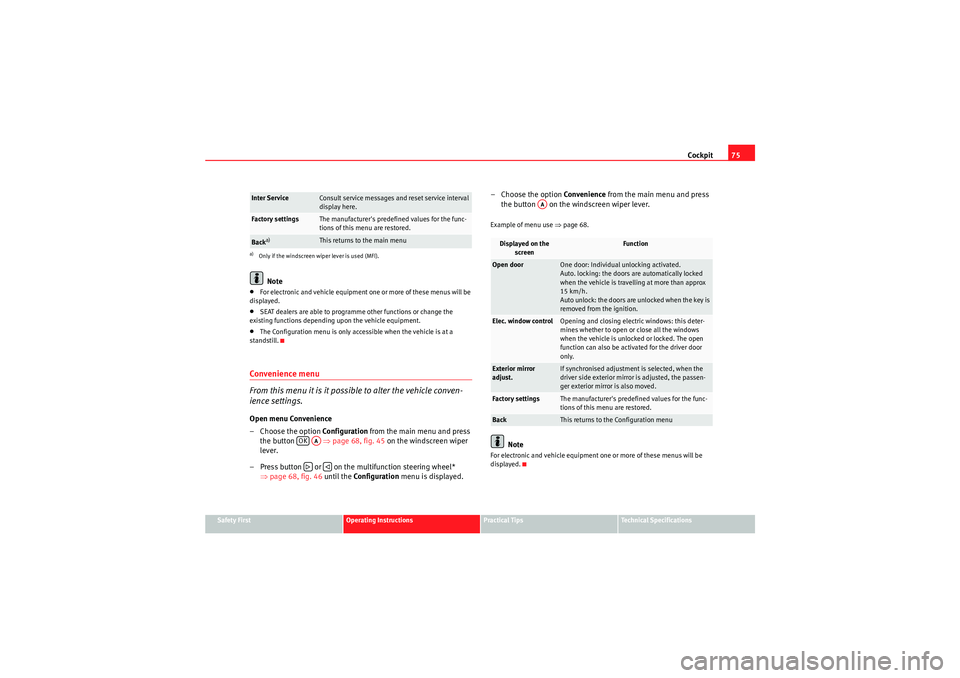
standstill.Convenience menu
From this menu it is it possible to alter the vehicle conven-
ience settings.Open menu Convenience
– Choose the option Configuration from the main menu and press
the button ⇒ page 68, fig. 45 on the windscreen wiper
lever.
– Press button or on the multifunction steering wheel* ⇒page 68, fig. 46 until the Configuration menu is displayed. – Choose the option
Convenience from the main menu and press
the button on the windscreen wiper lever.
Example of menu use ⇒page 68.
Note
For electronic and vehicle equipment one or more of these menus will be
displayed.
Inter Service
Consult service messages and reset service interval
display here.
Factory settings
The manufacturer's predefined values for the func-
tions of this menu are restored.
Back
a)
This returns to the main menu
a)Only if the windscreen wiper lever is used (MFI).
OK
AA„
ƒ
Displayed on the
screen
Function
Open door
One door: Individual unlocking activated.
Auto. locking: the doors are automatically locked
when the vehicle is travelling at more than approx
15 km/h.
Auto unlock: the doors are unlocked when the key is
removed from the ignition.
Elec. window control
Opening and closing electric windows: this deter-
mines whether to open or close all the windows
when the vehicle is unlocked or locked. The open
function can also be activated for the driver door
only.
Exterior mirror
adjust.
If synchronised adjustment is selected, when the
driver side exterior mirror is adjusted, the passen-
ger exterior mirror is also moved.
Factory settings
The manufacturer's predefined values for the func-
tions of this menu are restored.
Back
This returns to the Configuration menu
AA
Altea_EN.book Seite 75 Donnersta g, 2. September 2010 2:00 14
Page 139 of 317

Seats and storage compartments137
Safety First
Operating Instructions
Practical Tips
Technical Specifications
Seats and storage compartmentsThe importance of correct seat adjustmentProper seat adjustment optimises the level of protection
offered by seat belts and airbags.Your vehicle has five seats, two in the front and three in the rear. Each seat is
equipped with a three-point seat belt.
The driver seat and the front passenger seat can be adjusted in many ways to
suit the physical requirements of the vehicle occupants. The correct seat
position is very important for:•a fast and easy operation of all controls on the instrument panel,•a relaxed posture which does not cause drowsiness,•a safe driving ⇒ page 7,•ensuring that the seat belts and airbag system provide maximum protec-
tion ⇒page 19.WARNING
•If the driver and passengers assume improper sitting positions, they
may sustain critical injuries.•More people than available seats must never be transported in your
vehicle.•Every passenger in the vehicle must properly fasten and wear the seat
belt belonging to his or her seat. Chil dren must be protected with an appro-
priate child restraint system ⇒page 46, “Child safety”.•The front seats and all head restraints must always be adjusted to body
size and the seat belt must always be properly adjusted to provide you and
your passengers with optimum protection.
•Always keep your feet on the footwell when the vehicle is moving; never
rest them on the dash panel, out of the window or on the seat. This is also
applied to passengers. An incorrect sitting position exposes you to an
increased risk of injury in case of a sudden braking or an accident. If the
airbag is triggered, you could sustain severe injuries due to an incorrect
sitting position.•It is important for the driver and front passenger to keep a distance of
at least 25 cm from the steering wheel or dash panel. Failure to respect the
minimum distance means that the airbag will not protect you. Risk of fatal
injury. The distance between the driver and the steering wheel or between
the front passenger and the dash panel should always be as great as
possible.•Adjust the driver or front passenger seat only when the vehicle is
stationary. This also applies to the forwards/backwards adjustment of the
rear seats. Otherwise, your seat could move unexpectedly while the vehicle
is moving. This could increase the risk of an accident and therefore, injury.
In addition, while adjusting your seat, you will assume an incorrect sitting
position. Risk of fatal accidents.•Special guidelines apply to installing a child seat on the front
passenger seat. When installing a child seat, please observe the warnings
described in ⇒page 46, “Child safety”.WARNING (continued)
Altea_EN.book Seite 137 Donnerstag, 2. September 2010 2:00 14
Page 140 of 317

Seats and storage compartments
138Head restraintsCorrect adjustment of head restraints
Properly adjusted head restraints are an important part of
passenger protection and can reduce the risk of injuries in
most accident situations.
– Adjust the head restraint so that the top is at the same level as
the top of your head or as close as possible to the same level as
the top of your head, at least at eye level ⇒ fig. 91 and ⇒fig. 92 .Adjusting the head restraints ⇒page 139.
WARNING
•Travelling with the head restraints removed or improperly adjusted
increases the risk of severe injuries.•Improperly adjusted head restraints could lead to death in the event of
a collision or accident.•Incorrectly adjusted head restraints also increase the risk of injury
during sudden or unexpected driving or braking manoeuvres.•The head restraints must always be adjusted according to the
passenger’s height.
Fig. 91 Front view: head
restraints and seat belts
correctly adjusted
Fig. 92 Side view: head
restraints and seat belts
correctly adjusted
Altea_EN.book Seite 138 Donnerstag, 2. September 2010 2:00 14