Page 60 of 170

WARNING!
Do not use the exhaust brake feature when driving in
icy or slippery conditions as the increased engine
braking can cause the rear wheels to slide and the
vehicle to swing around with the possible loss of
vehicle control, which may cause an accident possi-
bly resulting in personal injury or death.
NOTE: For optimum braking power it is recommended
to use the exhaust brake while in TOW/HAUL mode.
The purpose of the exhaust brake (engine braking) fea-
ture is to supply negative (braking) torque to the engine.
Typically, the engine braking is used for, but not limited
to, vehicle towing applications where vehicle braking can
be achieved by the internal engine power, thereby spar-
ing the mechanical brakes of the vehicle. Benefits of the exhaust brake are:•vehicle driving control
•reduced brake fade
•longer brake life
•faster cab warm-up.
The exhaust brake feature can also be used to reduce the
engine warm up time. To use the exhaust brake as a
warm-up device, the vehicle must be stopped or moving
less than 5 mph (8 km/h), the exhaust brake switch must
be in the ON position, and the coolant temperature must
be below 180°F (82°C) and ambient temperature below
60°F (16°C).
4
STARTING AND OPERATING 59
Page 62 of 170

WARNING! (Continued)
•It is dangerous to move the shift lever out of PARK
or NEUTRAL if the engine speed is higher than
idle speed. If your foot is not firmly on the brake
pedal, the vehicle could accelerate quickly forward
or in reverse. You could lose control of the vehicle
and hit someone or something. Only shift into
gear when the engine is idling normally and when
your right foot is firmly on the brake pedal.
Brake/Transmission Shift Interlock System
This vehicle is equipped with a Brake Transmission Shift
Interlock System (BTSI) that holds the shift lever in the
PARK position when the ignition switch is in the LOCK
position. To move the shift lever out of the PARK
position, the ignition switch must be turned to any other
switch position (ACC, ON, or START) (engine running or
not) and the brake pedal must be pressed.
Brake/Transmission Interlock Manual Override
Column Shifter
There is an override for the BTSI that allows you to move
the shift lever out of the PARK position if an electrical
system malfunction occurs (i.e., dead battery).
1. Turn the ignition switch to the ACC or ON position
without starting the engine.
2. Tilt the steering wheel to the full up position
3. Firmly set the parking brake.
4. Press and maintain firm pressure on the brake pedal.
4
STARTING AND OPERATING 61
Page 64 of 170
the transmission into third gear, the transmission will
never shift above third gear, but can shift down into
second or first gear, when needed.
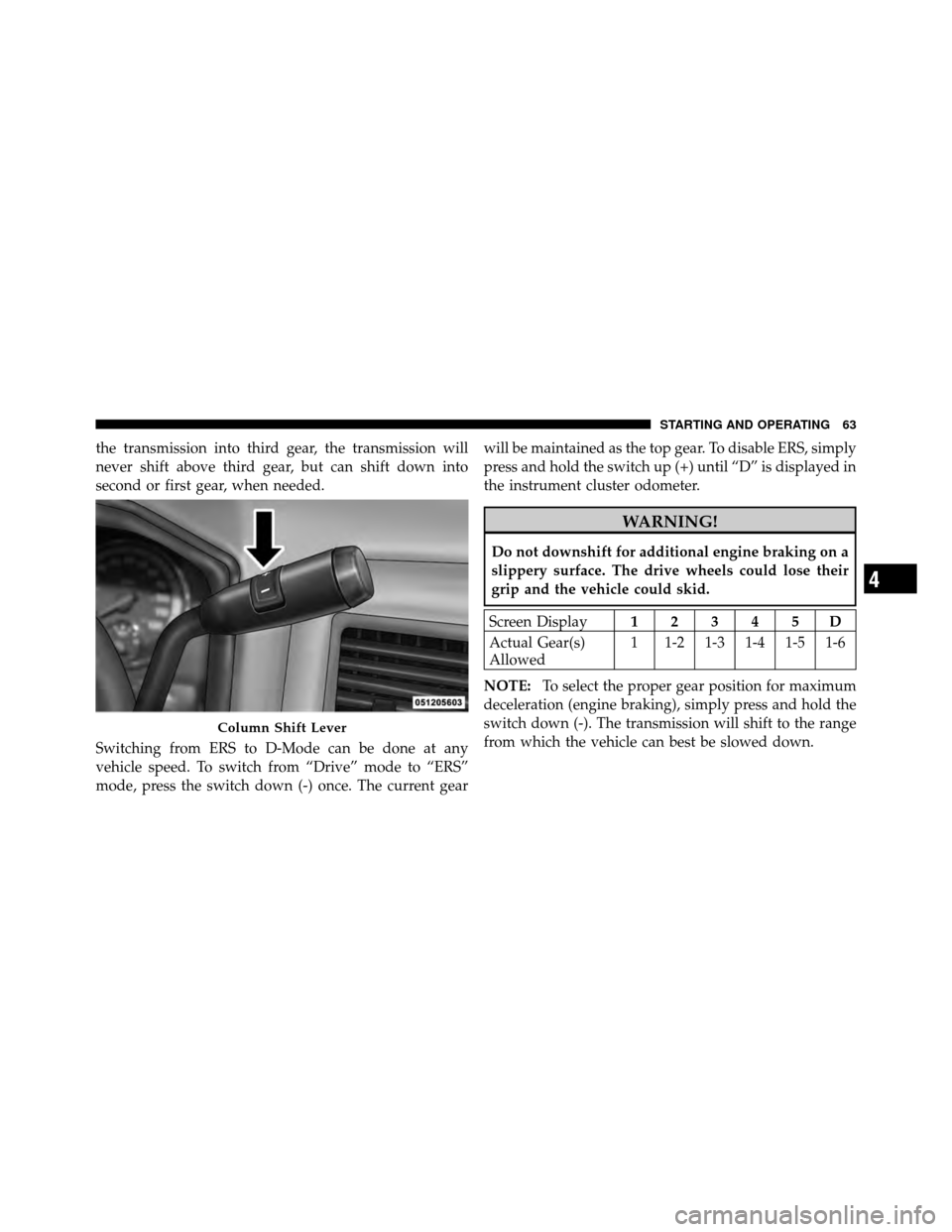
Switching from ERS to D-Mode can be done at any
vehicle speed. To switch from “Drive” mode to “ERS”
mode, press the switch down (-) once. The current gearwill be maintained as the top gear. To disable ERS, simply
press and hold the switch up (+) until “D” is displayed in
the instrument cluster odometer.
WARNING!
Do not downshift for additional engine braking on a
slippery surface. The drive wheels could lose their
grip and the vehicle could skid.
Screen Display
12345D
Actual Gear(s)
Allowed 1 1-2 1-3 1-4 1-5 1-6
NOTE: To select the proper gear position for maximum
deceleration (engine braking), simply press and hold the
switch down (-). The transmission will shift to the range
from which the vehicle can best be slowed down.
Column Shift Lever
4
STARTING AND OPERATING 63
Page 65 of 170

Gear Ranges
DO NOT race the engine when shifting from PARK or
NEUTRAL position into another gear range.
PARK
This range supplements the parking brake by locking the
transmission. The engine can be started in this range.
Never use PARK while the vehicle is in motion. Apply
the parking brake when leaving the vehicle in this range.
Always apply the parking brake first, then place the shift
lever into the PARK position. On four-wheel drive ve-
hicles be sure that the transfer case is in a drive position.
WARNING!
•Never use the PARK position as a substitute for
the parking brake. Always apply the parking
brake fully when parked to guard against vehicle
movement and possible injury or damage.(Continued)
WARNING! (Continued)
•Your vehicle could move and injure you and others
if it is not completely in PARK. Check by trying to
move the shift lever back and forth without first
pulling it toward you after you have set it in
PARK. Make sure it is in PARK before leaving the
vehicle.
•It is dangerous to move the shift lever out of PARK
or NEUTRAL if the engine speed is higher than
idle speed. If your foot is not firmly on the brake
pedal, the vehicle could accelerate quickly forward
or in reverse. You could lose control of the vehicle
and hit someone or something. Only shift into
gear when the engine is idling normally and when
your foot is firmly on the brake pedal.
REVERSE
This range should be used only after the vehicle has come
to a complete stop.
64 STARTING AND OPERATING
Page 70 of 170
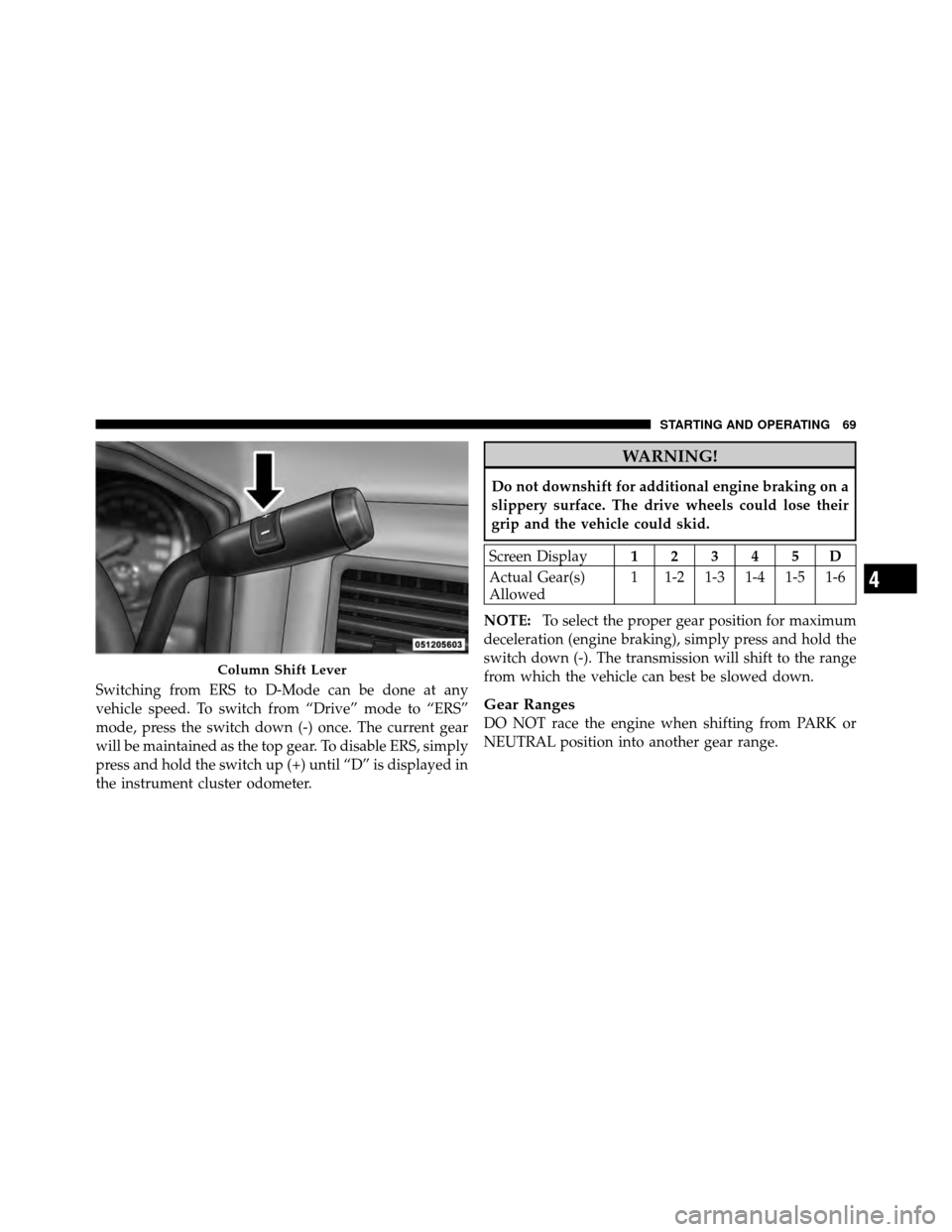
Switching from ERS to D-Mode can be done at any
vehicle speed. To switch from “Drive” mode to “ERS”
mode, press the switch down (-) once. The current gear
will be maintained as the top gear. To disable ERS, simply
press and hold the switch up (+) until “D” is displayed in
the instrument cluster odometer.
WARNING!
Do not downshift for additional engine braking on a
slippery surface. The drive wheels could lose their
grip and the vehicle could skid.
Screen Display12345D
Actual Gear(s)
Allowed 1 1-2 1-3 1-4 1-5 1-6
NOTE: To select the proper gear position for maximum
deceleration (engine braking), simply press and hold the
switch down (-). The transmission will shift to the range
from which the vehicle can best be slowed down.
Gear Ranges
DO NOT race the engine when shifting from PARK or
NEUTRAL position into another gear range.
Column Shift Lever
4
STARTING AND OPERATING 69
Page 71 of 170

PARK
This range supplements the parking brake by locking the
transmission. The engine can be started in this range.
Never use PARK while the vehicle is in motion. Apply
the parking brake when leaving the vehicle in this range.
Always apply parking brake first, then place the shift
lever in PARK position. On four-wheel drive vehicles be
sure that the transfer case is in a drive position.
WARNING!
•Never use the PARK position as a substitute for
the parking brake. Always apply the parking
brake fully when parked to guard against vehicle
movement and possible injury or damage.(Continued)
WARNING! (Continued)
•Your vehicle could move and injure you and others
if it is not completely in PARK. Check by trying to
move the shift lever back and forth without first
pulling it toward you after you have set it in
PARK. Make sure it is in PARK before leaving the
vehicle.
•It is dangerous to move the shift lever out of PARK
or NEUTRAL if the engine speed is higher than
idle speed. If your foot is not firmly on the brake
pedal, the vehicle could accelerate quickly forward
or in reverse. You could lose control of the vehicle
and hit someone or something. Only shift into
gear when the engine is idling normally and when
your right foot is firmly on the brake pedal.
70 STARTING AND OPERATING
Page 74 of 170
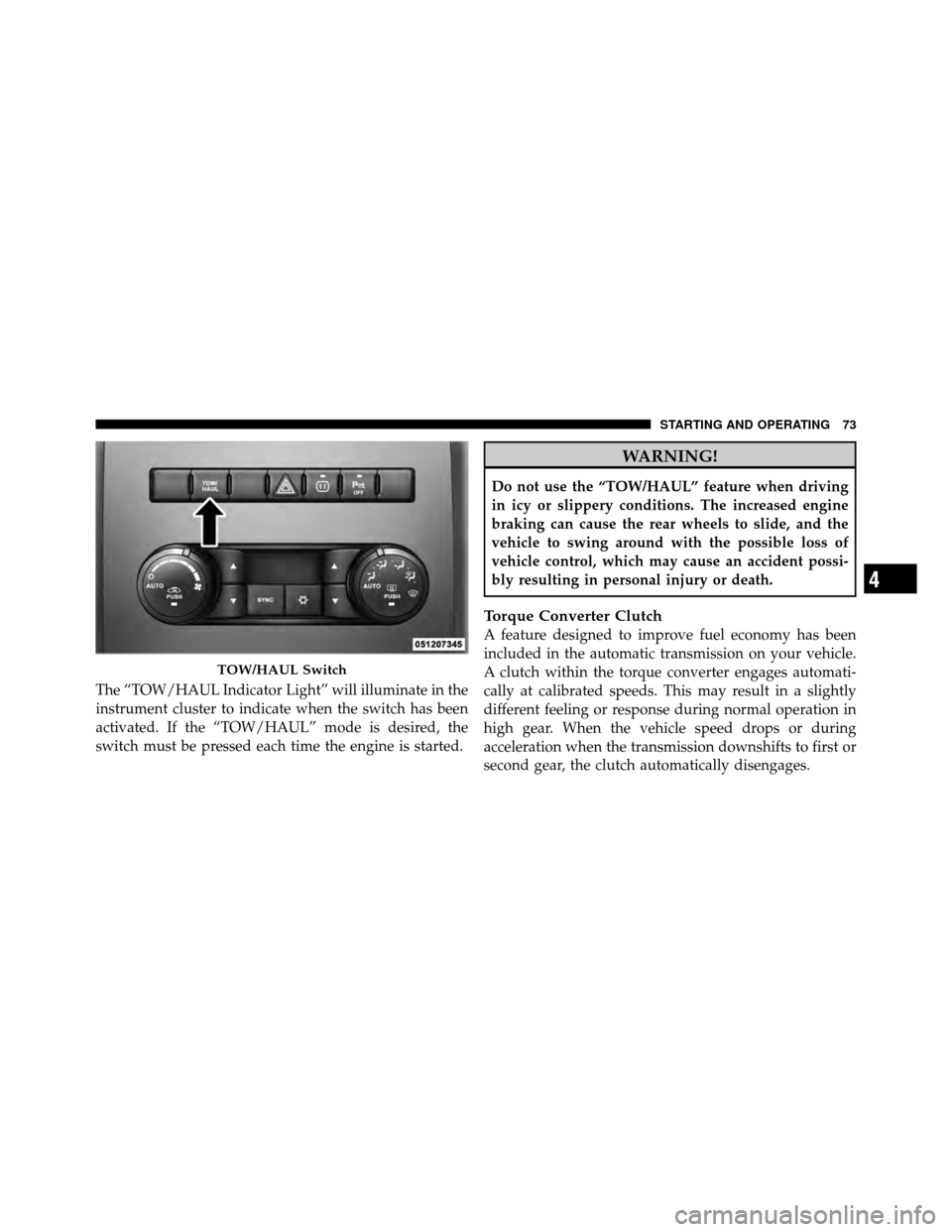
The “TOW/HAUL Indicator Light” will illuminate in the
instrument cluster to indicate when the switch has been
activated. If the “TOW/HAUL” mode is desired, the
switch must be pressed each time the engine is started.
WARNING!
Do not use the “TOW/HAUL” feature when driving
in icy or slippery conditions. The increased engine
braking can cause the rear wheels to slide, and the
vehicle to swing around with the possible loss of
vehicle control, which may cause an accident possi-
bly resulting in personal injury or death.
Torque Converter Clutch
A feature designed to improve fuel economy has been
included in the automatic transmission on your vehicle.
A clutch within the torque converter engages automati-
cally at calibrated speeds. This may result in a slightly
different feeling or response during normal operation in
high gear. When the vehicle speed drops or during
acceleration when the transmission downshifts to first or
second gear, the clutch automatically disengages.
TOW/HAUL Switch
4
STARTING AND OPERATING 73
Page 77 of 170
vehicle speeds listed for acceleration. When heavily
loaded or pulling a trailer these recommended up-shift
speeds may not apply.
Maximum Recommended Up-Shift Speeds
Gear
Selec- tion Lto2 2to3 3to4 4to5 5to6
Maxi- mum
Speed 7 mph
(11
km/h) 15 mph
(24
km/h) 25 mph
(40
km/h) 40 mph
(64
km/h) 45 mph
(72
km/h)
Downshifting
Moving from a high gear down to a lower gear is
recommended to preserve brakes when driving down
steep hills. In addition, downshifting at the right time
provides better acceleration when you desire to resume
speed. Downshift progressively. Do not skip gears to
avoid overspeeding the engine and clutch.
WARNING!
Do not downshift for additional engine braking on a
slippery surface. The drive wheels could lose their
grip and the vehicle could skid.
CAUTION!
When descending a hill, be very careful to downshift
one gear at a time to prevent overspeeding the engine
which can cause valve damage, and/or clutch disc
damage even if the clutch pedal is pressed.
76 STARTING AND OPERATING