Page 45 of 636
tilt the latch plate and pull on the lap belt. A snug belt
reduces the risk of sliding under the belt in an accident.WARNING!
•A lap belt worn too high can increase the risk of
internal injury in an accident. The belt forces
won’t be at the strong hip and pelvic bones, but
across your abdomen. Always wear the lap belt as
low as possible and keep it snug.
•A twisted belt will not protect you properly. In a
collision, it could even cut into you. Be sure the
belt is straight. If you can’t straighten a belt in a
vehicle, take it to your authorized dealer immedi-
ately and have it fixed.
5. Position the shoulder belt on your chest so that it is
comfortable and not resting on your neck. The retractor
will withdraw any slack in the belt.
Removing Slack From Belt
2
THINGS TO KNOW BEFORE STARTING YOUR VEHICLE 43
Page 46 of 636
6. To release the belt, push the red button on the buckle.
The belt will automatically retract to its stowed position.
If necessary, slide the latch plate down the webbing to
allow the belt to retract fully.
WARNING!
A frayed or torn belt could rip apart in an accident
and leave you with no protection. Inspect the belt
system periodically, checking for cuts, frays, or loose
parts. Damaged parts must be replaced immediately.
Do not disassemble or modify the system. Seat belt
assemblies must be replaced after an accident if they
have been damaged (bent retractor, torn webbing,
etc.) or if the airbag deployed.
Regular Cab Front Center Three Point Belt
1. The front center seat belt on the Regular Cab may be
disconnected to open up utilization of the storage areas
behind the front seats. The black latch plate can be
detached from the black keyed seat belt buckle located on
the inboard side of the passenger seat. Insert the seat belt
tongue into the center red slot on the black buckle. The
black buckle latch plate can be removed when the seat
belt tongue is pressed into the buckle. Allow the retractor
to take up the extra webbing, and the buckles will hang
vertically from the cab back exit bezel, thus freeing up all
the area behind the front seats.
44 THINGS TO KNOW BEFORE STARTING YOUR VEHICLE
Page 47 of 636
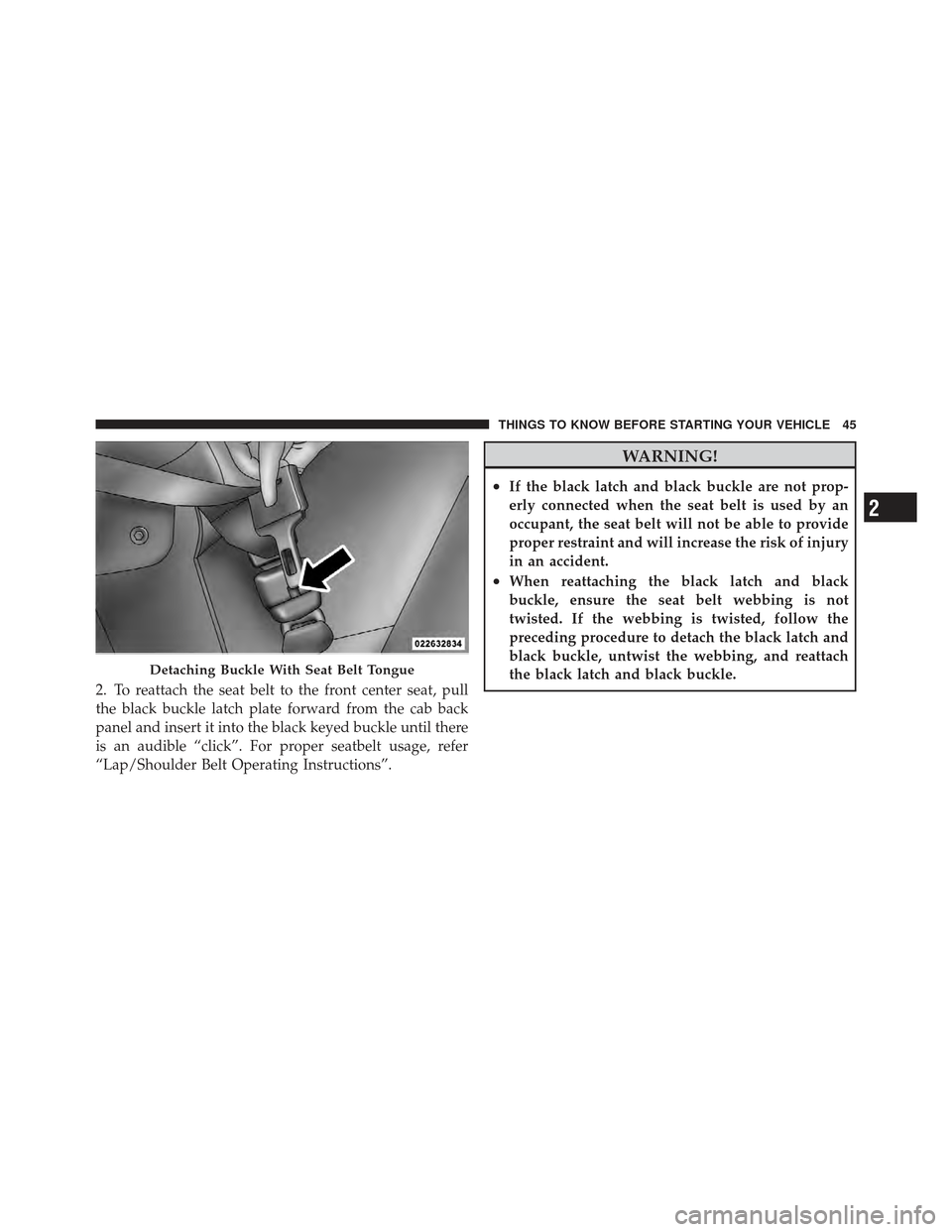
2. To reattach the seat belt to the front center seat, pull
the black buckle latch plate forward from the cab back
panel and insert it into the black keyed buckle until there
is an audible “click”. For proper seatbelt usage, refer
“Lap/Shoulder Belt Operating Instructions”.
WARNING!
•If the black latch and black buckle are not prop-
erly connected when the seat belt is used by an
occupant, the seat belt will not be able to provide
proper restraint and will increase the risk of injury
in an accident.
•When reattaching the black latch and black
buckle, ensure the seat belt webbing is not
twisted. If the webbing is twisted, follow the
preceding procedure to detach the black latch and
black buckle, untwist the webbing, and reattach
the black latch and black buckle.
Detaching Buckle With Seat Belt Tongue
2
THINGS TO KNOW BEFORE STARTING YOUR VEHICLE 45
Page 49 of 636

Lap/Shoulder Belt Untwisting Procedure
Use the following procedure to untwist a twisted lap/
shoulder belt.
1. Position the latch plate as close as possible to the
anchor point.
2. At about 6 to 12 in (15 to 30 cm) above the latch plate,
grasp and twist the belt webbing 180 degrees to create a
fold that begins immediately above the latch plate.
3. Slide the latch plate upward over the folded webbing.
The folded webbing must enter the slot at the top of the
latch plate.
4. Continue to slide the latch plate up until it clears the
folded webbing.
Adjustable Upper Shoulder Belt Anchorage
In the front row outboard seats, the shoulder belt can be
adjusted upward or downward to help position the belt
away from your neck. Squeeze the anchorage buttonlocated on the upper belt guide to release the anchorage,
and then move it up or down to the position that fits you
best.
As a guide, if you are shorter than average you will
prefer a lower position, and if you are taller than average
Adjusting Upper Shoulder Belt
2
THINGS TO KNOW BEFORE STARTING YOUR VEHICLE 47
Page 50 of 636

you will prefer a higher position. When you release the
anchorage, try to move it up or down to make sure that
it is locked in position.
Center Lap Belts
The center seating position for the Quad Cab�, Mega
Cab�and Crew Cab front seat has a lap belt only. To
fasten the lap belt, slide the latch plate into the buckle
until you hear a �click.�To lengthen the lap belt, tilt the
latch plate and pull. To remove slack, pull the loose end
of the webbing. Wear the lap belt snug against the hips.
Sit back and erect in the seat, then adjust the belt as
tightly as is comfortable.
WARNING!
•A lap belt worn too loose or too high is dangerous.
•A belt worn too loose can allow you to slip down
and under the belt in a collision.
(Continued)
WARNING! (Continued)
•A belt that is too loose or too high will apply crash
forces to the abdomen, not to the stronger hip
bones. In either case, the risk of internal injuries is
greater. Wear a lap belt low and snug.
Energy Management Feature
This vehicle has a safety belt system with an energy
management feature in the front seating positions to help
further reduce the risk of injury in the event of a head-on
accident.
This safety belt system has a retractor assembly that is
designed to release webbing in a controlled manner. This
feature is designed to help reduce the belt force acting on
the occupant’s chest.
48 THINGS TO KNOW BEFORE STARTING YOUR VEHICLE
Page 51 of 636

WARNING!
•The belt and retractor assembly must be replaced
if the seat belt assembly “Automatic Locking Re-
tractor (ALR)” feature or any other seat belt func-
tion is not working properly when checked ac-
cording to the procedures in the Service Manual.
•Failure to replace the belt and retractor assembly
could increase the risk of injury in accidents.
Seat Belts In Passenger Seating Positions
The seat belts in the passenger seating positions are
equipped with Automatic Locking Retractors (ALR)
which are used to secure a child restraint system. For
additional information, refer to “Installing Child Re-
straints Using The Vehicle Seat Belt” under the “Child
Restraints” section. The chart below defines the type of
feature for each seating position.
Driver Center Passenger
First Row N/A N/A ALR
Second Row ALR Cinch ALR Third Row N/A N/A N/A
•N/A — Not Applicable
•ALR — Automatic Locking Retractor
If the passenger seating position is equipped with an
ALR and is being used for normal usage:
Only pull the belt webbing out far enough to comfortably
wrap around the occupant’s mid-section so as to not
activate the ALR. If the ALR is activated, you will hear a
ratcheting sound as the belt retracts. Allow the webbing
to retract completely in this case and then carefully pull
out only the amount of webbing necessary to comfort-
ably wrap around the occupant’s mid-section. Slide the
latch plate into the buckle until you hear a �click.�
2
THINGS TO KNOW BEFORE STARTING YOUR VEHICLE 49
Page 52 of 636

Automatic Locking Retractor (ALR) Mode – If
Equipped
In this mode, the shoulder belt is automatically pre-
locked. The belt will still retract to remove any slack in
the shoulder belt.
When To Use The Automatic Locking Mode
Use the Automatic Locking Mode anytime a child safety
seat is installed in a seating position that has a belt with
this feature. Children 12 years old and under should
always be properly restrained in the rear seat.
How To Engage The Automatic Locking Mode
1. Buckle the combination lap and shoulder belt.
2. Grasp the shoulder portion and pull downward until
the entire belt is extracted.
3. Allow the belt to retract. As the belt retracts, you will
hear a clicking sound. This indicates the safety belt is
now in the Automatic Locking Mode.
How To Disengage The Automatic Locking Mode
Unbuckle the combination lap/shoulder belt and allow it
to retract completely to disengage the Automatic Locking
Mode and activate the vehicle sensitive (emergency)
locking mode.
WARNING!
•The belt and retractor assembly must be replaced
if the seat belt assembly Automatic Locking Re-
tractor (ALR) feature or any other seat belt func-
tion is not working properly when checked ac-
cording to the procedures in the Service Manual.
•Failure to replace the belt and retractor assembly
could increase the risk of injury in collisions.
Seat Belt Pretensioners — If Equipped
The seat belts for both front seating positions may be
equipped with pretensioning devices that are designed to
remove slack from the seat belt in the event of an
50 THINGS TO KNOW BEFORE STARTING YOUR VEHICLE
Page 53 of 636

accident. These devices may improve the performance of
the seat belt by assuring that the belt is tight around the
occupant early in a collision. Pretensioners work for all
size occupants, including those in child restraints.
NOTE:These devices are not a substitute for proper seat
belt placement by the occupant. The seat belt still must be
worn snugly and positioned properly.
The pretensioners are triggered by the Occupant Re-
straint Controller (ORC). Like the airbags, the pretension-
ers are single use items. A deployed pretensioner or a
deployed airbag must be replaced immediately.
Enhanced Seat Belt Use Reminder System
(BeltAlert�)
BeltAlert� is a feature intended to remind the driver to
fasten their seatbelt. This feature is active whenever the
ignition is on. If the driver is unbelted, the Seat Belt
Reminder Light will turn on and remain on until the
driver seatbelt is fastened. BeltAlert� triggers within60 seconds of vehicle speed over 5 mph (8 km/h). The
reminder sequence lasts for 96 seconds or until the driver
seatbelt is fastened. After the sequence completes, the
Seat Belt Reminder Light remains illuminated until the
driver front belt is fastened. The driver should instruct all
other occupants to fasten their seatbelts. If the driver
seatbelt is unbuckled while traveling at speeds greater
than 5 mph (8 km/h), BeltAlert�
will chime as a single
notification and illuminate the Seat Belt Reminder Light,
then will proceed to the 96 second reminder sequence.
BeltAlert� can be enabled or disabled by your authorized
dealer or by performing the following procedure:
NOTE: The following steps must occur within the first
60 seconds of the ignition switch being turned to the
ON/RUN or START position. Chrysler Group LLC does
not recommend deactivating the BeltAlert�.
2
THINGS TO KNOW BEFORE STARTING YOUR VEHICLE 51