Page 481 of 636

Recreational Towing – Two-Wheel Drive Models
DO NOT flat tow this vehicle. Damage to the drivetrain
will result.
Recreational towing (for two-wheel drive models) is
allowed ONLY if the rear wheels are OFF the ground.
This may be accomplished using a tow dolly or vehicle
trailer. If using a tow dolly, follow this procedure:
1. Properly secure the dolly to the tow vehicle, following
the dolly manufacturer’s instructions.
2. Drive the rear wheels onto the tow dolly.
3. Firmly set the parking brake. Place automatic trans-
mission in PARK, manual transmission in gear (not in
Neutral).
4. Properly secure the rear wheels to the dolly, following
the dolly manufacturer’s instructions.
5. Remove the key fob from the ignition switch.6. Install a suitable clamping device, designed for tow-
ing, to secure the front wheels in the straight position.
CAUTION!
•Towing with the rear wheels on the ground will
cause severe transmission damage. Damage from
improper towing is not covered under the New
Vehicle Limited Warranty.
•Do not disconnect the driveshaft because fluid
will leak from the transmission, causing damage
to internal parts.
Recreational Towing – Four-Wheel Drive Models
NOTE:
Both the manual shift and electronic shift trans-
fer cases must be shifted into NEUTRAL for recreational
towing. Automatic transmissions must be shifted into
PARK for recreational towing. Manual transmissions
5
STARTING AND OPERATING 479
Page 482 of 636

must be placed in gear (NOT in NEUTRAL) for recre-
ational towing. Refer to the following for the proper
transfer case NEUTRAL shifting procedure for your
vehicle.
CAUTION!
•Front or rear wheel lifts should not be used.
Internal damage to the transmission or transfer
case will occur if a front or rear wheel lift is used
when recreational towing.
•Tow only in the forward direction. Towing this
vehicle backwards can cause severe damage to the
transfer case.
•Automatic transmissions must be placed in the
PARK position for recreational towing.
•Manual transmissions must be placed in gear (not
in Neutral) for recreational towing.(Continued)
CAUTION! (Continued)
•Before recreational towing, perform the procedure
outlined under “Shifting Into NEUTRAL” to be
certain that the transfer case is fully in NEUTRAL.
Otherwise, internal damage will result.
•Towing this vehicle in violation of the above
requirements can cause severe transmission and/or
transfer case damage. Damage from improper tow-
ing is not covered under the New Vehicle Limited
Warranty.
•Do not disconnect the rear driveshaft because
fluid will leak from the transfer case, causing
damage to internal parts.
•Do not use a bumper-mounted clamp-on tow bar
on your vehicle. The bumper face bar will be
damaged.
480 STARTING AND OPERATING
Page 491 of 636
WHAT TO DO IN EMERGENCIES
CONTENTS
�Hazard Warning Flashers ................ 491
� Jacking And Tire Changing ............... 491
▫ Jack Location ....................... 492
▫ Removing The Spare Tire ............... 497
▫ Preparations ........................ 498
▫ Instructions ........................ 499
▫ Hub Caps/Wheel Covers — If Equipped . . . 505
▫ Wheel Nuts ........................ 506
▫ To Stow The Flat Or Spare .............. 509�
Hoisting ............................ 510
� Jump-Starting Procedures ................ 510
▫ Preparations For Jump-Start ............. 510
▫ Jump-Starting Procedure ............... 512
� Freeing A Stuck Vehicle ................. 514
� Emergency Tow Hooks — If Equipped ...... 515
� Shift Lever Override ................... 516
▫ Column Shifter — If Equipped ........... 516
▫ Center Console Shifter — If Equipped ..... 517
6
Page 492 of 636
�Towing A Disabled Vehicle ............... 518
▫ Towing Without The Ignition Key FOB ..... 519▫
Two-Wheel Drive Models .............. 520
▫ Four-Wheel Drive Vehicles .............. 520
490 WHAT TO DO IN EMERGENCIES
Page 493 of 636

HAZARD WARNING FLASHERS
The Hazard Warning flasher switch is located on the
upper switch bank just below the radio.Press the switch to turn on the Hazard Warning
flasher. When the switch is activated, all directional
turn signals will flash on and off to warn oncoming
traffic of an emergency. Press the switch a second time to
turn off the Hazard Warning flashers.
This is an emergency warning system and it should not
be used when the vehicle is in motion. Use it when your
vehicle is disabled and it is creating a safety hazard for
other motorists.
When you must leave the vehicle to seek assistance, the
Hazard Warning flashers will continue to operate even
though the ignition is placed in the OFF position.
NOTE: With extended use the Hazard Warning flashers
may wear down your battery.
JACKING AND TIRE CHANGING
WARNING!
•Do not attempt to change a tire on the side of the
vehicle close to moving traffic. Pull far enough off
the road to avoid the danger of being hit when
operating the jack or changing the wheel.
•Being under a jacked-up vehicle is dangerous. The
vehicle could slip off the jack and fall on you. You
could be crushed. Never put any part of your body
under a vehicle that is on a jack.
•Never start or run the engine while the vehicle is
on a jack. If you need to get under a raised vehicle,
take it to a service center where it can be raised on
a lift.
(Continued)6
WHAT TO DO IN EMERGENCIES 491
Page 499 of 636
Removing The Spare Tire
Remove the spare tire before attempting to jack up the
truck. Attach the wheel wrench to the jack extension tube.
Insert the tube through the access hole between the lower
tailgate and the top of the bumper and into the winch
mechanism tube. Rotate the wheel wrench handle coun-
terclockwise until the spare tire is on the ground withenough cable slack to allow you to pull it out from under
the vehicle. When the spare is clear, tilt the retainer at the
end of the cable and pull it through the center of the wheel.
NOTE:
Always stow the spare tire with the valve stem
facing the ground.
Jack And Tools (2500/3500 Series)
Removing The Spare Tire
1 — Wheel Wrench
2 — Spare Tire
6
WHAT TO DO IN EMERGENCIES 497
Page 500 of 636

It is recommended that you stow the flat or spare to
avoid tangling the loose cable.
NOTE:The winch mechanism is designed for use with
the jack extension tube only. Use of an air wrench or other
power tools is not recommended and can damage the
winch.
Preparations
1. Park the vehicle on a firm, level surface. Avoid ice or
slippery areas.
WARNING!
Do not attempt to change a tire on the side of the
vehicle close to moving traffic, pull far enough off
the road to avoid the danger of being hit when
operating the jack or changing the wheel.
2. Turn on the Hazard Warning flasher. 3. Set the parking brake.
4. Place the shift lever into PARK. On four-wheel drive
vehicles, shift the transfer case to the 4L position.
5. Turn the ignition OFF.
6. Block both the front and rear of the
wheel diagonally opposite the jacking
position. For example, if the right front
wheel is being changed, block the left
rear wheel.
NOTE: Passengers should not remain in the vehicle
when the vehicle is being jacked.
498 WHAT TO DO IN EMERGENCIES
Page 501 of 636
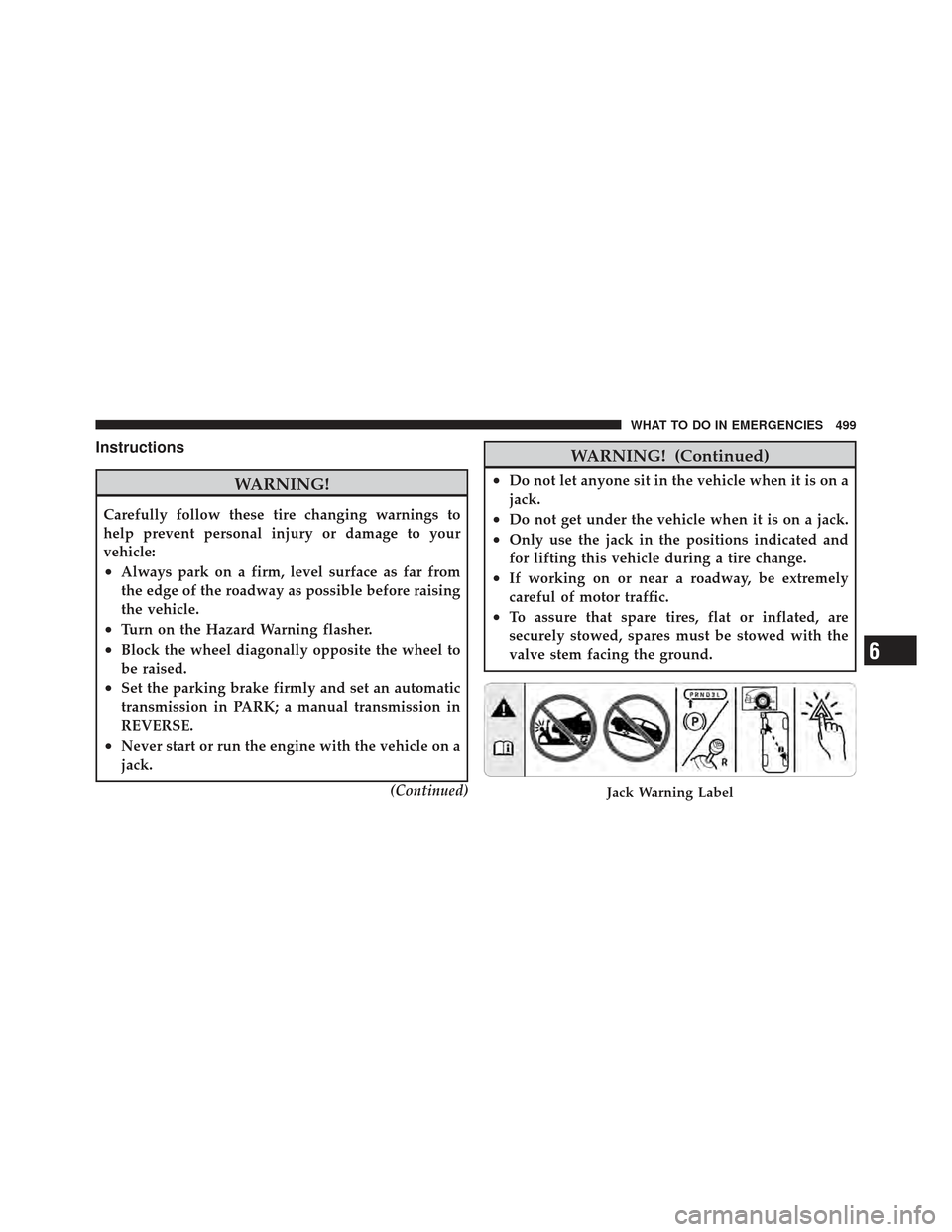
Instructions
WARNING!
Carefully follow these tire changing warnings to
help prevent personal injury or damage to your
vehicle:
•Always park on a firm, level surface as far from
the edge of the roadway as possible before raising
the vehicle.
•Turn on the Hazard Warning flasher.
•Block the wheel diagonally opposite the wheel to
be raised.
•Set the parking brake firmly and set an automatic
transmission in PARK; a manual transmission in
REVERSE.
•Never start or run the engine with the vehicle on a
jack.(Continued)
WARNING! (Continued)
•Do not let anyone sit in the vehicle when it is on a
jack.
•Do not get under the vehicle when it is on a jack.
•Only use the jack in the positions indicated and
for lifting this vehicle during a tire change.
•If working on or near a roadway, be extremely
careful of motor traffic.
•To assure that spare tires, flat or inflated, are
securely stowed, spares must be stowed with the
valve stem facing the ground.
Jack Warning Label
6
WHAT TO DO IN EMERGENCIES 499


