2011 Peugeot 308 SW BL change wheel
[x] Cancel search: change wheelPage 12 of 356
10
FAMILIARISATION
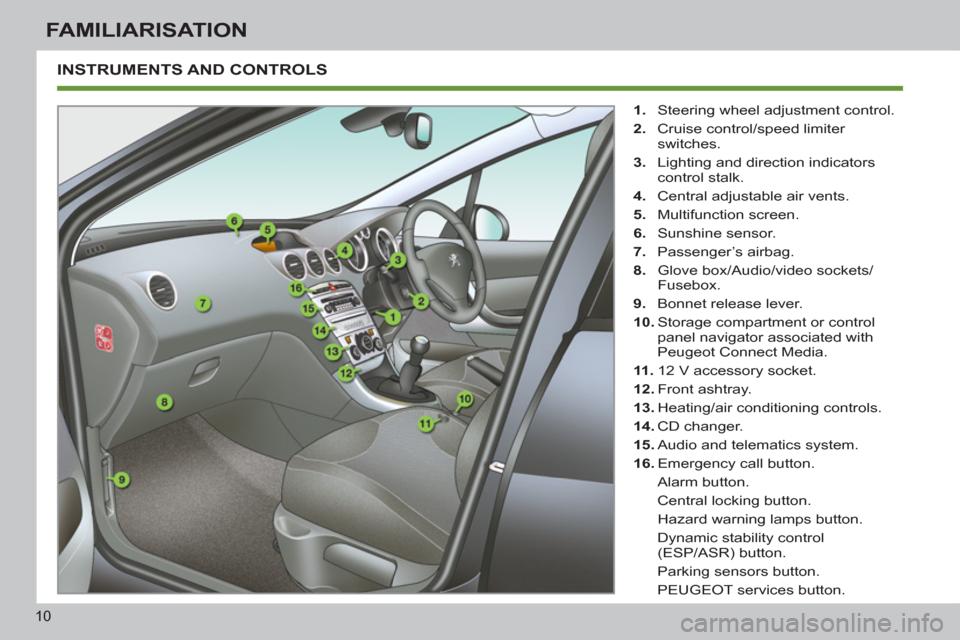
INSTRUMENTS AND CONTROLS
1.
Steering wheel adjustment control.
2.
Cruise control/speed limiter
switches.
3.
Lighting and direction indicators
control stalk.
4.
Central adjustable air vents.
5.
Multifunction screen.
6.
Sunshine sensor.
7.
Passenger’s airbag.
8.
Glove box/Audio/video sockets/
Fusebox.
9.
Bonnet release lever.
10.
Storage compartment or control
panel navigator associated with
Peugeot Connect Media.
11 .
12 V accessory socket.
12.
Front ashtray.
13.
Heating/air conditioning controls.
14.
CD changer.
15.
Audio and telematics system.
16.
Emergency call button.
Alarm button.
Central locking button.
Hazard warning lamps button.
Dynamic stability control
(ESP/ASR) button.
Parking sensors button.
PEUGEOT services button.
Page 26 of 356
Limit the causes of excess
consumption
Spread loads throughout the vehicle;
place the heaviest items in the bottom
of the boot, as close as possible to the
rear seats.
Limit the loads carried in the vehicle
and reduce wind resistance (roof bars,
roof rack, bicycle carrier, trailer...). Use
a roof box in preference.
Remove roof bars and roof racks after
use.
At the end of winter, remove snow
tyres and refi t your summer tyres.
Observe the recommendations
on maintenance
Check the tyre pressures regularly,
when cold, referring to the label in the
door aperture, driver's side.
Carry out this check in particular:
- before a long journey,
- at each change of season,
- after a long period out of use.
Don't forget the spare wheel and the
tyres on any trailer or caravan.
Have your vehicle serviced regularly
(engine oil, oil fi lter, air fi lter...) and
observe the schedule of operations
recommended by the manufacturer.
When refuelling, do not continue after
the 3 rd cut-off of the nozzle to avoid
any overfl ow.
At the wheel of your new vehicle,
it is only after the fi rst 1 800 miles
(3 000 kilometres) that you will see
the fuel consumption settle down to a
consistent average.
24
Page 84 of 356
3
i
!
!
82
COMFORT
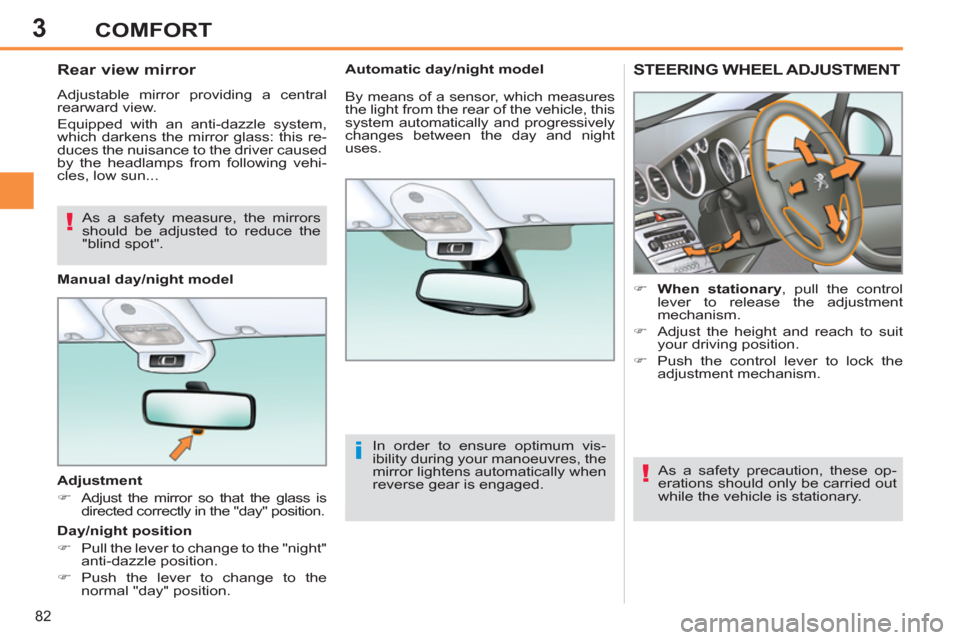
STEERING WHEEL ADJUSTMENT
)
When stationary
, pull the control
lever to release the adjustment
mechanism.
)
Adjust the height and reach to suit
your driving position.
)
Push the control lever to lock the
adjustment mechanism.
As a safety precaution, these op-
erations should only be carried out
while the vehicle is stationary.
Automatic day/night model
In order to ensure optimum vis-
ibility during your manoeuvres, the
mirror lightens automatically when
reverse gear is engaged.
By means of a sensor, which measures
the light from the rear of the vehicle, this
system automatically and progressively
changes between the day and night
uses.
Adjustment
)
Adjust the mirror so that the glass is
directed correctly in the "day" position.
As a safety measure, the mirrors
should be adjusted to reduce the
"blind spot".
Manual day/night model
Day/night position
)
Pull the lever to change to the "night"
anti-dazzle position.
)
Push the lever to change to the
normal "day" position.
Rear view mirror
Adjustable mirror providing a central
rearward view.
Equipped with an anti-dazzle system,
which darkens the mirror glass: this re-
duces the nuisance to the driver caused
by the headlamps from following vehi-
cles, low sun...
Page 138 of 356
8
!
i
i
i
136
SAFETY
TYRE UNDER-INFLATION
DETECTION
System which automatically and contin-
uously checks the pressure of the tyres
while driving.
All repairs and changing of tyres on a wheel fi tted with this system must
be carried out by a PEUGEOT
dealer or a qualifi ed workshop.
If, when changing a tyre, you fi t a
wheel which is not detected by your
vehicle (example: fi tting of snow
tyres), you must have the system
reinitialised by a PEUGEOT dealer
or a qualifi ed workshop.
This system does not avoid the
need to have the tyre pressures
checked regularly (refer to the
"Identifi cation markings" section) to
ensure that the optimum dynamic
performance of the vehicle is main-
tained and prevent premature wear
of the tyres, particularly in arduous
driving conditions (heavy load, high
speed).
The tyre pressures must be checked cold, at least once a month. Re-
member to check the pressure of
the spare wheel.
The tyre under-infl ation detection
system may experience temporary
interference due to electro-magnetic
emissions on a frequency close to
that used by the system.
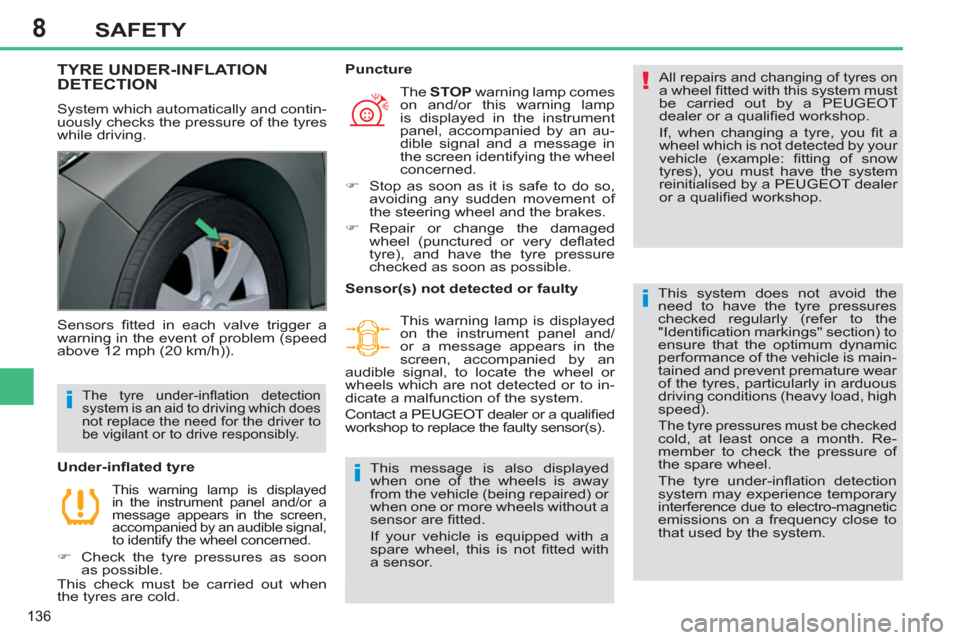
Sensors fi tted in each valve trigger a
warning in the event of problem (speed
above 12 mph (20 km/h)).
This warning lamp is displayed
in the instrument panel and/or a
message appears in the screen,
accompanied by an audible signal,
to identify the wheel concerned.
)
Check the tyre pressures as soon
as possible.
This check must be carried out when
the tyres are cold.
Under-infl ated tyre
The STOP
warning lamp comes
on and/or this warning lamp
is displayed in the instrument
panel, accompanied by an au-
dible signal and a message in
the screen identifying the wheel
concerned.
)
Stop as soon as it is safe to do so,
avoiding any sudden movement of
the steering wheel and the brakes.
)
Repair or change the damaged
wheel (punctured or very defl ated
tyre), and have the tyre pressure
checked as soon as possible.
Puncture
The tyre under-infl ation detection
system is an aid to driving which does
not replace the need for the driver to
be vigilant or to drive responsibly.
Sensor(s) not detected or faulty
This warning lamp is displayed
on the instrument panel and/
or a message appears in the
screen, accompanied by an
audible signal, to locate the wheel or
wheels which are not detected or to in-
dicate a malfunction of the system.
Contact a PEUGEOT dealer or a qualifi ed
workshop to replace the faulty sensor(s).
This message is also displayed
when one of the wheels is away
from the vehicle (being repaired) or
when one or more wheels without a
sensor are fi tted.
If your vehicle is equipped with a
spare wheel, this is not fi tted with
a sensor.
Page 153 of 356
9
i
151
DRIVING
6-SPEED ELECTRONIC GEAR
CONTROL GEARBOX
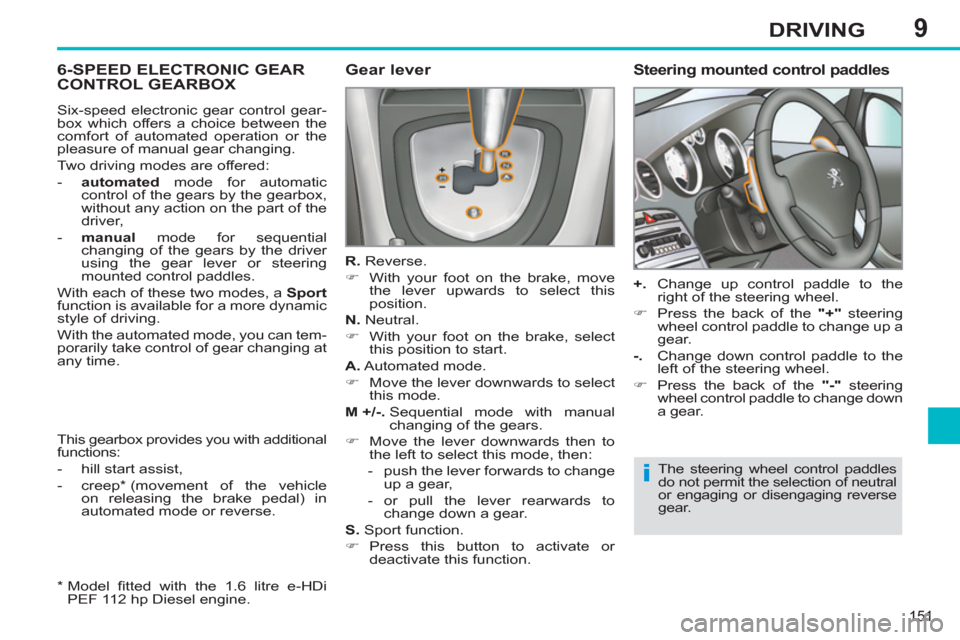
Gear lever
R.
Reverse.
)
With your foot on the brake, move
the lever upwards to select this
position.
N.
Neutral.
)
With your foot on the brake, select
this position to start.
A.
Automated mode.
)
Move the lever downwards to select
this mode.
M +/-.
Sequential mode with manual
changing of the gears.
)
Move the lever downwards then to
the left to select this mode, then:
- push the lever forwards to change
up a gear,
- or pull the lever rearwards to
change down a gear.
S.
Sport function.
)
Press this button to activate or
deactivate this function.
Steering mounted control paddles
+.
Change up control paddle to the
right of the steering wheel.
)
Press the back of the "+"
steering
wheel control paddle to change up a
gear.
-.
Change down control paddle to the
left of the steering wheel.
)
Press the back of the "-"
steering
wheel control paddle to change down
a gear.
The steering wheel control paddles
do not permit the selection of neutral
or engaging or disengaging reverse
gear. Six-speed electronic gear control gear-
box which offers a choice between the
comfort of automated operation or the
pleasure of manual gear changing.
Two driving modes are offered:
- automated
mode for automatic
control of the gears by the gearbox,
without any action on the part of the
driver,
- manual
mode for sequential
changing of the gears by the driver
using the gear lever or steering
mounted control paddles.
With each of these two modes, a Sport
function is available for a more dynamic
style of driving.
With the automated mode, you can tem-
porarily take control of gear changing at
any time.
This gearbox provides you with additional
functions:
- hill start assist,
- creep * (movement of the vehicle
on releasing the brake pedal) in
automated mode or reverse.
*
Model fi tted with the 1.6 litre e-HDi
PEF 112 hp Diesel engine.
Page 191 of 356
11
i
189
PRACTICAL INFORMATION
Parking the vehicle
Immobilise the vehicle where it
does not block traffi c: the ground
must be level, stable and non-slip-
pery ground.
Apply the parking brake, switch off
the ignition and engage fi rst gear *
to lock the wheels.
If necessary, place a chock under
the wheel diagonally opposite the
wheel to be changed.
It is imperative that you ensure that
the occupants get out of the vehicle
and wait where they are safe.
Never go underneath a vehicle
raised using a jack; use an axle
stand.
Removing the wheel
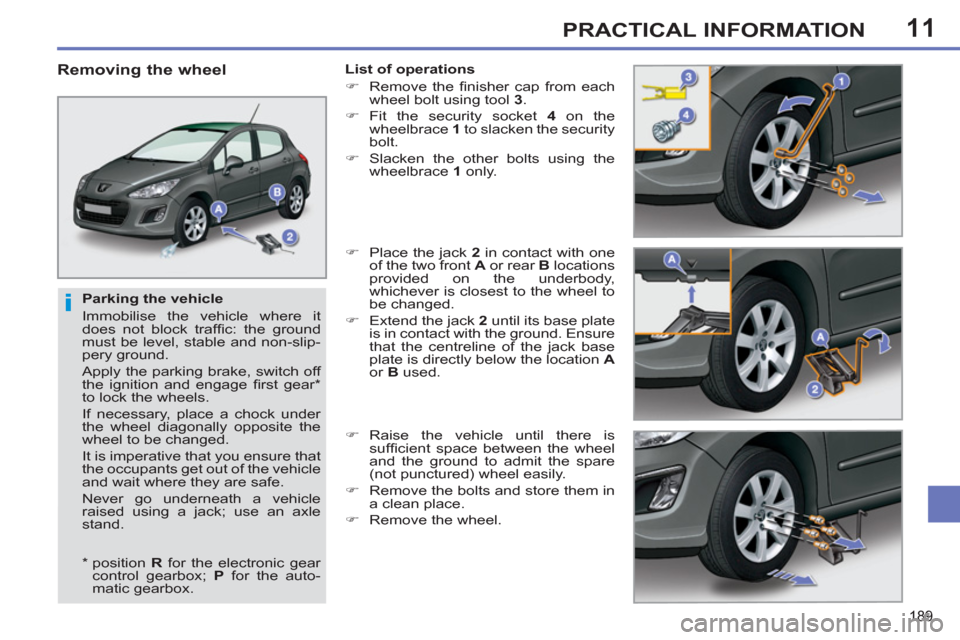
List of operations
)
Remove the fi nisher cap from each
wheel bolt using tool 3
.
)
Fit the security socket 4
on the
wheelbrace 1
to slacken the security
bolt.
)
Slacken the other bolts using the
wheelbrace 1
only.
)
Place the jack 2
in contact with one
of the two front A
or rear B
locations
provided on the underbody,
whichever is closest to the wheel to
be changed.
)
Extend the jack 2
until its base plate
is in contact with the ground. Ensure
that the centreline of the jack base
plate is directly below the location A
or B
used.
)
Raise the vehicle until there is
suffi cient space between the wheel
and the ground to admit the spare
(not punctured) wheel easily.
)
Remove the bolts and store them in
a clean place.
)
Remove the wheel.
*
position R
for the electronic gear
control gearbox; P
for the auto-
matic gearbox.
Page 201 of 356
11
199
PRACTICAL INFORMATION
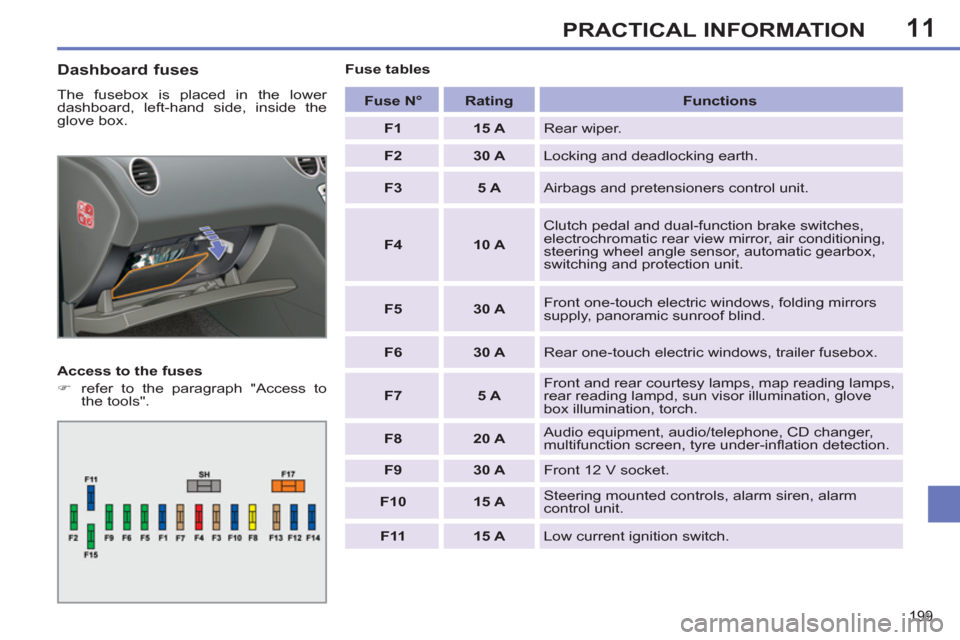
Dashboard fuses
The fusebox is placed in the lower
dashboard, left-hand side, inside the
glove box.
Access to the fuses
)
refer to the paragraph "Access to
the tools".
Fuse tables
Fuse N°
Rating
Functions
F1
15 A
Rear wiper.
F2
30 A
Locking and deadlocking earth.
F3
5 A
Airbags and pretensioners control unit.
F4
10 A
Clutch pedal and dual-function brake switches,
electrochromatic rear view mirror, air conditioning,
steering wheel angle sensor, automatic gearbox,
switching and protection unit.
F5
30 A
Front one-touch electric windows, folding mirrors
supply, panoramic sunroof blind.
F6
30 A
Rear one-touch electric windows, trailer fusebox.
F7
5 A
Front and rear courtesy lamps, map reading lamps,
rear reading lampd, sun visor illumination, glove
box illumination, torch.
F8
20 A
Audio equipment, audio/telephone, CD changer,
multifunction screen, tyre under-infl ation detection.
F9
30 A
Front 12 V socket.
F10
15 A
Steering mounted controls, alarm siren, alarm
control unit.
F11
15 A
Low current ignition switch.