Page 42 of 280
40
The high voltage battery must not in any
circumstances be charged from an ex-
ternal source and must only be handled
by a workshop technician.
There is the risk of serious burns, as
well as electric arcs that could cause
serious injury or even death.
A used Ni-MH (Nickel Metal Hydride)
type high voltage battery must be re-
moved in an appropriate manner by a
repair workshop, so that its recycling
presents no risk to the environment.
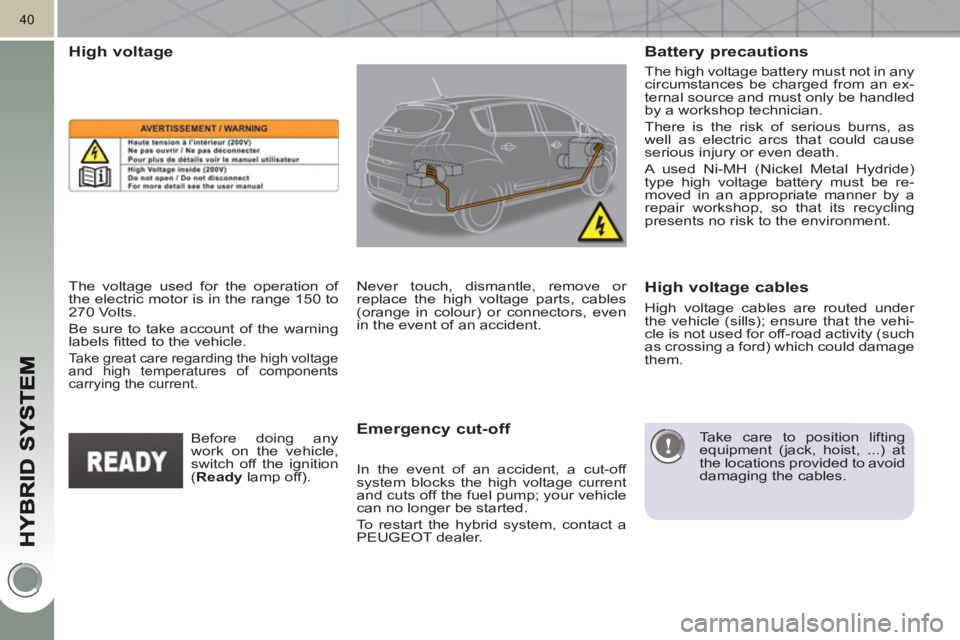
High voltage
The voltage used for the operation of
the electric motor is in the range 150 to
270 Volts.
Be sure to take account of the warning
labels fi tted to the vehicle.
Take great care regarding the high voltage
and high temperatures of components
carrying the current.
Emergency cut-off
Never touch, dismantle, remove or
replace the high voltage parts, cables
(orange in colour) or connectors, even
in the event of an accident.
In the event of an accident, a cut-off
system blocks the high voltage current
and cuts off the fuel pump; your vehicle
can no longer be started.
To restart the hybrid system, contact a
PEUGEOT dealer.
High voltage cables are routed under
the vehicle (sills); ensure that the vehi-
cle is not used for off-road activity (such
as crossing a ford) which could damage
them.
Before doing any
work on the vehicle,
switch off the ignition
( Ready
lamp off).
Battery precautions
High voltage cables
Take care to position lifting
equipment (jack, hoist, ...) at
the locations provided to avoid
damaging the cables.
Page 97 of 280
DIESEL
95
Quality of the fuel used for Diesel engines
The Diesel engines are perfectly com-
patible with biofuels which conform to
current and future European standards
(Diesel fuel which complies with stan-
dard EN 590 mixed with a biofuel which
complies with standard EN 14214)
available at the pumps (containing up
to 7 % Fatty Acid Methyl Ester).
The B30 biofuel can be used in cer-
tain Diesel engines; however, this use
is subject to strict application of the
special servicing conditions. Consult a
PEUGEOT dealer.
The use of any other type of (bio)fuel
(vegetable or animal oils, pure or dilut-
ed, domestic fuel...) is strictly prohibited
(risk of damage to the engine and fuel
system).
This equipment will become available
during the year.
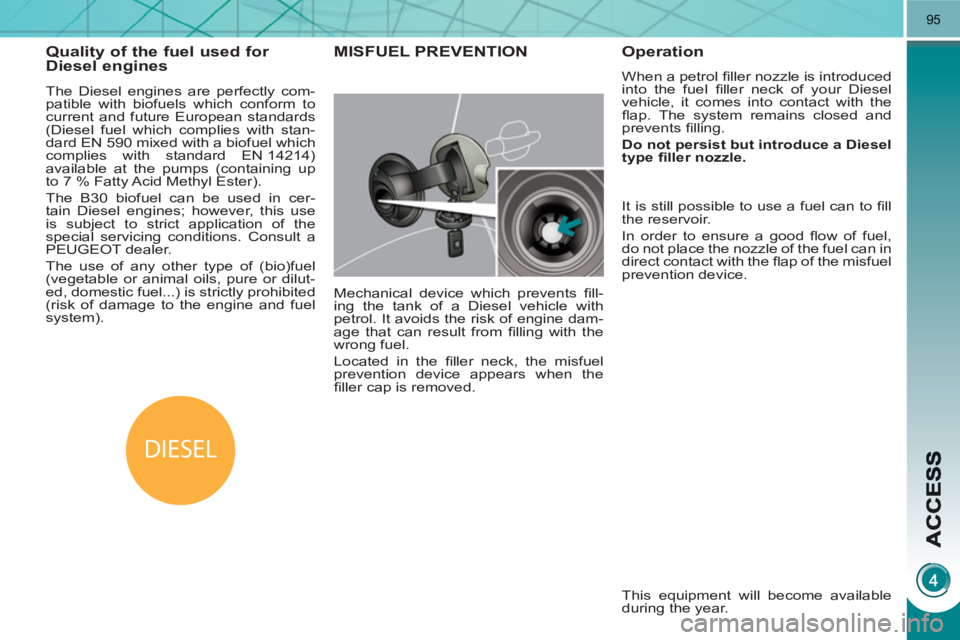
MISFUEL PREVENTION
Mechanical device which prevents fi ll-
ing the tank of a Diesel vehicle with
petrol. It avoids the risk of engine dam-
age that can result from fi lling with the
wrong fuel.
Located in the fi ller neck, the misfuel
prevention device appears when the
fi ller cap is removed.
Operation
When a petrol fi ller nozzle is introduced
into the fuel fi ller neck of your Diesel
vehicle, it comes into contact with the
fl ap. The system remains closed and
prevents fi lling.
Do not persist but introduce a Diesel
type fi ller nozzle.
It is still possible to use a fuel can to fi ll
the reservoir.
In order to ensure a good fl ow of fuel,
do not place the nozzle of the fuel can in
direct contact with the fl ap of the misfuel
prevention device.
Page 160 of 280
CHECKS
158
RUNNING OUT OF FUEL(DIESEL)
The fuel system must be primed if you
run out of fuel; refer to the engine com-
partment view on the "Diesel engine"
page.
If the engine does not start fi rst time,
don't keep trying.
Operate the priming pump again, then
the starter motor.
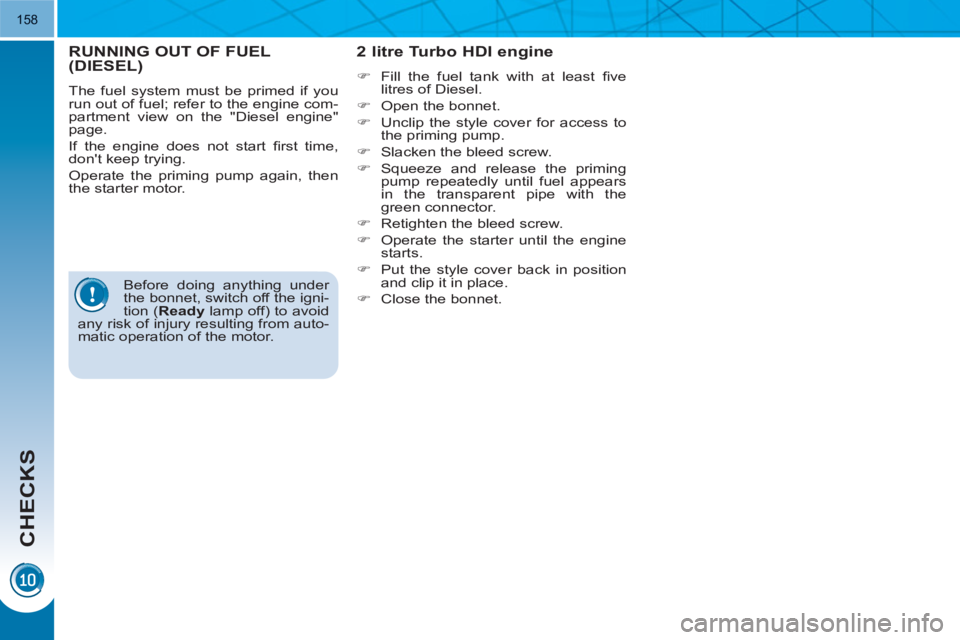
2 litre Turbo HDI engine
)
Fill the fuel tank with at least fi ve
litres of Diesel.
)
Open the bonnet.
)
Unclip the style cover for access to
the priming pump.
)
Slacken the bleed screw.
)
Squeeze and release the priming
pump repeatedly until fuel appears
in the transparent pipe with the
green connector.
)
Retighten the bleed screw.
)
Operate the starter until the engine
starts.
)
Put the style cover back in position
and clip it in place.
)
Close the bonnet.
Before doing anything under
the bonnet, switch off the igni-
tion ( Ready
lamp off) to avoid
any risk of injury resulting from auto-
matic operation of the motor.
Page 161 of 280
CHECKS
159
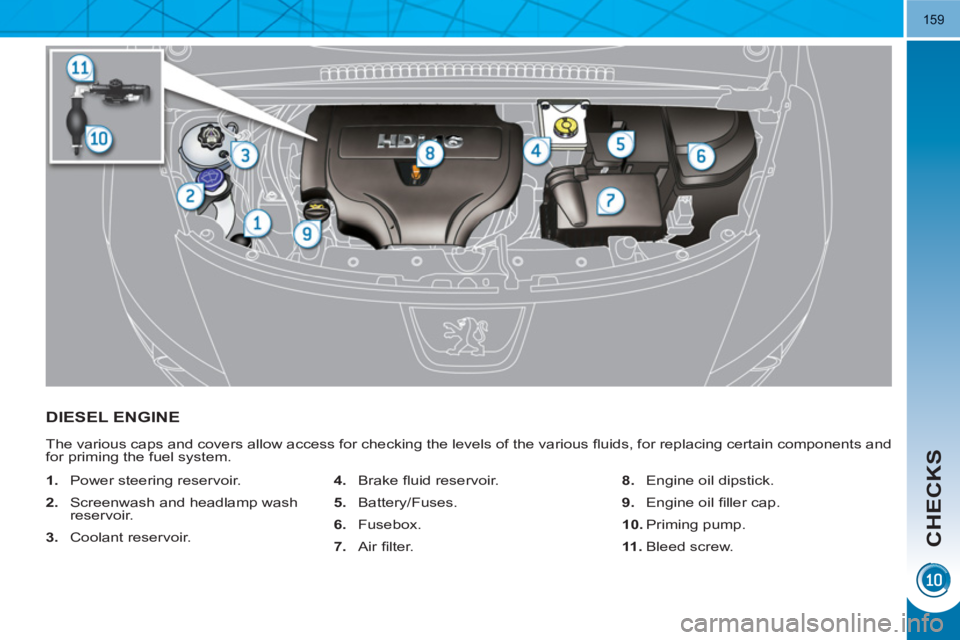
DIESEL ENGINE
The various caps and covers allow access for checking the levels of the various fl uids, for replacing certain components and
for priming the fuel system.
1.
Power steering reservoir.
2.
Screenwash and headlamp wash
reservoir.
3.
Coolant reservoir.
4.
Brake fl uid reservoir.
5.
Battery/Fuses.
6.
Fusebox.
7.
Air fi lter.
8.
Engine oil dipstick.
9.
Engine oil fi ller cap.
10.
Priming pump.
11 .
Bleed screw.