2011 PEUGEOT 207 lock
[x] Cancel search: lockPage 97 of 248
5
!
CHILD SAFETY
95
ADVICE ON CHILD SEATS
Installing a booster seat
The chest part of the seat belt must
be positioned on the child's shoulder
without touching the neck.
Ensure that the lap part of the
seat belt passes correctly over the
child's thighs.
PEUGEOT recommends the use of
a booster seat which has a back, fi t-
ted with a seat belt guide at shoulder
level. The incorrect installation of a child
seat in a vehicle compromises the
child's protection in the event of an
accident.
Remember to fasten the seat belts
or the child seat harnesses keep-
ing the slack relative to the child's
body to a minimum, even for short
journeys.
When installing a child seat using
the seat belt, ensure that the seat
belt is tightened correctly on the
child seat and that it secures the
child seat fi rmly on the seat of your
vehicle. Move the seat forwards if
necessary.
For optimum installation of the "for-
wards-facing" child seat, ensure that
the back of the child seat is in contact
with the back of the vehicle's seat
and that the head restraint does not
cause any discomfort.
If the head restraint has to be re-
moved, ensure that it is stored or
attached securely to prevent it from
being thrown around the vehicle in
the event of sharp braking. As a safety precaution, do not leave:
- a child or children alone and un-
supervised in a vehicle,
- a child or an animal in a vehicle
which is exposed to the sun,
with the windows closed,
- the keys within reach of children
inside the vehicle.
To prevent accidental opening of
the doors and rear windows, use
the "Child lock".
Take care not to open the rear windows
by more than one third.
To protect young children from the
rays of the sun, fi t side blinds on
the rear windows.
Children under the age of 10 must
not travel in the "forwards-facing"
position on the front passenger seat,
unless the rear seats are already
occupied by other children, cannot
be used or are absent.
Deactivate the passenger airbag
when a "rearwards-facing" child
seat is installed on the front seat.
Otherwise, the child would risk being
seriously injured or killed if the airbag
were to infl ate.
Page 98 of 248
5
!
i
CHILD SAFETY
96
The incorrect installation of a child
seat in a vehicle compromises the
child's protection in the event of an
accident.
For information regarding the ISOFIX
child seats which can be installed in
your vehicle, refer to the table giving
the locations for the installation of
ISOFIX child seats.
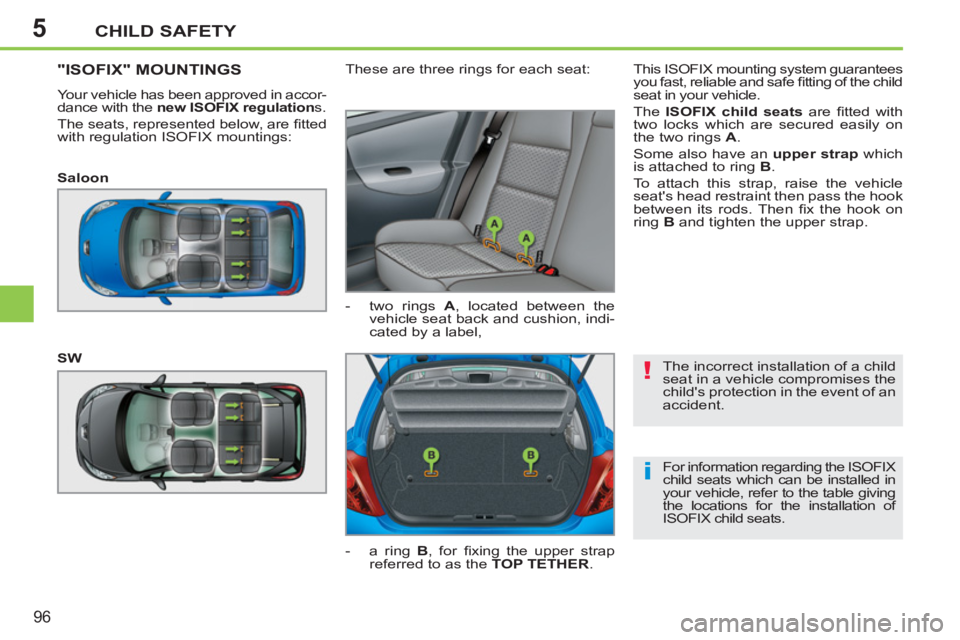
"ISOFIX" MOUNTINGS
Your vehicle has been approved in accor-
dance with the new ISOFIX regulation
s.
The seats, represented below, are fi tted
with regulation ISOFIX mountings: These are three rings for each seat:
- two rings A
, located between the
vehicle seat back and cushion, indi-
cated by a label,
- a ring B
, for fi xing the upper strap
referred to as the TOP TETHER
. This ISOFIX mounting system guarantees
you fast, reliable and safe fi tting of the child
seat in your vehicle.
The ISOFIX child seats
are fi tted with
two locks which are secured easily on
the two rings A
.
Some also have an upper strap
which
is attached to ring B
.
To attach this strap, raise the vehicle
seat's head restraint then pass the hook
between its rods. Then fi x the hook on
ring B
and tighten the upper strap.
Saloon
SW
Page 102 of 248

5
!
CHILD SAFETY
100
This system is independent and in
no circumstances does it take the
place of the central locking control.
Check the status of the child lock
each time you switch on the ignition.
Always remove the key from the
ignition when leaving the vehicle,
even for a short time.
In the event of a serious impact,
the electric child lock is deactivated
automatically to allow the rear pas-
sengers to exit the vehicle.
MANUAL CHILD LOCK
Mechanical system to prevent opening of
the rear door using its interior control.
The control is located on the edge of
each rear door.
)
With the ignition key, turn the red
control one quarter of a turn:
- to the right on the left-hand rear
door,
- to the left on the right-hand rear
door.
ELECTRIC CHILD LOCK
Remote control system to prevent opening
of the rear doors using their interior controls.
The control is located in the centre of
the dashboard.
)
Press button A
.
The indicator lamp on button A
comes
on, accompanied by a message on the
multifunction screen.
Locking
Unlocking
)
With the ignition key, turn the red
control one quarter of a turn:
- to the left on the left-hand rear
door,
- to the right on the right-hand rear
door.
Activation
Deactivation
)
Press button A
again.
The indicator lamp on button A
switches
off, accompanied by a message on the
multifunction screen.
Page 105 of 248
6
i
!
!
SAFETY
103
BRAKING ASSISTANCE
SYSTEMS *
Group of supplementary systems which
help you to obtain optimum braking in
complete safety in emergency situations:
- anti-lock braking system (ABS),
- electronic brake force distribution
(EBFD),
- emergency braking assistance (EBA).
Anti-lock braking system
and electronic brake force
distribution
Linked systems which improve the sta-
bility and manoeuvrability of your vehi-
cle when braking, in particular on poor
or slippery surfaces.
When braking in an emergency,
press very fi rmly without releasing
the pressure.
Emergency braking assistance
System which, in an emergency, en-
ables you to obtain the optimum braking
pressure more quickly, thus reducing
the stopping distance.
Activation
The anti-lock braking system comes
into operation automatically when there
is a risk of wheel lock.
Normal operation of the ABS may make
itself felt by slight vibration of the brake
pedal.
Activation
It is triggered by the speed at which the
brake pedal is pressed.
The effect of this is a reduction in the
resistance of the pedal and an increase
in braking effi ciency.
*
According to country. When braking in an emergency,
press fi rmly without releasing the
pressure.
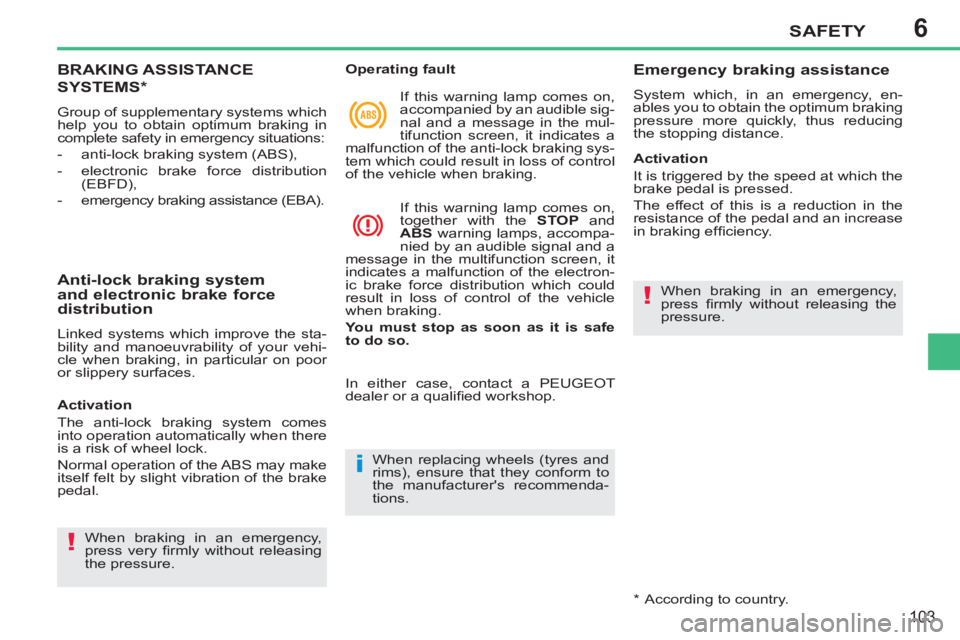
Operating fault
If this warning lamp comes on,
accompanied by an audible sig-
nal and a message in the mul-
tifunction screen, it indicates a
malfunction of the anti-lock braking sys-
tem which could result in loss of control
of the vehicle when braking.
If this warning lamp comes on,
together with the STOP
and
ABS
warning lamps, accompa-
nied by an audible signal and a
message in the multifunction screen, it
indicates a malfunction of the electron-
ic brake force distribution which could
result in loss of control of the vehicle
when braking.
You must stop as soon as it is safe
to do so.
In either case, contact a PEUGEOT
dealer or a qualifi ed workshop.
When replacing wheels (tyres and
rims), ensure that they conform to
the manufacturer's recommenda-
tions.
Page 109 of 248
6
i
SAFETY
107
The driver must ensure that the
passengers use the seat belts cor-
rectly and that they are all properly
restrained before setting off.
Wherever you are seated in the ve-
hicle, always fasten your seat belt,
even for short journeys.
Do not invert the seat belt buckles
as they will not fulfi l their role fully.
If the seats have armrests * , the lap
part of the seat belt must always
pass under the armrest.
The seat belts are fi tted with an in-
ertia reel permitting automatic ad-
justment of the length of the strap
to your size. The seat belt is stored
automatically when not in use.
Before and after use, ensure that
the seat belt is reeled in correctly.
The lower part of the strap must be
positioned as low as possible on
the pelvis.
The upper part must be positioned
in the hollow of the shoulder.
The inertia reels are fi tted with an
automatic locking device which
comes into operation in the event of
a collision, on emergency braking
or if the vehicle rolls over. You can
release the device by pulling rapidly
on the strap and releasing it.
*
According to model. In order to be effective, a seat belt:
- must be tightened as close to the
body as possible,
- must restrain one adult only,
- must not bear any trace of cuts or
fraying,
- must be pulled in front of you with a
smooth movement, checking that it
does not twist,
- must not be transformed or modifi ed
to avoid altering its performance.
In accordance with current safety regu-
lations, all repairs and checks must be
carried out by a PEUGEOT dealer who
can guarantee that the work is carried
out correctly, or qualifi ed workshop.
Have your seat belts checked regularly
by a PEUGEOT dealer or a qualifi ed
workshop and particularly if the straps
show signs of damage.
Clean the seat belt straps with soapy
water or a textile cleaning product, sold
by PEUGEOT dealers.
After folding or moving a seat or rear
bench seat, ensure that the seat belt is
positioned and rolled up correctly.
Recommendations for children:
- use a suitable child seat if the pas-
senger is less than 12 years old or
shorter than one metre fi fty,
- do not use the strap-guide * when
a child seat is installed,
- never use the same seat belt to
secure more than one person,
- never allow a child to travel on
your lap.
Depending on the nature and se-
riousness of the impacts
, the pre-
tensioning device may be triggered
before and independently of the air-
bags. Triggering of the pre-tensioners
is accompanied by a slight emission of
harmless smoke and a noise, due to
the activation of the pyrotechnic car-
tridge incorporated in the system.
In all cases, the airbag warning lamp
comes on.
Following an impact, have the seat
belts system checked, and if neces-
sary replaced, by a PEUGEOT dealer
or a qualifi ed workshop.
Page 118 of 248
7
i!
DRIVING
116
Stopping the vehicle
Before switching off the engine, you
can engage position P
or N
to place the
gearbox in neutral.
In both cases, apply the parking brake
to immobilise the vehicle.
Operating fault
When the ignition is on, the
lighting of this warning lamp,
accompanied by an audible
signal and a message in the
multifunction screen, indicates a gear-
box fault.
In this case, the gearbox switches to
back-up mode and is locked in 3rd gear.
You may feel a substantial knock when
changing from P
to R
and from N
to R
.
This will not cause any damage to the
gearbox.
Do not exceed 60 mph (100 km/h), local
speed restrictions permitting.
Contact a PEUGEOT dealer or a quali-
fi ed workshop as soon as possible.
There is a risk of damage to the
gearbox:
- if you press the accelerator and
brake pedals at the same time,
- if you force the movement of
the gear lever from the P
po-
sition to another position when
the battery is fl at.
To reduce fuel consumption when
at a prolonged standstill with the
engine running (traffi c jam...), put
the gear lever in the N
position and
apply the parking brake.
Manual operation
)
Select position M
for sequential
changing of the four gears.
)
Push the lever towards the +
sign to
change up a gear.
)
Pull the lever towards the -
sign to
change down a gear.
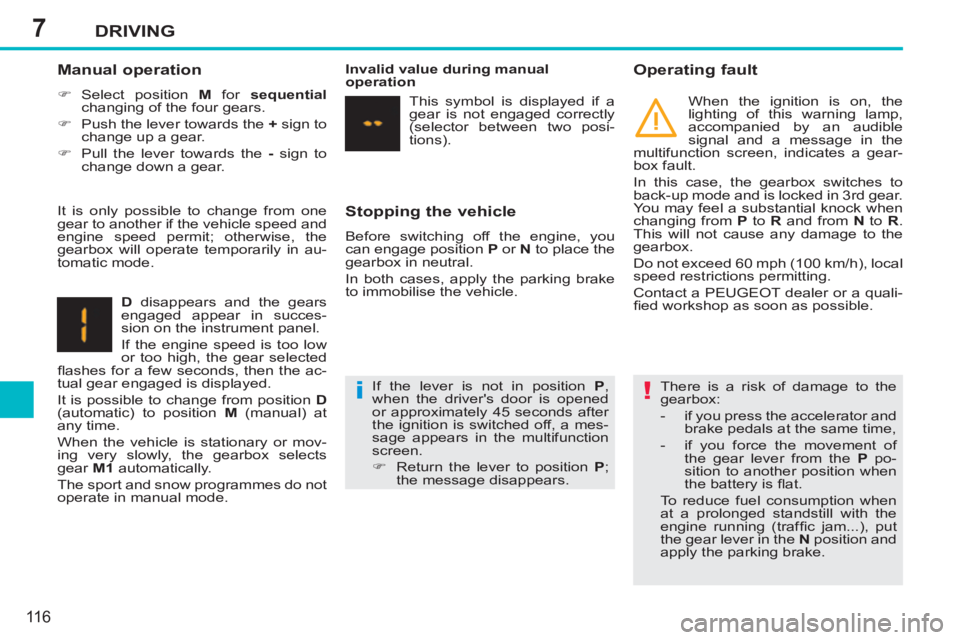
D
disappears and the gears
engaged appear in succes-
sion on the instrument panel.
If the engine speed is too low
or too high, the gear selected
fl ashes for a few seconds, then the ac-
tual gear engaged is displayed.
It is possible to change from position D
(automatic) to position M
(manual) at
any time.
When the vehicle is stationary or mov-
ing very slowly, the gearbox selects
gear M1
automatically.
The sport and snow programmes do not
operate in manual mode. If the lever is not in position P
,
when the driver's door is opened
or approximately 45 seconds after
the ignition is switched off, a mes-
sage appears in the multifunction
screen.
)
Return the lever to position P
;
the message disappears.
It is only possible to change from one
gear to another if the vehicle speed and
engine speed permit; otherwise, the
gearbox will operate temporarily in au-
tomatic mode.
Invalid value during manual
operation
This symbol is displayed if a
gear is not engaged correctly
(selector between two posi-
tions).
Page 123 of 248

7
i
i
DRIVING
121
VISUAL AND AUDIBLE
PARKING SENSORS
System consisting of four proximity sen-
sors, installed in the rear bumper.
It detects any obstacle (person, vehicle,
tree, barrier...) located behind the vehi-
cle, however, it will not be able to detect
obstacles located immediately below
the bumper. The parking sensors are switched on
by engaging reverse gear.
This is accompanied by an audible
signal.
* According to version. An object, such as a stake, a road-
works cone or any other similar
object may be detected at the start
of the manoeuvre but may no lon-
ger be detected when the vehicle
moves nearer to it. When the distance between the rear of
the vehicle and the obstacle is less than
approximately thirty centimetres, the
audible signal becomes continuous and
the "Danger" symbol appears, depend-
ing on the multifunction screen version.
The parking sensors are switched off
by moving the gear lever to neutral.
The parking sensor system can-
not, in any circumstances, replace
the need for vigilance and respon-
sibility on the part of the driver.
The proximity information is indicated
by:
- an audible signal which becomes
more rapid as the vehicle approach-
es the obstacle,
- a diagram on the multifunction
screen * , with blocks which move
closer to the vehicle.
Page 142 of 248
9
i
PRACTICAL INFORMATION
140
Parking the vehicle
Immobilise the vehicle where it
does not block traffi c: the ground
must be level, stable and non-
slippery.
Apply the parking brake, switch off
the ignition and engage fi rst gear *
to lock the wheels.
If necessary, place a chock under
the wheel diagonally opposite the
wheel to be changed.
You should ensure that the occu-
pants get out of the vehicle and
wait where they are safe.
Never go underneath a vehicle
raised using a jack; use an axle
stand.
Removing the wheel
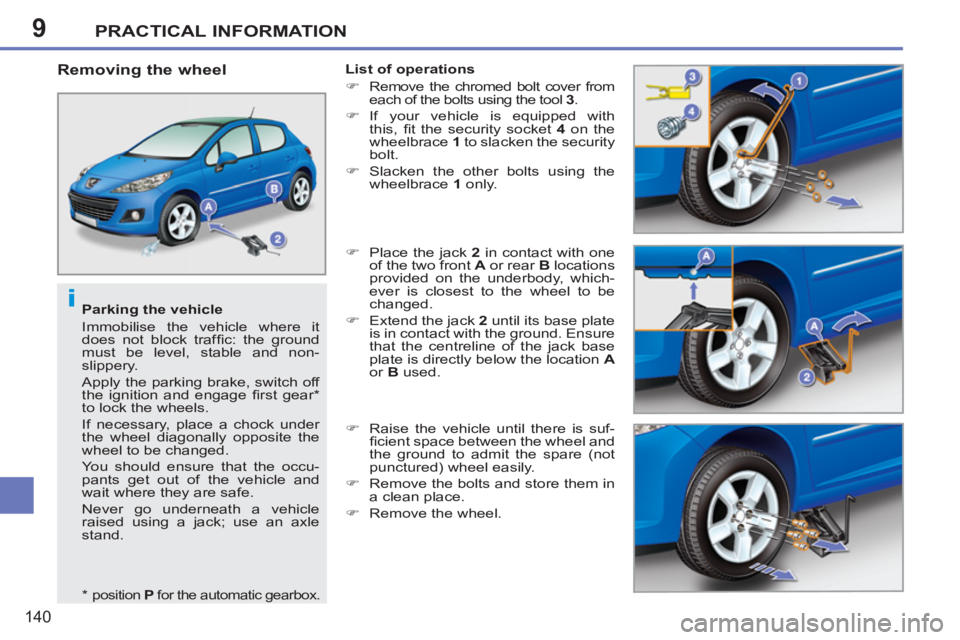
List of operations
)
Remove the chromed bolt cover from
each of the bolts using the tool 3
.
)
If your vehicle is equipped with
this, fi t the security socket 4
on the
wheelbrace 1
to slacken the security
bolt.
)
Slacken the other bolts using the
wheelbrace 1
only.
)
Place the jack 2
in contact with one
of the two front A
or rear B
locations
provided on the underbody, which-
ever is closest to the wheel to be
changed.
)
Extend the jack 2
until its base plate
is in contact with the ground. Ensure
that the centreline of the jack base
plate is directly below the location A
or B
used.
)
Raise the vehicle until there is suf-
fi cient space between the wheel and
the ground to admit the spare (not
punctured) wheel easily.
)
Remove the bolts and store them in
a clean place.
)
Remove the wheel.
*
position P
for the automatic gearbox.