2011 OPEL GT seats
[x] Cancel search: seatsPage 44 of 190

44 Seats, interior
Remov ing the belt
To rem ov e the be lt, de pres s the red
pushbutton on the buck le ; the be lt will
retract autom atic ally.Child restraint systems 3
A wa rning stick er on the sun v isors re minds
that the use of rea rward facing child
restra int systems p oses a risk of fatal injury.W hen us ing a child re straint s ys tem, alway s
observe the instructions on installation and
use.
T h e co un t r y in w hi ch y o u a r e t r a v el l i n g
ma y not pe rm it the us e of child re straint
systems on certain seats. Always comply
with the loc al or national re gulations.
Not e
zChildren und er 12 years or und er 150 cm
tall should only trav el in an ap prop ria te
child sa fe ty s ea t.
zWhen transporting children, use a child
res tra int s ys tem that is suitable for the
child 's we ight.
zThe cove rs of the child restraint sy ste m
can be wipe d clea n.
zDo not stick any thing on the child
restra int systems and do not cover them
with any other m aterials.
zOnly a llow childre n to enter a nd exit the
vehicle at the s ide fa cing away from the
tra ffic.
zA child res traint sy ste m which has be en
subje cted to stres s in an accide nt must
be re place d.
9 Warning
V ehicle with front pas s enge r airbag:
Rear-fa cing child seats must not be
fitted, danger of fata l injury.
Sp ecifically a pproved forwa rd -fa cing
child re straints can be fitte d on the front
pas s enger’ s se at, provided that the latte r
is move d as far bac k as it will go.
Opel has app roved c hild restra int
systems from the ’DUO’ and ’KID’ ranges.
9 Warning
N eve r carry c hild re stra int system s on
y our lap, risk of fatal injury .
Page 45 of 190

45Seats , interior
Pe rmi ssibl e o pti on s f or fi tt in g a c hi ld
sa f e ty sea t
O pe l F u l l Si ze ai r ba g sy st e m
The airbag system is identified by the w ord
AIRBAG on the steering wheel and above
the glove compartment.
The airbag sy ste m compris es :
zan airbag with inflator in the ste ering
wheel and a second one in the
instrume nt panel,
zcontrol ele ctronics with impac t se nsors,
zcontrol indicator for airbag syste ms v in
instrume nt panel,
zs eat occ upa ncy rec og nition.The airbag s ys tem is trigge red:
zdepe nding on the sev erity of the
accide nt,
zdepe nding on the type of im pact, within
the range shown in the illus tration.
E xce ption: The se at oc cup anc y re cognition
system deactiv ates the a irba g on the
p a s s en g e r’ s si d e i f t h e p a ss en g e r ’s se a t i s
unoccupied – s ee page 4 8.
E xample s of eve nts trigge ring the airba g
system:
zImpact against a non-y ie lding obs tacle:
the a irb ags are triggere d at a low ve hicle
sp e ed .
zImpact aga ins t a y ielding obs ta cle (such
as another vehicle): the airbags are only
trig gere d at a highe r ve hicle s pee d. Weight and
ag e cl assOn front
pa sse nge r
seat
1)
1)En sur e seat is in it s r ea r most po si ti on.
Group 0:
up t o 10 kg
or approx. 1 0 m onths
Group 0+:
up t o 13 kg
or approx. 2 ye arsX
Group I :
9 to 18 kg
or approx. 8 m onths to
2 yearsL
Group I I:
1 5 t o 25 kg
or approx. 3 to 7 ye ars
G ro u p I II:
2 2 t o 36 kg
or approx. 6 to 1 2 ye arsL
X
= No child re straint of any class
allowed in this s eating pos ition
L
= Suitable only for spe cifically
approve d child re straints. O pel has
approve d child re straint s yste ms
f ro m the ’D UO ’ and ’K ID ’ ran ge s.
Page 46 of 190
46 Seats, interior
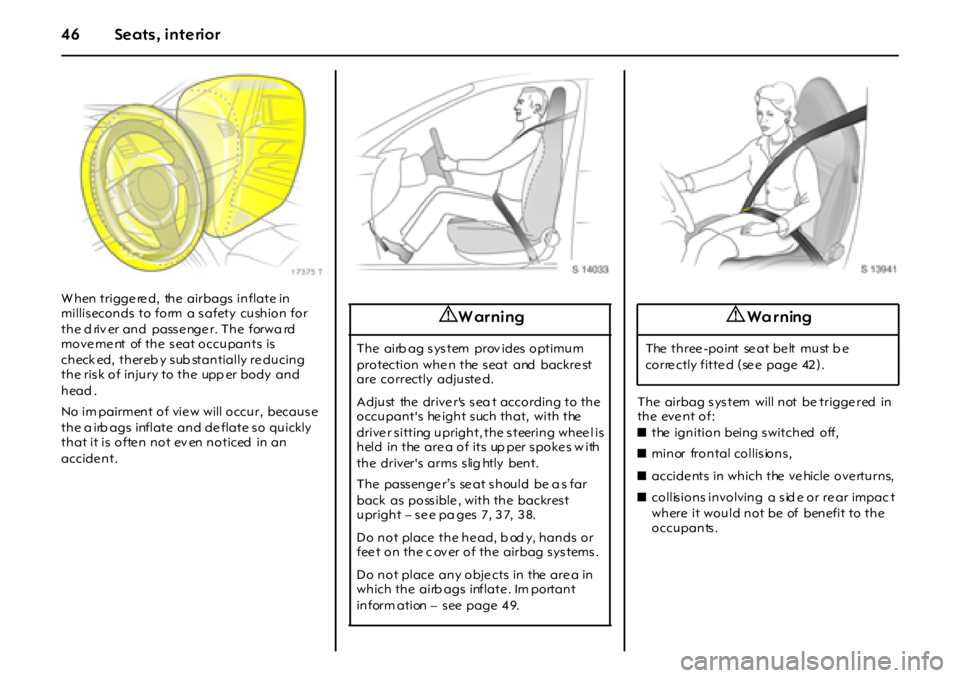
W hen trigge re d, the airbags inflate in
millis econds to form a s afety cushion for
the d riv er and pass e nge r. The forwa rd
move me nt of the s eat occupants is
ch eck ed, t h er eb y s ub st a n t i a l l y r e du ci n g
the risk of injury to the upp er body and
head .
No im pairment of vie w will occur, becaus e
the a irb ags inflate and de flate s o quickly
that it is often not ev en noticed in an
accide nt. The airbag s ys tem will not be trigge red in
t h e eve n t o f :
zthe ignition being s witched off,
zminor frontal collis ions ,
zaccidents in which the vehicle overturns,
zcollis ions involving a s id e or re ar impac t
where it would not be of benefit to the
occupants .
9 Warning
The airb ag s ys tem prov ides optimum
protection whe n the s eat and backre st
are correctly adjuste d.
Adjust the driver's sea t according to the
occupant's he ight such that, with the
drive r s itting upright, the s teering whee l is
held in the are a of its up per s poke s w ith
t h e dr i ver ' s a r m s s li g ht l y ben t .
The pass enge r’s se at s hould be a s far
back as poss ible , with the backres t
upright – s e e pa ges 7 , 3 7, 3 8.
Do not place the head, b od y, hands or
f ee t o n t h e c ov er o f t h e a i r ba g s ys t em s .
Do not place any obje cts in the are a in
which the airb ags inflate . Im portant
inform ation – s ee page 4 9.
9 Wa r ning
The three-point seat belt must be
corre ctly fitte d (se e page 42 ).
Page 47 of 190
47Seats , interior
In add ition, the airbag sys tem will not be
triggere d for the pas se nger in ve rsions with
s eat occupancy recognition if:
zthe passenger’s sea t is unoccupied .
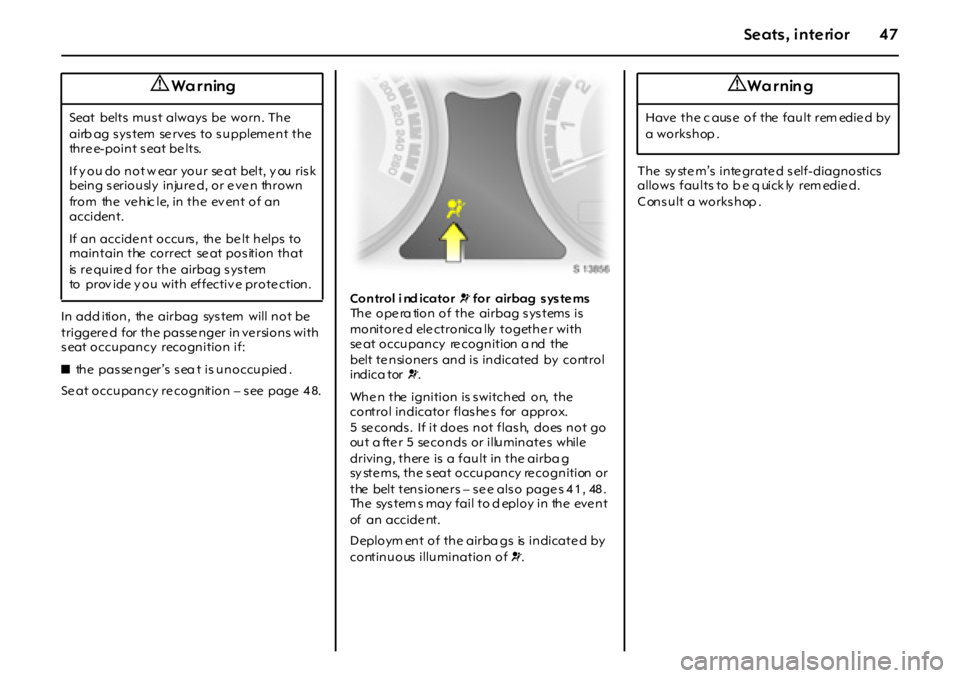
Se at occupancy re cognition – s ee page 4 8.Control i nd icator v for airbag syste ms
The opera tion of the airbag systems is
monitore d ele ctronica lly togethe r with
se at occupancy re cognition a nd the
belt te nsioners and is indicated by control
indica torv.
Whe n the ignition is s witched on, the
control indicator flas he s for approx.
5 se conds . If it does not flas h, does not go
out a fter 5 seconds or illuminates while
driving, there is a fault in the airba g
sy ste ms, the s eat occupancy re cognition or
the belt tens ione rs – s e e als o page s 4 1 , 48 .
The system s may fail to deploy in the event
of an accide nt.
Deploym ent of the airba gs is indicate d by
continuous illumination ofv.The sy ste m’s inte grate d s elf-diagnostics
allows faults to b e q uick ly rem edie d.
C onsult a workshop .
9 Wa r ning
Seat belts must always be worn. The
airb ag s ys tem se rves to s uppleme nt the
thre e-point s eat be lts.
If y ou do not w ear your seat belt, y ou risk
being seriously injure d, or e ve n thrown
fr o m th e ve h ic l e, i n t h e ev en t o f a n
accident.
If an accide nt occurs , the be lt helps to
maintain the correct se at position that
is re quire d for the airbag system
to p r ov i de y o u w i t h ef f ect i v e p r o t e ct i on .
9 Wa r nin g
Have the c ause of the fault rem edie d by
a works hop .
Page 48 of 190
48 Seats, interior
Se at oc cupancy re cognition
The s e at occupancy re cognition s ys tem
de activates the pas se nger’s airbag if the
pas se nger’s s ea t is not occupie d.
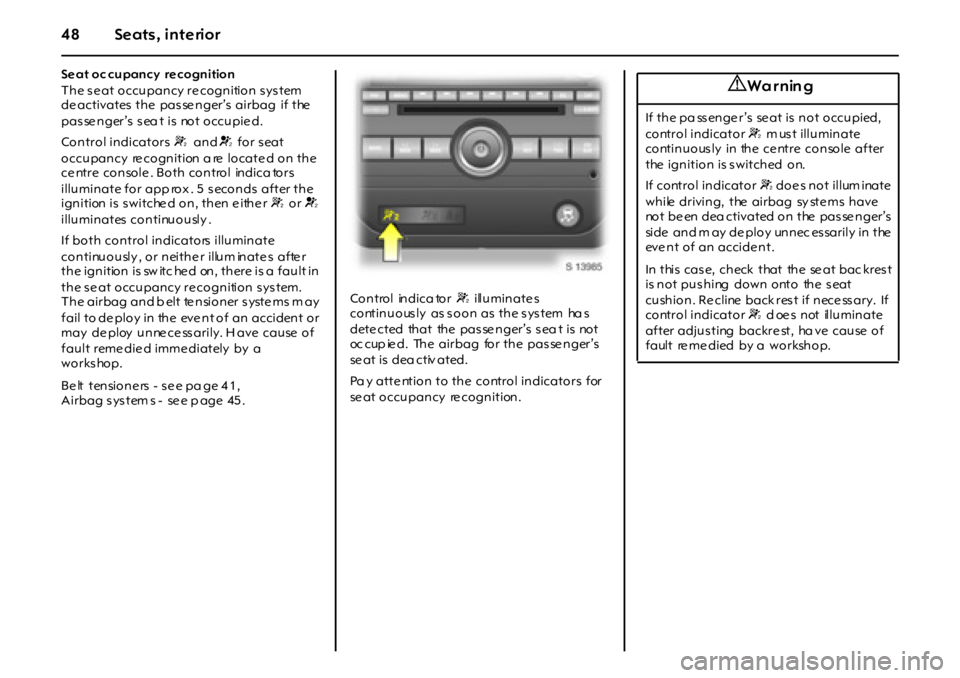
Control indicators W and V for seat
occupancy re cognition a re locate d on the
ce ntre console . Both control indica tors
illuminate for app rox . 5 seconds after the
ignition is switched on, then either W or V
illuminates continuously .
If both control indicators illuminate
continuously , or neither illum inates after
the ignition is sw itc he d on, there is a fault in
the s e at occupancy re cognition s ys tem.
The airbag and b elt te nsioner s yste ms m ay
f ail to de plo y in th e eve n t o f an acciden t o r
may deploy unnecessarily. H ave cause of
fault reme die d imme diately by a
workshop.
Be lt tensione rs - se e pa ge 41,
Airbag s ys tem s - se e p age 45 .Co n tro l in dica to r W illuminate s
c o nt i n u o us l y a s s o o n a s t h e s y s t em ha s
dete cted that the pas se nger’s s ea t is not
oc cup ie d. The airbag for the pas se nger’s
se at is dea ctiv ated.
Pa y atte ntion to the control indicators for
se at occupancy re cognition.9 Wa r nin g
If the pa ss enge r’s se at is not occupied,
control indicator W m us t illuminate
c o nt i n u o us l y i n th e c e nt r e c o n so l e a f t er
the ignition is s witched on.
If control indicator W doe s not illum inate
while driving, the airbag sy ste ms have
not be en dea ctivated on the passe nger’s
side and m ay de ploy unnec es sarily in the
eve nt of an accide nt.
In this cas e, check that the se at bac kres t
is not pus hing down onto the s eat
cushion. Re cline back res t if nece ss ary. If
control indicator W d oes not illuminate
after adjus ting backre st, ha ve cause of
fault re me died by a workshop.
Page 49 of 190

49Seats , interior
Control indicator V illuminates
continuously as soon as the sy stem has
de tecte d that the p assenge r’s se at is
occupied and the pass e nge r is correctly
s eate d. W hen a pas se ng er occupie s the
pas se nger’s s ea t, the a irb ag for the
pas se nger’s s ea t is activated and may
i n f la t e i n t h e eve n t o f a n a cci de n t .
P a y a t te n t i on to th e c o n t r ol i nd i c a t or s f o r
s eat occupancy recognition.Important
zAccessories a nd other objects must not
be affix ed or s tored in the area in which
the airbags inflate, since they could
cause injury if the a irb ags a re de ployed.
zDo not place any objec ts be twee n the
airbag s ys tems and the ve hicle
occupants ; ris k of injury.
zThe airbag sy ste ms and be lt tens ione r
control e lectronics can be found in the
centre console area. In order to av oid
malfunctions, do not store mag netic
objects in this a re a.
zDo not stick any thing on the steering
whee l or ins trument pa ne l, or cov er
ei t h er o f t h e se a r ea s w it h o t h er
materials .
zUse only a dry cloth or Interior/
Upholstery Cle ane r to clea n the ste ering
w h ee l a n d i n st r u m e nt p a n el . D o no t u s e
any agg re s sive cle aning agents .
9 Warning
If the pas se nger’s s eat is occupie d,
control ind ic ator V must illuminate
continuously in the c entre console after
the ig nition is sw itc he d on.
If control indicator V does not illuminate
while driving, the airbag s ys tems have
not be en activa te d on the passe ng er’s
side; risk of fa ta l injury.
In this case, turn off the ignition, e nsure
the pass e nge r’s se at ba ckres t is in an
upright position and the pas se nger is
sitting upright in the se at. Re sta rt the
ve hicle. If the control indicator does not
illuminate w hile driving, hav e ca us e of
fault rem edie d by a works hop .
If control indicator v for airbag systems
and b elt te ns ioners illum inate s in the
instrume nt panel and W is illuminated in
t h e cen t r e c on s o l e w h i l e t h e p a ss en g e r ’s
s eat is occupie d, cons ult a works hop
imme diate ly.
9 Wa r nin g
Ne ver ca rry child restraint syste ms or
other objects on your lap; risk of fa ta l
injury.
Page 50 of 190

50 Seats, interior
zThe airbag sys tem s are trigge red
depe nding on the seve rity of the
accident and the type of impa ct.
zEach airbag c an b e trigge re d only once,
which is indicated by continuous
illumination of control ind icatorv. Once
trigg ered , an airbag must be re place d
without delay. Consult a work shop.
zThe s pe eds , directions of move ment and
deformation properties of the vehicles,
and the prope rties of the obstacle
concerned, determ ine the severity of the
accident and trig gering of the airb ags.
Th e de gr ee o f damag e to y ou r v eh icle
and the re sulting repa ir costs alone a re
not indicative that the crite ria for
trigg ering of the airba gs were me t.
zDo not m odify airbag sys tem
com ponents, since this would render the
vehicle unroadworthy.zApplicable safe ty directive s mus t alwa ys
be observed when disposing of the
vehicle. For this reason, disposal should
be done by an a uthorise d re cycling
compa ny .
zPers ons we ighing les s than 3 5 kg s hould
only trave l in a ve hicle suitable for fitting
a c hild re straint s ys tem. The us e of child
restraint systems in your vehic le is not
rec om mende d.
zDo not place any he avy objects on the
p a s s en g er ’ s s e a t w h en t h e se a t i s
u n o ccu p i ed, o t h er w i s e t h e a i r ba g f o r t h e
pas s enger’ s s e at may be trig gere d
unne ce ss arily in the eve nt of an
accide nt.
zTo pre vent m alfunctions in the se at
occupancy recognition sys te m, do not
use protective cov ers or seat cushions on
the pass e nge r’s se at. N o t e s o n lo ad in g t h e ve h i c l e
zSe cure heav y obje cts in the luggage
compartme nt. If objec ts are to be
st a c k ed , t he h ea vi er o b j e c t s sh o u l d b e
placed at the bottom. Uns ecured obje cts
in the luggage compa rtm ent would be
thrown forward w ith g re at force in the
eve nt of heavy braking, for exam ple.
zIf heav y loads s lip when the ve hicle is
brake d he avily or drive n a round a be nd ,
the handling of the v ehicle may cha nge.
zThe warning triangle 3 and firs t-aid kit
(cushion) 3 s ho u ld alwa ys be fr e ely
acce ss ible.
9 Wa r ning
If hand led im prop erly, the airbag
sys tem s c an be trigge red in a n e xplos ive
manne r; risk of injury !
Page 51 of 190
51Seats , interior
zNo objects should be p laced on the
in s t r um en t p a n e l . T h ey a r e re f l ect e d i n
th e g l a s s, o bst r u ct t h e dr i ver ’ s v i ew a nd
will be thrown throug h the ve hic le in the
eve nt of he avy braking, for e xam ple.
zOb j e c t s m u s t no t b e st o r ed in t h e a i r b a g
inflation a rea, because they could cause
injury if the airbag s ys tem is deploye d.
zLoads m ust not obstruct the operation of
the pe dals, hand brake and g ear s hift
lever, or hinder the freed om of
m o vem en t o f t h e d ri v er . D o no t p l a ce
any unsecured objects in the interior.
zDo not drive with luggage compartme nt
op en w h en t r a n s p o r t i ng bu l ky o bj e ct s,
for e xam ple, to avoid caus ing damag e
to th e v e h ic le .
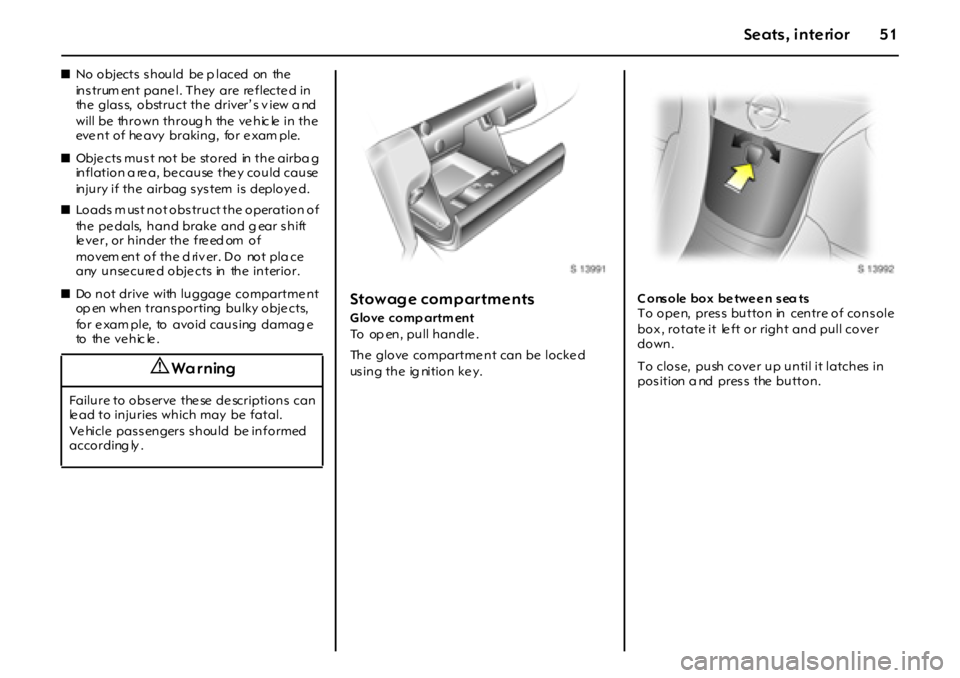
Stow ag e comp ar tme nts
Glove comp artm ent
To op en, pull handle .
The glove compartment can be locked
us i n g t h e ig ni t i o n k e y .Console box between sea ts
To open, press button in centre of console
box , rotate it le ft or right and pull cove r
down.
To clos e, push cove r up until it latches in
position a nd press the button.
9 Wa r ning
Failure to observe these descriptions can
le ad to in ju r ies wh ich may be f atal.
Vehicle passengers should be informed
according ly .