Page 258 of 407
To remove the key from the ignition switch:1. Shift the shift selector to the P (Park) posi- tion with the ignition switch in the ON posi-
tion.
2. Place the ignition switch in the LOCK posi- tion.
3. Remove the key from the ignition switch.
If the shift selector is shifted to the P (Park)
position after the ignition switch is placed in the
OFF position or when the ignition switch cannot
be placed in the LOCK position, proceed as
follows to remove the key. 1. Move the shift selector into the P (Park) position.
2. Place the ignition switch slightly toward the ON position.
3. Place the ignition switch in the LOCK posi- tion.
4. Remove the key.
The shift selector is designed so it cannot moved
out of P (Park) and into any of the other gear
positions if the ignition switch is placed in the
OFF position or if the key is removed from the
switch. The shift selector can be moved if the igni-
tion switch is in the ON position and the
foot brake pedal is depressed.
There is an OFF position between the
LOCK and ACC positions. The OFF position
is indicated by a “1” on the key cylinder. For
models without NISSAN vehicle immobi-
lizer system: when the ignition switch is in
the OFF position, the steering wheel is not
locked .
In order for the steering wheel to be locked, it
must be turned about 1/8 of a turn clockwise
from the straight up position.
To lock the steering wheel, turn the ignition
to the LOCK position. Remove the key. To
unlock the steering wheel, insert the key
and turn it gently while rotating the steer-
ing wheel slightly right and left.
If the key will not turn from the LOCK posi-
tion, turn the steering wheel to the left or
right while turning the key to unlock the
key cylinder.KEY POSITIONS
LOCK: Normal parking position (0)
OFF: (Not used) (1)
ACC: (Accessories) (2)
This position activates electrical accessories
such as the radio when the engine is not running.
ON: Normal operating position (3)
This position turns on the ignition system and the
electrical accessories.
START: (4)
This position starts the engine. As soon as the
engine has started, release the key. It automati-
cally returns to the ON position.
5-10Starting and driving
Page 334 of 407
●Do not leave the bulb out of the fog light
for a long period of time as dust, mois-
ture and smoke may enter the fog light
body and affect the performance of the
fog light.
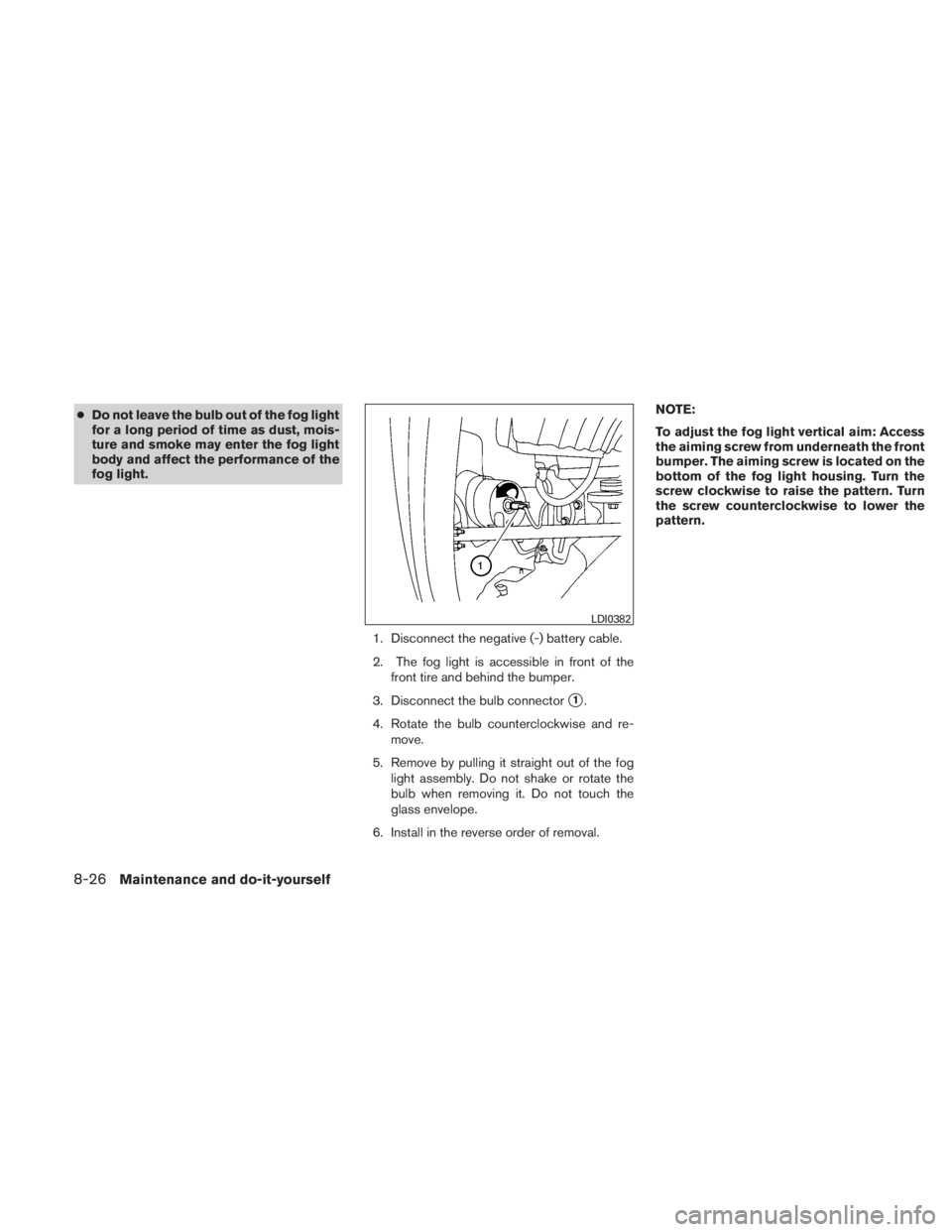
1. Disconnect the negative (-) battery cable.
2. The fog light is accessible in front of thefront tire and behind the bumper.
3. Disconnect the bulb connector
�1.
4. Rotate the bulb counterclockwise and re- move.
5. Remove by pulling it straight out of the fog light assembly. Do not shake or rotate the
bulb when removing it. Do not touch the
glass envelope.
6. Install in the reverse order of removal. NOTE:
To adjust the fog light vertical aim: Access
the aiming screw from underneath the front
bumper. The aiming screw is located on the
bottom of the fog light housing. Turn the
screw clockwise to raise the pattern. Turn
the screw counterclockwise to lower the
pattern.
Page 368 of 407
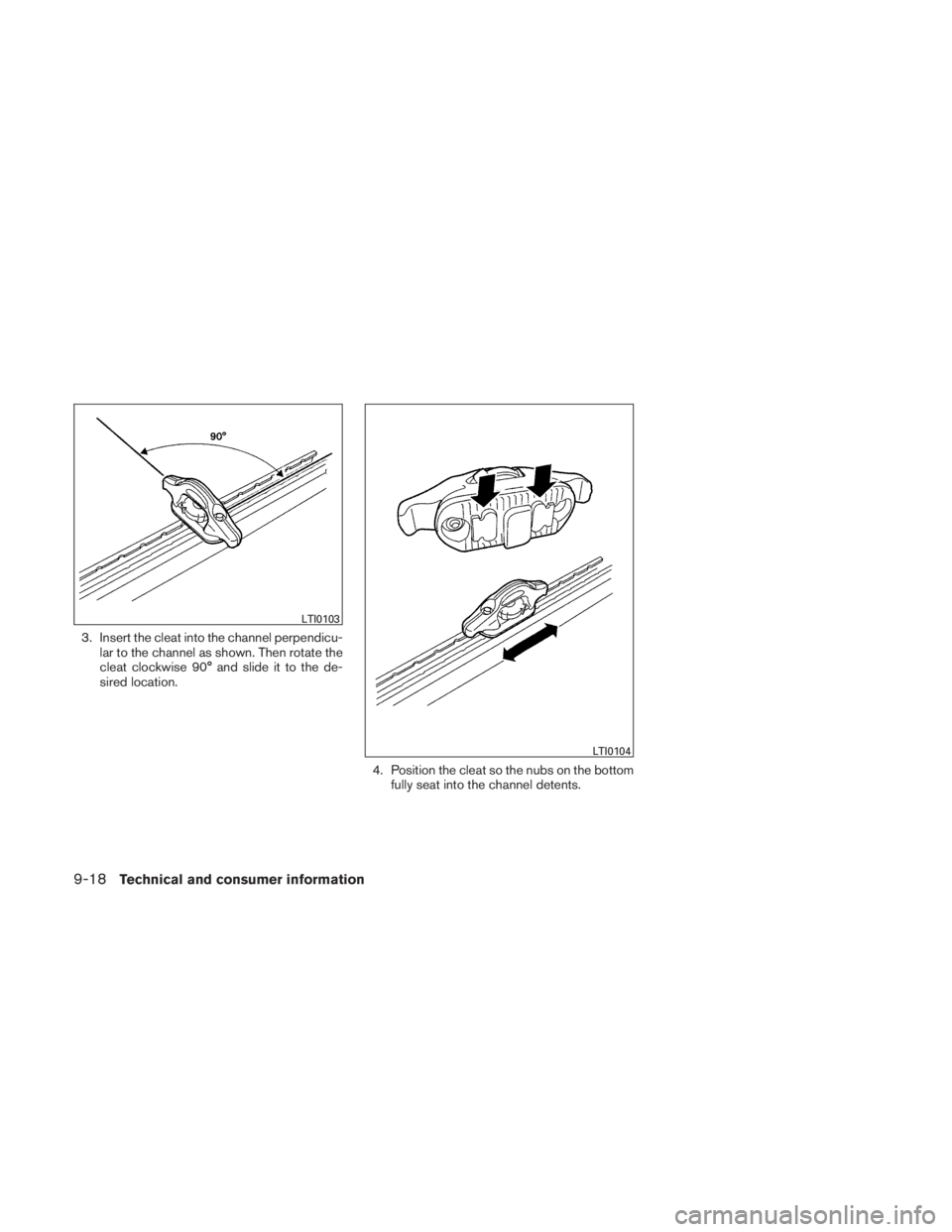
3. Insert the cleat into the channel perpendicu-lar to the channel as shown. Then rotate the
cleat clockwise 90° and slide it to the de-
sired location.
4. Position the cleat so the nubs on the bottomfully seat into the channel detents.
Page 400 of 407
Precautions on child
restraints.........1-27, 1-33, 1-37, 1-44
Top tether strap anchor point locations . .1-31
Child safety rear door lock ............3-7
Chimes, audible reminders ...........2-20
Cleaning exterior and interior ...........7-2
Clock ...................4-38, 4-46
(models with navigation system) ......4-11
Clock set .....................4-11
C.M.V.S.S. certification label ..........9-11
Cold weather driving ..............5-36
Compact disc (CD) player ...........4-39
Control panel buttons ...............4-2
Back button ..................4-3
Brightness/contrast button .........4-13
Enter button ..................4-2
Setting button .................4-7
Startup screen .................4-3
Trip button ...................4-4
Controls Audio controls (steering wheel) .......4-54
Heater and air conditioner
controls .............4-14, 4-20, 4-28
Rear audio controls .............4-55
Coolant Capacities and recommended
fuel/lubricants .................9-2
Changing engine coolant ...........8-8
Checking engine coolant level ........8-7
Engine coolant temperature gauge .....2-6
Corrosion protection ...............7-5
Cruise control ..................5-20
Cup holders ...................2-44
Curtain side-impact and rollover air bag . . . .1-59 D
Daytime running light system (Canada only) . .2-31
Defroster switch Rear window and outside mirror defroster
switch .....................2-28
Digital video disc DVD ..............4-56
Dimensions and weights .............9-9
Dimmer switch for instrument panel ......2-32
Display
controls (see control panel buttons) . .4-2
Distance to empty .................4-5
Door locks .....................3-3
Drive belt .....................8-15
Drive positioner, Automatic ...........3-24
Driving Cold weather driving ............5-36
Driving with automatic transmission . . . .5-13
Precautions when starting and driving . . . .5-2
E
Economy - fuel ..................5-22
Electronic locking rear differential (E-Lock)
system ......................5-29
Electronic locking rear differential (E-Lock)
system switch ..................2-35
Emission control information label .......9-11
Emission control system warranty .......9-44
Engine Before starting the engine ..........5-11
Block heater .................5-37
Capacities and recommended
fuel/lubricants .................9-2
Changing engine coolant ...........8-8 Changing engine oil
..............8-9
Changing engine oil filter ..........8-10
Checking engine coolant level ........8-7
Checking engine oil level ...........8-8
Engine compartment check locations . . . .8-6
Engine coolant temperature gauge .....2-6
Engine cooling system ............8-7
Engine oil ...................8-8
Engine oil and oil filter recommendation . . .9-6
Engine oil viscosity ..............9-7
Engine serial number ............9-11
Engine specifications .............9-8
Starting the engine .............5-11
Engine oil pressure gauge ............2-8
Engine oil pressure low/engine coolant
temperature high warning light .........2-15
English/metric setting ..............4-10
Enter button ....................4-2
Event data recorders ..............9-45
Exhaust gas (Carbon monoxide) .........5-2
F
Flashers
(See
hazard warning flasher switch) ......2-33
Flat tire .......................6-2
Floor mat positioning aid .............7-5
Fluid Brake fluid ..................8-12
Capacities and recommended
fuel/lubricants .................9-2
Engine coolant .................8-7
Engine oil ...................8-8
Power steering fluid .............8-11
Window washer fluid ............8-12
10-2