2011 NISSAN LEAF light
[x] Cancel search: lightPage 203 of 1062

2 Instruments and controls
Cockpit ....................................................................................... 2-3
Instrument panel ....................................................................... 2-4
Meters and gauges .................................................................. 2-5Speedometer and odometer ........................................... 2-6
Li-ion battery temperature gauge ................................... 2-7
Power meter ........................................................................ 2-7
Driving range ....................................................................... 2-8
Li-ion battery available charge gauge ........................... 2-9
Li-ion battery capacity level gauge ............................. 2-10
Outside air temperature ................................................ 2-10
ECO indicator .................................................................. 2-10
Clock .................................................................................. 2-11
Warning/indicator lights and audible reminders ........... 2-12
Checking bulbs ................................................................ 2-13
Warning lights .................................................................. 2-13
Indicator lights .................................................................. 2-18
Audible reminders ........................................................... 2-20
Dot matrix liquid crystal display ......................................... 2-22 Indicators for operation .................................................. 2-23
Trip computer ................................................................... 2-27
Warning information displays ....................................... 2-31
Indicators for maintenance ........................................... 2-33
Indicator for timer ............................................................ 2-34 Security systems .................................................................. 2-35
Vehicle security system ............................................... 2-35
NISSAN Vehicle Immobilizer System ....................... 2-36
Windshield wiper and washer switch ............................. 2-38 Washer operation ......................................................... 2-39
Rear window wiper and washer switch ........................ 2-39
Rear window and outside mirror defroster switch ...... 2-40
Instrument brightness control ............................................ 2-41
Headlight and turn signal switch ...................................... 2-41 Headlight switch ........................................................... 2-41
Turn signal switch ......................................................... 2-44
Fog light switch (if so equipped) ..................................... 2-44
Hazard warning flasher switch .......................................... 2-45
Heated steering wheel (if so equipped) ........................ 2-45
Horn ......................................................................................... 2-46
Heated seats (if so equipped) .......................................... 2-47
Vehicle Dynamic Control (VDC) OFF switch ................ 2-48
Power outlet ........................................................................... 2-49
Storage ................................................................................... 2-49 Cup holders .................................................................... 2-49
Sunglasses holder ........................................................ 2-50
Glove box ........................................................................ 2-51Console box ................................................................... 2-51
Page 220 of 1062
0 Illustrated table of contents
Seats, seat belts and Supplemental Restraint
System (SRS) ........................................................................... 0-2
Exterior front .............................................................................. 0-3
Exterior rear ............................................................................... 0-4
Passenger compartment ........................................................ 0-5 Cockpit ....................................................................................... 0-6
Instrument panel ...................................................................... 0-7
Meters and gauges ................................................................. 0-8
Motor compartment ................................................................ 0-9
Warning and indicator lights ............................................. 0-10
Page 225 of 1062

Driving range button
— Audio control
— Bluetooth
®Hands-Free Phone System control
6. Steering wheel
— Electric power steering system (P.5-21) — Horn (P.2-46)
— Driver’s supplemental air bag (P.1-36)
7. Wiper and washer switch (P.2-38)
8. Steering-wheel-mounted controls (right side)
— Cruise control switches (P.5-17)
9. Fuse box cover (P.8-16)
10. Vehicle Dynamic Control (VDC) OFF switch (P.2-48)
11. Headlight aiming control (P.2-44)
12. Approaching Vehicle Sound for Pedestrians (VSP) OFF switch (P.EV-27)
13. Immediate charge switch (P.CH-24)
14. Heated steering wheel switch* (P.2-45)
15. Tilting steering wheel lever (P.3-19)
16. Heated seat switch* (P.2-47)
17. Selector lever (P.5-12)
18. Electric parking brake (P.5-15)
*: if so equipped
COCKPIT
Page 229 of 1062
12-volt battery charge
warning light2-13
Page 230 of 1062
EV Overview
The EV (Electric Vehicle) system ...................................... EV-2
Li-ion battery .......................................................................... EV-2 Driving with a discharged Li-ion battery ................... EV-3
Charging the 12-volt battery ........................................ EV-5
Li-ion battery heater (if so equipped) ........................ EV-5
High voltage precautions .................................................... EV-7
High-voltage components ............................................. EV-7
Road accident precautions ................................................ EV-8 Emergency shut-off system .......................................... EV-9
EV (Electric Vehicle) characteristics ................................ EV-9
Noise and vibration ...................................................... EV-10
Life with an EV (scene guide) ........................................ EV-10 Charging the Li-ion battery ........................................ EV-10
Before driving your vehicle ........................................ EV-13
Starting your vehicle .................................................... EV-16 Driving the vehicle ..................................................... EV-17
At home after driving ................................................. EV-21
Efficient use of your vehicle ............................................ EV-22
Range ............................................................................ EV-22
Improve driving range ............................................... EV-22
Li-ion battery life ......................................................... EV-23
Li-ion battery maintenance ...................................... EV-23
EV unique information ...................................................... EV-24 Meters and indicators ............................................... EV-24
Approaching Vehicle Sound for Pedestrians
(VSP) system .............................................................. EV-27
Electric shift control system .................................... EV-29
Electric parking brake ............................................... EV-29
LED headlight (low beam) ....................................... EV-29
Solar cell module (if so equipped) ........................ EV-30
Driving range button ................................................ EV-30
Page 234 of 1062

CHARGING THE 12-VOLT BATTERY
While vehicle is driven
The Li-ion battery charges the 12-volt battery as
necessary when the power switch is in the
READY to drive position.
While the vehicle is not in use
When the EV (Electric Vehicle) system is off, the
12-volt battery charges automatically for 5
minutes every 5 days.
The charge timing resets to 5 days without
charging the 12-volt battery if:
.The vehicle is placed in the READY to drive
position for more than 5 minutes.
. The Li-ion battery is charged for more than 5
minutes.
When charging the 12-volt battery, the charge
status indicator light on the instrument panel
illuminates. See “Charging status indicator
lights” in the “CH. Charging” section.
LI-ION BATTERY HEATER (if so
equipped)
CAUTION
The Li-ion battery heater does not
operate if the available Li-ion battery
charge is less than approximately 30%
and the charger is not connected to the
vehicle. To help prevent the Li-ion
battery from freezing, do not leave the
vehicle in an environment if tempera-
tures may go below -48F (-208C) unless
the vehicle is connected to a charger.
The Li-ion battery heater helps to prevent the Li-
ion battery from freezing and helps to prevent
significant reductions in the Li-ion battery output
when the temperature is cold. The Li-ion battery
heater automatically turns on when the Li-ion
battery temperature is approximately -48 F
(-208C) or colder. The Li-ion battery heater
automatically turns off when the Li-ion battery
temperture is approximately 148F (-108C) or
higher.
The Li-ion battery heater uses electrical power
from an external source when a charger is
connected to the vehicle. The Li-ion battery
heater uses electrical power from the Li-ion battery when the charger is not connected to the
vehicle.
NOTE:
.
Connect the charger to the vehicle and
place the power switch in the OFF
position when parking the vehicle if
temperatures may go below -48 F
(-208C) . This provides external power
to the Li-ion battery heater when it
operates and does not discharge the
Li-ion battery.
. The charging status indicator lights
illuminate in a specific pattern when
the Li-ion battery heater operates. The
charging status indicator lights use the
same pattern to indicate 12-volt battery
charging, A/C-Heater Timer (Climate
Ctrl. Timer) operation or Remote Cli-
mate Control operation. The charging
status indicator lights do not change if
the Li-ion battery heater operates at
the same time as the above features.
See “Charging status indicator lights”
in the “CH. Charging” section.
. The Li-ion battery heater uses Li-ion
battery power to operate, even if the
vehicle is connected to a charger when:
EV OverviewEV-5
Page 238 of 1062
EMERGENCY SHUT-OFF SYSTEM
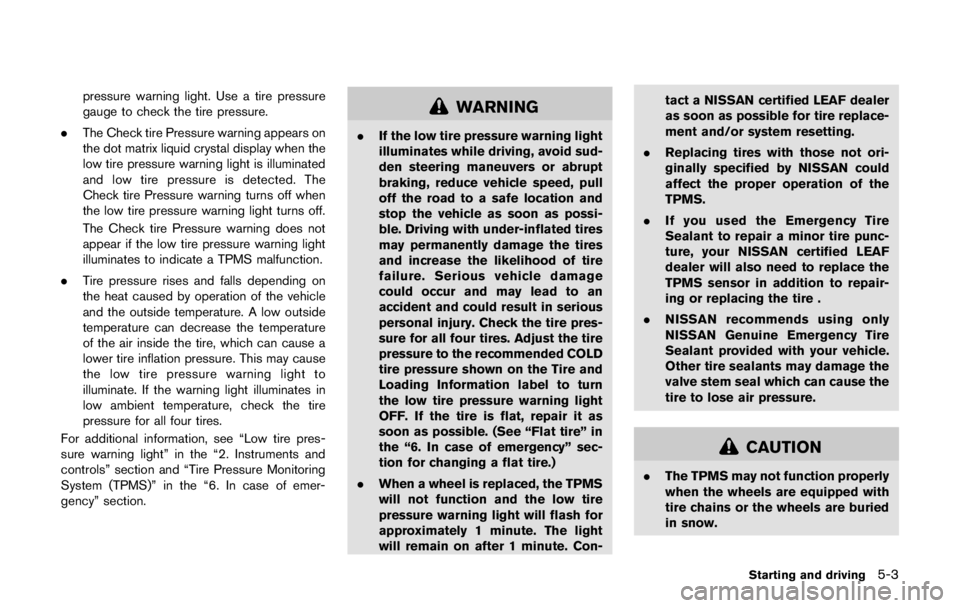
The emergency shut-off system is activated and
the high-voltage system automatically turns off in
the following conditions:
- Front and side collisions in which the air bags
are deployed.
- Certain rear collisions.
- Certain EV (Electric Vehicle) system malfunc-
tions
For the above collisions and certain other EV
(Electric Vehicle) system malfunctions, the
READY to drive indicator light will turn off. See
“Warning/indicator lights and audible remin-
ders” in the “2. Instruments and controls”
section.
The emergency shut-off activates for the above
collisions to minimize risk of an event that could
cause injury or an accident. If the emergency
shut-off system activates, the EV system may
not be switched to READY to drive position,
contact a NISSAN certified LEAF dealer. Even if
the power switch is switched to READY to drive
position, the system may shut-off suddenly.
Therefore, drive cautiously to the nearest
NISSAN certified LEAF dealer or contact a
NISSAN certified LEAF dealer as soon as
possible.WARNING
.Pay special attention to pedes-
trians. Because there is no engine
noise, pedestrians may not know
the vehicle is approaching, moving
or about to move, and may step into
the path of vehicle travel.
. When leaving the vehicle, be sure to
turn off the EV (Electric Vehicle)
system.
. Be sure to push the P (Park) posi-
tion switch on the selector lever and
apply the parking brake when park-
ing because the vehicle can move
when the READY to drive indicator
light is ON. When the READY to
drive indicator light is ON, do not
leave your vehicle in a shift position
other than the P (Park) position.
. Keep the brake pedal depressed
until you are ready to drive. When
the vehicle is in the D (drive) posi-
tion or ECO or R (reverse) position,
if you release the brake pedal and
do not depress accelerator, the
vehicle will creep and may start
abruptly. This may cause serious injury or death.
NOTE:
. The vehicle cannot run with a dis-
charged Li-ion battery. Repeated accel-
eration consumes more power from the
Li-ion battery than driving at a steady
speed.
. This vehicle is equipped with a regen-
erative brake system. The primary pur-
pose of regenerative brake system is to
provide some power to recharge the Li-
ion battery and extend driving range. A
secondary benefit is “engine braking”
that operates based on Li-ion battery
conditions.
. In the D (Drive) position, when the
accelerator pedal is released, the re-
generative brake system provides
some deceleration.
. When you put the shift selector in the
ECO position and take your foot off the
accelerator pedal, more regenerative
brake is applied than in the D (Drive)
position.
. Less deceleration is provided by the
regenerative brake system when the Li-
EV OverviewEV-9
EV (Electric Vehicle)
CHARACTERISTICS
Page 248 of 1062
illuminates, the Li-ion battery charge is too low
for travel. See “Low battery charge warning
light” in the “2. Instruments and controls”
section. Charge the Li-ion battery as soon as
possible.
EV OverviewEV-19