2011 NISSAN CUBE weight
[x] Cancel search: weightPage 304 of 345
Black plate (302,1)
Model "Z12-D" EDITED: 2010/ 9/ 27
If you have a flat tire, see “FLAT TIRE” in
the “6. In case of emergency” section.TIRE PRESSURE
Tire Pressure Monitoring System (TPMS)This vehicle is equipped with the Tire Pressure
Monitoring System (TPMS) . It monitors tire
pressure of all tires except the spare. When
the low tire pressure warning light is lit, one or
more of your tires is significantly under-inflated.
The TPMS will activate only when the vehicle is
driven at speeds above 16 MPH (25 km/h) .
Also, this system may not detect a sudden drop
in tire pressure (for example a flat tire while
driving) .
For more details, see “Low tire pressure warning
light” in the “2. Instruments and controls”
section, “TIRE PRESSURE MONITORING SYS-
TEM (TPMS)” in the “5. Starting and driving”
section and “TIRE PRESSURE MONITORING
SYSTEM (TPMS)” in the “6. In case of
emergency” section.Tire inflation pressureCheck the pressure of the tires (including
the spare) often and always prior to long
distance trips. The recommended tire
pressure specifications are shown on the
Tire and Loading Information label under
the “Cold Tire Pressure” heading. The Tireand Loading Information label is affixed to
the driver side center pillar. Tire pressures
should be checked regularly because:
.
Most tires naturally lose air over time.
.
Tires can lose air suddenly when driven
over potholes or other objects or if the
vehicle strikes a curb while parking.
The tire pressures should be checked
when the tires are cold. The tires are
considered COLD after the vehicle has
been parked for 3 or more hours, or driven
less than 1 mile (1.6 km) at moderate
speeds.
Incorrect tire pressure, including un-
der inflation, may adversely affect tire
life and vehicle handling.
WARNING
.
Improperly inflated tires can fail
suddenly and cause an accident.
.
The Gross Vehicle Weight rating
(GVWR) is located on the F.M.V.
S.S./C.M.V.S.S. certification la-
bel. The vehicle weight capacity
is indicated on the Tire and
Loading Information label. Do not load your vehicle beyond
this capacity. Overloading your
vehicle may result in reduced
tire life, unsafe operating condi-
tions due to premature tire fail-
ure, or unfavorable handling
characteristics and could also
lead to a serious accident. Load-
ing beyond the specified capa-
city may also result in failure of
other vehicle components.
.
Before taking a long trip, or
whenever you heavily load your
vehicle, use a tire pressure
gauge to ensure that the tire
pressures are at the specified
level.
.
For additional information re-
garding tires, refer to “Important
Tire Safety Information” (US) or
“Tire Safety Information” (Cana-
da) in the Warranty Information
Booklet.
WHEELS AND TIRES8-30
Maintenance and do-it-yourself
Page 307 of 345
Black plate (305,1)
Model "Z12-D" EDITED: 2010/ 9/ 27
SDI1606
Example
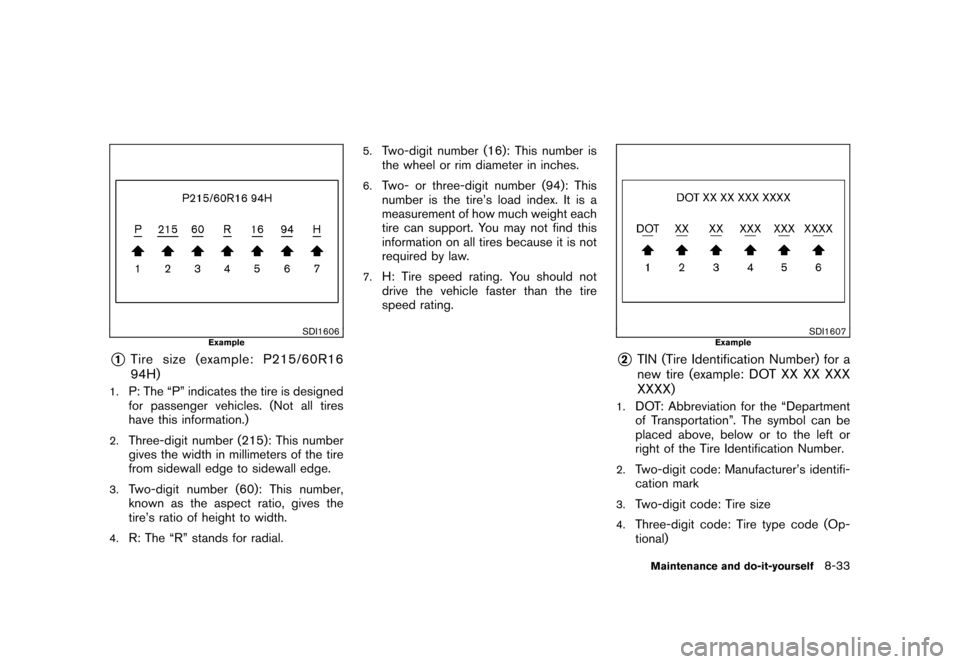
*1
Tire size (example: P215/60R16
94H)
1.
P: The “P” indicates the tire is designed
for passenger vehicles. (Not all tires
have this information.)
2.
Three-digit number (215): This number
gives the width in millimeters of the tire
from sidewall edge to sidewall edge.
3.
Two-digit number (60): This number,
known as the aspect ratio, gives the
tire’s ratio of height to width.
4.
R: The “R” stands for radial.
5.
Two-digit number (16): This number is
the wheel or rim diameter in inches.
6.
Two- or three-digit number (94): This
number is the tire’s load index. It is a
measurement of how much weight each
tire can support. You may not find this
information on all tires because it is not
required by law.
7.
H: Tire speed rating. You should not
drive the vehicle faster than the tire
speed rating.
SDI1607
Example
*2
TIN (Tire Identification Number) for a
new tire (example: DOT XX XX XXX
XXXX)
1.
DOT: Abbreviation for the “Department
of Transportation”. The symbol can be
placed above, below or to the left or
right of the Tire Identification Number.
2.
Two-digit code: Manufacturer’s identifi-
cation mark
3.
Two-digit code: Tire size
4.
Three-digit code: Tire type code (Op-
tional)
Maintenance and do-it-yourself
8-33
Page 315 of 345
Black plate (28,1)
9 Technical and consumer information
Model "Z12-D" EDITED: 2010/ 9/ 27
Capacities and recommended fuel/lubricants............ 9-2
Fuel recommendation ...................................... 9-3
Engine oil and oil filter recommendation ............... 9-5
Air conditioning system refrigerant and lubricant
recommendations ........................................... 9-6
Specifications. ................................................... 9-7
Engine ......................................................... 9-7
Wheels and tires ............................................ 9-7
Dimensions and weights .................................. 9-8
When traveling or registering your vehicle in
another country .................................................. 9-8
Vehicle identification ........................................... 9-8
Vehicle Identification Number (VIN) plate ............. 9-8
Vehicle identification number (chassis number) ...... 9-9
Engine serial number ...................................... 9-9
F.M.V.S.S./C.M.V.S.S. certification label ............... 9-9
Emission control information label .................... 9-10
Tire and loading information label ..................... 9-10
Air conditioner specification label
(if so equipped) ........................................... 9-10
Installing front license plate ................................ 9-11
Except for Kro ¯
m models ................................. 9-11 For Kro
¯
m models ......................................... 9-13
Vehicle loading information ................................. 9-14
Terms ........................................................ 9-14
Vehicle load capacity .................................... 9-14
Securing the load ......................................... 9-16
Loading tips ................................................ 9-16
Measurement of weights ................................ 9-17
Towing a trailer ................................................ 9-17
Flat towing ..................................................... 9-17
Continuously Variable Transmission (CVT) .......... 9-18
Manual Transmission ..................................... 9-18
Uniform tire quality grading ................................. 9-18
Treadwear .................................................. 9-18
Traction AA, A, B and C ................................ 9-18
Temperature A, B and C ................................ 9-18
Emission control system warranty ......................... 9-19
Reporting safety defects .................................... 9-19
Readiness for Inspection/Maintenance (I/M) test . . .... 9-20
Event Data Recorders (EDR) .............................. 9-21
Owner’s Manual/Service Manual order information . . . 9-21
In the event of a collision ............................... 9-21
Page 322 of 345
Black plate (320,1)
Model "Z12-D" EDITED: 2010/ 9/ 27
DIMENSIONS AND WEIGHTSOverall length in (mm)156.7 (3,980)*1
156.5 (3,975)*2
157.8 (4,010)*1, *3
157.5 (4,000)*2, *3
Overall width in (mm) 66.7 (1,695)
Overall height in (mm) 66.1 (1,680)
65.0 (1,650)*3
Front tread in (mm) 58.1 (1,475)
Rear tread in (mm) 58.3 (1,480)
Wheelbase in (mm) 99.6 (2,530)
Gross Vehicle
Weight Rating
(GVWR) lb (kg)
See the F.M.V.S.S. or
C.M.V.S.S. certification
label on the driver’s
side center pillar.
Gross Axle
Weight Rating
(GAWR)
Front lb (kg)
Rear lb (kg)
*1: With front license plate bracket
*2: Without front license plate bracket
*3: Kro ¯
m model
When planning to travel in another coun-
try, you should first find out if the fuel available is
suitable for your vehicle’s engine.
Using fuel with an octane rating that is too low
may cause engine damage. All gasoline vehicles
must be operated with unleaded gasoline.
Therefore, avoid taking your vehicle to areas
where appropriate fuel is not available.
When transferring the registration of your
vehicle to another country, state, province
or district, it may be necessary to modify the
vehicle to meet local laws and regulations.
The laws and regulations for motor vehicle
emission control and safety standards vary
according to the country, state, province or
district; therefore, vehicle specifications may
differ.
When any vehicle is to be taken into
another country, state, province or district
and registered, its modifications, transpor-
tation, and registration are the responsi-
bility of the user. NISSAN is not
responsible for any inconvenience that
may result.
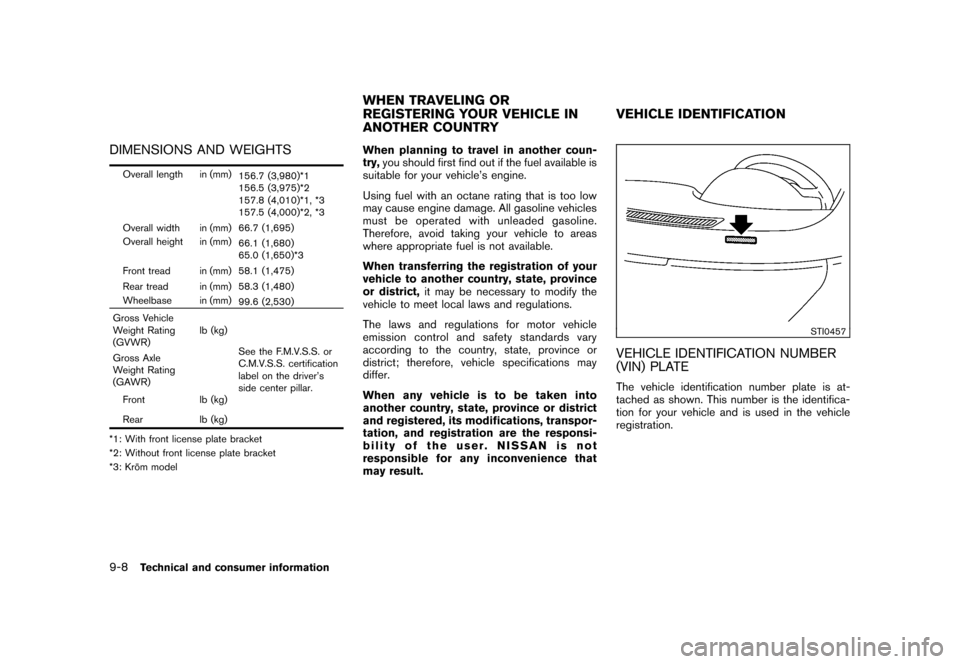
STI0457
VEHICLE IDENTIFICATION NUMBER
(VIN) PLATEThe vehicle identification number plate is at-
tached as shown. This number is the identifica-
tion for your vehicle and is used in the vehicle
registration.
WHEN TRAVELING OR
REGISTERING YOUR VEHICLE IN
ANOTHER COUNTRY VEHICLE IDENTIFICATION
9-8
Technical and consumer information
Page 323 of 345
Black plate (321,1)
Model "Z12-D" EDITED: 2010/ 9/ 27
STI0637
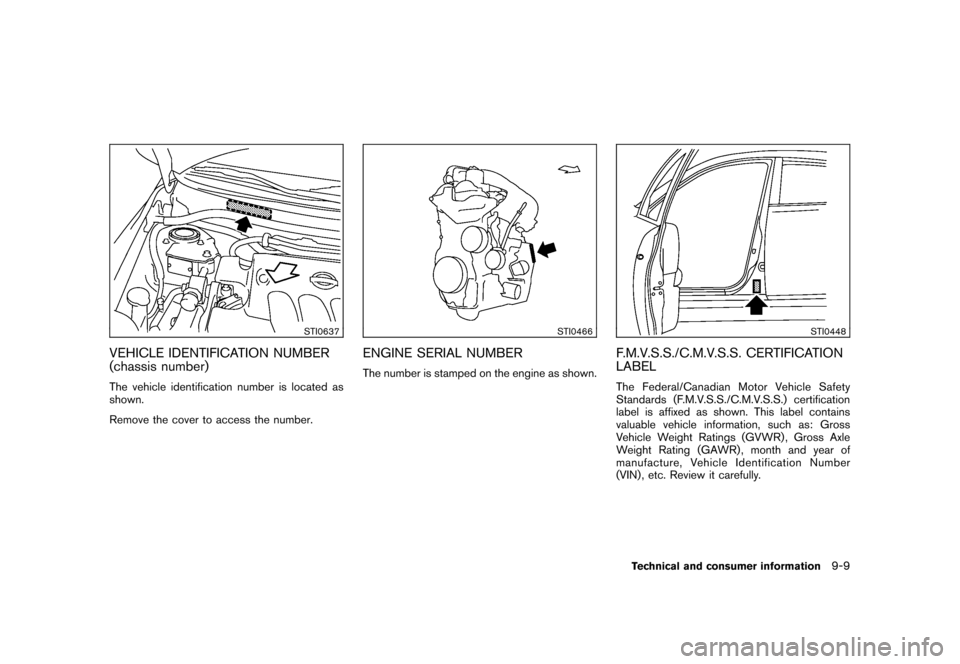
VEHICLE IDENTIFICATION NUMBER
(chassis number)The vehicle identification number is located as
shown.
Remove the cover to access the number.
STI0466
ENGINE SERIAL NUMBERThe number is stamped on the engine as shown.
STI0448
F.M.V.S.S./C.M.V.S.S. CERTIFICATION
LABELThe Federal/Canadian Motor Vehicle Safety
Standards (F.M.V.S.S./C.M.V.S.S.) certification
label is affixed as shown. This label contains
valuable vehicle information, such as: Gross
Vehicle Weight Ratings (GVWR) , Gross Axle
Weight Rating (GAWR) , month and year of
manufacture, Vehicle Identification Number
(VIN) , etc. Review it carefully.
Technical and consumer information
9-9
Page 328 of 345
Black plate (326,1)
Model "Z12-D" EDITED: 2010/ 9/ 27
WARNING
.
It is extremely dangerous to ride
in a cargo area inside the vehi-
cle. In a collision, people riding
in these areas are more likely to
be seriously injured or killed.
.
Do not allow people to ride in
any area of your vehicle that is
not equipped with seats and
seat belts.
.
Be sure everyone in your vehicle
is in a seat and using a seat belt
properly.
TERMSIt is important to familiarize yourself with the
following terms before loading your vehicle:.
Curb Weight (actual weight of your
vehicle) - vehicle weight including:
standard and optional equipment,
fluids, emergency tools, and spare tire
assembly. This weightdoes notin-
clude passengers and cargo.
.
GVW (Gross Vehicle Weight) - curb
weight plus the combined weight of
passengers and cargo.
.
GVWR (Gross Vehicle Weight Rating)
- maximum total combined weight of the
unloaded vehicle, passengers, luggage,
hitch, trailer tongue load and any other
optional equipment. This information is
located on the F.M.V.S.S./C.M.V.S.S.
label.
.
GAWR (Gross Axle Weight Rating) -
maximum weight (load) limit specified
for the front or rear axle. This informa-
tion is located on the F.M.V.S.S./C.M.V.
S.S. label.
.
GCWR (Gross Combined Weight Rat-
ing) - The maximum total weight rating
of the vehicle, passengers, cargo, and
trailer.
.
Vehicle Capacity Weight, Load limit,
Total load capacity - maximum total
weight limit specified of the load
(passengers and cargo) for the vehicle.
This is the maximum combined weight
of occupants and cargo that can be
loaded into the vehicle. If the vehicle is
used to tow a trailer, the trailer tongue
weight must be included as part of the
cargo load. This information is located
on the Tire and Loading Information
label.
.
Cargo capacity - permissible weight of
cargo, the subtracted weight of occu-
pants from the load limit.
VEHICLE LOAD CAPACITYDo not exceed the load limit of your vehicle
shown as “The combined weight of occu-
pants and cargo” on the Tire and Loading
Information label. Do not exceed the
number of occupants shown as “Seating
Capacity” on the Tire and Loading Informa-
tion label.
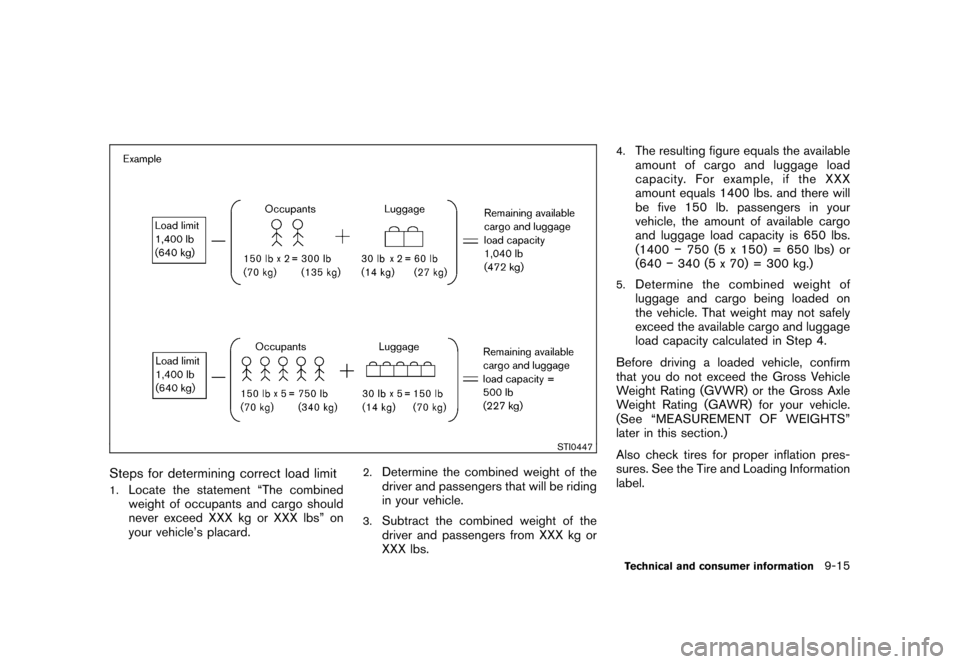
To get “the combined weight of occupants
and cargo”, add the weight of all occu-
pants, then add the total luggage weight.
Examples are shown in the following
illustration.
VEHICLE LOADING INFORMATION9-14
Technical and consumer information
Page 329 of 345
Black plate (327,1)
Model "Z12-D" EDITED: 2010/ 9/ 27
STI0447
Steps for determining correct load limit1.
Locate the statement “The combined
weight of occupants and cargo should
never exceed XXX kg or XXX lbs” on
your vehicle’s placard.
2.
Determine the combined weight of the
driver and passengers that will be riding
in your vehicle.
3.
Subtract the combined weight of the
driver and passengers from XXX kg or
XXX lbs.
4.
The resulting figure equals the available
amount of cargo and luggage load
capacity. For example, if the XXX
amount equals 1400 lbs. and there will
be five 150 lb. passengers in your
vehicle, the amount of available cargo
and luggage load capacity is 650 lbs.
(1400750 (5 x 150) = 650 lbs) or
(640 340 (5 x 70) = 300 kg.)
5.
Determine the combined weight of
luggage and cargo being loaded on
the vehicle. That weight may not safely
exceed the available cargo and luggage
load capacity calculated in Step 4.
Before driving a loaded vehicle, confirm
that you do not exceed the Gross Vehicle
Weight Rating (GVWR) or the Gross Axle
Weight Rating (GAWR) for your vehicle.
(See “MEASUREMENT OF WEIGHTS”
later in this section.)
Also check tires for proper inflation pres-
sures. See the Tire and Loading Information
label.Technical and consumer information
9-15
Page 331 of 345
Black plate (329,1)
Model "Z12-D" EDITED: 2010/ 9/ 27
warranty.
MEASUREMENT OF WEIGHTSSecure loose items to prevent weight shifts
that could affect the balance of your
vehicle. When the vehicle is loaded, drive
to a scale and weigh the front and the rear
wheels separately to determine axle loads.
Individual axle loads should not exceed
either of the Gross Axle Weight Ratings
(GAWR) . The total of the axle loads should
not exceed the Gross Vehicle Weight
Rating (GVWR) . These ratings are given
on the vehicle certification label. If weight
ratings are exceeded, move or remove
items to bring all weights below the ratings.
Do not tow a trailer with your vehicle.Towing your vehicle with all four wheels on the
ground is sometimes called flat towing. This
method is sometimes used when towing a
vehicle behind a recreational vehicle, such as a
motor home.
CAUTION
.Failure to follow these guidelines
can result in severe transmission
damage.
. Whenever flat towing your vehicle,
always tow forward, never back-
ward.
. DO NOT tow any Continuously Vari-
able Transmission (CVT) vehicle
with all four wheels on the ground
(flat towing) . Doing so WILL DA-
MAGE internal transmission parts
due to lack of transmission lubrica-
tion.
. For emergency towing procedures
refer to “TOWING YOUR VEHICLE”
in the “6. In case of emergency”
section of this manual.
TOWING A TRAILER FLAT TOWING
Technical and consumer information
9-17