2011 NISSAN CUBE seat adjustment
[x] Cancel search: seat adjustmentPage 28 of 345
Black plate (24,1)
Model "Z12-D" EDITED: 2010/ 9/ 27
SSS1034
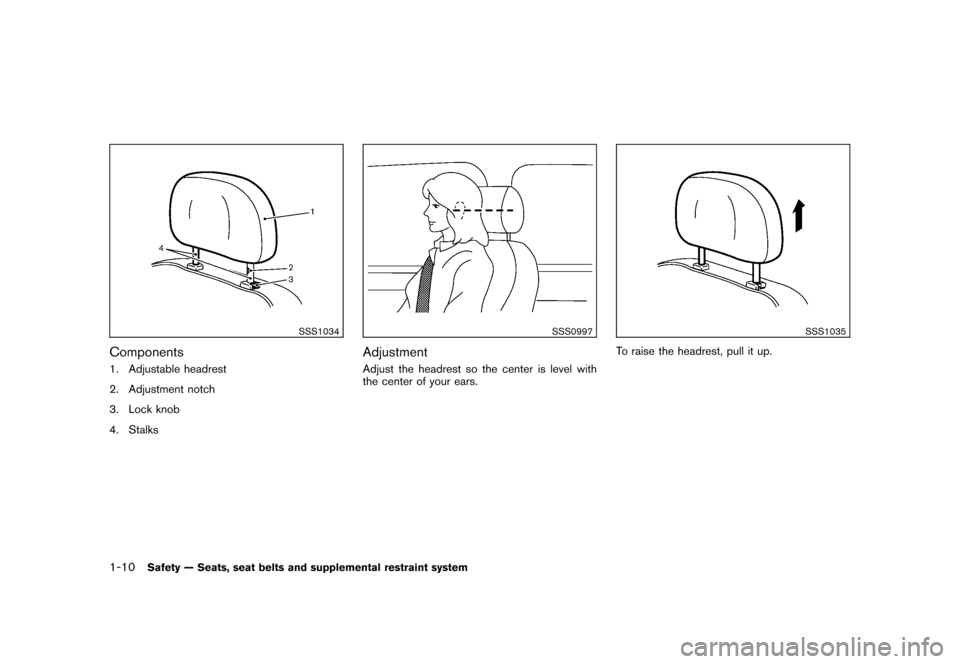
Components1. Adjustable headrest
2. Adjustment notch
3. Lock knob
4. Stalks
SSS0997
AdjustmentAdjust the headrest so the center is level with
the center of your ears.
SSS1035
To raise the headrest, pull it up.
1-10
Safety — Seats, seat belts and supplemental restraint system
Page 29 of 345
Black plate (25,1)
Model "Z12-D" EDITED: 2010/ 9/ 27
SSS1036
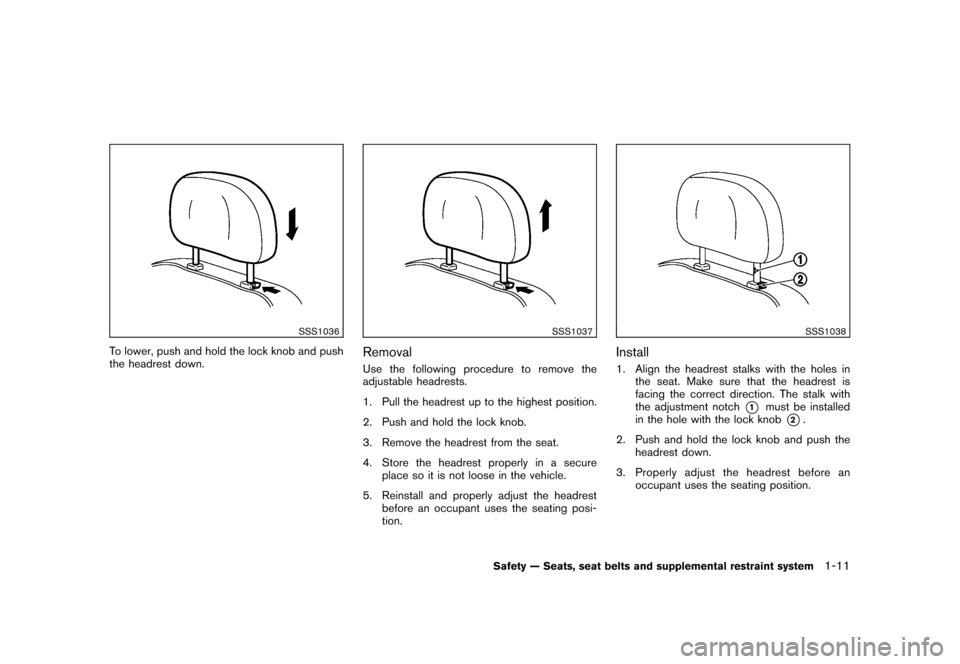
To lower, push and hold the lock knob and push
the headrest down.
SSS1037
RemovalUse the following procedure to remove the
adjustable headrests.
1. Pull the headrest up to the highest position.
2. Push and hold the lock knob.
3. Remove the headrest from the seat.
4. Store the headrest properly in a secureplace so it is not loose in the vehicle.
5. Reinstall and properly adjust the headrest before an occupant uses the seating posi-
tion.
SSS1038
Install1. Align the headrest stalks with the holes inthe seat. Make sure that the headrest is
facing the correct direction. The stalk with
the adjustment notch
*1
must be installed
in the hole with the lock knob
*2.
2. Push and hold the lock knob and push the headrest down.
3. Properly adjust the headrest before an occupant uses the seating position.
Safety — Seats, seat belts and supplemental restraint system
1-11
Page 35 of 345
Black plate (31,1)
Model "Z12-D" EDITED: 2010/ 9/ 27
SSS0987
Rear seat belt buckles (except for Cargo
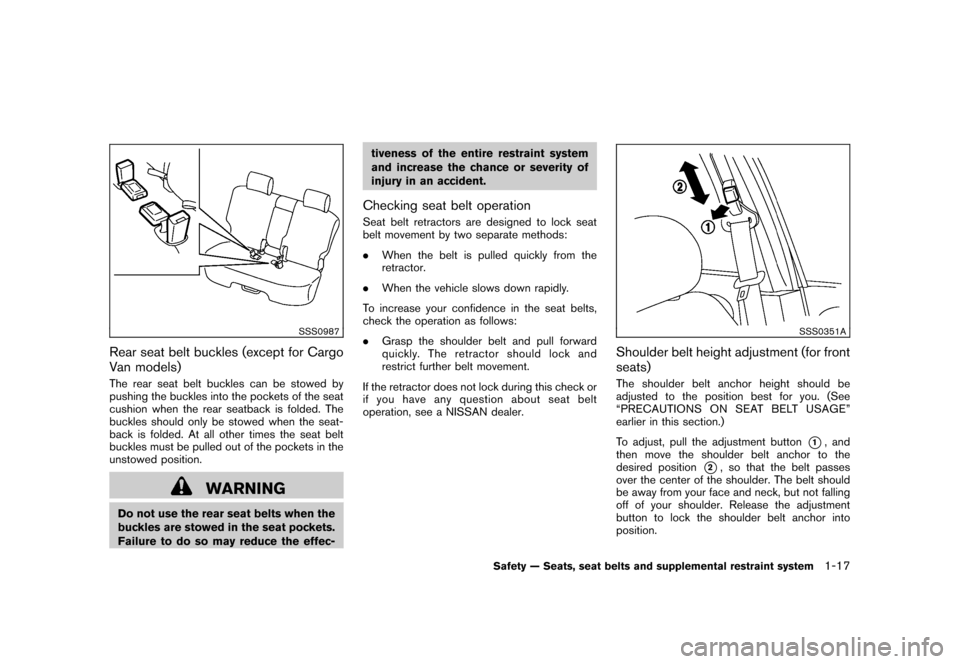
Van models)The rear seat belt buckles can be stowed by
pushing the buckles into the pockets of the seat
cushion when the rear seatback is folded. The
buckles should only be stowed when the seat-
back is folded. At all other times the seat belt
buckles must be pulled out of the pockets in the
unstowed position.
WARNING
Do not use the rear seat belts when the
buckles are stowed in the seat pockets.
Failure to do so may reduce the effec-tiveness of the entire restraint system
and increase the chance or severity of
injury in an accident.
Checking seat belt operationSeat belt retractors are designed to lock seat
belt movement by two separate methods:
.
When the belt is pulled quickly from the
retractor.
. When the vehicle slows down rapidly.
To increase your confidence in the seat belts,
check the operation as follows:
. Grasp the shoulder belt and pull forward
quickly. The retractor should lock and
restrict further belt movement.
If the retractor does not lock during this check or
if you have any question about seat belt
operation, see a NISSAN dealer.
SSS0351A
Shoulder belt height adjustment (for front
seats)The shoulder belt anchor height should be
adjusted to the position best for you. (See
“PRECAUTIONS ON SEAT BELT USAGE”
earlier in this section.)
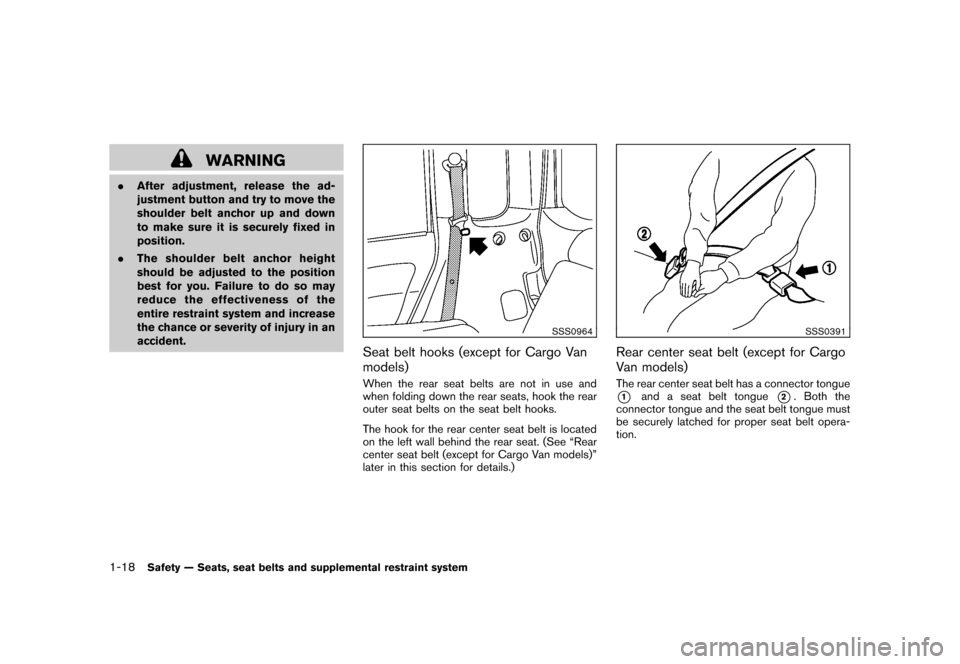
To adjust, pull the adjustment button
*1, and
then move the shoulder belt anchor to the
desired position
*2, so that the belt passes
over the center of the shoulder. The belt should
be away from your face and neck, but not falling
off of your shoulder. Release the adjustment
button to lock the shoulder belt anchor into
position.
Safety — Seats, seat belts and supplemental restraint system
1-17
Page 36 of 345
Black plate (32,1)
Model "Z12-D" EDITED: 2010/ 9/ 27
WARNING
.After adjustment, release the ad-
justment button and try to move the
shoulder belt anchor up and down
to make sure it is securely fixed in
position.
. The shoulder belt anchor height
should be adjusted to the position
best for you. Failure to do so may
reduce the effectiveness of the
entire restraint system and increase
the chance or severity of injury in an
accident.
SSS0964
Seat belt hooks (except for Cargo Van
models)When the rear seat belts are not in use and
when folding down the rear seats, hook the rear
outer seat belts on the seat belt hooks.
The hook for the rear center seat belt is located
on the left wall behind the rear seat. (See “Rear
center seat belt (except for Cargo Van models)”
later in this section for details.)
SSS0391
Rear center seat belt (except for Cargo
Van models)The rear center seat belt has a connector tongue*1
and a seat belt tongue
*2. Both the
connector tongue and the seat belt tongue must
be securely latched for proper seat belt opera-
tion.
1-18
Safety — Seats, seat belts and supplemental restraint system
Page 42 of 345
Black plate (38,1)
Model "Z12-D" EDITED: 2010/ 9/ 27
possible after fitting the child
restraint.
— Infants and children should al- ways be placed in an appropri-
ate child restraint while in the
vehicle.
. When the child restraint is not in
use, keep it secured with the LATCH
system or a seat belt. In a sudden
stop or collision, loose objects can
injure occupants or damage the
vehicle.
CAUTION
A child restraint in a closed vehicle can
become very hot. Check the seating
surface and buckles before placing a
child in the child restraint.
This vehicle is equipped with a universal child
restraint anchor system, referred to as the
LATCH (Lower Anchors and Tethers for CHil-
dren) system. Some child restraints include rigid
or webbing-mounted attachments that can be
connected to these anchors. For details, see
“Lower Anchors and Tethers for CHildren
System (LATCH) (except for Cargo Van mod-
els)” later in this section. If you do not have a LATCH compatible child
restraint, the vehicle seat belts can be used.
Several manufacturers offer child restraints for
infants and small children of various sizes. When
selecting any child restraint, keep the following
points in mind:
.
Choose only a restraint with a label certifying
that it complies with Federal Motor Vehicle
Safety Standard 213 or Canadian Motor
Vehicle Safety Standard 213.
. Check the child restraint in your vehicle to
be sure it is compatible with the vehicle’s
seat and seat belt system.
. If the child restraint is compatible with your
vehicle, place your child in the child restraint
and check the various adjustments to be
sure the child restraint is compatible with
your child. Choose a child restraint that is
designed for your child’s height and weight.
Always follow all recommended procedures.
All U.S. states and Canadian provinces or
territories require that infants and small
children be restrained in an approved child
restraint at all times while the vehicle is
being operated. Canadian law requires the
top tether strap on forward-facing child
restraints be secured to the designated
anchor point on the vehicle.
Lower Anchors and Tethers for CHildren
System (LATCH) (except for Cargo Van
models)Your vehicle is equipped with special anchor
points that are used with LATCH (Lower
Anchors and Tethers for CHildren) system
compatible child restraints. This system may
also be referred to as the ISOFIX or ISOFIX
compatible system. With this system, you do not
have to use a vehicle seat belt to secure the
child restraint.
The LATCH anchor points are provided to install
child restraints in the rear outboard seating
positions only. Do not attempt to install a child
restraint in the center position using the LATCH
anchors.
1-24
Safety — Seats, seat belts and supplemental restraint system
Page 52 of 345
Black plate (48,1)
Model "Z12-D" EDITED: 2010/ 9/ 27
SSS0646
Forward-facing rigid-mounted — step 3
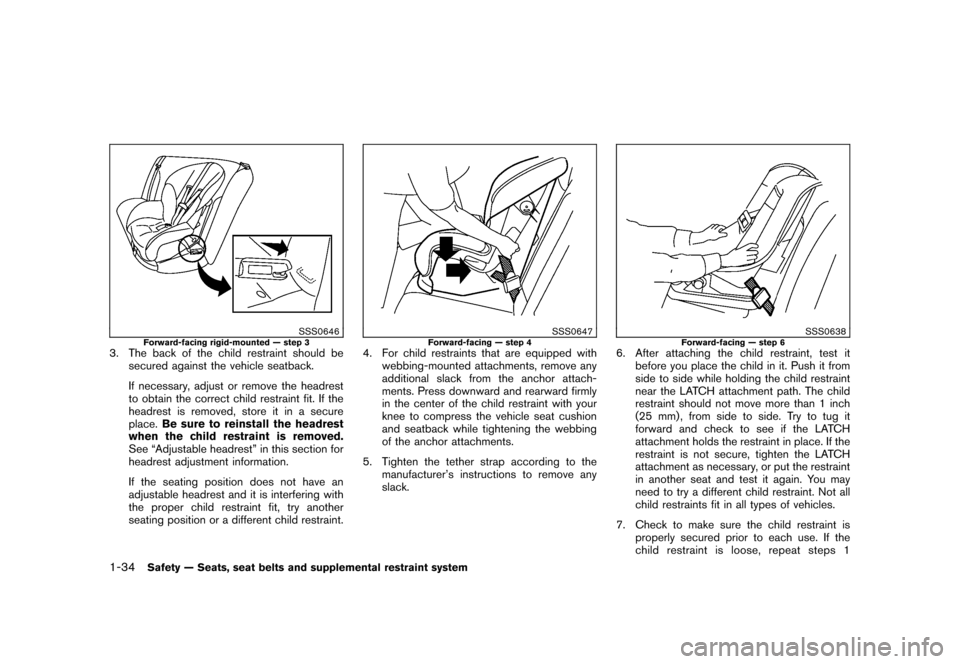
3. The back of the child restraint should besecured against the vehicle seatback.
If necessary, adjust or remove the headrest
to obtain the correct child restraint fit. If the
headrest is removed, store it in a secure
place. Be sure to reinstall the headrest
when the child restraint is removed.
See “Adjustable headrest” in this section for
headrest adjustment information.
If the seating position does not have an
adjustable headrest and it is interfering with
the proper child restraint fit, try another
seating position or a different child restraint.
SSS0647
Forward-facing — step 4
4. For child restraints that are equipped with webbing-mounted attachments, remove any
additional slack from the anchor attach-
ments. Press downward and rearward firmly
in the center of the child restraint with your
knee to compress the vehicle seat cushion
and seatback while tightening the webbing
of the anchor attachments.
5. Tighten the tether strap according to the manufacturer’s instructions to remove any
slack.
SSS0638
Forward-facing — step 6
6. After attaching the child restraint, test itbefore you place the child in it. Push it from
side to side while holding the child restraint
near the LATCH attachment path. The child
restraint should not move more than 1 inch
(25 mm) , from side to side. Try to tug it
forward and check to see if the LATCH
attachment holds the restraint in place. If the
restraint is not secure, tighten the LATCH
attachment as necessary, or put the restraint
in another seat and test it again. You may
need to try a different child restraint. Not all
child restraints fit in all types of vehicles.
7. Check to make sure the child restraint is properly secured prior to each use. If the
child restraint is loose, repeat steps 1
1-34
Safety — Seats, seat belts and supplemental restraint system
Page 53 of 345
Black plate (49,1)
Model "Z12-D" EDITED: 2010/ 9/ 27
through 6.
FORWARD-FACING CHILD RE-
STRAINT INSTALLATION USING THE
SEAT BELTS
WARNING
.The three-point seat belt with Auto-
matic Locking Retractor (ALR) must
be used when installing a child
restraint. Failure to use the ALR
mode will result in the child re-
straint not being properly secured.
The restraint could tip over or be
loose and cause injury to a child in a
sudden stop or collision. Also, it can
change the operation of the front
passenger air bag. See “Front pas-
senger air bag and status light”
later in this section.
. When installing a child restraint
system in the rear center position,
both the center seat belt connector
tongue and buckle tongue must be
secured. See “Rear center seat belt
(except for Cargo Van models)” ear-
lier in this section.
SSS0640
Forward-facing (front passenger seat) — step 1
Refer to all Warnings and Cautions in the “Child
safety” and “Child restraints” sections before
installing a child restraint.
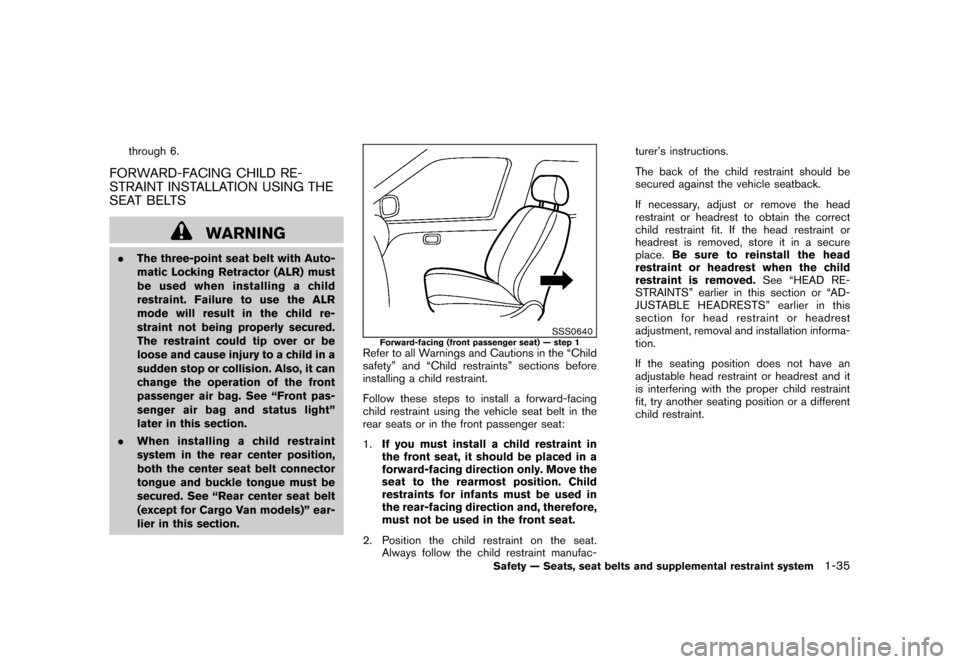
Follow these steps to install a forward-facing
child restraint using the vehicle seat belt in the
rear seats or in the front passenger seat:
1.If you must install a child restraint in
the front seat, it should be placed in a
forward-facing direction only. Move the
seat to the rearmost position. Child
restraints for infants must be used in
the rear-facing direction and, therefore,
must not be used in the front seat.
2. Position the child restraint on the seat. Always follow the child restraint manufac- turer’s instructions.
The back of the child restraint should be
secured against the vehicle seatback.
If necessary, adjust or remove the head
restraint or headrest to obtain the correct
child restraint fit. If the head restraint or
headrest is removed, store it in a secure
place.
Be sure to reinstall the head
restraint or headrest when the child
restraint is removed. See “HEAD RE-
STRAINTS” earlier in this section or “AD-
JUSTABLE HEADRESTS” earlier in this
section for head restraint or headrest
adjustment, removal and installation informa-
tion.
If the seating position does not have an
adjustable head restraint or headrest and it
is interfering with the proper child restraint
fit, try another seating position or a different
child restraint.
Safety — Seats, seat belts and supplemental restraint system
1-35
Page 57 of 345
Black plate (53,1)
Model "Z12-D" EDITED: 2010/ 9/ 27
LRS0455
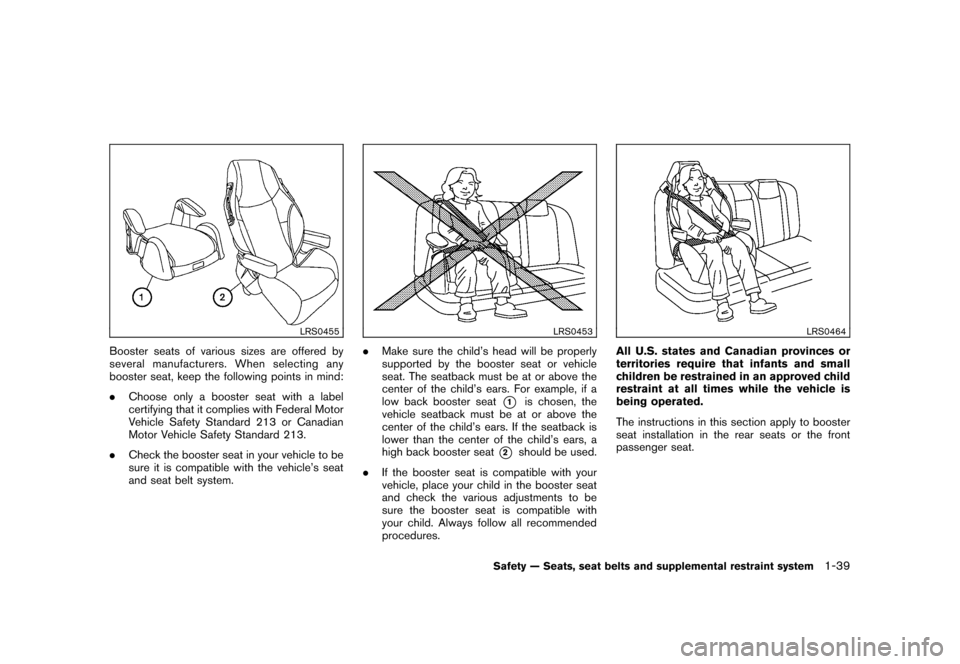
Booster seats of various sizes are offered by
several manufacturers. When selecting any
booster seat, keep the following points in mind:
.Choose only a booster seat with a label
certifying that it complies with Federal Motor
Vehicle Safety Standard 213 or Canadian
Motor Vehicle Safety Standard 213.
. Check the booster seat in your vehicle to be
sure it is compatible with the vehicle’s seat
and seat belt system.
LRS0453
.Make sure the child’s head will be properly
supported by the booster seat or vehicle
seat. The seatback must be at or above the
center of the child’s ears. For example, if a
low back booster seat
*1
is chosen, the
vehicle seatback must be at or above the
center of the child’s ears. If the seatback is
lower than the center of the child’s ears, a
high back booster seat
*2
should be used.
. If the booster seat is compatible with your
vehicle, place your child in the booster seat
and check the various adjustments to be
sure the booster seat is compatible with
your child. Always follow all recommended
procedures.
LRS0464
All U.S. states and Canadian provinces or
territories require that infants and small
children be restrained in an approved child
restraint at all times while the vehicle is
being operated.
The instructions in this section apply to booster
seat installation in the rear seats or the front
passenger seat.
Safety — Seats, seat belts and supplemental restraint system
1-39