2011 NISSAN CUBE emergency towing
[x] Cancel search: emergency towingPage 264 of 345
Black plate (262,1)
Model "Z12-D" EDITED: 2010/ 9/ 27
SCE0833
VEHICLE RECOVERY (freeing a stuck
vehicle)
WARNING
.Stand clear of a stuck vehicle.
. Do not spin your tires at high speed.
This could cause them to explode
and result in serious injury. Parts of
your vehicle could also overheat
and be damaged.Pulling a stuck vehicleDo not use the tie down hook for towing or vehicle recovery.
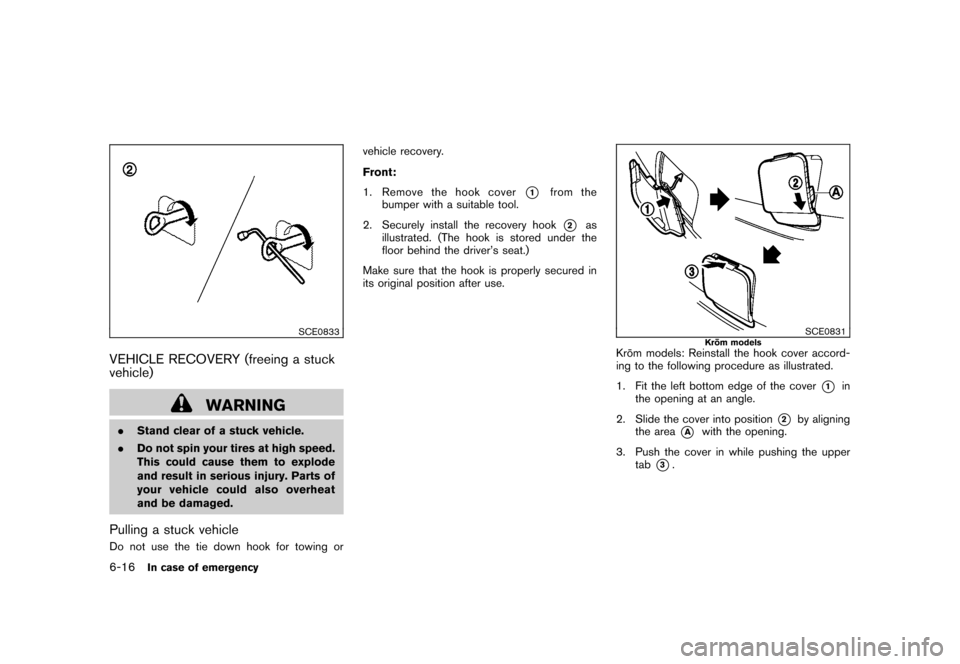
Front:
1. Remove the hook cover
*1
from the
bumper with a suitable tool.
2. Securely install the recovery hook*2
as
illustrated. (The hook is stored under the
floor behind the driver’s seat.)
Make sure that the hook is properly secured in
its original position after use.
SCE0831
Kro ¯
m models
Kro ¯
m models: Reinstall the hook cover accord-
ing to the following procedure as illustrated.
1. Fit the left bottom edge of the cover
*1
in
the opening at an angle.
2. Slide the cover into position
*2
by aligning
the area
*A
with the opening.
3. Push the cover in while pushing the upper tab
*3.
6-16
In case of emergency
Page 265 of 345
Black plate (263,1)
Model "Z12-D" EDITED: 2010/ 9/ 27
SCE0678
Rear
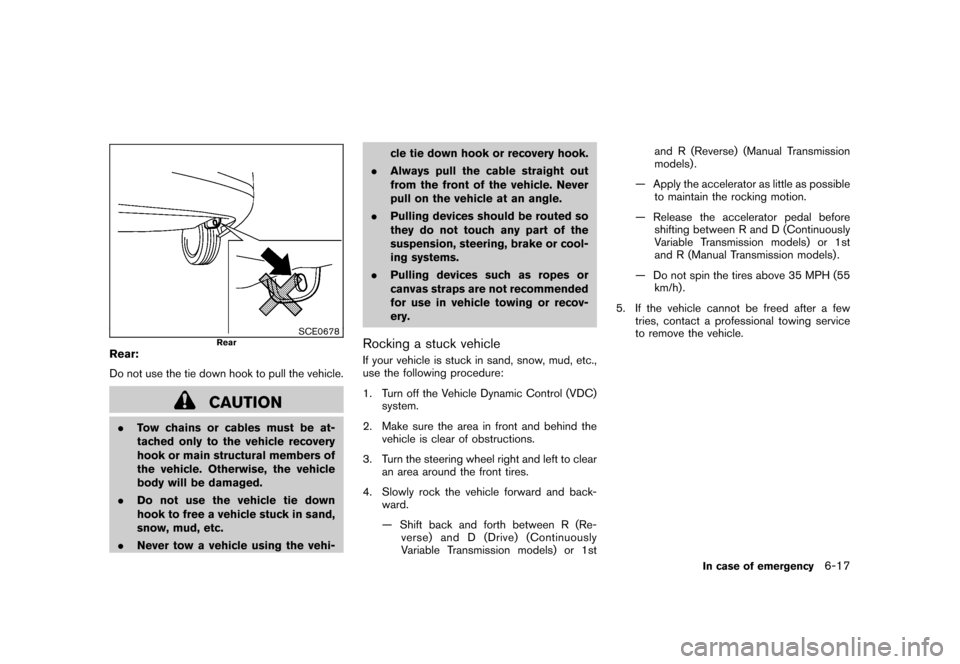
Rear:
Do not use the tie down hook to pull the vehicle.
CAUTION
.Tow chains or cables must be at-
tached only to the vehicle recovery
hook or main structural members of
the vehicle. Otherwise, the vehicle
body will be damaged.
. Do not use the vehicle tie down
hook to free a vehicle stuck in sand,
snow, mud, etc.
. Never tow a vehicle using the vehi- cle tie down hook or recovery hook.
. Always pull the cable straight out
from the front of the vehicle. Never
pull on the vehicle at an angle.
. Pulling devices should be routed so
they do not touch any part of the
suspension, steering, brake or cool-
ing systems.
. Pulling devices such as ropes or
canvas straps are not recommended
for use in vehicle towing or recov-
ery.
Rocking a stuck vehicleIf your vehicle is stuck in sand, snow, mud, etc.,
use the following procedure:
1. Turn off the Vehicle Dynamic Control (VDC)
system.
2. Make sure the area in front and behind the vehicle is clear of obstructions.
3. Turn the steering wheel right and left to clear an area around the front tires.
4. Slowly rock the vehicle forward and back- ward.
— Shift back and forth between R (Re-verse) and D (Drive) (Continuously
Variable Transmission models) or 1st and R (Reverse) (Manual Transmission
models) .
— Apply the accelerator as little as possible to maintain the rocking motion.
— Release the accelerator pedal before shifting between R and D (Continuously
Variable Transmission models) or 1st
and R (Manual Transmission models) .
— Do not spin the tires above 35 MPH (55 km/h) .
5. If the vehicle cannot be freed after a few tries, contact a professional towing service
to remove the vehicle.
In case of emergency
6-17
Page 331 of 345
Black plate (329,1)
Model "Z12-D" EDITED: 2010/ 9/ 27
warranty.
MEASUREMENT OF WEIGHTSSecure loose items to prevent weight shifts
that could affect the balance of your
vehicle. When the vehicle is loaded, drive
to a scale and weigh the front and the rear
wheels separately to determine axle loads.
Individual axle loads should not exceed
either of the Gross Axle Weight Ratings
(GAWR) . The total of the axle loads should
not exceed the Gross Vehicle Weight
Rating (GVWR) . These ratings are given
on the vehicle certification label. If weight
ratings are exceeded, move or remove
items to bring all weights below the ratings.
Do not tow a trailer with your vehicle.Towing your vehicle with all four wheels on the
ground is sometimes called flat towing. This
method is sometimes used when towing a
vehicle behind a recreational vehicle, such as a
motor home.
CAUTION
.Failure to follow these guidelines
can result in severe transmission
damage.
. Whenever flat towing your vehicle,
always tow forward, never back-
ward.
. DO NOT tow any Continuously Vari-
able Transmission (CVT) vehicle
with all four wheels on the ground
(flat towing) . Doing so WILL DA-
MAGE internal transmission parts
due to lack of transmission lubrica-
tion.
. For emergency towing procedures
refer to “TOWING YOUR VEHICLE”
in the “6. In case of emergency”
section of this manual.
TOWING A TRAILER FLAT TOWING
Technical and consumer information
9-17
Page 338 of 345
Black plate (2,1)
10-2Control panel buttons — color screen with
navigation system.................................... 4-2
Controls, Steering wheel audio controls ......... 4-53
Coolant Capacities and recommended
fuel/lubricants .................................... 9-2
Changing engine coolant ........................ 8-8
Checking engine coolant level .................. 8-8
Corrosion protection ................................. 7-7
Cruise control ...................................... 5-21
Cup holders ........................................ 2-34
CVT, Driving with CVT
(Continuously Variable Transmission) ........ 5-7, 5-14
D
Daytime running light system ..................... 2-26
Defroster switch, Rear window and outside
mirror defroster switch ............................ 2-24
Dimensions and weights ............................ 9-8
Door open warning light ........................... 2-12
Drive belt ........................................... 8-15
Driving Cold weather driving .......................... 5-29
Driving with CVT
(Continuously Variable Transmission) .... 5-7, 5-14
Driving with manual transmission ........ 5-8, 5-18
Precautions when starting and driving ......... 5-2
E
Economy, Fuel ..................................... 5-23
Electric power steering system ................... 5-25
Electric power steering warning light ............ 2-13
Emission control information label ................ 9-10
Emission control system warranty ................ 9-19Engine
Before starting the engine .................... 5-12
Break-in schedule .............................. 5-23
Capacities and recommended
fuel/lubricants .................................... 9-2
Changing engine coolant ........................ 8-8
Changing engine oil and filter ................... 8-9
Checking engine coolant level .................. 8-8
Checking engine oil level ........................ 8-9
Coolant temperature gauge ..................... 2-6
Emergency engine shut off .................... 5-11
Engine block heater ........................... 5-30
Engine compartment check locations .......... 8-6
Engine cooling system .......................... 8-7
Engine oil ......................................... 8-9
Engine oil and oil filter recommendation ....... 9-5
Engine oil viscosity .............................. 9-5
Engine serial number ............................ 9-9
Engine specifications ............................ 9-7
If your vehicle overheats ....................... 6-11
Starting the engine ............................ 5-12
Event Data Recorders (EDR) ..................... 9-21
Exhaust gas (carbon monoxide) .................... 5-2
F
F.M.V.S.S./C.M.V.S.S. certification label. ........... 9-9
Filter Air cleaner housing filter ...................... 8-16
Changing engine oil and filter ................... 8-9
Flashers (See hazard warning flasher switch) . . . 2-28
Flat tire ................................................ 6-2
Flat towing .......................................... 9-17
Floor mat cleaning ................................... 7-5 Fluid
Brake and clutch fluid ......................... 8-11
Capacities and recommended
fuel/lubricants .................................... 9-2
Continuously Variable Transmission (CVT)
fluid ............................................. 8-11
Engine coolant ................................... 8-7
Engine oil ......................................... 8-9
Window washer fluid .......................... 8-12
FM-AM radio with Compact Disc (CD)
player ........................................ 4-34, 4-38
FM-AM-SAT radio with Compact Disc (CD)
player ............................................... 4-45
Fog light switch .................................... 2-28
Front manual seat adjustment. ...................... 1-3
Front passenger air bag and status light ........ 1-49
Front seat, Front seat adjustment .................. 1-3
Front-seat active head restraints ................... 1-9
Fuel Capacities and recommended
fuel/lubricants .................................... 9-2
Distance to empty ............................... 2-9
Fuel economy .................................. 5-23
Fuel octane rating ................................ 9-3
Fuel recommendation ............................ 9-3
Fuel-filler cap ................................... 3-24
Fuel-filler door .................................. 3-24
Gauge ............................................ 2-7
Fuses ............................................... 8-20
Fusible links ........................................ 8-21
G
Gas cap ............................................ 3-24
Gauge ................................................ 2-4
Model "Z12-D" EDITED: 2010/ 9/ 27