2011 NISSAN 370Z ROADSTER lock
[x] Cancel search: lockPage 33 of 419
Black plate (29,1)
Model "Z34-D" EDITED: 2010/ 7/ 27
PREGNANT WOMENNISSAN recommends that pregnant women use
seat belts. The seat belt should be worn snug,
and always position the lap belt as low as
possible around the hips, not the waist, and
place the shoulder belt over your shoulder and
across your chest. Never run the lap/shoulder
belt over your abdominal area. Contact your
doctor for specific recommendations.INJURED PERSONSNISSAN recommends that injured persons use
seat belts, depending on the injury. Check with
your doctor for specific recommendations.THREE-POINT TYPE SEAT BELT
WARNING
.Every person who drives or rides in
this vehicle should use a seat belt at
all times.
. Do not ride in a moving vehicle
when the seatback is reclined. This
can be dangerous. The shoulder belt
will not be against your body. In an
accident, you could be thrown into it
and receive neck or other serious
injuries. You could also slide under
the lap belt and receive serious internal injuries.
. For the most effective protection
when the vehicle is in motion, the
seat should be upright. Always sit
well back in the seat with both feet
on the floor and adjust the seat belt
properly.
SSS0292
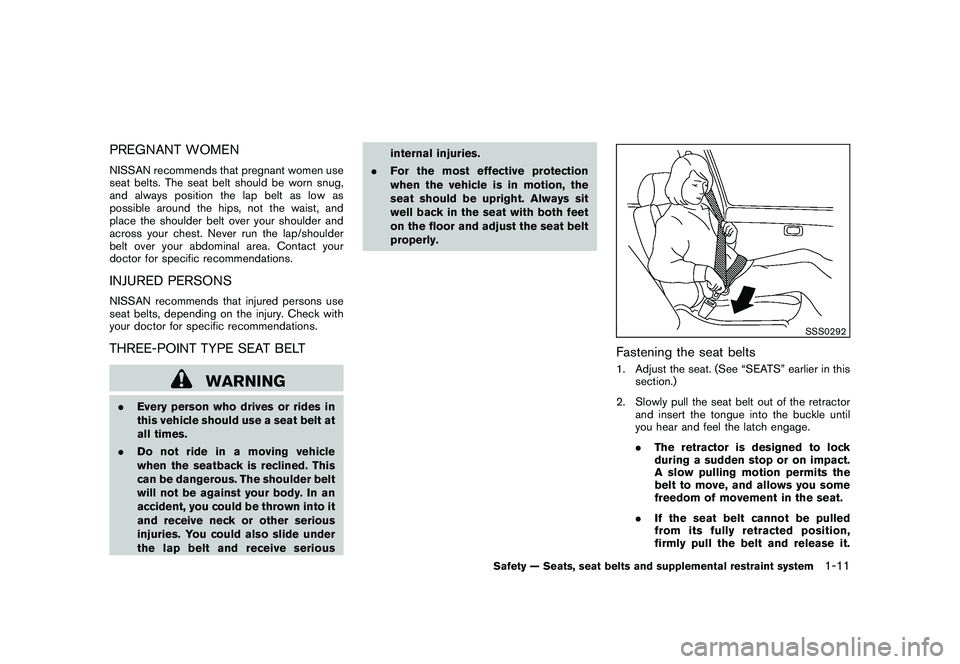
Fastening the seat belts1. Adjust the seat. (See “SEATS” earlier in this
section.)
2. Slowly pull the seat belt out of the retractor and insert the tongue into the buckle until
you hear and feel the latch engage.
.The retractor is designed to lock
during a sudden stop or on impact.
A slow pulling motion permits the
belt to move, and allows you some
freedom of movement in the seat.
. If the seat belt cannot be pulled
from its fully retracted position,
firmly pull the belt and release it.
Safety — Seats, seat belts and supplemental restraint system
1-11
Page 34 of 419
Black plate (30,1)
Model "Z34-D" EDITED: 2010/ 7/ 27
Then smoothly pull the belt out of
the retractor.
SSS0290
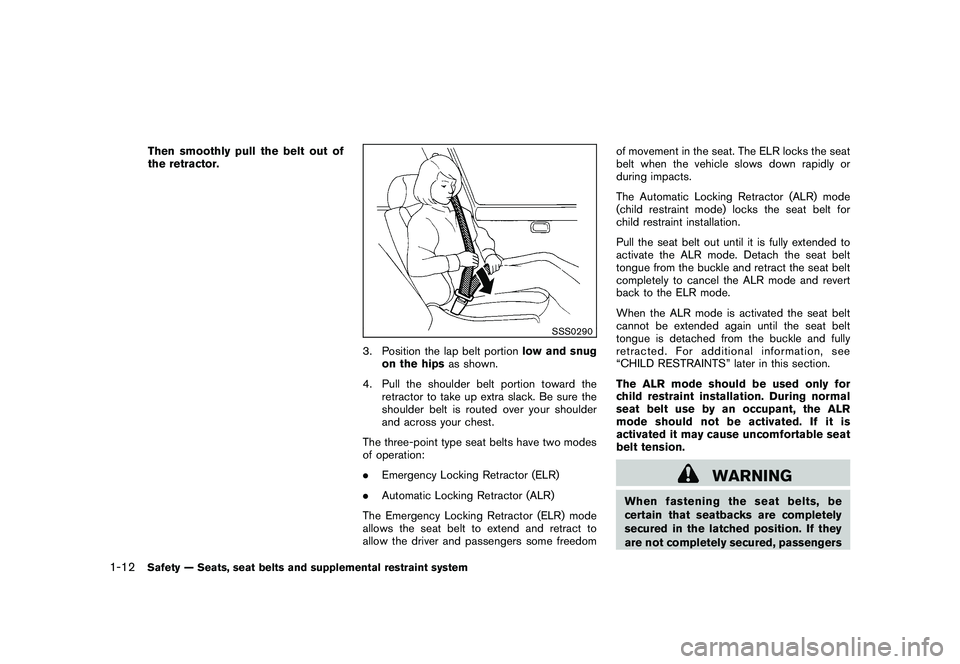
3. Position the lap belt portionlow and snug
on the hips as shown.
4. Pull the shoulder belt portion toward the retractor to take up extra slack. Be sure the
shoulder belt is routed over your shoulder
and across your chest.
The three-point type seat belts have two modes
of operation:
. Emergency Locking Retractor (ELR)
. Automatic Locking Retractor (ALR)
The Emergency Locking Retractor (ELR) mode
allows the seat belt to extend and retract to
allow the driver and passengers some freedom of movement in the seat. The ELR locks the seat
belt when the vehicle slows down rapidly or
during impacts.
The Automatic Locking Retractor (ALR) mode
(child restraint mode) locks the seat belt for
child restraint installation.
Pull the seat belt out until it is fully extended to
activate the ALR mode. Detach the seat belt
tongue from the buckle and retract the seat belt
completely to cancel the ALR mode and revert
back to the ELR mode.
When the ALR mode is activated the seat belt
cannot be extended again until the seat belt
tongue is detached from the buckle and fully
retracted. For additional information, see
“CHILD RESTRAINTS” later in this section.
The ALR mode should be used only for
child restraint installation. During normal
seat belt use by an occupant, the ALR
mode should not be activated. If it is
activated it may cause uncomfortable seat
belt tension.
WARNING
When fastening the seat belts, be
certain that seatbacks are completely
secured in the latched position. If they
are not completely secured, passengers
1-12
Safety — Seats, seat belts and supplemental restraint system
Page 35 of 419
Black plate (31,1)
Model "Z34-D" EDITED: 2010/ 7/ 27
may be injured in an accident or sudden
stop.
SSS0326
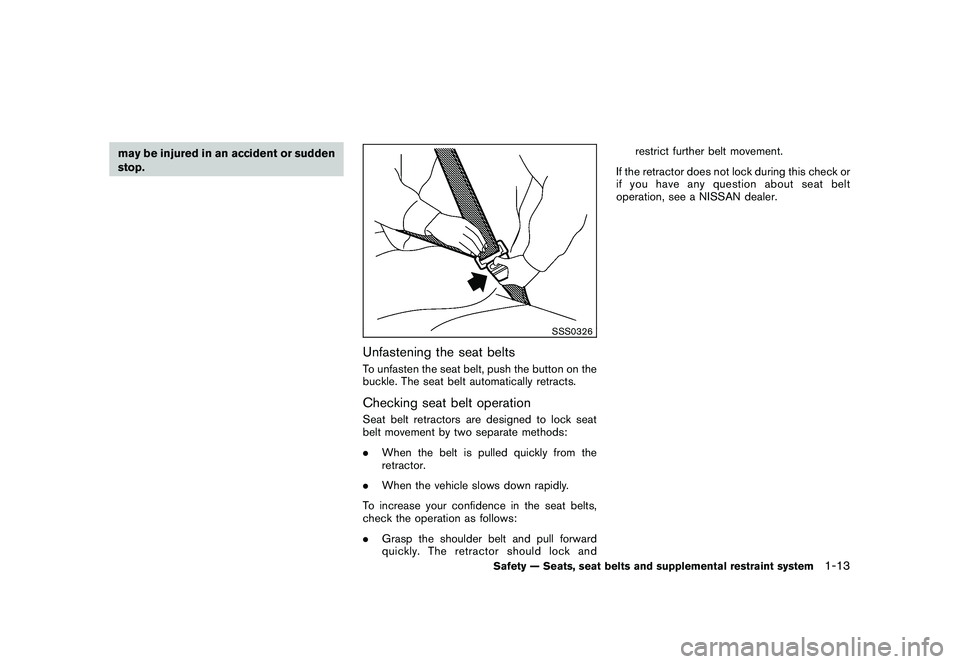
Unfastening the seat beltsTo unfasten the seat belt, push the button on the
buckle. The seat belt automatically retracts.Checking seat belt operationSeat belt retractors are designed to lock seat
belt movement by two separate methods:
.When the belt is pulled quickly from the
retractor.
. When the vehicle slows down rapidly.
To increase your confidence in the seat belts,
check the operation as follows:
. Grasp the shoulder belt and pull forward
quickly. The retractor should lock and restrict further belt movement.
If the retractor does not lock during this check or
if you have any question about seat belt
operation, see a NISSAN dealer.
Safety — Seats, seat belts and supplemental restraint system
1-13
Page 41 of 419
Black plate (37,1)
Model "Z34-D" EDITED: 2010/ 7/ 27
If the cargo cover is not removed, it
may damage the top tether strap
during a collision. A child could be
seriously injured or killed in a colli-
sion if the child restraint top tether
strap is damaged.
. Do not allow cargo to contact the
top tether strap when it is attached
to the top tether anchor. Properly
secure the cargo so it does not
contact the top tether strap. Cargo
that is not properly secured or that
contacts the top tether strap may
damage the top tether strap during
a collision. Your child could be
seriously injured or killed in a colli-
sion if the child restraint top tether
strap is damaged.
SSS0929
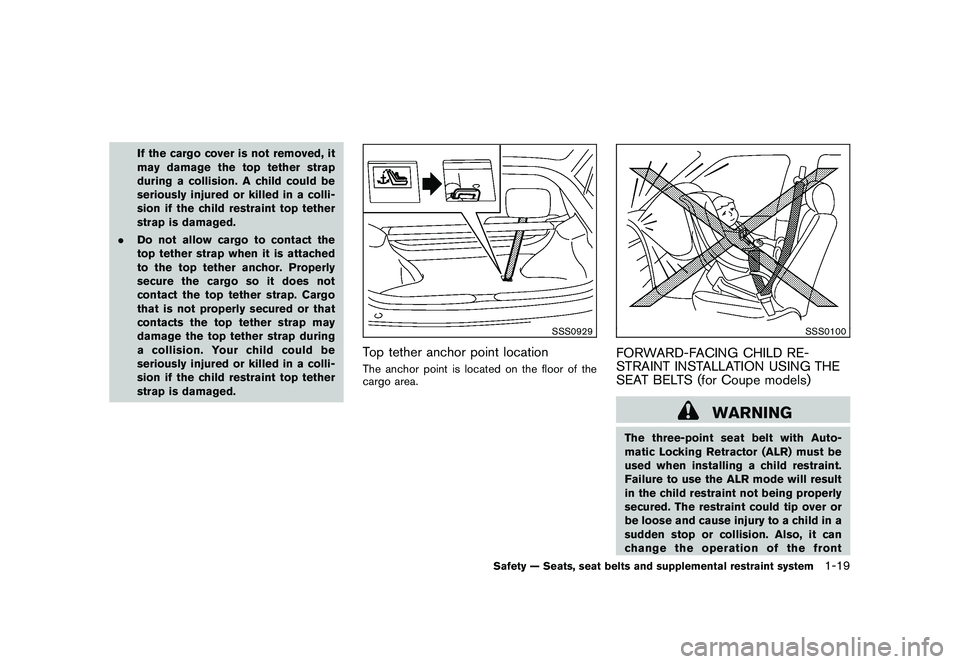
Top tether anchor point locationThe anchor point is located on the floor of the
cargo area.
SSS0100
FORWARD-FACING CHILD RE-
STRAINT INSTALLATION USING THE
SEAT BELTS (for Coupe models)
WARNING
The three-point seat belt with Auto-
matic Locking Retractor (ALR) must be
used when installing a child restraint.
Failure to use the ALR mode will result
in the child restraint not being properly
secured. The restraint could tip over or
be loose and cause injury to a child in a
sudden stop or collision. Also, it can
change the operation of the front
Safety — Seats, seat belts and supplemental restraint system
1-19
Page 43 of 419
Black plate (39,1)
Model "Z34-D" EDITED: 2010/ 7/ 27
SSS0360B
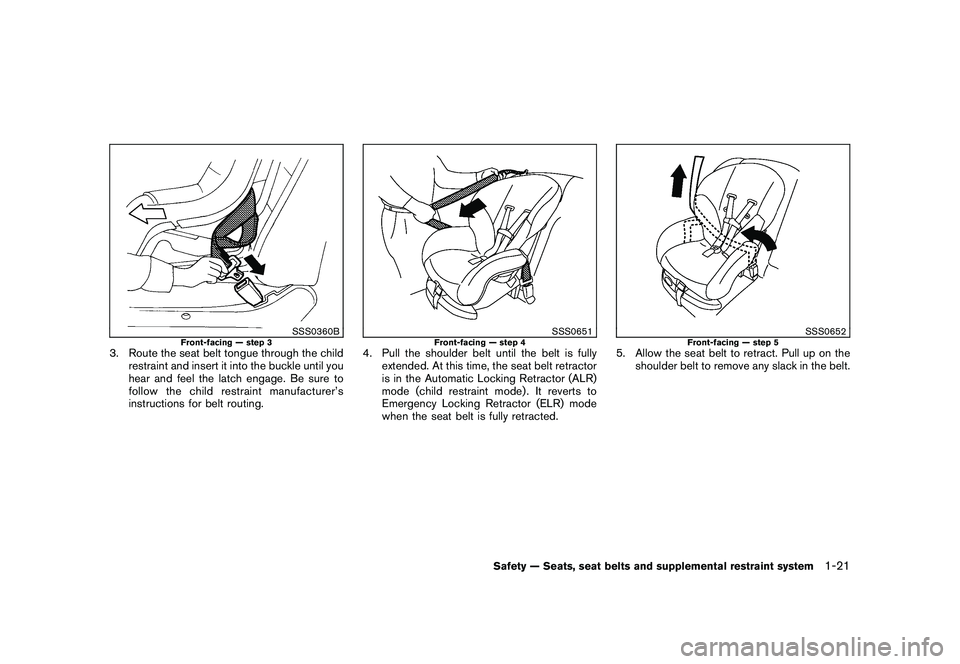
Front-facing — step 3
3. Route the seat belt tongue through the childrestraint and insert it into the buckle until you
hear and feel the latch engage. Be sure to
follow the child restraint manufacturer’s
instructions for belt routing.
SSS0651
Front-facing — step 4
4. Pull the shoulder belt until the belt is fullyextended. At this time, the seat belt retractor
is in the Automatic Locking Retractor (ALR)
mode (child restraint mode) . It reverts to
Emergency Locking Retractor (ELR) mode
when the seat belt is fully retracted.
SSS0652
Front-facing — step 5
5. Allow the seat belt to retract. Pull up on theshoulder belt to remove any slack in the belt.
Safety — Seats, seat belts and supplemental restraint system
1-21
Page 44 of 419
Black plate (40,1)
Model "Z34-D" EDITED: 2010/ 7/ 27
SSS0653
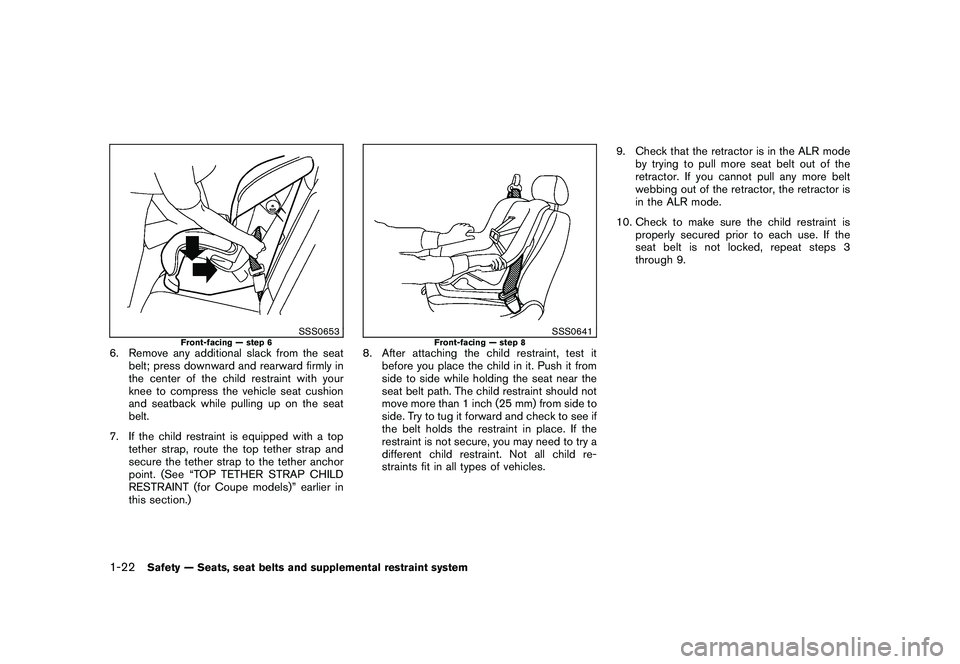
Front-facing — step 6
6. Remove any additional slack from the seatbelt; press downward and rearward firmly in
the center of the child restraint with your
knee to compress the vehicle seat cushion
and seatback while pulling up on the seat
belt.
7. If the child restraint is equipped with a top tether strap, route the top tether strap and
secure the tether strap to the tether anchor
point. (See “TOP TETHER STRAP CHILD
RESTRAINT (for Coupe models)” earlier in
this section.)
SSS0641
Front-facing — step 8
8. After attaching the child restraint, test itbefore you place the child in it. Push it from
side to side while holding the seat near the
seat belt path. The child restraint should not
move more than 1 inch (25 mm) from side to
side. Try to tug it forward and check to see if
the belt holds the restraint in place. If the
restraint is not secure, you may need to try a
different child restraint. Not all child re-
straints fit in all types of vehicles. 9. Check that the retractor is in the ALR mode
by trying to pull more seat belt out of the
retractor. If you cannot pull any more belt
webbing out of the retractor, the retractor is
in the ALR mode.
10. Check to make sure the child restraint is properly secured prior to each use. If the
seat belt is not locked, repeat steps 3
through 9.
1-22
Safety — Seats, seat belts and supplemental restraint system
Page 47 of 419
Black plate (43,1)
Model "Z34-D" EDITED: 2010/ 7/ 27
Booster seat installation
CAUTION
Do not use the lap/shoulder belt Auto-
matic Locking Retractor mode when
using a booster seat with the seat belts.
Refer to all Warnings and Cautions in the “Child
safety”, “Child restraints” and “Booster seats”
sections earlier in this section before installing a
child restraint.
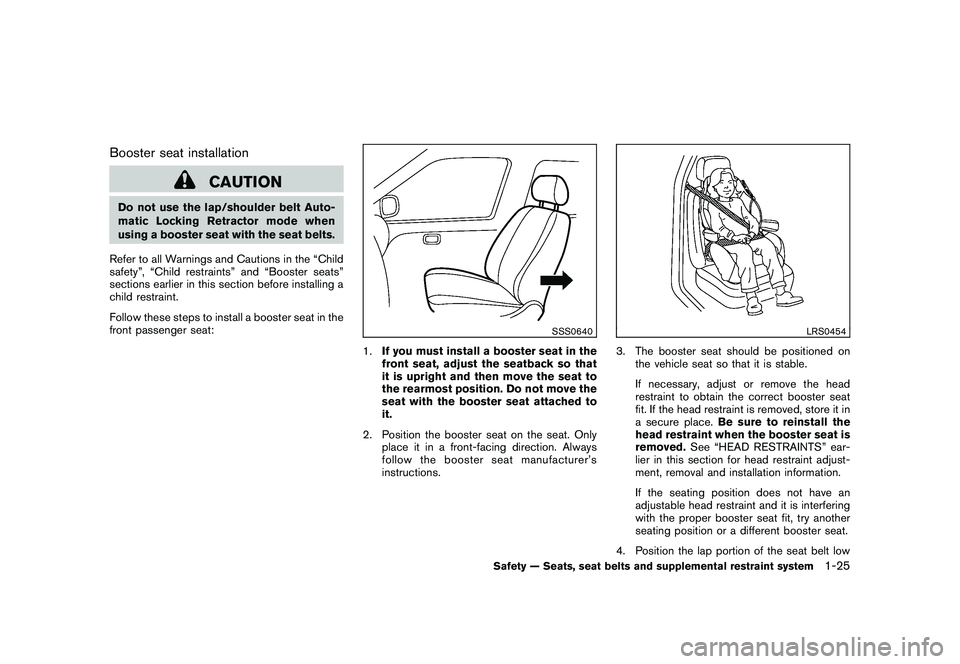
Follow these steps to install a booster seat in the
front passenger seat:
SSS0640
1. If you must install a booster seat in the
front seat, adjust the seatback so that
it is upright and then move the seat to
the rearmost position. Do not move the
seat with the booster seat attached to
it.
2. Position the booster seat on the seat. Only place it in a front-facing direction. Always
follow the booster seat manufacturer’s
instructions.
LRS0454
3. The booster seat should be positioned onthe vehicle seat so that it is stable.
If necessary, adjust or remove the head
restraint to obtain the correct booster seat
fit. If the head restraint is removed, store it in
a secure place. Be sure to reinstall the
head restraint when the booster seat is
removed. See “HEAD RESTRAINTS” ear-
lier in this section for head restraint adjust-
ment, removal and installation information.
If the seating position does not have an
adjustable head restraint and it is interfering
with the proper booster seat fit, try another
seating position or a different booster seat.
4. Position the lap portion of the seat belt low
Safety — Seats, seat belts and supplemental restraint system
1-25
Page 61 of 419
Black plate (57,1)
Model "Z34-D" EDITED: 2010/ 7/ 27
This means the system is operational.
If any of the following conditions occur, the front
air bag, side air bag, curtain air bag and
pretensioner systems need servicing:
.The supplemental air bag warning light
remains on approximately 7 seconds after
the ignition switch is pushed to the ON
position.
. The supplemental air bag warning light
flashes intermittently.
. The supplemental air bag warning light does
not come on at all.
Under these conditions, the front air bag, side air
bag, curtain air bag or pretensioner systems may
not operate properly. They must be checked and
repaired. Take your vehicle to the nearest
NISSAN dealer.
WARNING
If the supplemental air bag warning
light is on, it could mean that the front
air bag, side air bag, curtain air bag
and/or pretensioner systems will not
operate in an accident. To help avoid
injury to yourself or others, have your
vehicle checked by a NISSAN dealer as
soon as possible.
REPAIR AND REPLACEMENT PRO-
CEDUREThe front air bags, side air bags, curtain air bags
and pretensioners are designed to activate on a
one-time-only basis. As a reminder, unless it is
damaged, the supplemental air bag warning light
will remain illuminated after inflation has oc-
curred. Repair and replacement of these sys-
tems should be done only by a NISSAN dealer.
When maintenance work is required on the
vehicle, the front air bags, side air bags, curtain
air bags, pretensioners and related parts should
be pointed out to the person conducting the
maintenance. The ignition switch should always
be in the LOCK position when working under
the hood or inside the vehicle.
WARNING
. Once a front air bag, side air bag, or
curtain air bag has inflated, the air
bag module will not function again
and must be replaced. Additionally,
the activated pretensioner must
also be replaced. The air bag mod-
ule and pretensioner system should
be replaced by a NISSAN dealer.
The air bag module and preten-
sioner system cannot be repaired.
. The front air bag, side air bag and curtain air bag systems and the
pretensioner system should be in-
spected by a NISSAN dealer if there
is any damage to the front end or
side portion of the vehicle.
. If you need to dispose of the
supplemental air bag or preten-
sioner systems or scrap the vehicle,
contact a NISSAN dealer. Correct
supplemental air bag and seat belt
pretensioner system disposal pro-
cedures are set forth in the appro-
priate NISSAN Service Manual.
Incorrect disposal procedures could
cause personal injury.
Safety — Seats, seat belts and supplemental restraint system
1-39