Page 196 of 714
Features and controls
3-81
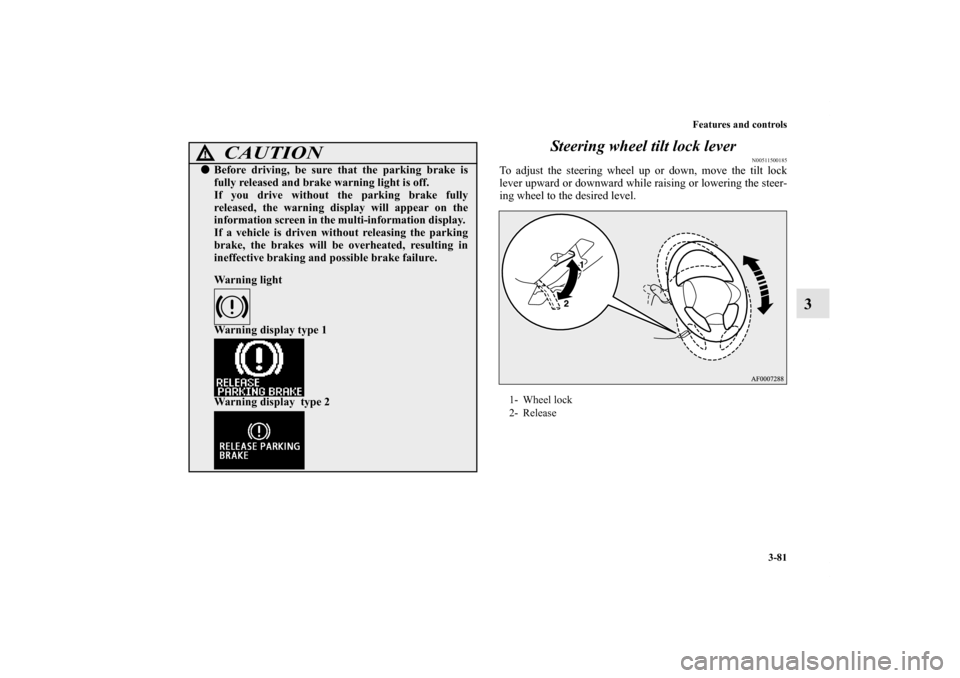
3 Steering wheel tilt lock lever
N00511500185
To adjust the steering wheel up or down, move the tilt lock
lever upward or downward while raising or lowering the steer-
ing wheel to the desired level.
CAUTION
!�Before driving, be sure that the parking brake is
fully released and brake warning light is off.
If you drive without the parking brake fully
released, the warning display will appear on the
information screen in the multi-information display.
If a vehicle is driven without releasing the parking
brake, the brakes will be overheated, resulting in
ineffective braking and possible brake failure.
Warning light
Warning display type 1
Warning display type 2
1- Wheel lock
2- Release
BK0122500US.book 81 ページ 2010年5月12日 水曜日 午前11時11分
Page 199 of 714

3-84 Features and controls
3
To reduce the glareThe day/night knob (A) at the bottom of the mirror can be used
to adjust the mirror to reduce the glare from the headlights of
vehicles behind you during night driving.
Outside rearview mirrors
N00512200163
Adjust the outside rearview mirrors only after making any seat
adjustments so as to have a clear view to the rear of the vehicle.To adjust the mirror position
N00549100128
The outside rearview mirrors can be adjusted when the ignition
switch is in the “ON” or “ACC” position.
1- Daytime position
2- Night position
WA R N I N G
!�Do not attempt to adjust the outside rearview mir-
rors while driving. This can be dangerous.
Be sure to adjust the mirrors before driving.�Your passenger’s side mirror is convex. The objects
you see in the mirror will look smaller and farther
away than they appear in a regular flat mirror.
Do not use this mirror to estimate the distance of
vehicles following you when changing lanes.
BK0122500US.book 84 ページ 2010年5月12日 水曜日 午前11時11分
Page 201 of 714
3-86 Features and controls
3
Door mirror heater
(if so equipped)
N00549300162
When the rear window defogger switch is pressed with the
engine running, the outside rearview mirrors are defogged or
defrosted. Current will flow through the heater element inside
the mirrors, thus clearing away frost or condensation.
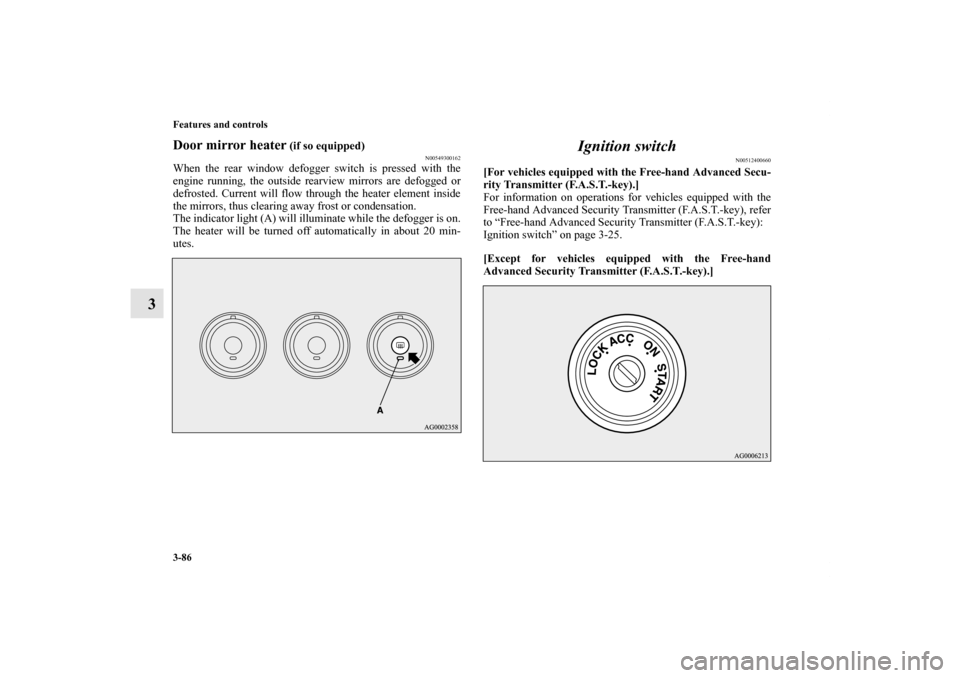
The indicator light (A) will illuminate while the defogger is on.
The heater will be turned off automatically in about 20 min-
utes.
Ignition switch
N00512400660
[For vehicles equipped with the Free-hand Advanced Secu-
rity Transmitter (F.A.S.T.-key).]
For information on operations for vehicles equipped with the
Free-hand Advanced Security Transmitter (F.A.S.T.-key), refer
to “Free-hand Advanced Security Transmitter (F.A.S.T.-key):
Ignition switch” on page 3-25.
[Except for vehicles equipped with the Free-hand
Advanced Security Transmitter (F.A.S.T.-key).]
BK0122500US.book 86 ページ 2010年5月12日 水曜日 午前11時11分
Page 204 of 714
Features and controls
3-89
3 Steering wheel lock
N00512500166
[For vehicles equipped with the Free-hand Advanced Secu-
rity Transmitter (F.A.S.T.-key).]
For information on operations for vehicles equipped with the
Free-hand Advanced Security Transmitter (F.A.S.T.-key), refer
to “Free-hand Advanced Security Transmitter (F.A.S.T.-key):
Steering wheel lock” on page3-32
[Except for vehicles equipped with the Free-hand
Advanced Security Transmitter (F.A.S.T.-key).]
To l o c kRemove the key at the “LOCK” position.
Turn the steering wheel until it is locked.To u n l o c kTurn the key to the “ACC” position while moving the steering
wheel slightly.NOTE�If the front wheels are turned, the anti-theft lock may
sometimes make it difficult to turn the key from “LOCK”
to “ACC”. Firmly turn the steering wheel to the left or to
the right as you turn the key.
CAUTION
!�Remove the key when leaving the vehicle.
BK0122500US.book 89 ページ 2010年5月12日 水曜日 午前11時11分
Page 206 of 714
Features and controls
3-91
3
3. Press and hold the brake pedal down with your right foot.
4. Make sure the selector lever is in the “P” (PARK) posi-
tion.
5. Turn the ignition switch to the “ON” position and make
certain that all warning lights are functioning properly
before starting the engine.
6. Turn the ignition switch to the “START” position without
pressing the accelerator pedal. Release the ignition switch
when the engine starts.NOTE�Minor noises may be heard on engine start-up. These will
disappear as the engine warms up.Startability of automatic transaxle vehicle and CVT
vehicle with ambient temperature of -22
°F (-30
°C) or
lower
When the ambient temperature is -22 °F (-30 °C) or lower, it
may not be possible to start from a standstill even with the
selector lever in the “D” (DRIVE) position.
This occurs because the transaxle has not warmed up suffi-
ciently; it does not indicate a problem. If this occurs, place the
selector lever in the “P” (PARK) position and let the engine
idle for at least 10 minutes.
The transaxle will warm up, and you will be able to start nor-
mally.
Do not leave the vehicle during warm-up operation.
Using the MIVEC engine (3.0 liter models)The MIVEC engine automatically switches its intake-valve
control between a low-speed mode and a high-speed mode in
accordance with driving conditions for maximum engine per-
formance.NOTE�To protect the engine, the high-speed mode may not be
selected while the engine coolant temperature is low. In
such a case, the engine revolutions do not rise to over
5,000 rpm even if the accelerator pedal is depressed.
BK0122500US.book 91 ページ 2010年5月12日 水曜日 午前11時11分
Page 216 of 714
Features and controls
3-101
3
Passing accelerationTo gain extra acceleration in “D” (DRIVE) position (when
passing another vehicle) push the accelerator to the floor. The
automatic transaxle will automatically downshift.NOTE�In sports mode, downshifts do not take place when the
accelerator is depressed all the way to the floor.WaitingFor short waiting periods, such as at traffic lights, the vehicle
can be left in gear and held stationary with the service brake.
For longer waiting periods with the engine running, place the
selector lever in the “N” (NEUTRAL) position and apply the
parking brake, while holding the vehicle stationary with the
service brake.
Prior to moving off after having stopped the vehicle, make sure
that the selector lever is in “D” (DRIVE) position or Sports
mode position.
�Do not rev the engine with the brake pedal pressed
when the vehicle is stationary.
This can damage the transaxle.
Also, when you depress the accelerator pedal while
holding down the brake pedal with the selector lever
in the “D” (DRIVE) position, the engine revolutions
may not rise as high as when performing the same
operation with the selector lever in the “N” (NEU-
TRAL) position.
CAUTION
!
CAUTION
!�To avoid transaxle overheating, never try to keep
your vehicle stationary on a hill by using the acceler-
ator pedal. Always apply the parking brake and/or
service brake.�Do not rev the engine unnecessarily while the vehicle
is stationary. Unexpected acceleration may occur if
the selector lever is in a position other than “P”
(PARK) or “N” (NEUTRAL).
BK0122500US.book 101 ページ 2010年5月12日 水曜日 午前11時11分
Page 226 of 714
Features and controls
3-111
3
Passing accelerationTo gain extra acceleration in “D” (DRIVE) position (when
passing another vehicle) push the accelerator to the floor. The
CVT will automatically downshift.NOTE�In sports mode, downshifts do not take place when the
accelerator is depressed all the way to the floor.WaitingFor short waiting periods, such as at traffic lights, the vehicle
can be left in selector lever position and held stationary with
the service brake.
For longer waiting periods with the engine running, place the
selector lever in the “N” (NEUTRAL) position and apply the
parking brake, while holding the vehicle stationary with the
service brake.
Prior to moving off after having stopped the vehicle, make sure
that the selector lever is in “D” (DRIVE) position or Sports
mode position.
�Do not rev the engine with the brake pedal pressed
when the vehicle is stationary.
This can damage the CVT.
Also, when you depress the accelerator pedal while
holding down the brake pedal with the selector lever
in the “D” (DRIVE) position, the engine revolutions
may not rise as high as when performing the same
operation with the selector lever in the “N” (NEU-
TRAL) position.
CAUTION
!
CAUTION
!�To avoid transmission overheating, never try to keep
your vehicle stationary on a hill by using the acceler-
ator pedal. Always apply the parking brake and/or
service brake.�Do not rev the engine unnecessarily while the vehicle
is stationary. Unexpected acceleration may occur if
the selector lever is in a position other than “P”
(PARK) or “N” (NEUTRAL).
BK0122500US.book 111 ページ 2010年5月12日 水曜日 午前11時11分
Page 237 of 714
3-122 Features and controls
3
�Note that the stopping distance required of the 4-wheel
drive vehicle differs very little from that of the front-
wheel drive vehicle. When driving on a snow-covered
road or a slippery, muddy surface, make sure that you
keep a sufficient distance between your vehicle and the
one ahead of you.
�The driving posture should be more upright; adjust the
seat to a good position for easy steering and pedal opera-
tion. Be sure to wear the seat belt.
�After driving on rough roads, check each part of the vehi-
cle and wash it thoroughly with water. Refer to the
“Inspection and maintenance following rough road opera-
tion” section and “Vehicle care and Maintenance” sec-
tions.Turning sharp cornersWhen turning a sharp corner in “4WD LOCK” or “LOCK”
position at low speed, a slight difference in steering may be
experienced similar to feeling as if the brakes were applied.
This is called tight corner braking and results from each of the
four tires being at a different distance from the corner. The phe-
nomenon is typical of 4-wheel drive vehicles. If this occurs,
either straighten out the steering wheel or change to another
mode.
On snowy or icy roadsSet the drive mode-selector to “4WD AUTO”, “4WD LOCK”
or “SNOW” in accordance with the road conditions, and then
gradually depress the accelerator pedal for a smooth start.NOTE�The use of snow tires is recommended.
�Maintain a safe distance between vehicles, avoid sudden
braking, and use engine braking (downshifting).Driving on sandy or muddy roadsSet the drive mode-selector to “4WD LOCK” or “LOCK” and
then gradually depress the accelerator pedal for a smooth start.
Keep the pressure on the accelerator pedal as constant as possi-
ble, and drive at low speed.
CAUTION
!�Setting the drive mode-selector to “4WD LOCK” or
“LOCK” position to drive on dry paved road will
increase fuel consumption, with possible noise gen-
eration.
CAUTION
!�Avoid sudden braking, sudden acceleration and
sharp turning. Skidding occurs and control of the
vehicle could be lost.
CAUTION
!�Do not force the vehicle or drive recklessly on sandy
surfaces. In comparison with normal road surfaces,
the engine and other drive-system components are
put under excessive strain when driving on such a
surface. This could lead to accidents.
BK0122500US.book 122 ページ 2010年5月12日 水曜日 午前11時11分
![MITSUBISHI OUTLANDER 2011 2.G Owners Manual Features and controls
3-89
3 Steering wheel lock
N00512500166
[For vehicles equipped with the Free-hand Advanced Secu-
rity Transmitter (F.A.S.T.-key).]
For information on operations for vehicles equi](/manual-img/19/7521/w960_7521-203.png "MITSUBISHI OUTLANDER 2011 2.G Owners Manual Features and controls
3-89
3 Steering wheel lock
N00512500166
[For vehicles equipped with the Free-hand Advanced Secu-
rity Transmitter (F.A.S.T.-key).]
For information on operations for vehicles equi")