Page 282 of 714
Features and controls
3-167
3
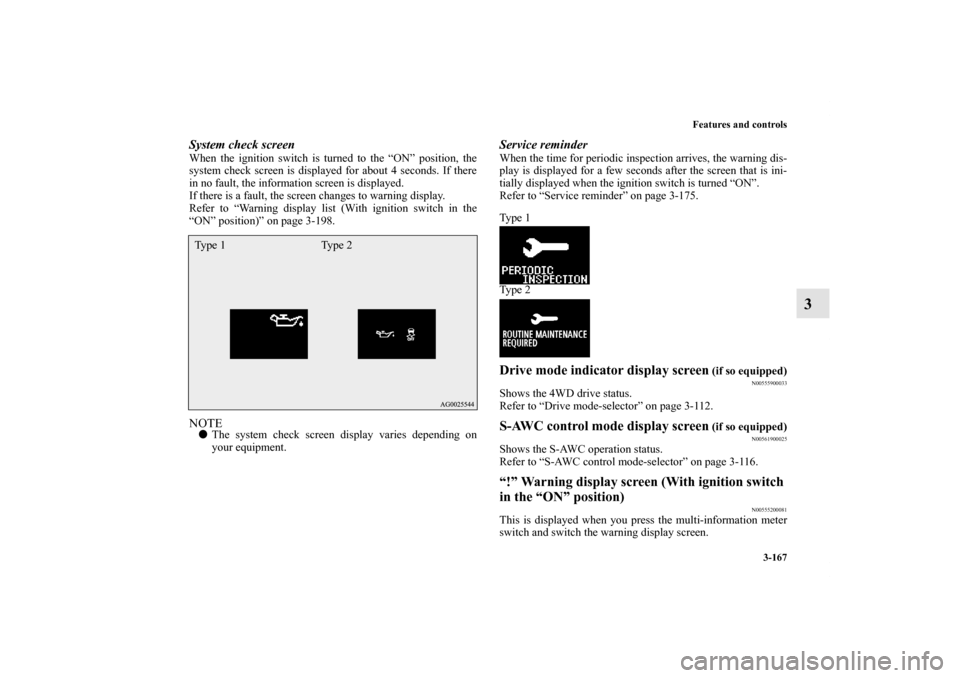
System check screenWhen the ignition switch is turned to the “ON” position, the
system check screen is displayed for about 4 seconds. If there
in no fault, the information screen is displayed.
If there is a fault, the screen changes to warning display.
Refer to “Warning display list (With ignition switch in the
“ON” position)” on page 3-198.NOTE�The system check screen display varies depending on
your equipment.
Service reminderWhen the time for periodic inspection arrives, the warning dis-
play is displayed for a few seconds after the screen that is ini-
tially displayed when the ignition switch is turned “ON”.
Refer to “Service reminder” on page 3-175.
Ty p e 1
Ty p e 2Drive mode indicator display screen
(if so equipped)
N00555900033
Shows the 4WD drive status.
Refer to “Drive mode-selector” on page 3-112.S-AWC control mode display screen
(if so equipped)
N00561900025
Shows the S-AWC operation status.
Refer to “S-AWC control mode-selector” on page 3-116.“!” Warning display screen (With ignition switch
in the “ON” position)
N00555200081
This is displayed when you press the multi-information meter
switch and switch the warning display screen.
Ty p e 1 Ty p e 2
BK0122500US.book 167 ページ 2010年5月12日 水曜日 午前11時11分
Page 317 of 714

3-202 Features and controls
3
�There is a fault in the Active stability
control (ASC).
�There is a fault in the Hill start assist.�Contact an authorized Mitsubishi
Motors dealer or a repair facility of
your choice to have the system
checked.
Refer to “Active stability control
(ASC)” on page 3-136.
�Have the vehicle checked at an autho-
rized Mitsubishi Motors dealer or a
repair facility of your choice.
Refer to “Hill start assist” on page 3-
128.
�There is a fault in the electronically
controlled 4WD system.�Contact an authorized Mitsubishi
Motors dealer or a repair facility of
your choice to have the system
checked.
Refer to “Electronically controlled
4WD system” on page 3-112.
�There is a fault in the automatic tran-
saxle or CVT.�Contact an authorized Mitsubishi
Motors dealer or a repair facility of
your choice to have the system
checked.
Refer to “Automatic transaxle” on
page 3-92.
Refer to “Continuously variable trans-
mission (CVT)” on page 3-102.
�The electronically controlled 4WD sys-
tem is hot.Refer to “Electronically controlled 4WD
system” on page 3-112.
Screen type 1
Screen type 2
Cause
Do this (Reference)
BK0122500US.book 202 ページ 2010年5月12日 水曜日 午前11時11分
Page 319 of 714
3-204 Features and controls
3
Other interrupt displays (With ignition switch in the “ON” position)
N00558200196
The operation status of each system is displayed on the information screen. For further details, refer to the appropriate page for each
system.
Screen type 1
Screen type 2
System operation status
Reference
�When “2WD” drive mode is selected
with the drive mode selector.Refer to “Electronically controlled 4WD
system” on page 3-112.
�When “4WD AUTO” mode is selected
with the drive mode selector.
�When “4WD LOCK” mode is selected
with the drive mode selector.
�When the Active stability control
(ASC) is operating.Refer to “Active stability control (ASC) ” on
page 3-136.
BK0122500US.book 204 ページ 2010年5月12日 水曜日 午前11時11分
Page 405 of 714
4-2 Driving safety
4Driving precaution
N00629300053
Utility vehicles have higher ground clearance and a narrower
track, which enables them to perform in a wide variety of off-
road situations. Because of the higher ground clearance, these
vehicles have a higher center of gravity, which makes them
handle differently than ordinary vehicles when driving on
pavement. They are not designed to maneuver or corner at the
same speed on pavement as conventional 2-wheel drive pas-
senger cars any more than low-slung sports cars are designed
to perform satisfactorily in off-road conditions.
Always drive safely and steer the vehicle carefully. Avoid oper-
ating the vehicle in a manner that might require sharp turns or
abrupt maneuvers. As with other vehicles of this type, failure
to operate this vehicle correctly can result in loss of control or
vehicle rollover.
In a rollover crash, an unbelted person is significantly more
likely to die than a person wearing a seat belt. Before starting
the vehicle, always make certain that you and all your passen-
gers are properly wearing their seat belts (with children in the
rear seat, in appropriate restraints).
Fuel economy
N00628800149
Fuel economy is dependent on many factors. Your personal
driving habits can have a significant effect on your fuel use.
Several recommendations for achieving the greatest fuel econ-
omy are listed below.
�Whenever accelerating from a stop, always accelerate
slowly and smoothly.
�When parked for even a short period, do not idle the
engine. Shut it off.
�Plan your trips to avoid unnecessary stops.
�Keep your tires inflated to the recommended pressures.
�When you drive on highways or dry improved roads, set
the drive mode-selector “2WD”, “4WD AUTO” or “TAR-
MAC” position (if so equipped).
�For freeway driving, maintain a speed of approximately
50 mph (80 km/h) when traffic, roadway and weather con-
ditions safely permit.
�Keep your air filter clean and your vehicle lubricated
according to the recommendations in this manual.
�Always keep your vehicle well maintained. A poorly
maintained engine wastes fuel and costs money.
�Never overload your vehicle.
WA R N I N G
!�Utility vehicles have a significantly higher rollover
rate than other types of vehicles. Avoid abrupt
maneuvers and excessive speed. Always buckle up.
BK0122500US.book 2 ページ 2010年5月12日 水曜日 午前11時11分
Page 594 of 714
For emergencies
6-25
6 To w i n g
N00837000820
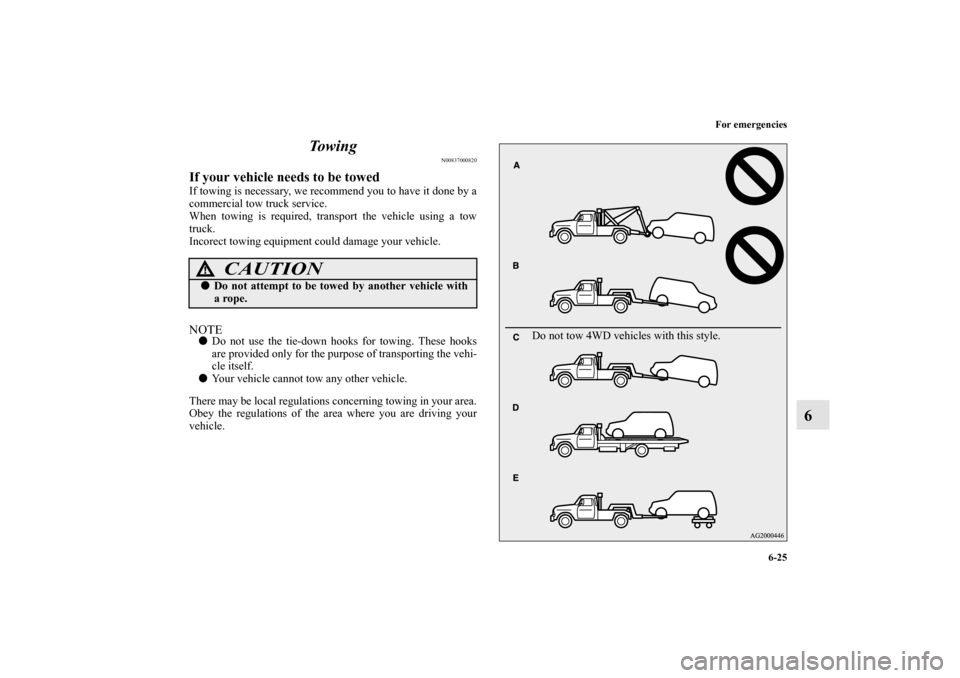
If your vehicle needs to be towedIf towing is necessary, we recommend you to have it done by a
commercial tow truck service.
When towing is required, transport the vehicle using a tow
truck.
Incorect towing equipment could damage your vehicle.NOTE�Do not use the tie-down hooks for towing. These hooks
are provided only for the purpose of transporting the vehi-
cle itself.
�Your vehicle cannot tow any other vehicle.
There may be local regulations concerning towing in your area.
Obey the regulations of the area where you are driving your
vehicle.
CAUTION
!�Do not attempt to be towed by another vehicle with
a rope.
Do not tow 4WD vehicles with this style.
BK0122500US.book 25 ページ 2010年5月12日 水曜日 午前11時11分
Page 706 of 714
Alphabetical index
3
E
Electric rear window defogger switch 3-232
Electronic immobilizer (Anti-theft starting system) 3-5
,3-42
Electronically controlled 4WD system 3-112
Emission-control system maintenance 7-35
Engine
Compartment 7-7
Coolant 7-12
,9-11
Hood 7-4
MIVEC 3-33,3-41
,3-91
Oil and oil filter 7-8,9-11
Overheating 6-5
Serial number 9-2
Specification 9-9
Engine coolant temperature display 3-169
Engine hood 7-4
Exhaust system 7-40
F
Floor console box 3-276
Fluid
Automatic transaxle fluid 7-16
,9-11
Brake fluid 9-11
Continuously variable transmission (CVT) fluid 7-18
,9-11
Engine coolant 7-12
,9-11
Engine oil 7-8
Power steering fluid 7-21
,9-11
Rear axle oil 7-19Transfer oil 7-18
Washer fluid 7-19
,9-11
Fluid capacities and lubricants 9-11
Free-hand advanced security transmitter (F.A.S.T.-key) 3-16
Front fog lights
Bulb capacity 7-51
Indicators 3-206
Replacement 7-65
Switch 3-222
Front seat adjustment 2-5
Front side-marker lights
Bulb capacity 7-51
Replacement 7-61
Front turn-signal light
Bulb capacity 7-51
Replacement 7-62
Fuel
Filling the fuel tank 1-4
Fuel economy 4-2
Fuel hoses 7-36
Fuel selection 1-2
Tank capacity 9-11
Fuses 7-42
Fusible links 7-42
G
General maintenance
Maintenance 7-37
General vehicle data 9-6
BK0122500US.book 3 ページ 2010年5月12日 水曜日 午前11時11分