Page 622 of 700

Vehicle care and maintenance
7-45
7
Exhaust system
N00942200108
The best way to keep carbon monoxide gas from entering
inside your vehicle is to have the engine exhaust system prop-
erly serviced.
Have a competent mechanic inspect the complete exhaust sys-
tem and nearby body areas for broken, damaged, deteriorated,
or mispositioned parts if you notice any of the following:
�A change in the sound of the exhaust system
�The smell of exhaust fumes inside the vehicle
�The underside or rear of the vehicle is damaged
Also check the exhaust system each time the vehicle is raised
for lubrication, oil changes, or required service. Any open
seams or loose connections could let dangerous exhaust fumes
seep into the luggage compartment and passenger compart-
ments. Check for any of the following conditions: �Check for holes or exhaust gas leaks caused by corrosion
or damage.
�Check the joints and connections for looseness or exhaust
gas leaks.
�Check the rubber hangers and brackets for damage.
Hood lock release mechanism and safety catch
N00942500114
The hood lock release mechanism and hood safety catch should
be checked, cleaned, and oiled when needed for easy move-
ment and to stop rust and wear. Use Multipurpose Grease
NLGI Grade 2 sparingly for all sliding parts of the hood latch
and release lever. Work the grease into the hood lock mecha-
nism until all the movable surfaces are covered.
Also, put a light coat of the same grease on the safety catch
wherever moving parts touch.
WA R N I N G
!�Carbon monoxide gas from your vehicle’s exhaust is
poisonous. Breathing these fumes can cause uncon-
sciousness or death.
BK0119300US.book 45 ページ 2010年5月21日 金曜日 午前10時13分
Page 675 of 700

8-2 Customer assistance/Reporting Safety Defects
8Consumer information (For vehicles sold in
U.S.A.)
N01047100100
This information is provided in compliance with the require-
ments of the National Highway Traffic Safety Administration,
Department of Transportation. It provides the purchasers
and/or prospective purchasers with information on reporting
safety defects. Uniform tire quality gradingDOT quality grades - All passenger vehicle tires must conform
to Federal Safety Requirements in addition to these grades. The
specific grade rating in each grade category is shown on the
side wall of the tires on your vehicle. Treadwear The treadwear grade is a comparative rating based on the wear
rate of the tire when tested under controlled conditions on a
specified government test course. For example, a tire graded
150 would wear one and one-half (1
1/2) times as well on the
government course as a tire graded 100. The relative perfor-
mance of tires depends upon the actual conditions of their use,
however, and may depart significantly from the norm due to
variations in driving habits, service practices and differences in
road characteristics and climate.
Traction AA, A, B, C The traction grades, from highest to lowest, are AA, A, B and
C. Those grades represent the tire’s ability to stop on wet pave-
ment as measured under controlled conditions on specified
government test surfaces of asphalt and concrete. A tire
marked C may have poor traction performance.
Temperature A, B, CThe temperature grades are A (the highest), B and C, represent-
ing the tire’s resistance to the generation of heat and its ability
to dissipate heat when tested under controlled conditions on a
specified indoor laboratory test wheel. Sustained high tempera-
ture can cause the material of the tire to degenerate and reduce
tire life, and excessive temperature can lead to sudden tire fail-
ure. The grade C corresponds to a level of performance which
all passenger car tires must meet under the Federal Motor Vehi-
cle Safety Standard No. 109. Grades B and A represent higher
levels of performance on the laboratory test wheel than the
minimum required by law.
WA R N I N G
!�The traction grade assigned to this tire is based on
straight-ahead braking traction tests, and does not
include acceleration, cornering, hydroplaning, or
peak traction characteristics.
WA R N I N G
!�The temperature grade for this tire is established for
a tire that is properly inflated and not overloaded.
Excessive speed, underinflation, or excessive load-
ing, either separately or in combination, can cause
heat buildup and possible tire failure.
BK0119300US.book 2 ページ 2010年5月21日 金曜日 午前10時13分
Page 677 of 700
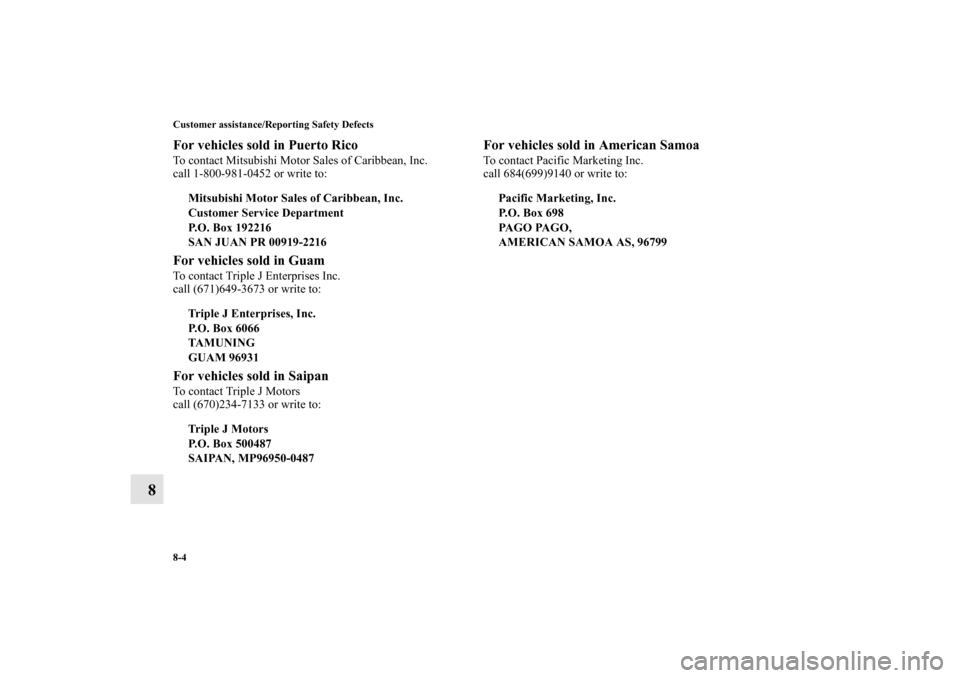
8-4 Customer assistance/Reporting Safety Defects
8
For vehicles sold in Puerto RicoTo contact Mitsubishi Motor Sales of Caribbean, Inc.
call 1-800-981-0452 or write to:For vehicles sold in GuamTo contact Triple J Enterprises Inc.
call (671)649-3673 or write to:For vehicles sold in SaipanTo contact Triple J Motors
call (670)234-7133 or write to:
For vehicles sold in American SamoaTo contact Pacific Marketing Inc.
call 684(699)9140 or write to:
Mitsubishi Motor Sales of Caribbean, Inc.
Customer Service Department
P.O. Box 192216
SAN JUAN PR 00919-2216
Triple J Enterprises, Inc.
P.O. Box 6066
TAMUNING
GUAM 96931
Triple J Motors
P.O. Box 500487
SAIPAN, MP96950-0487Pacific Marketing, Inc.
P.O. Box 698
PAGO PAGO,
AMERICAN SAMOA AS, 96799
BK0119300US.book 4 ページ 2010年5月21日 金曜日 午前10時13分
Page 693 of 700

Alphabetical index
2Parking brake 3-78
Parking brake lever stroke 7-39
Pedal 3-136
Pedal free play 7-38
Power brakes 3-137
Service brake 3-136
Break-in recommendations 3-3
Bulb capacity 7-56
C
California Perchlorate Materials Requirements 1-10
Capacities 9-11
Card holder 3-276
Cargo loads 4-12
Catalytic converter 7-3
Certification label 9-5
Charging system warning light 3-217
Chassis number 9-3
Child restraint 2-24
Child safety locks for rear door 3-59
Cleaning
Inside of your vehicle 7-90
Outside of your vehicle 7-92
Clutch
Fluid 7-21
,9-11
Pedal free play 7-38
Coat hooks 3-291
Combination headlights and dimmer switch 3-221
Coming home light 3-228Consumer information 8-2
Continuously variable transmission (CVT) 3-97
Fluid 7-18
,9-11
Selector lever operation 3-98
Sports mode 3-105
Coolant (engine) 7-12
,9-11
Cruise control 3-150
Indicator 3-152
Cup holder 3-289
D
Daytime running lights
Bulb capacity 7-56
Replacement 7-64
Defogger (rear window) 3-241
Defrosting or defogging (windshield, door windows)
5-20
,5-29
,5-39
,5-49
Dimensions 9-6
Dimmer (high/low beam change) 3-226
Disc brake pads 7-43
Dome light
Bulb capacity 7-59
Replacement 7-87
Switch 3-282
Dome light/Reading lights
Bulb capacity 7-59
Replacement 7-86
Switch 3-280
Doors
BK0119300US.book 2 ページ 2010年5月21日 金曜日 午前10時13分
Page 697 of 700

Alphabetical index
6Seat 2-2
Arm rest 2-9
Front seats 2-3
Heated seats 2-7
Rear seats 2-8
Seats and restraint systems 2-3
Seat belt 2-14
Adjustable seat belt shoulder anchor 2-20
Child restraint 2-24
Driver’s seat belt reminder/warning 2-18
Force limiter 2-23
Front passenger seat belt warning light 2-19
Maintenance and inspection 2-34
Pre-tensioner 2-22
Seat belt extender 2-21
Seat belt instructions 2-15
Seat belt use during pregnancy 2-21
Service brake 3-136
Service precautions 7-2
Snow tires 7-37
Spark plugs 7-41
Steering
Power steering fluid 7-22
,9-11
Tilt lock lever 3-80
Wheel lock 3-31
,3-88
Storage spaces 3-284
Front console boxes 3-287
Sun visors 3-275
Supplemental Restraint System 2-35How the Supplement Restraint System works 2-39
Servicing 2-59
Warning light/display 2-44
T
Tank capacity 1-5
,9-11
Theft-alarm system
System 3-64
Tire pressure monitoring system 3-159
Warning light/display 3-160
Tires 7-29
How to change a tire 6-9
Inflation pressure 7-32
Maintenance 7-34
Quality grading 8-2
Replacing tires and wheels 7-34
Rotation 7-35
Size (tire and wheel) 9-10
Snow tires 7-37
Tire and loading information placard 4-9
,9-4
Tire chains 7-37
Tread wear indicators 7-35
Tissue holder 3-288
Tools 6-7
Storage 6-7
Towing 6-22
Trailer towing 4-13
Transfer oil 7-19
Trunk area light
BK0119300US.book 6 ページ 2010年5月21日 金曜日 午前10時13分
Page 700 of 700
NOTE
Maintenance recordName of Owner Date of Purchase
Address of Owner Model of Vehicle
Name and Address of Dealer Vehicle Identification Number
Service Performed DateKilometers
MilesInspection and Maintenance Item
10GS41(NAFTA)_BK0102103US_cover3.fm 1 ページ 2009年11月24日 火曜日 午後6時2分