Page 547 of 700
5-148 Comfort controls
5Antenna
N00734200426
Roof antenna (except for vehicles with SIRIUS
satellite radio)To r e m o v eTurn the pole (A) counterclockwise.To i n s t a l lScrew the pole (A) clockwise into the base (B) until it is
securely retained.NOTE�Be sure to remove the roof antenna in the following cases:
• When using an automatic car wash
• When covering your vehicle with a car cover
• When driving into a structure that has a low ceiling
Roof antenna (for vehicles with SIRIUS satellite
radio)For securing the best satellite reception, the angle of the
antenna is fixed.
BK0119300US.book 148 ページ 2010年5月21日 金曜日 午前10時13分
Page 548 of 700
Comfort controls
5-149
5
To r e m o v eTurn the pole (A) counterclockwise.To i n s t a l lScrew the pole (A) clockwise into the base (B) until it is
securely retained.NOTE�Be sure to remove the roof antenna in the following cases:
• When entering a place with low clearance
• When using an automatic car wash
• When covering your vehicle with a car cover
Digital clock
N00755000065
The time is displayed when the ignition switch is in the “ON”
or “ACC” position.To set the time1. Press and hold the CLOCK button and the clock display
flashes.
2. Press the various buttons to adjust.H — “Hour” setting
Press this button to fast-forward the “hours”.
M — “Minutes” setting
Press this button to fast-forward the “minutes”.
CLOCK DISP H M :00
BK0119300US.book 149 ページ 2010年5月21日 金曜日 午前10時13分
Page 573 of 700
6-22 For emergencies
6
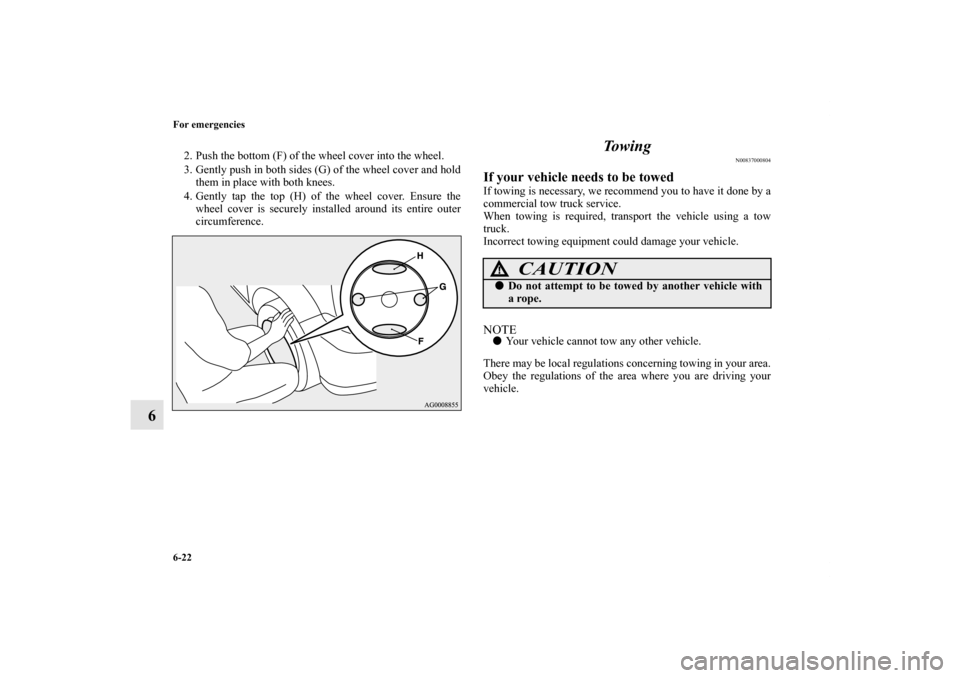
2. Push the bottom (F) of the wheel cover into the wheel.
3. Gently push in both sides (G) of the wheel cover and hold
them in place with both knees.
4. Gently tap the top (H) of the wheel cover. Ensure the
wheel cover is securely installed around its entire outer
circumference.
To w i n g
N00837000804
If your vehicle needs to be towedIf towing is necessary, we recommend you to have it done by a
commercial tow truck service.
When towing is required, transport the vehicle using a tow
truck.
Incorrect towing equipment could damage your vehicle.NOTE�Your vehicle cannot tow any other vehicle.
There may be local regulations concerning towing in your area.
Obey the regulations of the area where you are driving your
vehicle.
CAUTION
!�Do not attempt to be towed by another vehicle with
a rope.
BK0119300US.book 22 ページ 2010年5月21日 金曜日 午前10時13分
Page 575 of 700

6-24 For emergencies
6
Towing manual transaxle vehicles with rear wheels off
the ground (Type B)Place the gearshift lever in the “Neutral” position.
Turn the ignition switch to the “ACC” position and secure the
steering wheel in a straight-ahead position with a rope or tie-
down strap. Never place the ignition switch in the “LOCK”
position when towing.Towing with front wheels off the ground (Type C)Release the parking brake.
Place the gearshift lever in the “Neutral” position (manual tran-
saxle) or the selector lever in the “N” (NEUTRAL) position
(CVT).
Operation under adverse driving conditions
N00837200662
If your vehicle becomes stuck in sand, mud or
snow If your vehicle becomes stuck in snow, sand, or mud, it can
often be moved by a rocking motion. Rock your vehicle back
and forth to free it.
Do not rev the engine or spin the wheels. Constant efforts to
free a stuck vehicle can cause overheating and transaxle fail-
ure. Let the engine idle for a few minutes to cool the transaxle
before trying again.
If your vehicle is still stuck after several rocking attempts, call
for a commercial tow truck service.
�[For front-wheel drive vehicle equipped with the
active stability control (ASC)]
If the vehicle is towed with the ignition switch in the
“ON” position and only the front wheels or only the
rear wheels raised off the ground, the ASC may
operate, resulting in an accident. When towing the
vehicle with only the front wheels or only the rear
wheels raised, keep the ignition switch in the
“LOCK” or “ACC” position.
WA R N I N G
!�To prevent entry of exhaust gas from the towing
vehicle, set the selection switch to the recirculation
position.
CAUTION
!
WA R N I N G
!�When trying to rock your vehicle out of a stuck posi-
tion, make sure that there are no people nearby. The
rocking motion can make your vehicle suddenly
lurch forward or backward, and injure any
bystanders.
BK0119300US.book 24 ページ 2010年5月21日 金曜日 午前10時13分
Page 582 of 700
Vehicle care and maintenance
7-5
7
Release the safety lever and lift the engine hood. NOTE�To prevent damage to the engine hood and wipers, make
sure the wipers are at resting position when you open the
engine hood. Support the engine hood with the hood prop. Insert the hood
prop securely in the opening under the hood marked with an
arrow.
CAUTION
!�Always insert the support prop into the hole spe-
cially made for it. Propping the engine hood at any
other place could cause the prop to slip out and lead
to an accident. �The hood prop can fall out if the hood is lifted by a
strong wind.
BK0119300US.book 5 ページ 2010年5月21日 金曜日 午前10時13分
Page 601 of 700
7-24 Vehicle care and maintenance
7
2. Turn the plastic nuts (C) counterclockwise, and then
remove the battery upper cover (D).NOTE�Be careful not to lose the removed plastic nuts.
To i n s t a l l1. Install the battery upper cover (A) onto the battery, and
then push the plastic nuts (B) in the direction shown by
the arrows to secure the cover. NOTE�Be sure to install the plastic nuts in the correct direction.
�Make sure that the battery upper cover is installed
securely.
2. To install the air duct, perform the removal steps in
reverse.
CAUTION
!�Be sure to install the battery upper cover. Other-
wise, the battery electrolyte may spill and cause a
malfunction.
BK0119300US.book 24 ページ 2010年5月21日 金曜日 午前10時13分
Page 603 of 700
7-26 Vehicle care and maintenance
7
NOTE�For vehicles equipped with a turbocharger, the battery
upper cover must be removed to check the battery indica-
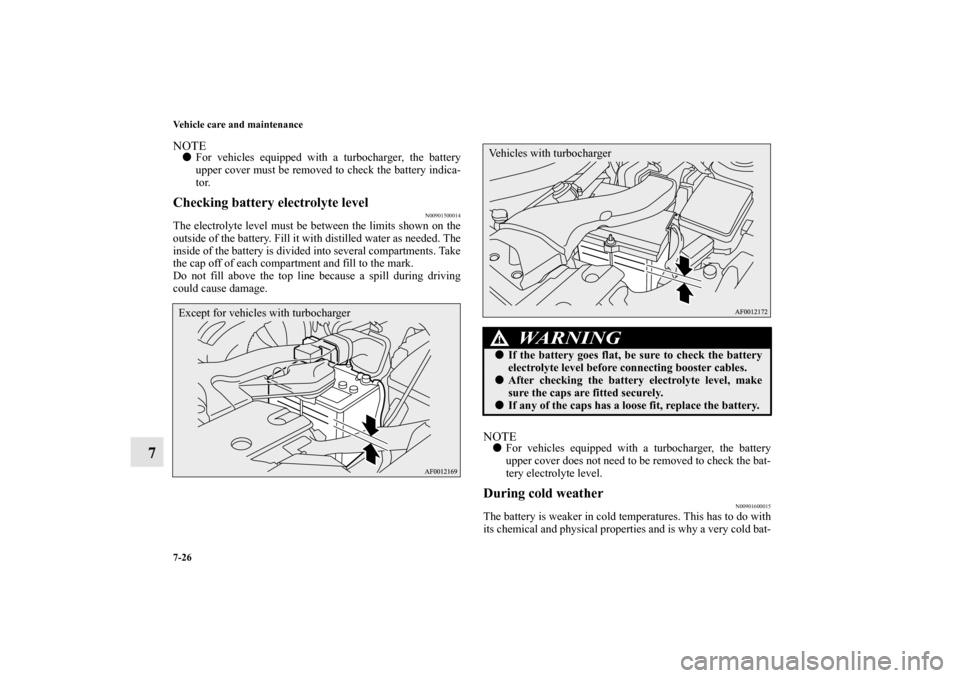
tor.Checking battery electrolyte level
N00901500014
The electrolyte level must be between the limits shown on the
outside of the battery. Fill it with distilled water as needed. The
inside of the battery is divided into several compartments. Take
the cap off of each compartment and fill to the mark.
Do not fill above the top line because a spill during driving
could cause damage.
NOTE�For vehicles equipped with a turbocharger, the battery
upper cover does not need to be removed to check the bat-
tery electrolyte level.During cold weather
N00901600015
The battery is weaker in cold temperatures. This has to do with
its chemical and physical properties and is why a very cold bat-
Except for vehicles with turbocharger
WA R N I N G
!�If the battery goes flat, be sure to check the battery
electrolyte level before connecting booster cables.�After checking the battery electrolyte level, make
sure the caps are fitted securely.�If any of the caps has a loose fit, replace the battery.Vehicles with turbocharger
BK0119300US.book 26 ページ 2010年5月21日 金曜日 午前10時13分
Page 605 of 700

7-28 Vehicle care and maintenance
7
NOTE�Check each battery terminal for corrosion. You can stop
more corrosion by washing with a solution of baking soda
and water. Grease the posts and clamps after cleaning or
tightening them.
�Check to see that the battery is securely installed and can-
not be moved. Also check each terminal for tightness.
�If you will not be driving your vehicle for a long period of
time, remove the battery and store it in a place where the
battery fluid will not freeze. Memory data for settings
made by the user may be erased when the battery is
removed. If this happens, reset the settings again using the
relevant procedures. The battery only should be stored
with a full charge.
�Before cleaning the battery, tighten all the filler port caps
to keep dirt and moisture out.
WA R N I N G
!�Never disconnect the battery while the engine is run-
ning, or you could damage the vehicle’s electrical
parts. �Never short-circuit the battery. This could cause it
to overheat and be damaged. �Keep sparks, cigarettes, and flames away from the
battery because the battery could explode. �Electrolyte (battery acid) is made of corrosive
diluted sulfuric acid. If it spills on nearby parts, it
can crack, stain, or discolor them. And if gets on
your skin or in your eyes, it can cause burns or
blindness. Please observe the following handling
instructions:
• If electrolyte gets on plastic parts or other nearby
parts, wipe it off with a soft cloth or chamois
soaked in a solution of water and neutral detergent
then immediately rinse the affected parts with
plenty of water.
• If electrolyte gets on your hands or clothes, rinse
thoroughly with water. If electrolyte gets in your
eyes, flush them with water immediately and get
immediate medical attention.
�Open doors and windows in any closed space where
you may be charging or working with the battery. �Always wear protective clothing and goggles when
working with the battery, or have a skilled automo-
bile technician do it. �If you are quick-charging your battery, first discon-
nect the battery cables.
�In order to prevent a short circuit, be sure to discon-
nect the negative (-) terminal first, and reconnect it
last.�If the electrolyte level is very low, have the battery
checked at an authorized Mitsubishi Motors dealer
or a repair facility of your choice.�Battery terminals and related accessories contain
lead and lead compounds. Wash hands after han-
dling.
WA R N I N G
!
BK0119300US.book 28 ページ 2010年5月21日 金曜日 午前10時13分