3-124 Features and controls
3
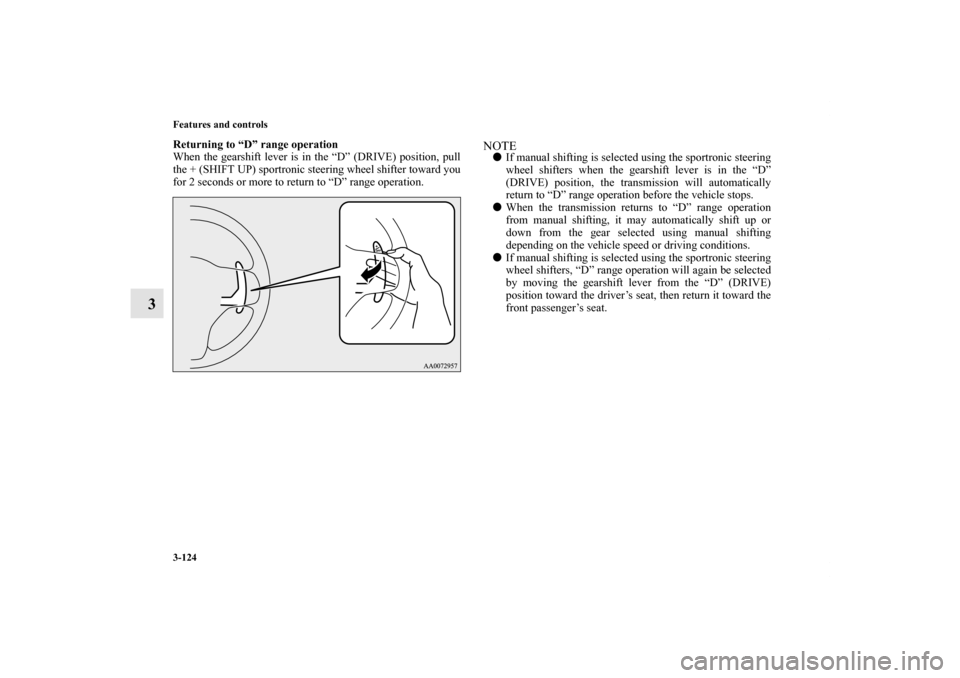
Returning to “D” range operation
When the gearshift lever is in the “D” (DRIVE) position, pull
the + (SHIFT UP) sportronic steering wheel shifter toward you
for 2 seconds or more to return to “D” range operation.
NOTE�If manual shifting is selected using the sportronic steering
wheel shifters when the gearshift lever is in the “D”
(DRIVE) position, the transmission will automatically
return to “D” range operation before the vehicle stops.
�When the transmission returns to “D” range operation
from manual shifting, it may automatically shift up or
down from the gear selected using manual shifting
depending on the vehicle speed or driving conditions.
�If manual shifting is selected using the sportronic steering
wheel shifters, “D” range operation will again be selected
by moving the gearshift lever from the “D” (DRIVE)
position toward the driver’s seat, then return it toward the
front passenger’s seat.
BK0119300US.book 124 ページ 2010年5月21日 金曜日 午前10時13分
4-8 Driving safety
4Loading information
N00629900349
It is very important to know how much weight your vehicle can
carry. This weight is called the vehicle capacity weight and
includes the weight of all occupants, cargo and non-factory-
installed options. The tire and loading information placard
located on the driver’s door sill of your vehicle will show how
much weight it may properly carry.
It is important to familiarize yourself with the following terms
before loading your vehicle:
�Vehicle maximum load on the tire: load on an individual
tire that is determined by distributing to each axle its share
of the maximum loaded vehicle weight and dividing by
two.
�Vehicle normal load on the tire: load on an individual tire
that is determined by distributing to each axle its share of
the curb weight, accessory weight, and normal occupant
weight and dividing by two.
�Maximum loaded vehicle weight: the sum of -
(a) Curb weight;
(b) Accessory weight;
(c) Vehicle capacity weight; and
(d) Production options weight.�Curb weight: the weight of a motor vehicle with standard
equipment including the maximum capacity of fuel, oil,
and coolant.
�Accessory weight: the combined weight (in excess of
those standard items which may be replaced) of automatic
transmission, power steering, power brakes, power win-
dows, power seats, radio, and heater, to the extent that
these items are available as factory- installed equipment
(whether installed or not).
�Vehicle capacity weight: the rated cargo and luggage load
plus 150 lbs (68 kg)* times the vehicle’s designated seat-
ing capacity.
�Production options weight: the combined weight of those
installed regular production options weighing over 5 lbs
(2.3 kg) in excess of those standard items which they
replace, not previously considered in curb weight or
accessory weight, including heavy duty brakes, ride level-
ers, roof rack, heavy duty battery, and special trim.
�Normal occupant weight: 150 lbs (68 kg)* times the num-
ber of specified occupants. (In your vehicle the number is
3)
�Occupant distribution: distribution of occupants in a vehi-
cle as specified. (In your vehicle the distribution is 2 in
front, 1 in second row seat)
WA R N I N G
!�Never overload your vehicle. Overloading can dam-
age your vehicle, adversely affect vehicle perfor-
mance, including handling and braking, cause tire
failure, and result in an accident.
*: 150 lbs (68 kg) is the weight of one person as defined by
U.S.A. and Canadian regulations.
BK0119300US.book 8 ページ 2010年5月21日 金曜日 午前10時13分