Page 299 of 424
5-62 Comfort controls
5Steering wheel remote control switch
(if so
equipped)N00714800312
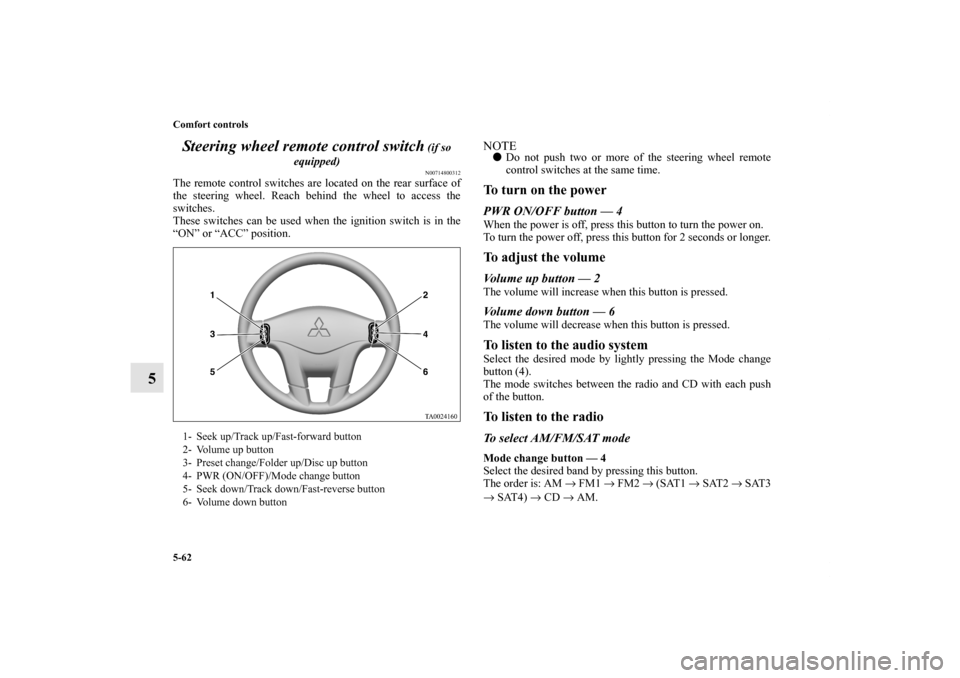
The remote control switches are located on the rear surface of
the steering wheel. Reach behind the wheel to access the
switches.
These switches can be used when the ignition switch is in the
“ON” or “ACC” position.
NOTE�Do not push two or more of the steering wheel remote
control switches at the same time.To turn on the powerPWR ON/OFF button — 4When the power is off, press this button to turn the power on.
To turn the power off, press this button for 2 seconds or longer.To adjust the volumeVolume up button — 2The volume will increase when this button is pressed.Volume down button — 6The volume will decrease when this button is pressed.To listen to the audio systemSelect the desired mode by lightly pressing the Mode change
button (4).
The mode switches between the radio and CD with each push
of the button.To listen to the radioTo select AM/FM/SAT modeMode change button — 4
Select the desired band by pressing this button.
The order is: AM → FM1 → FM2 → (SAT1 → SAT2 → SAT3
→ SAT4) → CD → AM.
1- Seek up/Track up/Fast-forward button
2- Volume up button
3- Preset change/Folder up/Disc up button
4- PWR (ON/OFF)/Mode change button
5- Seek down/Track down/Fast-reverse button
6- Volume down button
BK0121200US.book 62 ページ 2010年4月14日 水曜日 午前11時24分
Page 334 of 424
For emergencies
6-23
6 Operation under adverse driving conditions
N00837200688
If your vehicle becomes stuck in sand, mud or
snow If your vehicle becomes stuck in snow, sand, or mud, it can
often be moved by a rocking motion. Move the selector lever
rhythmically between “Sports mode” and “R” (REVERSE)
position, while pressing lightly on the accelerator pedal.
Do not rev the engine or spin the wheels. Constant efforts to
free a stuck vehicle can cause overheating and transaxle fail-
ure. Let the engine idle for a few minutes to cool the transaxle
before trying again.
If your vehicle is still stuck after several rocking attempts, call
for a commercial tow truck service.
On wet roads
WA R N I N G
!�When trying to rock your vehicle out of a stuck posi-
tion, make sure that there are no people nearby. The
rocking motion can make your vehicle suddenly
lurch forward or backward, and injure any
bystanders.
CAUTION
!�Avoid flooded roads. Water is often deeper than it
looks, and you could be seriously hurt by driving
into flood water. �When driving in rain, on water-covered roads, or
through a car wash, water could get into the brake
discs and make them fail temporarily. In such cases,
lightly press the brake pedal to see if they are work-
ing properly. If they are not, press the pedal lightly
several times while driving to dry the brake pads,
then check them again. �When driving in rain, a layer of water may form
between the tires and the road surface (aquaplan-
ing). This loosens your tires’ grip on the road, mak-
ing it difficult to steer or brake properly. When
driving on a wet road:
• Drive your vehicle at a safe speed.
• Do not drive on worn tires.
• Always keep the tires at the correct inflation pres-
sures.
BK0121200US.book 23 ページ 2010年4月14日 水曜日 午前11時24分
Page 354 of 424
Vehicle care and maintenance
7-19
7 Tires
N00939200537
It is important to familiarize yourself with the following terms:
�Cold tire pressure:
• The measured pressure after the vehicle has been parked
for at least three hours,
or
• The measured pressure when the vehicle is driven less
than 1 mile (1.6 km) after having been parked for three
hours.
�Maximum inflation pressure: the maximum permissible
cold tire inflation pressure for this tire.
�Recommended inflation pressure: the inflation pressure
for optimum tire performance.�Intended outboard sidewall:
• The sidewall that contains a whitewall, bears white let-
tering or bears manufacturer, brand, and/or model name
molding that is higher or deeper than the same molding
on the other sidewall of the tire,
or
• The outward facing sidewall of an asymmetrical tire that
has a particular side that must always face outward
when mounted on a vehicle.
�Passenger car tire: a tire intended for use on passenger
cars, multipurpose passenger vehicles, and trucks, that
have a gross vehicle weight rating (GVWR) of 10,000
pounds or less.
�Light truck (LT) tire: a tire designated by its manufacturer
as primarily intended for use on lightweight trucks or mul-
tipurpose passenger vehicles.
�Tread: portion of a tire that comes into contact with the
road.
�Tread rib: a tread section running circumferentially
around a tire.
�Tread separation: pulling away of the tread from the tire
carcass.
�Carcass: the tire structure, except tread and sidewall rub-
ber which, when inflated, bears the load.
�Sidewall: portion of a tire between the tread and bead.
�Section width: the linear distance between the exteriors of
the sidewalls of an inflated tire, excluding elevations due
to labeling, decoration, or protective bands.
�Bead: the part of the tire that is made of steel wires,
wrapped or reinforced by ply cords and that is shaped to
fit the rim.
�Ply: a layer of rubber-coated parallel cords.
WA R N I N G
!�Driving with tires that are worn, damaged or
improperly inflated is dangerous.
These type tire conditions will adversely affect vehi-
cle performance.
These type tire conditions can also cause a tread sep-
aration or blowout which may result in an accident
causing serious injury or death.�Tires, including spare tire, degrade over time with
age even when they are not being used. It is recom-
mended that tires over 6 years generally be replaced
even if damage is not obvious.
BK0121200US.book 19 ページ 2010年4月14日 水曜日 午前11時24分
Page 366 of 424
Vehicle care and maintenance
7-31
7
Direct ozone reduction radiator
(if so equipped)
N00952900023
Some models are equipped with a PremAir® direct ozone
reduction (DOR) radiator.
General maintenance
N00941500159
The next pages list the maintenance service recommended by
Mitsubishi Motors Corporation. In addition to the general
maintenance that needs to be performed at the times listed,
there are other parts which do not usually need regular mainte-
nance.
But, if any of these parts stops working properly, your vehicle
performance could suffer. Have these items checked if you
notice a problem with them.
See your authorized Mitsubishi Motors dealer for assistance, if
you have any questions.Disc brake pads
N00941600020
Good brakes are essential to safe driving. Check the brake pads
for wear. For good braking performance, replace the brake pads
with the same type pads as the originals.Brake hoses
N00941700047
Brake hoses and tubing should be checked for:
�Severe surface cracking, scuffing or worn spots. If the
fabric casing of the hose is showing through any cracks or
worn spots in the rubber hose cover, the hose should be
replaced. The brakes can fail if the hose wears through.
�Improper installation may cause twisting, or wheel, tire or
chassis interference.
CAUTION
!�Replacement of this emission control component
with a non-DOR radiator is a violation of air pollu-
tion regulation.
BK0121200US.book 31 ページ 2010年4月14日 水曜日 午前11時24分
Page 424 of 424
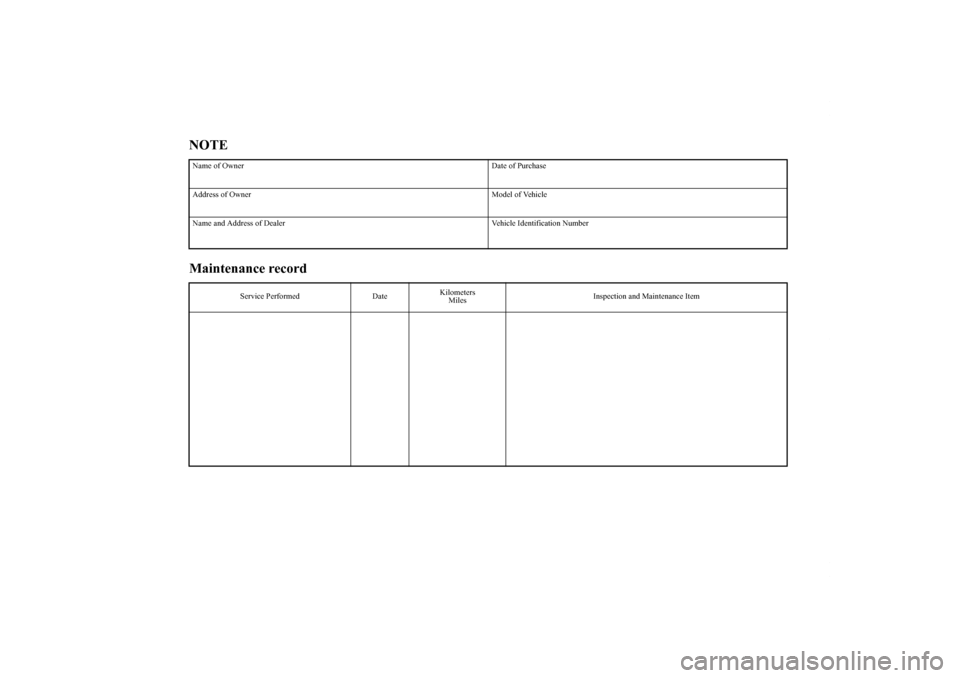
NOTE
Maintenance recordName of Owner Date of Purchase
Address of Owner Model of Vehicle
Name and Address of Dealer Vehicle Identification Number
Service Performed DateKilometers
MilesInspection and Maintenance Item
MMNA_表3.fm 1 ページ 2005年12月15日 木曜日 午後2時57分