Page 354 of 424
Vehicle care and maintenance
7-19
7 Tires
N00939200537
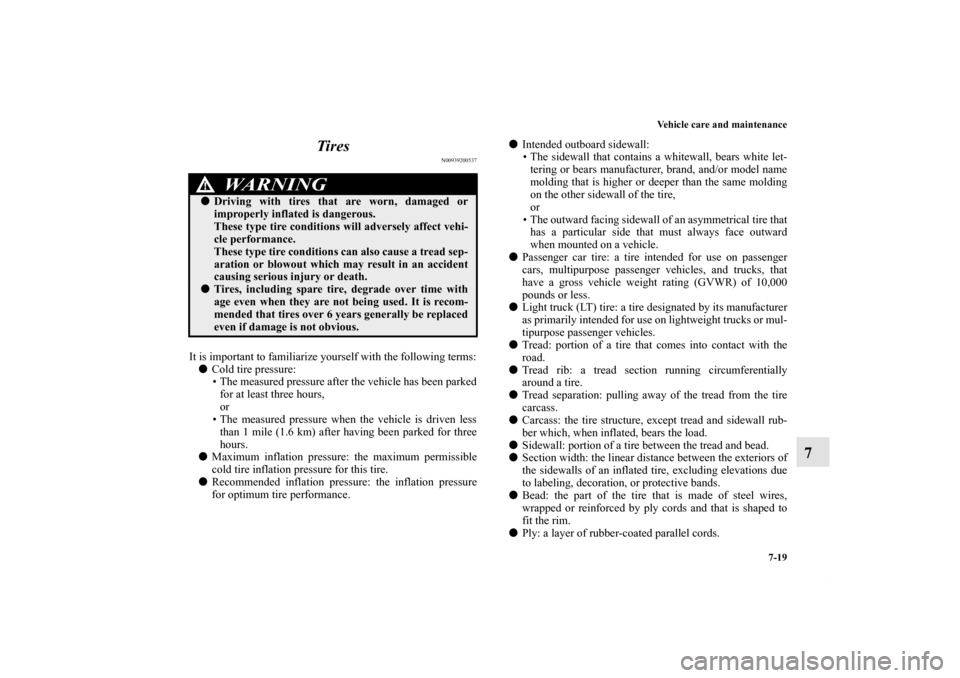
It is important to familiarize yourself with the following terms:
�Cold tire pressure:
• The measured pressure after the vehicle has been parked
for at least three hours,
or
• The measured pressure when the vehicle is driven less
than 1 mile (1.6 km) after having been parked for three
hours.
�Maximum inflation pressure: the maximum permissible
cold tire inflation pressure for this tire.
�Recommended inflation pressure: the inflation pressure
for optimum tire performance.�Intended outboard sidewall:
• The sidewall that contains a whitewall, bears white let-
tering or bears manufacturer, brand, and/or model name
molding that is higher or deeper than the same molding
on the other sidewall of the tire,
or
• The outward facing sidewall of an asymmetrical tire that
has a particular side that must always face outward
when mounted on a vehicle.
�Passenger car tire: a tire intended for use on passenger
cars, multipurpose passenger vehicles, and trucks, that
have a gross vehicle weight rating (GVWR) of 10,000
pounds or less.
�Light truck (LT) tire: a tire designated by its manufacturer
as primarily intended for use on lightweight trucks or mul-
tipurpose passenger vehicles.
�Tread: portion of a tire that comes into contact with the
road.
�Tread rib: a tread section running circumferentially
around a tire.
�Tread separation: pulling away of the tread from the tire
carcass.
�Carcass: the tire structure, except tread and sidewall rub-
ber which, when inflated, bears the load.
�Sidewall: portion of a tire between the tread and bead.
�Section width: the linear distance between the exteriors of
the sidewalls of an inflated tire, excluding elevations due
to labeling, decoration, or protective bands.
�Bead: the part of the tire that is made of steel wires,
wrapped or reinforced by ply cords and that is shaped to
fit the rim.
�Ply: a layer of rubber-coated parallel cords.
WA R N I N G
!�Driving with tires that are worn, damaged or
improperly inflated is dangerous.
These type tire conditions will adversely affect vehi-
cle performance.
These type tire conditions can also cause a tread sep-
aration or blowout which may result in an accident
causing serious injury or death.�Tires, including spare tire, degrade over time with
age even when they are not being used. It is recom-
mended that tires over 6 years generally be replaced
even if damage is not obvious.
BK0121200US.book 19 ページ 2010年4月14日 水曜日 午前11時24分
Page 358 of 424
Vehicle care and maintenance
7-23
7
Tire inflation pressures
N00939300798
Proper tire inflation pressure is essential for the safe and satis-
factory operation of your vehicle. The wrong tire pressure will
cause problems in three major areas:
�Safety
Too little pressure increases flexing in the tire and can
cause tire failure. Too much pressure can cause a tire to
lose its ability to cushion shock. Objects on the road and
potholes could then cause tire damage that may result in
tire failure.
�Economy
The wrong tire pressure can cause uneven wear patterns in
the tire tread. These abnormal wear patterns will reduce
the tread life, and the tire will have to be replaced sooner.
Too little pressure also makes it harder for the tire to roll,
and this uses up more fuel.
�Ride comfort and vehicle stability
The superior riding experience built into your vehicle
partly depends on the correct tire pressure. Too much
pressure gives an uncomfortable and jarring ride. Too lit-
tle pressure feels as if your vehicle is slow to respond.
Unequal tire pressures can make steering your vehicle
uneven and unpredictable.
The correct tire pressure for your vehicle is listed on the plac-
ard attached to the sill of the driver’s door.
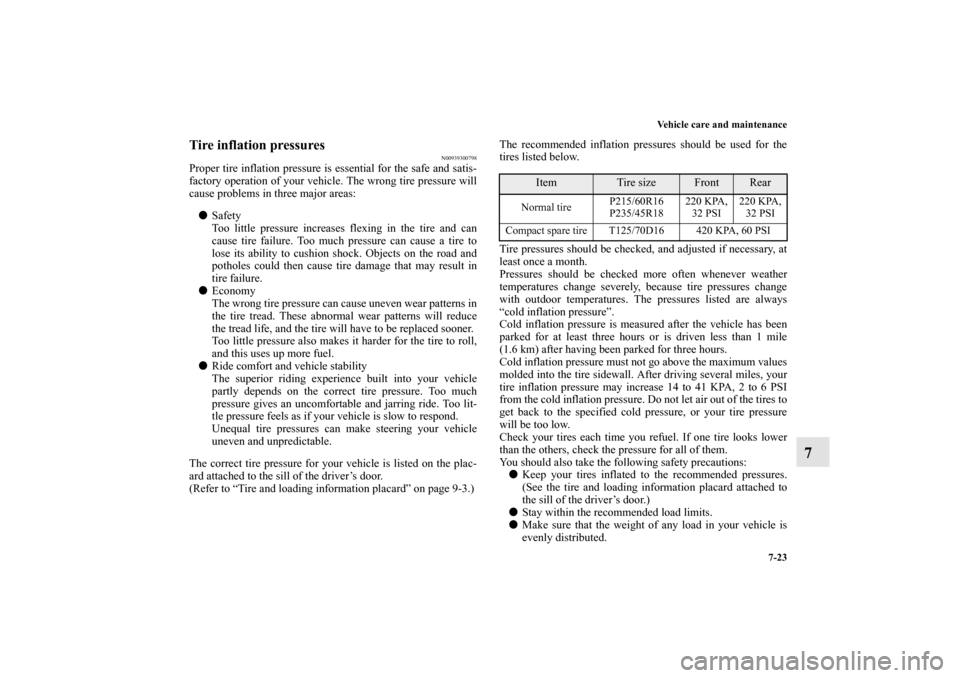
(Refer to “Tire and loading information placard” on page 9-3.)The recommended inflation pressures should be used for the
tires listed below.
Tire pressures should be checked, and adjusted if necessary, at
least once a month.
Pressures should be checked more often whenever weather
temperatures change severely, because tire pressures change
with outdoor temperatures. The pressures listed are always
“cold inflation pressure”.
Cold inflation pressure is measured after the vehicle has been
parked for at least three hours or is driven less than 1 mile
(1.6 km) after having been parked for three hours.
Cold inflation pressure must not go above the maximum values
molded into the tire sidewall. After driving several miles, your
tire inflation pressure may increase 14 to 41 KPA, 2 to 6 PSI
from the cold inflation pressure. Do not let air out of the tires to
get back to the specified cold pressure, or your tire pressure
will be too low.
Check your tires each time you refuel. If one tire looks lower
than the others, check the pressure for all of them.
You should also take the following safety precautions:
�Keep your tires inflated to the recommended pressures.
(See the tire and loading information placard attached to
the sill of the driver’s door.)
�Stay within the recommended load limits.
�Make sure that the weight of any load in your vehicle is
evenly distributed.
Item
Tire size
Front
Rear
Normal tireP215/60R16
P235/45R18220 KPA,
32 PSI220 KPA,
32 PSI
Compact spare tire T125/70D16 420 KPA, 60 PSI
BK0121200US.book 23 ページ 2010年4月14日 水曜日 午前11時24分
Page 408 of 424
9
Specifications
Vehicle labeling . . . . . . . . . . . . . . . . . . . . . . . . . . .9- 2
Vehicle dimensions . . . . . . . . . . . . . . . . . . . . . . . .9- 4
Vehicle weights . . . . . . . . . . . . . . . . . . . . . . . . . . .9- 5
Engine specifications . . . . . . . . . . . . . . . . . . . . . . .9- 6
Battery . . . . . . . . . . . . . . . . . . . . . . . . . . . . . . . . . .9- 7
Tires and wheels. . . . . . . . . . . . . . . . . . . . . . . . . . .9- 7
Capacities . . . . . . . . . . . . . . . . . . . . . . . . . . . . . . . .9- 8
BK0121200US.book 1 ページ 2010年4月14日 水曜日 午前11時24分
Page 412 of 424
Specifications
9-5
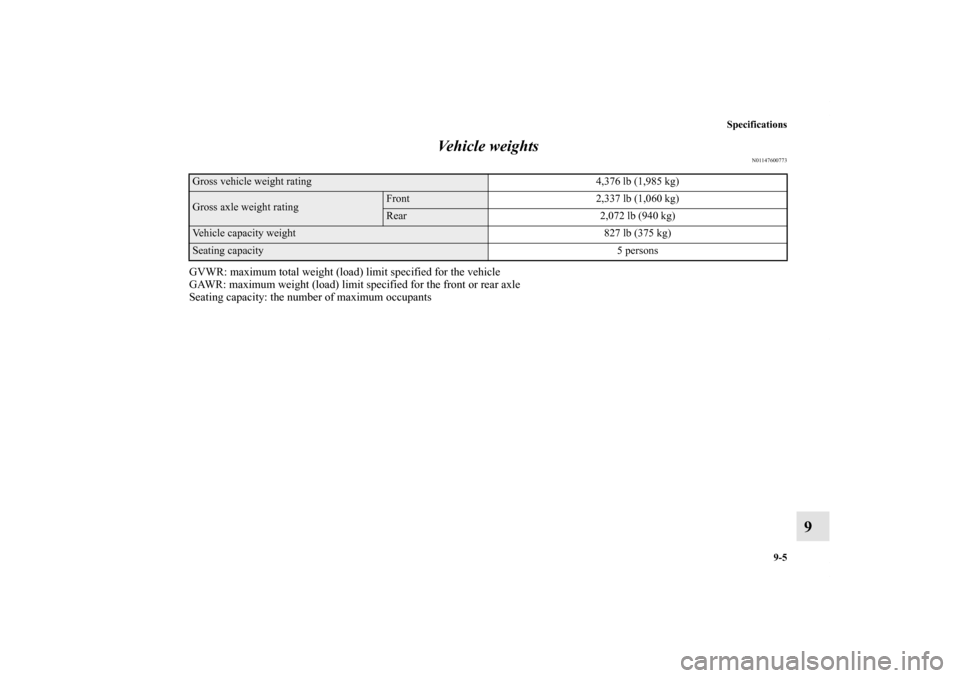
9 Vehicle weights
N01147600773
GVWR: maximum total weight (load) limit specified for the vehicle
GAWR: maximum weight (load) limit specified for the front or rear axle
Seating capacity: the number of maximum occupantsGross vehicle weight rating 4,376 lb (1,985 kg)Gross axle weight rating
Front 2,337 lb (1,060 kg)Rear 2,072 lb (940 kg)
Vehicle capacity weight 827 lb (375 kg)Seating capacity5 persons
BK0121200US.book 5 ページ 2010年4月14日 水曜日 午前11時24分
Page 422 of 424
Alphabetical index
7
Traction control function 3-52
Trailer towing 4-13
Trip odometer 3-73
Trunk lid 3-16
Trunk room light
Capacity 7-46
Replacement 7-60
Turn signal light
Indicators 3-78
Lever 3-84
V
Vanity mirror 3-122
Vanity mirror light
Capacity 7-46
Vanity mirror lights
Replacement 7-60
Vehicle care precautions 7-61
Vehicle dimensions 9-4
Vehicle emission control information label 9-2
Vehicle identification number plate 9-2
Vehicle labeling 9-2
Vehicle preparation before driving 4-3
Vehicle weights 9-5
Vents 5-2
W
Warning lights 3-78
WasherFluid 7-13
Switch 3-89
Washer fluid 9-8
Waxing 7-64
Weights 9-5
Wheel
Covers 6-19
Specification 9-7
Wiper
Switch 3-87
Windshield 3-87
Wiper blades 7-29
BK0121200US.book 7 ページ 2010年4月14日 水曜日 午前11時24分
Page:
< prev 1-8 9-16 17-24