Page 141 of 494
3-46 Features and controls
3
To close the top by manually
N00505700036
1. Without obstructing traffic, stop the vehicle on a level,
firm surface where you can work safely.
2. Securely apply the parking brake. If the vehicle has an
automatic transaxle, place the selector lever in the “P”
(PARK) position. If the vehicle has a manual transaxle,
place the gearshift lever in the 1st position.
3. Completely open the power windows.
4. Place the ignition switch in the OFF position.
5. Pull down both sun visors.
6. Slide the front seats fully forward. Tip the seatbacks for-
ward. Refer to “To adjust the seat forward or backward”
on page 2-5 and “To adjust the seatback” on page 2-6.
7. Remove the woofer cover (A) in the center of the rear seat
by gently pulling at its side edges.8. Remove the emergency tool (B) that is mounted in the
rear seat behind the woofer cover.
A
B
BK0115900US.book 46 ページ 2009年10月27日 火曜日 午後12時1分
Page 149 of 494

3-54 Features and controls
3Parking brake
N00511400168
To park the vehicle, first bring it to a complete stop, fully
engage the parking brake, and then move the gearshift lever to
1st (on a uphill) or “R” (Reverse) (on a downhill) position, for
vehicles with a manual transaxle or set the selector lever to “P”
(PARK) position on automatic transaxle vehicles.To apply To release
When parking on a hill, apply the parking brake and turn the
front wheels toward the curb on a downhill grade, away from
the curb on an uphill grade.
1- Pull the lever up without pushing the button at the end of
hand grip.
When the parking brake is set and the ignition key is in the
“ON” position, the brake warning light in the instrument
cluster will come on.
Before driving, be sure to release the parking brake.
1- Pull the lever up slightly.
2- Press and hold the button at the end of the hand grip.
3- Push the lever downward.
CAUTION
!�Before driving, be sure that the parking brake is
fully released and brake warning light is off.
If a vehicle is driven without releasing the parking
brake, the brakes will be overheated, resulting in
ineffective braking and possible brake failure.
BK0115900US.book 54 ページ 2009年10月27日 火曜日 午後12時1分
Page 157 of 494
3-62 Features and controls
3
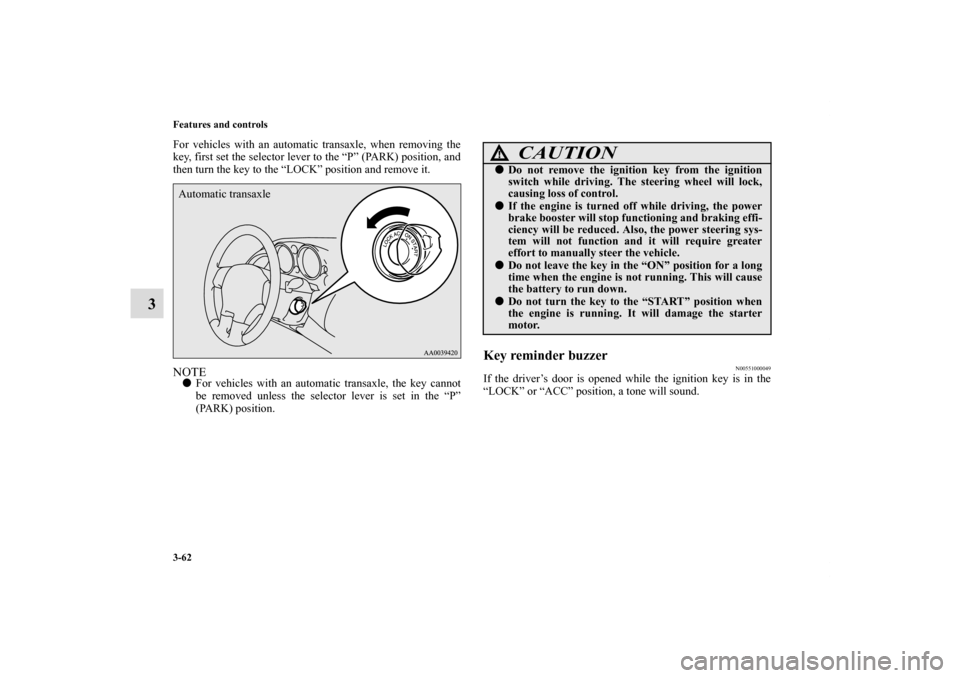
For vehicles with an automatic transaxle, when removing the
key, first set the selector lever to the “P” (PARK) position, and
then turn the key to the “LOCK” position and remove it.NOTE�For vehicles with an automatic transaxle, the key cannot
be removed unless the selector lever is set in the “P”
(PARK) position.
Key reminder buzzer
N00551000049
If the driver’s door is opened while the ignition key is in the
“LOCK” or “ACC” position, a tone will sound.
Automatic transaxle
CAUTION
!�Do not remove the ignition key from the ignition
switch while driving. The steering wheel will lock,
causing loss of control.�If the engine is turned off while driving, the power
brake booster will stop functioning and braking effi-
ciency will be reduced. Also, the power steering sys-
tem will not function and it will require greater
effort to manually steer the vehicle.�Do not leave the key in the “ON” position for a long
time when the engine is not running. This will cause
the battery to run down.�Do not turn the key to the “START” position when
the engine is running. It will damage the starter
motor.
BK0115900US.book 62 ページ 2009年10月27日 火曜日 午後12時1分
Page 160 of 494

Features and controls
3-65
3
Normal conditionsTo start your vehicle:
Make sure all occupants are properly seated with seat belts fas-
tened.
1. Insert the ignition key.
2. Make sure the parking brake is applied.
3. Press and hold the brake pedal down with your right foot.
4. Press and hold the clutch pedal all the way down (manual
transaxle).NOTE�For models equipped with a manual transaxle, the starter
will not operate unless the clutch pedal is fully depressed
(Clutch interlock). This is a safety feature.
5. On vehicles with manual transaxle, place the gearshift
lever in the “N” (Neutral) position.
On vehicles with automatic transaxle, make sure the
selector lever is in the “P” (PARK) position.
6. Turn the ignition key to the “ON” position and make cer-
tain that all warning lights are functioning properly before
starting the engine.
7. Turn the ignition key to the “START” position without
pressing the accelerator pedal. Release the key when the
engine starts. NOTE�Minor noises may be heard on engine start-up. These will
disappear as the engine warms up.
At extremely cold ambient temperatureIf the engine won’t start, press the accelerator pedal about half-
way down while cranking the engine. Release the accelerator
pedal when the engine starts.
CAUTION
!�When starting the engine, make sure that you hold
the brake pedal down. During very cold weather, if
you start the engine with your foot on the accelera-
tor pedal, switch to the brake pedal as soon as the
engine has started.
BK0115900US.book 65 ページ 2009年10月27日 火曜日 午後12時1分
Page 165 of 494

3-70 Features and controls
3
At high altitude locations, upshift as listed below.Vehicles equipped with 5-speed manual transaxle
Vehicles equipped with 6-speed manual transaxle
Downshifting
N00513000096
It is recommended that you downshift to a lower gear when
needed to maintain the desired speed, according to the table.
Avoid downshifting at too high a speed. The engine may suffer
damage.
To maintain a safe speed and prolong brake life, shift down to
2nd or 1st when descending a steep hill.
Downshifting is also important to avoid “lugging” the engine
at too low a speed, such as when turning a corner or when driv-
ing up a steep hill.Recommended downshifting speed
Shift point
Upshift speeds
1st gear to 2nd gear 15 mph (24 km/h)2nd gear to 3rd gear 25 mph (40 km/h)3rd gear to 4th gear 40 mph (64 km/h)4th gear to 5th gear 45 mph (72 km/h)
Shift point
Upshift speeds
1st gear to 2nd gear 15 mph (24 km/h)2nd gear to 3rd gear 25 mph (40 km/h)3rd gear to 4th gear 40 mph (64 km/h)4th gear to 5th gear 45 mph (72 km/h)5th gear to 6th gear 50 mph (80 km/h)
Downshifting speed
Shift point
Under 20 mph (32 km/h)Shift down from current gear to
2nd gear.20 to 30 mph (32 to 48 km/h)Shift down from current gear to
3rd gear.
BK0115900US.book 70 ページ 2009年10月27日 火曜日 午後12時1分
Page 166 of 494

Features and controls
3-71
3
Driving precautions
N00513100101
�The table below shows the maximum recommended driv-
ing speed for in each gear. Do not drive near or at these
speeds for prolonged periods of time.Possible driving speed�Do not use the gearshift lever as a handrest. This can
result in premature wear of the transaxle shift forks.
Automatic transaxle
N00513200102
Designed for the most efficient control and equipped with self-
adapting capabilities, the electronically controlled transaxle
used in your vehicle selects the most favorable gear for each
type of driving and road condition.DRIVING UPHILLThe transaxle may not shift to a higher gear if the computer
determines your current speed would be affected.
For smoother operation, the transaxle may not shift if you
release the throttle while climbing a steep hill. This is normal
because the computer controls the shifting. After reaching the
top of the hill, your normal gear shift function will resume.DRIVING DOWNHILLWhen traveling down steep grades and using the brakes, the
computer may automatically select a lower gear. This helps
engine braking efforts, reducing your need to use the brakes.
Shift
points
Possible driving speed
Vehicles equipped with
5-speed manual
transaxle
Vehicles equipped with
6-speed manual
transaxle
1st gear 30 mph (50 km/h) 37 mph (60 km/h)2nd gear 55 mph (90 km/h) 55 mph (90 km/h)3rd gear 80 mph (130 km/h) 80 mph (130 km/h)4th gear 108 mph (175 km/h) 108 mph (175 km/h)5th gear — 130 mph (210 km/h)
CAUTION
!�The electronically controlled transaxle system is
strictly intended to provide supplementary func-
tions. When driving downhill under certain condi-
tions, when the automatic transaxle is cold
immediately after starting, no automatic downshift
may be made. The driver should move the selector
lever to shift down to a lower gear (3rd gear or 2nd
gear), which will permit the engine to begin braking.
BK0115900US.book 71 ページ 2009年10月27日 火曜日 午後12時1分
Page 167 of 494

3-72 Features and controls
3
NOTE�During the break-in period or immediately after recon-
necting the battery, your vehicle may not shift smoothly.
This does not indicate a problem in the transaxle. Shifting
will become smoother once the transaxle has been shifted
several times by the electronic control system.Selector lever operation
N00513800182
As an additional safety precaution, models equipped with an
automatic transaxle have a shift-lock device that holds the
selector lever in the “P” (PARK) position. To move the selector
lever from the “P” (PARK) position to another position, follow
the steps below.
1. Press and hold the brake pedal down.
2. Move the selector lever to the desired position.NOTE�The selector lever cannot be moved from “P” (PARK) to
another position if the ignition key is at the “LOCK” posi-
tion, or has been removed, or if the brake pedal is not
pressed and held down.The transaxle has 4 forward (4-speed automatic transaxle) or 5
forward (5-speed automatic transaxle) gears and 1 reverse gear.
The individual gears are selected automatically, depending on
the position of the gear selector lever, the speed of the vehicle
and the position of the accelerator pedal.
The selector lever has 2 “gates”: the main gate (A) and the
manual gate (B).
NOTE�For information on manual gate operation, refer to “Sports
mode” on page 3-77.
BK0115900US.book 72 ページ 2009年10月27日 火曜日 午後12時1分
Page 168 of 494
Features and controls
3-73
3
In the main gate, the selector lever has 4 positions, and is
equipped with a lock button (C) to prevent inadvertent selec-
tion of the wrong gear.
The lock button must be pushed while the brake pedal is
depressed to move the selector lever.
The selector lever will move without pushing the lock
button.
The lock button must be pushed to move the selector
lever. WA R N I N G
!�If the lock button is always pressed when using the
selector lever, the lever may be accidentally shifted
into the “P” (PARK) or “R” (REVERSE) position.
Do not press the lock button when making shifts
shown by in the illustration.
BK0115900US.book 73 ページ 2009年10月27日 火曜日 午後12時1分

