2011 MERCEDES-BENZ SL CLASS lock
[x] Cancel search: lockPage 56 of 316

they reach a height where a lap/shoulder belt
fits properly without a booster.
When the child restraint is not in use, remove
it from the vehicle or secure it with the seat
belt to prevent the child restraint from
becoming a projectile in the event of an
accident.
Panic alarm
Example illustration: SmartKey with KEYLESS-GO
XActivating: Press and hold \0003
button \000F for at least 1 second.
An audible alarm and flashing exterior
lamps will operate.
XDeactivating: Press \0003 button \000F again.
or
XInsert the SmartKey into the starter switch.
or
XPress the KEYLESS-GO start/stop button.
The SmartKey with KEYLESS-GO must be
inside the vehicle.
iUSA only:
This device complies with Part 15 of the
FCC Rules. Operation is subject to the
following two conditions:
1. This device may not cause harmful
interference, and
2. this device must accept any
interference received, including
interference that may cause undesired
operation.
Any unauthorized modification to this
device could void the user’s authority to
operate the equipment.
iCanada only:
This device complies with RSS-210 of
Industry Canada. Operation is subject to
the following two conditions:
1.This device may not cause interference,
and
2. this device must accept any
interference received, including
interference that may cause undesired
operation of the device.
Any unauthorized modification to this
device could void the user’s authority to
operate the equipment.
Driving safety systems
Introduction
This section contains information about the
following driving safety systems:
RABS (Antilock Brake System)
RBAS (Brake Assist System)
RESP® (Electronic Stability Program)
RElectro-hydraulic brake system
iIn winter operation, the maximum
effectiveness of most of the driving
systems described in this section is only
achieved with winter tires, or snow chains
as required.
54Driving safety systemsSafety and security
230_AKB; 6; 22, en-USd2ureepe,Version: 2.11.8.12009-07-28T18:49:58+02:00 - Seite 54
Page 57 of 316

Safety notesGWarning!
The following factors increase the risk of
accidents:
R Excessive speed, especially in turns
R Wet and slippery road surfaces
R Following another vehicle too closely
The driving safety systems described in this
section cannot reduce these risks or prevent
the natural laws of physics from acting on the
vehicle. They cannot increase braking or
steering efficiency beyond that afforded by
the condition of the vehicle brakes and tires
or the traction afforded.
Only a safe, attentive, and skillful driver can
prevent accidents.
The capabilities of a vehicle equipped with the
driving safety systems described in this
section must never be exploited in a reckless
or dangerous manner which could jeopardize
the user’s safety or the safety of others.
Always adjust your driving style to the
prevailing road and weather conditions and
keep a safe distance to other road users and
objects on the street.
If a driving system malfunctions, other driving
safety systems may also switch off. Observe
indicator and warning lamps that may come
on as well as messages in the multifunction
display that may appear.
ABS
GObserve Safety notes, see page 55.GWarning!
Do not pump the brake pedal. Use firm, steady
brake pedal pressure instead. Pumping the
brake pedal defeats the purpose of the ABS
and significantly reduces braking
effectiveness.
The Antilock Brake System (ABS) regulates
the brake pressure so that the wheels do not
lock during braking. This allows you to
maintain the ability to steer your vehicle.
The ABS is functional above a speed of
approximately 5 mph (8 km/h) independent
of road surface conditions.
On slippery road surfaces, the ABS will
respond even to light brake pressure.
The ABS indicator lamp 0031 in the
instrument cluster comes on when you switch
on the ignition. It goes out when the engine
is running.
Braking
If the ABS activates during braking, the ABS/
ESP ®
warning lamp 00F2 or 0067 7
in the
instrument cluster flashes. Because of the
electro-hydraulic brake system, you will not
feel any pulsation in the brake pedal.
XKeep firm and steady pressure on the brake
pedal.
Continuous, steady brake pedal pressure
yields the advantages provided by the ABS,
namely braking power and the ability to steer
the vehicle.
The ABS/ESP ®
warning lamp 00F2 or 0067 7
flashes whenever the ABS is activated. It can
be an indication for hazardous road
conditions and functions as a reminder to
take extra care while driving.
Emergency brake maneuver
XKeep continuous full pressure on the brake
pedal.GWarning!
If the ABS malfunctions, other driving safety
systems such as the BAS or the ESP ®
are also
switched off. Observe indicator and warning
lamps that may come on as well as messages
in the multifunction display that may appear.
7 Depending on vehicle production date.Driving safety systems55Safety and security230_AKB; 6; 22, en-USd2ureepe,Version: 2.11.8.12009-07-28T18:49:58+02:00 - Seite 55Z
Page 58 of 316

If the ABS malfunctions, the wheels may lock
during hard braking, reducing steering
capability and extending the braking distance.
BAS
GObserve Safety notes, see page 55.
The Brake Assist System (BAS) operates in
emergency situations. If you apply the brakes
very quickly, the BAS provides full brake
boost automatically, thereby potentially
reducing the braking distance.
XApply continuous full braking pressure until
the emergency braking situation is over.
The ABS will prevent the wheels from
locking.
When you release the brake pedal, the brakes
function again as normal. The BAS is then
deactivated.
GWarning!
If the BAS malfunctions, the brake system still
functions, but without the additional brake
boost available that the BAS would normally
provide in an emergency braking maneuver.
Therefore, the braking distance may increase.
ESP ®
GObserve Safety notes, see page 55.
The Electronic Stability Program (ESP
®
) is
operational as soon as the engine is running.
It monitors the vehicle’s traction (force of
adhesive friction between the tires and the
road surface) and handling.
The ESP ®
recognizes that the vehicle deviates
from the direction of travel as intended by the
driver. By applying brakes to individual
wheels and by limiting the engine output, the
ESP ®
works to stabilize the vehicle. The
ESP ®
is especially useful while driving off and
on wet or slippery road surfaces. The ESP ®
also stabilizes the vehicle during braking and
steering maneuvers.
The ABS/ESP ®
warning lamp 00F2 or 0067 8
in the instrument cluster comes on when you
switch on the ignition. It goes out when the
engine is running.
The ABS/ESP ®
warning lamp 00F2 or 0067 8
in the instrument cluster flashes when the
ESP ®
is engaged.GWarning!
Never switch off the ESP ®
when you see the
ABS/ESP ®
warning lamp 00F2 or 0067 9
flashing in the instrument cluster. In this case
proceed as follows:
R When driving off, apply as little throttle as
possible.
R While driving, ease up on the accelerator
pedal.
R Adapt your speed and driving style to the
prevailing road conditions.
Failure to observe these guidelines could
cause the vehicle to skid. The ESP ®
cannot
prevent accidents resulting from excessive
speed.
! Because the ESP ®
operates
automatically, the engine and ignition must
be shut off (SmartKey in starter switch
position 0 or 1 or KEYLESS-GO start/stop
button in position 0 or 1) when the parking
brake is being tested on a brake test
dynamometer or when the vehicle is being
towed with the front axle raised.
Active braking action through the ESP ®
may otherwise seriously damage the brake
system which is not covered by the
Mercedes-Benz Limited Warranty.
! The ESP ®
will only function properly if you
use wheels of the recommended tire size
8 Depending on vehicle production date.
9 Depending on vehicle production date.56Driving safety systemsSafety and security
230_AKB; 6; 22, en-USd2ureepe,Version: 2.11.8.12009-07-28T18:49:58+02:00 - Seite 56
Page 64 of 316

Electro-hydraulic brake system
The electro-hydraulic brake system combines
a hydraulic brake circuit with electronically
controlled brake servo assistance. You have
increased braking safety and improved
braking comfort.GWarning!
Never ignore a brake malfunction indicated in
the speedometer display, for example by the
0027 (USA only) or 004D (Canada only)
indicator lamp. Refer to the “Practical hints”
section. Also read and observe the messages
in the instrument cluster multifunction
display.
For information on warning and indicator
lamps, see the “Practical hints” section
( Y page 255). For information on the
messages that may appear in the
multifunction display, see the “Practical
hints” section ( Y page 227) and
( Y page 237).
GWarning!
The electro-hydraulic brake system requires
electrical power to operate.
A malfunction in the vehicle’s power supply or
electrical system may impair brake system
operation and switch it into its emergency
operation mode. In such a case, the red brake
warning lamp comes on and warning
messages appear in the multifunction display
while driving. To brake, the driver must then
apply significantly greater brake pedal
pressure and depress the pedal much further
to obtain the expected braking effect. If
necessary, apply full pressure to the brake
pedal. Brakes are only applied to the front
wheels. Stopping distance is increased!
If there is a malfunction in the electro-
hydraulic brake system, we recommend that
the vehicle be transported with all wheels off
the ground using flatbed or appropriate wheel
lift/dolly equipment.
A tow bar must be used if circumstances do
not permit the use of the recommended
towing methods and the vehicle requires
towing with all four wheels on the ground.
Towing the vehicle with all four wheels on the
ground is only permissible for distances up to
30 miles (50 km) and at a speed not to exceed
30 mph (50 km/h). For more information, see
the “Towing the vehicle” section in this
Operator’s Manual.
The electro-hydraulic brake system is
activated automatically when you
R unlock the vehicle with the SmartKey or
with KEYLESS-GO
R open the driver’s or passenger door
R turn the SmartKey in the starter switch to
position 1
R press the start/stop button on the gear
selector lever once (vehicles with
KEYLESS-GO)
R depress the brake pedal
R release the parking brake
If the electro-hydraulic brake system is
activated as the brake pedal is first
depressed, you may feel a reduced pedal
resistance and longer pedal travel than
normal. When releasing the pedal, you may
also feel the brake pedal pulsate and you may
hear a sound which is caused by the
activation of the electro-hydraulic brake
system pump. This is normal and not an
indication of a malfunction. Pedal travel
returns to normal when you release the brake
pedal and the sound soon ceases.
If you experience the above while driving and
the red brake warning lamp illuminates
and/or warning messages appear in the
multifunction display, the brake system is
malfunctioning. Follow the instructions of the
warning message(s) and have the brake
system checked immediately.GWarning!
Have brake pad replacement and other work
on the electro-hydraulic brake system carried
62Driving safety systemsSafety and security
230_AKB; 6; 22, en-USd2ureepe,Version: 2.11.8.12009-07-28T18:49:58+02:00 - Seite 62
Page 65 of 316

out by qualified technicians only. Contact an
authorized Mercedes-Benz Center for further
information.
The electro-hydraulic brake system must be
deactivated prior to working on the system.
High pressure is intermittently built up in the
system as part of its automatic self-test.
In addition, the system is automatically
activated when the vehicle is unlocked by
remote control, when the driver or passenger
door is opened, when the SmartKey in the
starter switch is turned to position 1 or the
KEYLESS-GO start/stop button is pressed
once, when the brake pedal is depressed or
when the parking brake is released. Failure to
deactivate the system prior to maintenance
will cause brake pistons to extend and brake
fluid to leak, which may result in injuries
(contusions and acid burns). Extended brake
pistons may also cause injury.
The electro-hydraulic brake system switches
off automatically
R approximately 2 minutes after you turned
the SmartKey in the starter switch to
position 0 or removed the SmartKey
R approximately 2 minutes after you pressed
the KEYLESS-GO start/stop button to turn
off the engine or power supply and opened
the driver’s door (with driver’s door open,
the starter switch is set to position 0, same
as SmartKey removed from starter switch)
R approximately 20 seconds after you locked
the vehicle from outside
For more information on your vehicle’s
brakes, see the “Driving instructions” section
( Y page 210).
Anti-theft systems
Immobilizer
The immobilizer prevents unauthorized
persons from starting your vehicle.
When leaving the vehicle, always take the
SmartKey with you and lock the vehicle. The
engine can be started by anyone with a valid
SmartKey that is left inside the vehicle.
ActivatingXWith SmartKey: Remove the SmartKey
from the starter switch.XWith KEYLESS-GO: Turn off the engine and
open the driver’s door.
Deactivating
XSwitch on the ignition.
i Starting the engine will also deactivate
the immobilizer.
In the event that the engine cannot be
started (yet the vehicle’s battery is
charged), the system is not operational.
Contact an authorized Mercedes-Benz
Center or call 1-800-FOR-MERCedes (in the
USA) or 1-800-387-0100 (in Canada).
Anti-theft alarm system
Once the alarm system has been armed, a
visual and audible alarm is triggered when
someone opens
R a door
R the trunk
R the hood
R a storage compartment in the rear
R the glove box
R the storage compartment under the
armrest
The alarm will stay on even if the activating
element, a door, for example, is closed
immediately.
The alarm system will also be triggered when
R the vehicle is raised (tow-away alarm)
R the vehicle is opened with the mechanical
key
Anti-theft systems63Safety and security230_AKB; 6; 22, en-USd2ureepe,Version: 2.11.8.12009-07-28T18:49:58+02:00 - Seite 63Z
Page 66 of 316

Ra door is opened from the inside
Rthe trunk is opened with the emergency
release button
To cancel the alarm after it has been
triggered, see “Canceling the alarm”
(Y page 65).
iIf the alarm stays on for more than
30 seconds, the Tele Aid system initiates a
call to the Customer Assistance Center
automatically. The Tele Aid system will
initiate the call provided that
Ryou have subscribed to the Tele Aid
service
Rthe Tele Aid service has been activated
properly
Rthe necessary mobile phone, power
supply and GPS coverage are available
XArming: Lock the vehicle with the
SmartKey or with KEYLESS-GO.
The turn signal lamps flash three times and
an acoustic warning sounds three times to
indicate that the vehicle is locked. Indicator
lamp \000F flashes to indicate that the alarm
system is armed.
iIf the turn signal lamps do not flash three
times and the acoustic warning does not
sound three times, a door or the trunk may
not be properly closed.
Close the respective element.XDisarming: Unlock the vehicle with the
SmartKey or with KEYLESS-GO.
The turn signal lamps flash once and an
acoustic warning sounds once to indicate
that the alarm system is disarmed.
iUnless you open a door or the trunk within
approximately 40 seconds after unlocking
the vehicle:
RThe vehicle will be locked again.
RThe anti-theft alarm system will be
rearmed.
Tow-away alarm
Once the tow-away alarm is armed, a visual
and audible alarm will be triggered when
someone attempts to raise the vehicle.
To cancel the alarm after it has been
triggered, see “Canceling the alarm”
(Y page 65).
iIf the alarm stays on for more than
30 seconds, a call to the Customer
Assistance Center is initiated automatically
by the Tele Aid system provided that you
have subscribed to the Tele Aid service and
that it has been activated properly, and that
the necessary mobile phone, power supply
and GPS coverage are available.
XArming: Lock the vehicle with the
SmartKey or with KEYLESS-GO.
The tow-away alarm is armed after about
30 seconds automatically.
XDisarming: Unlock the vehicle with the
SmartKey or with KEYLESS-GO.
The tow-away alarm remains disarmed until
you lock the vehicle again.
Disabling tow-away alarm
To prevent triggering the tow-away alarm,
disable the tow-away alarm feature before
towing the vehicle, or when parking on a
64Anti-theft systemsSafety and security
230_AKB; 6; 22, en-USd2ureepe,Version: 2.11.8.12009-07-28T18:49:58+02:00 - Seite 64
Page 67 of 316
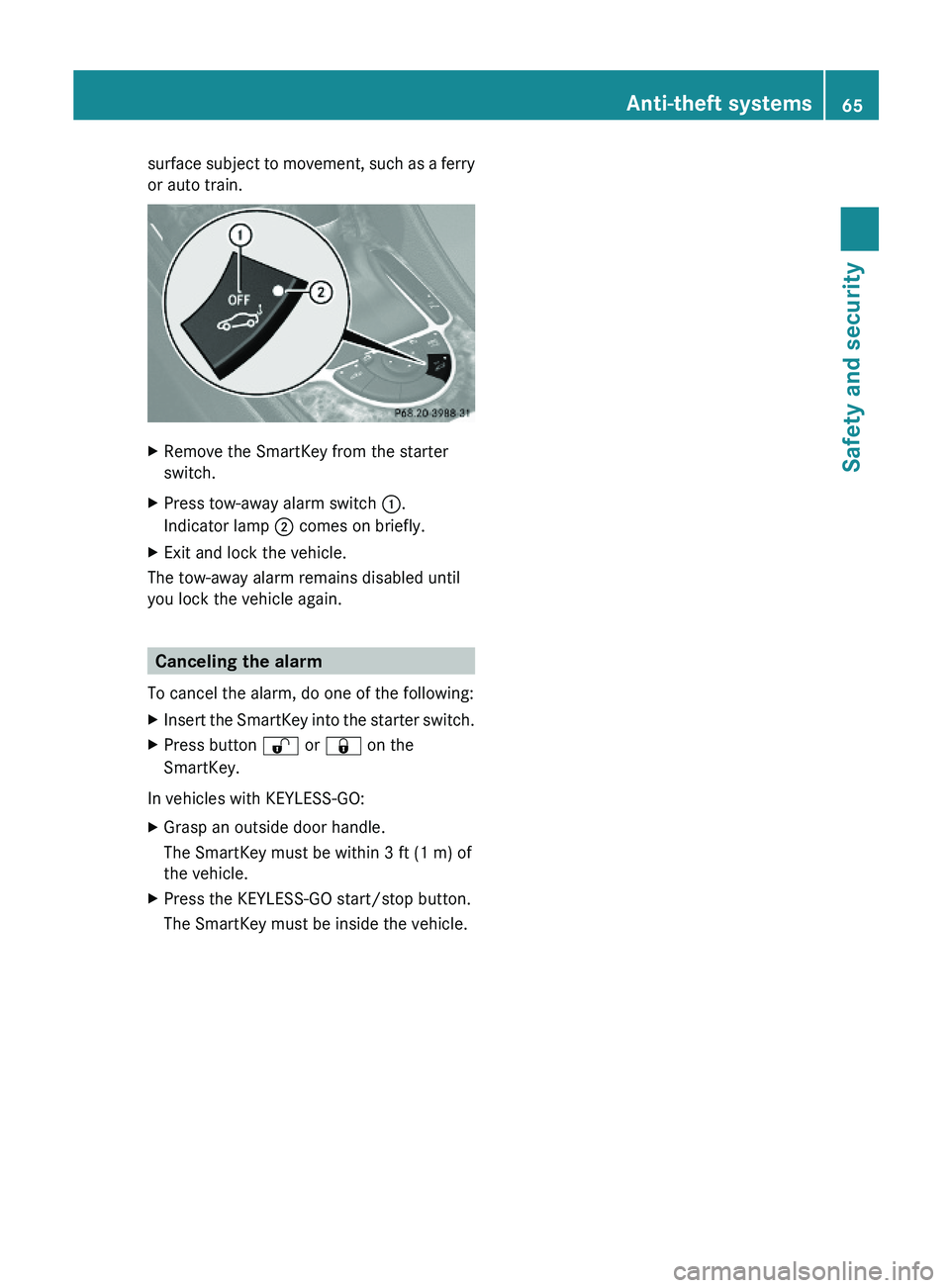
surface subject to movement, such as a ferry
or auto train.
XRemove the SmartKey from the starter
switch.
XPress tow-away alarm switch \000F.
Indicator lamp \000G comes on briefly.
XExit and lock the vehicle.
The tow-away alarm remains disabled until
you lock the vehicle again.
Canceling the alarm
To cancel the alarm, do one of the following:
XInsert the SmartKey into the starter switch.XPress button \0006 or \0007 on the
SmartKey.
In vehicles with KEYLESS-GO:
XGrasp an outside door handle.
The SmartKey must be within 3 ft (1 m) of
the vehicle.
XPress the KEYLESS-GO start/stop button.
The SmartKey must be inside the vehicle.
Anti-theft systems65Safety and security230_AKB; 6; 22, en-USd2ureepe,Version: 2.11.8.12009-07-28T18:49:58+02:00 - Seite 65Z
Page 69 of 316

Vehicle equipment ..............................68
Locking and unlocking .......................68
Starter switch positions .....................78
Seats ....................................................80
Multifunction steering wheel .............84
Mirrors .................................................86
Memory function .................................88
Lighting ................................................89
Wipers ..................................................95
Power windows ...................................96
Driving and parking ............................98
Automatic transmission ...................103
Instrument cluster ............................111
Control system ..................................113
Driving systems ................................130
Climate control system ....................148
Rear window defroster .....................155
Retractable hardtop .........................155
Loading and storing ..........................161
Useful features .................................164
67Controls in detail230_AKB; 6; 22, en-USd2ureepe,Version: 2.11.8.12009-07-28T18:49:58+02:00 - Seite 67