2011 MERCEDES-BENZ M-CLASS SUV warning
[x] Cancel search: warningPage 26 of 389
are listed in the original purchase agreement
of your vehicle. Should you hav eany ques-
tions concerning equipment and operation,
please consult aMercedes-Ben zService
Cent re. Oper
ating safety Safe
tynotes G
WARNING
All wor konthe vehicle and, in particular ,work
relevant to safet yoronsafety-related sys-
tems must be carried out at aqualified spe-
cialist workshop. The specialist workshop
must have the necessary specialist knowl-
edge and tools to carry out the work required.
Mercedes -Benz recommends that you use a
Mercedes-Benz Ser vice Centre for thi spur-
pose. G
WARNING
Some safety systems only function when the
engine is running. You should therefore never
switch off the engine when driving. Otherwise,
the safety systems of your vehicle may not
function correctly and as aresult will no lon-
ger protec tyou and other person sasinten-
ded .Ina ddition, there is arisk that you may
lose control of your vehicle and thus cause an
accident. G
WARNING
Work carried out incorrectly, or alterations
made to the vehicle, e.g. re-routing of cables
under coverings, could cause the safety sys-
tems of your vehicle to stop working properly.
The safety systems would thus no longer pro-
tect you and other persons as intended. In
addition, there is arisk that you may lose con-
trol of your vehicle and thus cause an acci-
dent.
All work and alteration stothe vehicle, e.g.
installation sormodifications, should there-
for ebec arried out at aqualified specialist
workshop. G
WARNING
If work on electronic equipmen tand its soft-
ware is carried out incorrectly, this equipment
could stop working. The electronic systems
are networ kedv ia interfaces. Tampering with
these electronic systems could cause mal-
func tions in system swhich hav enot been
modified. Malfunction ssuch as these can
seriously jeopardis ethe vehicle' soperating
safety and therefore your own safety.
You should therefore have all work and mod-
ifications to electronic components carried
out at aqualified specialist workshop. G
WARNING
If you drive over obstacle sathigh speed or if
the vehicle bottoms out in rough terrain, it
could cause heavy impact stothe vehicle
underbody, tyres or wheels. This coul dcause
your vehicle to be damaged, which in turn
might lead to an accident. This also applies to
vehicles which are equipped with underbody
protection.
You shoul dtherefore drive over obstacles
slowly. Prevent the vehicle from bottoming
out when driving off-road an difnecessar y,
hav eyourvehicle inspected at aqualified spe-
cialist workshop. General notes
The following information applie stoa ll radio
system component sinthe vehicle and to
COMAN D:
The radio system component sinthis vehicle
ar ec ompliant with the basic requirements
and all other relevant condition sofDirective
1999/5/EC. You can obtain further informa-
tion from any Mercedes-Ben zService Centre.
The equipment is approved by the vehicle
manufacturer in accordance with European
Automotive EMC Directive 95/54/ EC.O per-
ation accordin gtoits intende dpurpose is
thus approved for your vehicle. The equip-
ment does not require certification. Introduction
23 Z
Page 27 of 389

The equipment conform
stothe relevant
equipment -specific EMC specification sin
accordanc ewith the following European
standards:
R EN 550 13
R EN 55020
Therefore, adherence to the relevant specifi-
cations for electromagnetic compatibility is
guarantee dfor this device.
As aresult, interferenc ecaused by your
equipment to other electrical/electronic
equipment and interferenc etoyour equip-
men tcaused by other electrical/electronic
equipment can be largely prevented. On-board diagnostic interface
G
WARNING
If you connect equipment to the on-board
diagnostic interface, it can affect the opera-
tion of the vehicle systems. This can impair
the operating safety of your vehicle while driv-
ing. There is arisk of accident.
Do not connect any equipment to the on-
board diagnostic interface. G
WARNING
Loose equipment or equipment cables which
are connected to the on-board diagnostic
interface may infringe on the space around
the pedals. The equipment or the cables could
get between the pedals in the event of sudden
braking or acceleration .You may then no lon-
ger be able to brake, operate the clutch or
accelerate as intended. There is arisk of acci-
dent.
Do not attach any equipment or cables in the
driver footwell.
Connecting equipment to the on-board diag-
nostic interface can lead to emissions moni-
torin ginformation being reset. Thi smay lead
to the vehicle failing to meet the require-
ment satthe nex temissions con trol test or
main inspec tion. If the engin
eisswitched off and equipment
on the on-board diagnostic interface is used,
the starter battery may discharge.
The on-board diagnostic interface is intended
for the connection of diagnostic equipment at
aq ualified specialist workshop. Qualified specialist workshop
Aq ualified specialist workshop has the nec-
essary specialist knowledge, tools and quali-
fication stocorrectlyc arry out the work
required on your vehicle. This is especially the
cas efor work releva ntto safety.
Observ ethe information in th eServic eBook-
let.
Alway shave th efollowin gwork carried out at
aq ualified specialist workshop:
R work relevan ttosafety
R servic eand maintenance work
R repair work
R alterations, installation work and modifica-
tions
R work on ele ctroniccomponen ts
Mercedes-Ben zrecom mends that you use a
Mercedes-Benz Service Centre. Vehicle registration
Mercedes-Benz may ask its Service Centres
to carry out technical inspectio nson certain
ve hicles to improv etheir quality or safety.
If you did not purchase your vehicle from an
authorised specialist dealer and your vehicle
has never been inspected at aMercedes-
Ben zService Cent re,itisp ossible that your
vehicle is not registered in your nam ewith
Mercedes-Benz. Mercedes-Ben zcan only
infor myou about vehicle chec ksif it has your
registration data.
It is advisable to register your vehicle with a
Mercedes-Benz Servic eCentre. 24
Introduction
Page 28 of 389

Inform Mercedes-Benz as soon as poss
ible
abou tany change in address or vehicl eown-
ership. Correct use
G
WARNING
Variou swarning stickers are affixed to your
vehicle. Their purpose is to draw your atten-
tion, and the attention of others, to various
dangers. Therefore, do not remove any warn-
ing stic kers unles sthe stic kerc learly states
that you may do so.
If you remov ethe warnin gstickers, you or
others could be injured by failing to recognise
certain dangers.
Observe the following information whe nusing
your vehicle:
R the safety notes in this manual
R the "Technical data" section in this manual
R national roa dtraffic regulations
R national roa dtraffic licensing regulations Implie
dwarranty
! Follo wthe instructions in this manual
about the proper operation of your vehicle
as well as about possible vehicle damage.
Damage to your vehicle that arises from
culpable contravention sagainst these
instructions ar enot covered either by
Mercedes-Ben zimplie dwarrant yorbythe
New or Used-Vehicle Warrant yof
Daimler AG. Data stored in the vehicle
Fault data
Compone ntsc ritical for vehicl eoperation are
equipped with fault data memories as stand-
ard. There are also data storage devices
which recor dthe technical reactions of vehi-
cle component stocertain driving situations (e.g. airbag deployment or ESP
®
interven-
tion).
This data is used exclusivel yto:
R assist in the rec tificatio noffaults and
defects
R help Mercedes -Benz optimise and develop
vehicle fun ctions
The data cannot be used to trac ethe vehicle's
movements.
When your vehicle is serviced by Mercedes-
Ben z,this technical information can be read
out from the fault memory. Thi sisperformed
by authorised employees of the Mercedes-
Benz service network using special diagnos-
tic computers.
Af teraf ault has been rectified, the informa-
tion is deleted from the memory. Other mem-
ory data is constantly overwritten. Other devices tha
tstore data
Depe nding on the equipment level, your vehi-
cle may featur ecommunication sand/or
entertainment systems (e.g .navigation devi-
ces, telephone systems). Thes eallow you to
save and edit data required for the operation
of the respective device.
Fur ther information on operation (e.g. on
deletin gdata) can be found in the separate
operating instructions. Introduction
25 Z
Page 32 of 389

Function Page
:
Overhead con
trol panel 36
;
PARKTRONI
Cwarning dis-
play 191
=
Combination switch 108
?
Instrument cluster 30
A
Horn
B
DIRECT SELECT lever 145
C
Steerin
gwheel gearshift
paddles 149
D
Nigh
tView Assist Plus 205
E
Light switch 106
F
On-board diagnostic inter-
face 24 Function Page
G
Opens the bonnet 318
H
Electric parking brake 161
I
Ignition lock 139
Start/Stop button 139
J
Adjusts the steerin
gwheel
manually 98
K
Adjusts the steeri
ngwheel
electrically 98
Steerin
gwheel heati ng 99
L
Cruise control lever 170
M
Climate control systems 120Dashbo
ard
29Atag lance
Page 35 of 389

Warnin
gand indicator lamps Fun
ction Page
:
Dipped-bea
mheadlamps 107
;
ESP
® 288
=
Main-beam headlamps 108
?
Electric parkin
gbrake (red) 285
A
Electric parking brake (yel-
low)
285
B
Brakes (yellow) 285
C
Distance warning signal 293
D
Turn signal 108
E
Tyre pressure moni
tor 293
F
SRS
290 Function Page
G
Sea
tbelt 284
H
Diesel engine: preglow 140
I
Coolant 291
J
Rear foglamp 107
K
Engine diagnostics 290
L
Reserv
efuel 291
M
ESP
®
OFF 288
N
ABS 286
O
Brakes (red) 28532
Instrument clusterAt
ag lance
Page 37 of 389
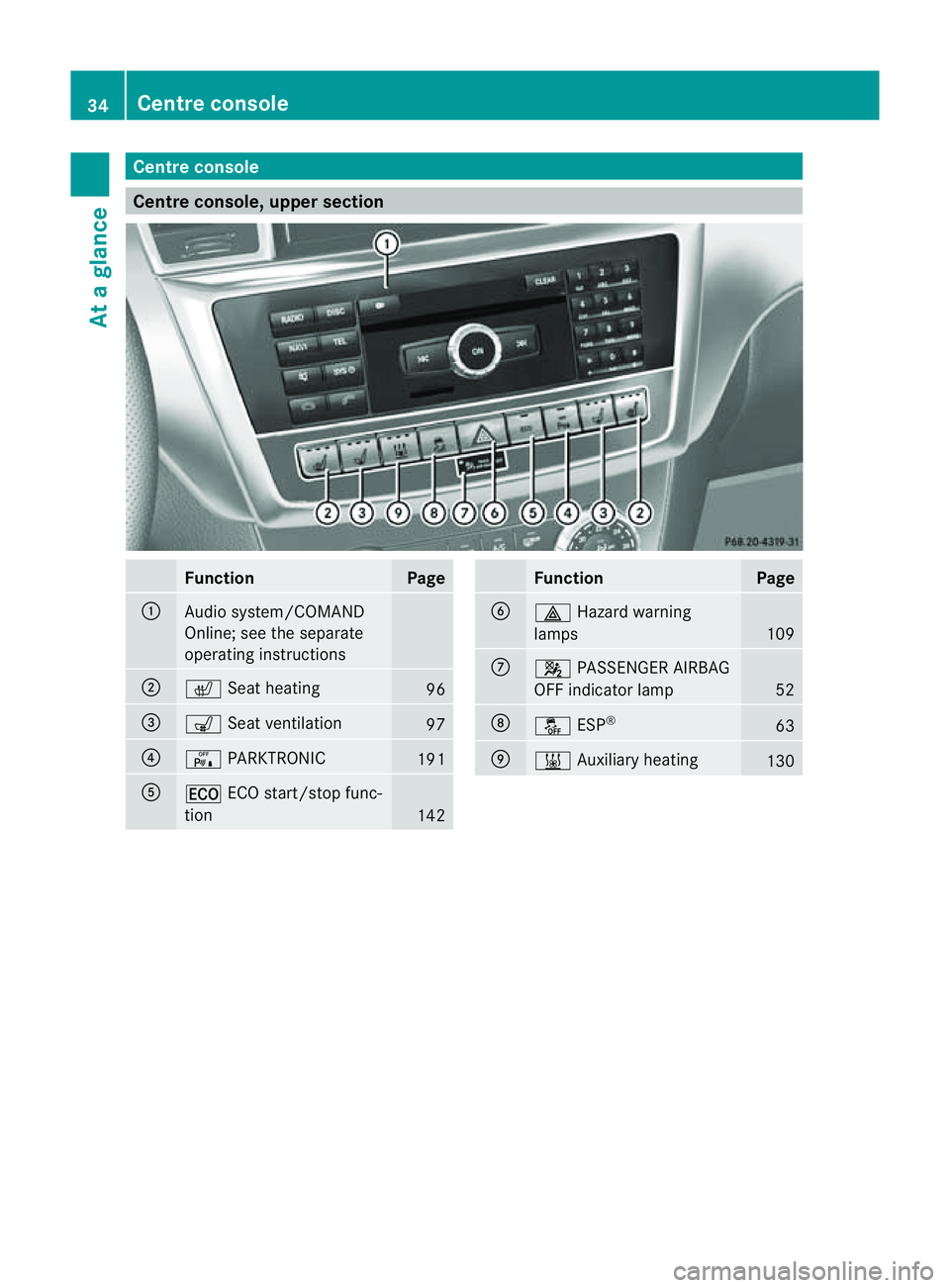
Centre console
Centr
econsole, upper section Function Page
:
Audi
osystem/COMAND
Online; see the separate
ope ratin ginstructions ;
c
Seat hea ting 96
=
s
Seat ventilation 97
?
c
PARKTRONIC 191
A
¤
ECO start/sto pfunc-
tion 142 Function Page
B
£
Hazard warning
lamps 109
C
4
PASSENG ER AIRBAG
OFF indicator lamp 52
D
å
ESP® 63
E
&
Auxiliary heating 13034
Centre consoleAt
ag lance
Page 43 of 389
Usefu
linfor mati on
i This Owner's Manual describes all models
and all standard and optional equipment
available to your vehicle at the time of pub-
lication of the Owner's Manual. Country-
specific deviation sare possible .Please
not ethat your vehicle ma ynot be equipped
with all featur es described. This also
applies to safety-releva ntsystems and
functions.
i Please read the information on qualified
specialist workshops (Y page 24).Occupant safety
Important safet
ynotes
Seat belts, together wit hthe Supp lemental
Restrain tSyste m–S RS (Y page 41), are
complementary, co-ordinated restrain tsys-
tems. They reduce the risk of injur yinspe-
cific, pre-defined types of accident situations
and thereby increase occupant safety .How-
ever ,seat belts and airbags generally do not
protec tagainst objec tspenetratin gthe vehi-
cle from the outside.
To ensur ethat the restraint system scan
deliver their full potential protection, make
sure that:
R the seat and head restraint are adjusted
properly (Y page 92).
R the seat belt has been fastened properly
(Y page 47).
R the airbags can inflate unrestricted if
deplo yed (Y page42).
R the steering whee lisadjusted properly
(Y page 92).
R the restraint systems have not been modi-
fied.
i An airba gincrease sthe protection of
vehicle occupants wearing aseat belt. As
such, they are only an additional restraint
system which complemen ts,b ut does not
replace, the seat belt. All vehicle occupants must wear their seat belt correctly at all
times, even if the vehicle is equipped with
airbags. The airbags are not deplo yed inall
types of accidents. For example, if the pro-
tective capacity of correctly fastened seat
belts is not increased by deplo yingthe air-
bags, the airbags will not deploy. Airbag
deploymen tonly provides incre asedpro-
tection if th eseatb eltisw ornc orrect ly
because:
R the sea tbelt helps to keep the vehicle
occupan tinthe best position in relation
to the airbag.
R in ah ead-on collision ,for example, the
seat belt prevents the vehicle occupant
from being propelled towards the point
of impact .Itcan thus reduce the risk of
injury.
In accidents in which an airbag is deployed,
it provides increased protection only if the
seat belt is worn correctly. G
WARNING
If service work is not carried out correctly, the
operating safety of your vehicle may be affec-
ted. This could cause you to lose control of
your vehicle and cause an accident. More-
over, the safety systems may no longer be
able to protect you or others as they are
designed to do.
Always have service work carried out at a
qualified specialist workshop. The workshop
must have the necessary specialist knowl-
edge and tools to carr yout the work required.
Mercedes-Ben zrecom mends that you use a
Mercedes-Benz Service Centre for this pur-
pose. In particular, work relevant to safety or
on safety-related systems must be carried out
at aq ualified specialist workshop. 40
Occupant safetySafety
Page 44 of 389

G
WARNING
Modifications to or work performe dincor-
rectly on the following parts can result in the
restraint systems not functioning as intended:
R the restraint system, consisting of seat
belts and thei ranchorage points, bel tten-
sioners, belt for celimiter sand airbags
R the wiring
R networked electronic systems
Airbags and belt tensioners could fail to
deploy or be trigge redinana ccident despite
the deceleration force being sufficient to trig-
ger the systems, or could be triggered unin-
tentionally. For this reason, never make any
modifications to the restrain tsystems.
Therefore, you must not tamper with elec-
tronic components or their software. SRS (Supplemen
talRestraint System)
Introduction SRS consists of:
R
the 6 SRS warning lamp
R airbags
R airba gcontrol unit (with crash sensors)
R belt tensioner sfor the front seat belts and
the outer seat belts in the rear
R belt force limiters
SRS reduces the risk of occupan ts coming
into contact with the vehicle's interio rinthe
even tofana ccident. It can als oreduce the
effect of the forces to which occupant sare
subjected during an accident.
SRS warnin glamp SRS functions are checked regularly when
you switch on the ignition and when the
engine is running. Therefore ,malfunctions
can be detected in good time.
The 6 SRS warning lamp in the instrument
cluster lights up when the ignition is switched
on. It goes out no later than afew seconds
after the engine is star ted. G
WARNING
If SRS is malfunctioning, individual systems
may be activated unintentionally or may not
be triggered in the even tofanaccident with
ah igh rate of vehicle deceleration.
Am alfunction has occurred if:
R the 6 SRS warning lamp does not light
up when the ignition is switched on.
R the engine is runnin gand the 6SRS
warning lamp doe snot go out after afew
seconds.
R the engine is runnin gand the 6SRS
warning lamp lights up again.
In this case, have SRS checked immediately
at aq ualified specialist workshop .Mercedes-
Benz recommends that you use aMercedes-
Benz Servic eCentr efor this purpose.
In particular ,work relevant to safet yoron
safety-related systems must be carried out at
aq ualified specialist workshop.
Triggering of belt tensioners, belt force
limiters and airbags During the first stage of
acollision ,the airbag
con trol unit evaluates important physical
data relatin gtovehicle deceleration or accel-
eration, such as:
R duration
R direction
R magnitude
Based on the evaluation of this data, the air-
bag control unit pre-emptively triggers the
belt tensioner sinthe first stage.
i The front belt tensioner scan only be trig-
gered if the seat belt tongues on the front
seats are correctly engaged in the seat belt
buckles.
If there is an even higher rate of vehicle decel-
eration or acceleration in alongitudinal direc-
tion ,the front airbags ar ealso deployed.
Your vehicle has adaptive, two-stage front air-
bags. The airbag control unit evaluates vehi-
cle deceleration or acceleration in the event Occupant safety
41Safety Z