2011 MERCEDES-BENZ G-CLASS check engine
[x] Cancel search: check enginePage 158 of 288
Vehicle equipment
i This manual describes all the standard
and optional equipment of your vehicle
which was available at the time of
purchase. Country-specific differences are
possible. Please note that your vehicle may
not be equipped with all features
described. This also applies to safety-
relevant systems and functions.
Important safety notes
You will find an illustration of the instrument
cluster in the "At a glance" section
( Y page 26).
GWarning
A driver's attention to the road and traffic
conditions must always be his/her primary
focus when driving.
For your safety and the safety of others,
selecting features through the multifunction
steering wheel should only be done by the
driver when traffic and road conditions permit
it to be done safely.
Bear in mind that at a speed of just 30 mph
(approximately 50 km/h ), your vehicle is
covering a distance of 44 feet (approximately
14 m) every second.
GWarning!
No messages will be displayed if either the
instrument cluster or the multifunction
display is inoperative.
As a result, you will not be able to see
information about your driving conditions,
such as
R speed
R outside temperature
R warning/indicator lamps
R malfunction/warning messages
R failure of any systems
Driving characteristics may be impaired.
If you must continue to drive, do so with added
caution. Contact an authorized Mercedes-
Benz Center as soon as possible.GWarning
Malfunction and warning messages are only
indicated for certain systems and are
intentionally not very detailed. The
malfunction and warning messages are
simply a reminder with respect to the
operation of certain systems. They do not
replace the owner's and/or driver's
responsibility to maintain the vehicle's
operating safety. Have all required
maintenance and safety checks performed on
the vehicle. Bring the vehicle to an authorized
Mercedes-Benz Center to address the
malfunction and warning messages.
Displays and operation
Tachometer
The red band in the tachometer indicates the
engine's overrevving range.
! Do not drive in the overrevving range, as
this could damage the engine.
The fuel supply is interrupted to protect the
engine when the red band is reached.
Displaying the coolant temperature
GWarning
Driving when your engine is overheated can
cause some fluids which may have leaked into
the engine compartment to catch fire. You
could be seriously burned.
Steam from an overheated engine can cause
serious burns which can occur just by opening
the engine hood. Stay away from the engine
if you see or hear steam coming from it.
Stop the vehicle in a safe location away from
other traffic. Turn off the engine, get out of the
vehicle and do not stand near the vehicle until
the engine has cooled down.
156Displays and operationOn-board computer and displays
ProCarManuals.com
Page 173 of 288
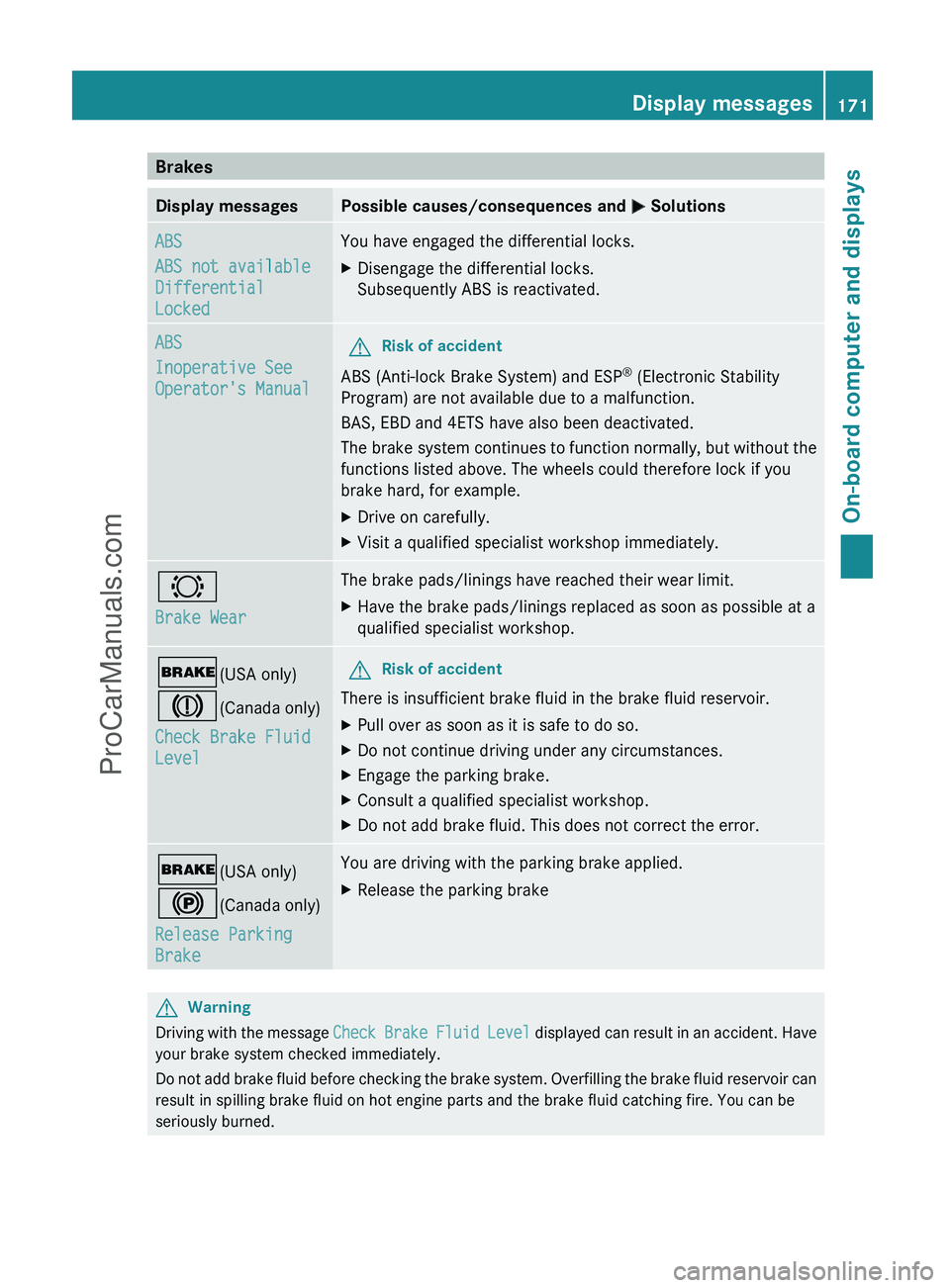
BrakesDisplay messagesPossible causes/consequences and M SolutionsABS
ABS not available
Differential
LockedYou have engaged the differential locks.XDisengage the differential locks.
Subsequently ABS is reactivated.ABS
Inoperative See
Operator's ManualGRisk of accident
ABS (Anti-lock Brake System) and ESP ®
(Electronic Stability
Program) are not available due to a malfunction.
BAS, EBD and 4ETS have also been deactivated.
The brake system continues to function normally, but without the
functions listed above. The wheels could therefore lock if you
brake hard, for example.
XDrive on carefully.XVisit a qualified specialist workshop immediately.#
Brake WearThe brake pads/linings have reached their wear limit.XHave the brake pads/linings replaced as soon as possible at a
qualified specialist workshop.$ (USA only)
J (Canada only)
Check Brake Fluid
LevelGRisk of accident
There is insufficient brake fluid in the brake fluid reservoir.
XPull over as soon as it is safe to do so.XDo not continue driving under any circumstances.XEngage the parking brake.XConsult a qualified specialist workshop.XDo not add brake fluid. This does not correct the error.$ (USA only)
! (Canada only)
Release Parking
BrakeYou are driving with the parking brake applied.XRelease the parking brakeGWarning
Driving with the message Check Brake Fluid Level displayed can result in an accident. Have
your brake system checked immediately.
Do not add brake fluid before checking the brake system. Overfilling the brake fluid reservoir can
result in spilling brake fluid on hot engine parts and the brake fluid catching fire. You can be
seriously burned.
Display messages171On-board computer and displaysZProCarManuals.com
Page 176 of 288
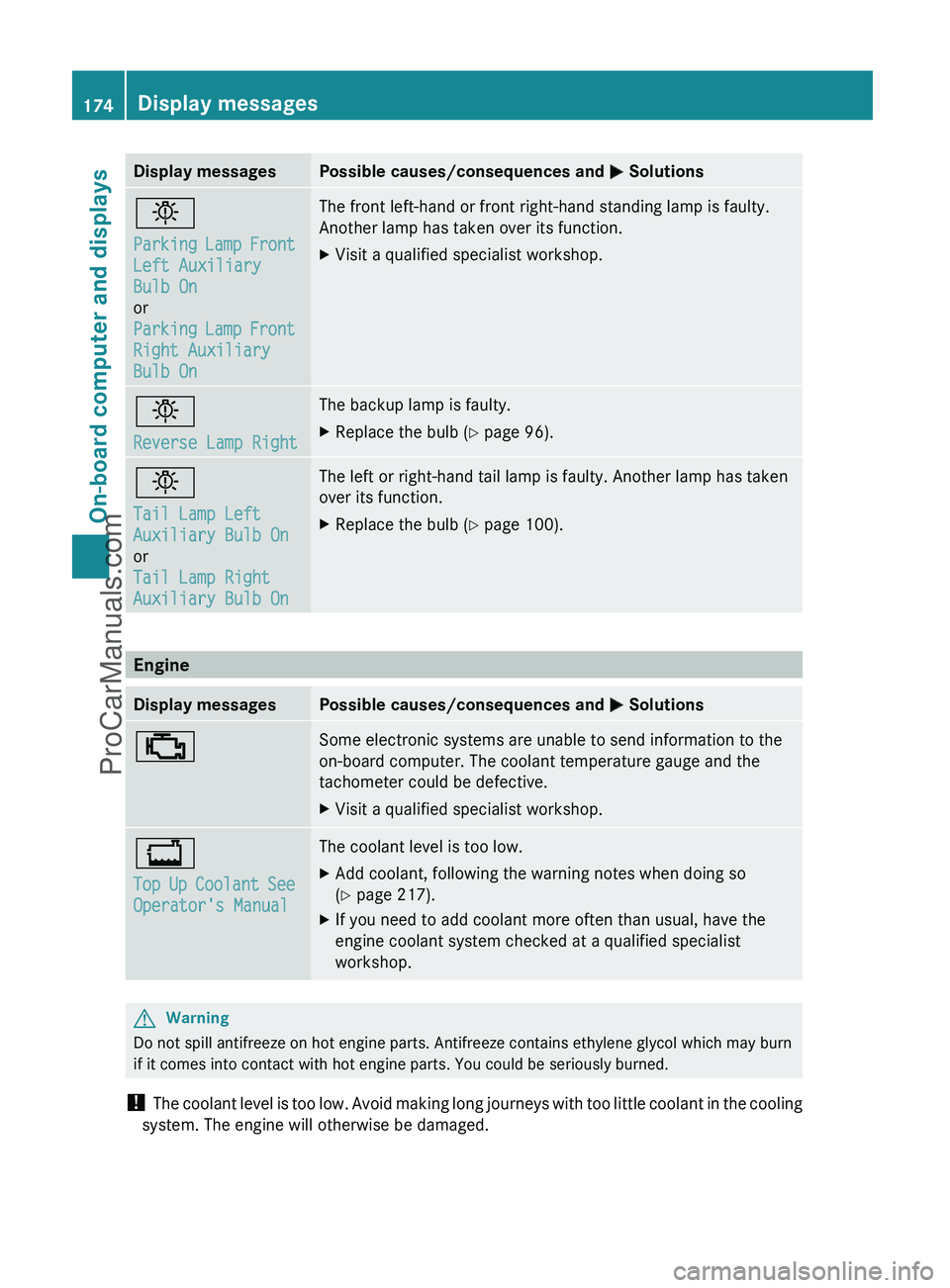
Display messagesPossible causes/consequences and M Solutionsb
Parking Lamp Front
Left Auxiliary
Bulb On
or
Parking Lamp Front
Right Auxiliary
Bulb OnThe front left-hand or front right-hand standing lamp is faulty.
Another lamp has taken over its function.XVisit a qualified specialist workshop.b
Reverse Lamp RightThe backup lamp is faulty.XReplace the bulb ( Y page 96).b
Tail Lamp Left
Auxiliary Bulb On
or
Tail Lamp Right
Auxiliary Bulb OnThe left or right-hand tail lamp is faulty. Another lamp has taken
over its function.XReplace the bulb ( Y page 100).
Engine
Display messagesPossible causes/consequences and M Solutions;Some electronic systems are unable to send information to the
on-board computer. The coolant temperature gauge and the
tachometer could be defective.XVisit a qualified specialist workshop.+
Top Up Coolant See
Operator's ManualThe coolant level is too low.XAdd coolant, following the warning notes when doing so
( Y page 217).XIf you need to add coolant more often than usual, have the
engine coolant system checked at a qualified specialist
workshop.GWarning
Do not spill antifreeze on hot engine parts. Antifreeze contains ethylene glycol which may burn
if it comes into contact with hot engine parts. You could be seriously burned.
! The coolant level is too low. Avoid making long journeys with too little coolant in the cooling
system. The engine will otherwise be damaged.
174Display messagesOn-board computer and displays
ProCarManuals.com
Page 177 of 288
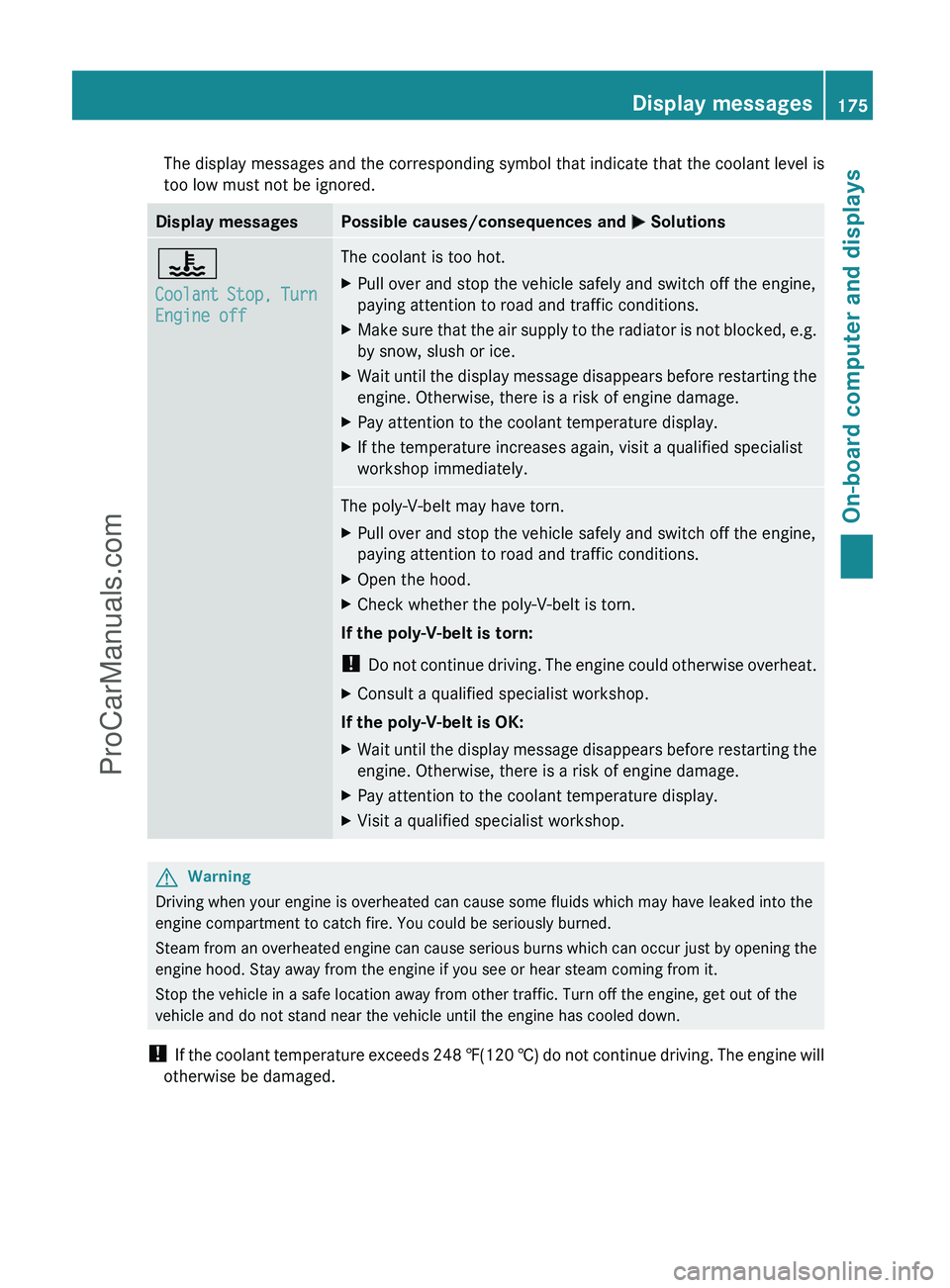
The display messages and the corresponding symbol that indicate that the coolant level is
too low must not be ignored.Display messagesPossible causes/consequences and M Solutions?
Coolant Stop, Turn
Engine offThe coolant is too hot.XPull over and stop the vehicle safely and switch off the engine,
paying attention to road and traffic conditions.XMake sure that the air supply to the radiator is not blocked, e.g.
by snow, slush or ice.XWait until the display message disappears before restarting the
engine. Otherwise, there is a risk of engine damage.XPay attention to the coolant temperature display.XIf the temperature increases again, visit a qualified specialist
workshop immediately.The poly-V-belt may have torn.XPull over and stop the vehicle safely and switch off the engine,
paying attention to road and traffic conditions.XOpen the hood.XCheck whether the poly-V-belt is torn.
If the poly-V-belt is torn:
! Do not continue driving. The engine could otherwise overheat.
XConsult a qualified specialist workshop.
If the poly-V-belt is OK:
XWait until the display message disappears before restarting the
engine. Otherwise, there is a risk of engine damage.XPay attention to the coolant temperature display.XVisit a qualified specialist workshop.GWarning
Driving when your engine is overheated can cause some fluids which may have leaked into the
engine compartment to catch fire. You could be seriously burned.
Steam from an overheated engine can cause serious burns which can occur just by opening the
engine hood. Stay away from the engine if you see or hear steam coming from it.
Stop the vehicle in a safe location away from other traffic. Turn off the engine, get out of the
vehicle and do not stand near the vehicle until the engine has cooled down.
! If the coolant temperature exceeds 248 ‡(120 †) do not continue driving. The engine will
otherwise be damaged.
Display messages175On-board computer and displaysZProCarManuals.com
Page 178 of 288

Display messagesPossible causes/consequences and M Solutions?The engine fan is defective.XAt coolant temperatures under 248 ‡ (120 †), drive to the next
qualified specialist workshop.XAvoid subjecting the engine to heavy loads, e.g. driving in
mountainous terrain, and stop-and-go traffic.#The battery is not being charged.
Possible causes are:
R a defective alternator
R a torn poly-V-belt
R a malfunction in the electronicsXPull over and stop the vehicle safely and switch off the engine,
paying attention to road and traffic conditions.XOpen the hood.XCheck whether the poly-V-belt is torn.
If the poly-V-belt is torn:
! Do not continue driving. The engine could otherwise overheat.
XConsult a qualified specialist workshop.
If the poly-V-belt is OK:
XVisit a qualified specialist workshop.The battery voltage is too low.XSwitch off electrical consumers that are not required.XHave the battery and alternator checked at a qualified specialist
workshop.The battery has been charged or the vehicle has been jump-
started.XHave the battery and alternator checked at a qualified specialist
workshop.4
Check oil level at
next gas stationThe engine oil level has dropped to a critical level.XCheck the oil level ( Y page 215).XIf necessary, add engine oil ( Y page 216).XHave the engine checked for leaks if you need to add engine oil
more often than usual.You have added too much engine oil. There is a risk of damaging
the engine or catalytic converter.XSiphon off excess engine oil until it is at the specified level.
Observe the legal requirements.176Display messagesOn-board computer and displays
ProCarManuals.com
Page 179 of 288
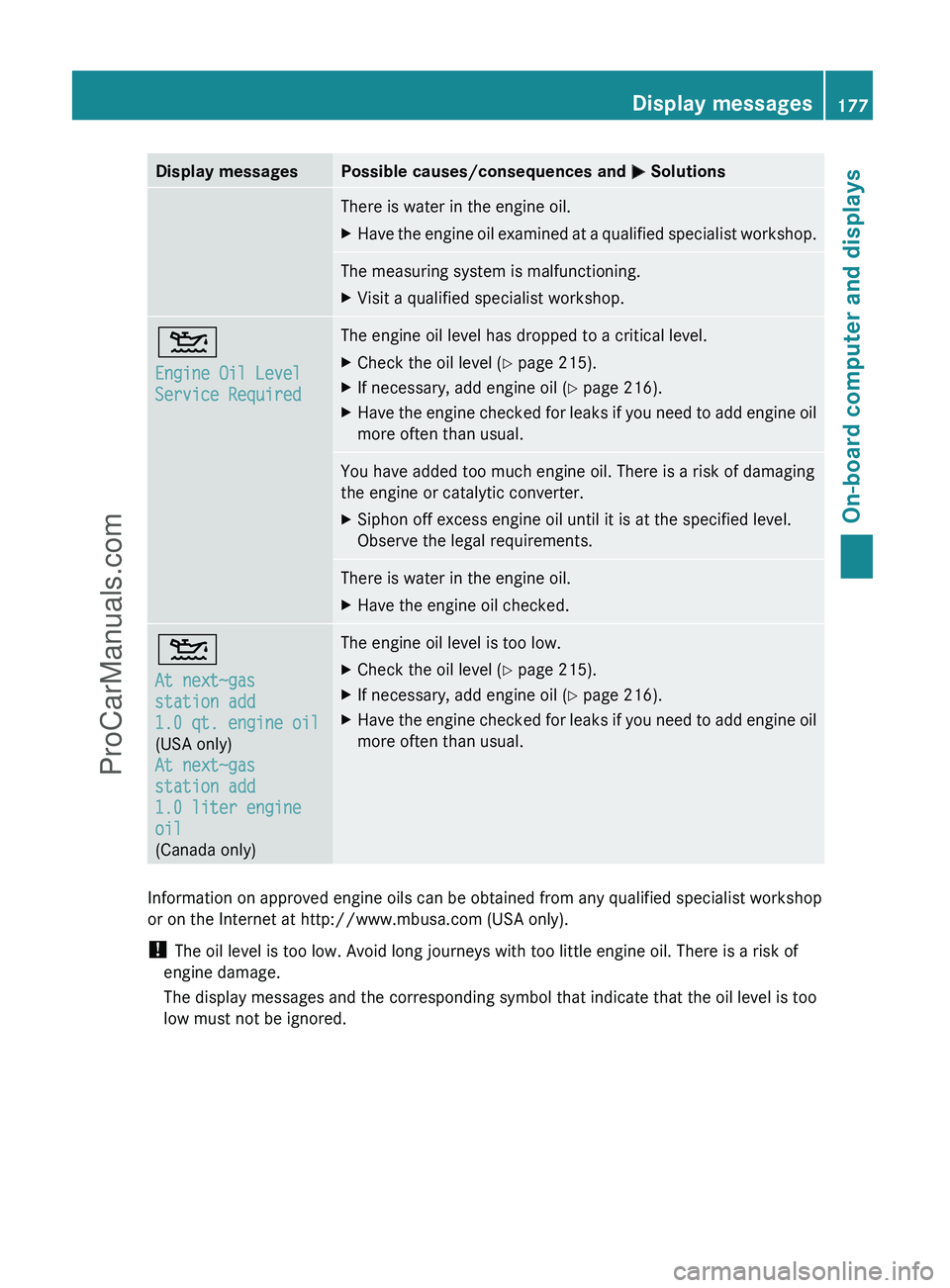
Display messagesPossible causes/consequences and M SolutionsThere is water in the engine oil.XHave the engine oil examined at a qualified specialist workshop.The measuring system is malfunctioning.XVisit a qualified specialist workshop.4
Engine Oil Level
Service RequiredThe engine oil level has dropped to a critical level.XCheck the oil level ( Y page 215).XIf necessary, add engine oil ( Y page 216).XHave the engine checked for leaks if you need to add engine oil
more often than usual.You have added too much engine oil. There is a risk of damaging
the engine or catalytic converter.XSiphon off excess engine oil until it is at the specified level.
Observe the legal requirements.There is water in the engine oil.XHave the engine oil checked.4
At next~gas
station add
1.0 qt. engine oil
(USA only)
At next~gas
station add
1.0 liter engine
oil
(Canada only)The engine oil level is too low.XCheck the oil level ( Y page 215).XIf necessary, add engine oil ( Y page 216).XHave the engine checked for leaks if you need to add engine oil
more often than usual.
Information on approved engine oils can be obtained from any qualified specialist workshop
or on the Internet at http://www.mbusa.com (USA only).
! The oil level is too low. Avoid long journeys with too little engine oil. There is a risk of
engine damage.
The display messages and the corresponding symbol that indicate that the oil level is too
low must not be ignored.
Display messages177On-board computer and displaysZProCarManuals.com
Page 180 of 288
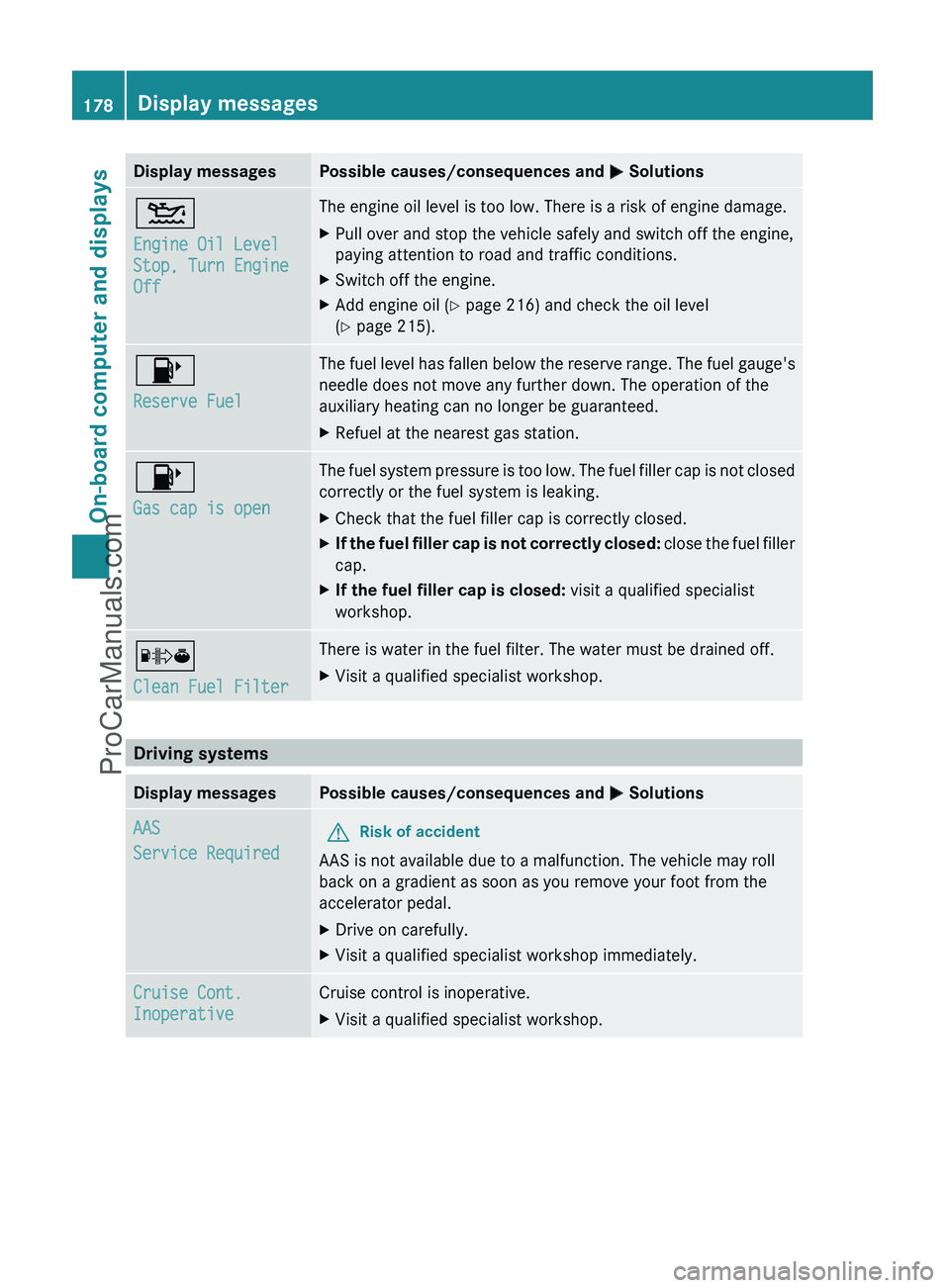
Display messagesPossible causes/consequences and M Solutions4
Engine Oil Level
Stop, Turn Engine
OffThe engine oil level is too low. There is a risk of engine damage.XPull over and stop the vehicle safely and switch off the engine,
paying attention to road and traffic conditions.XSwitch off the engine.XAdd engine oil ( Y page 216) and check the oil level
( Y page 215).8
Reserve FuelThe fuel level has fallen below the reserve range. The fuel gauge's
needle does not move any further down. The operation of the
auxiliary heating can no longer be guaranteed.XRefuel at the nearest gas station.8
Gas cap is openThe fuel system pressure is too low. The fuel filler cap is not closed
correctly or the fuel system is leaking.XCheck that the fuel filler cap is correctly closed.XIf the fuel filler cap is not correctly closed: close the fuel filler
cap.XIf the fuel filler cap is closed: visit a qualified specialist
workshop.´
Clean Fuel FilterThere is water in the fuel filter. The water must be drained off.XVisit a qualified specialist workshop.
Driving systems
Display messagesPossible causes/consequences and M SolutionsAAS
Service RequiredGRisk of accident
AAS is not available due to a malfunction. The vehicle may roll
back on a gradient as soon as you remove your foot from the
accelerator pedal.
XDrive on carefully.XVisit a qualified specialist workshop immediately.Cruise Cont.
InoperativeCruise control is inoperative.XVisit a qualified specialist workshop.178Display messagesOn-board computer and displays
ProCarManuals.com
Page 185 of 288
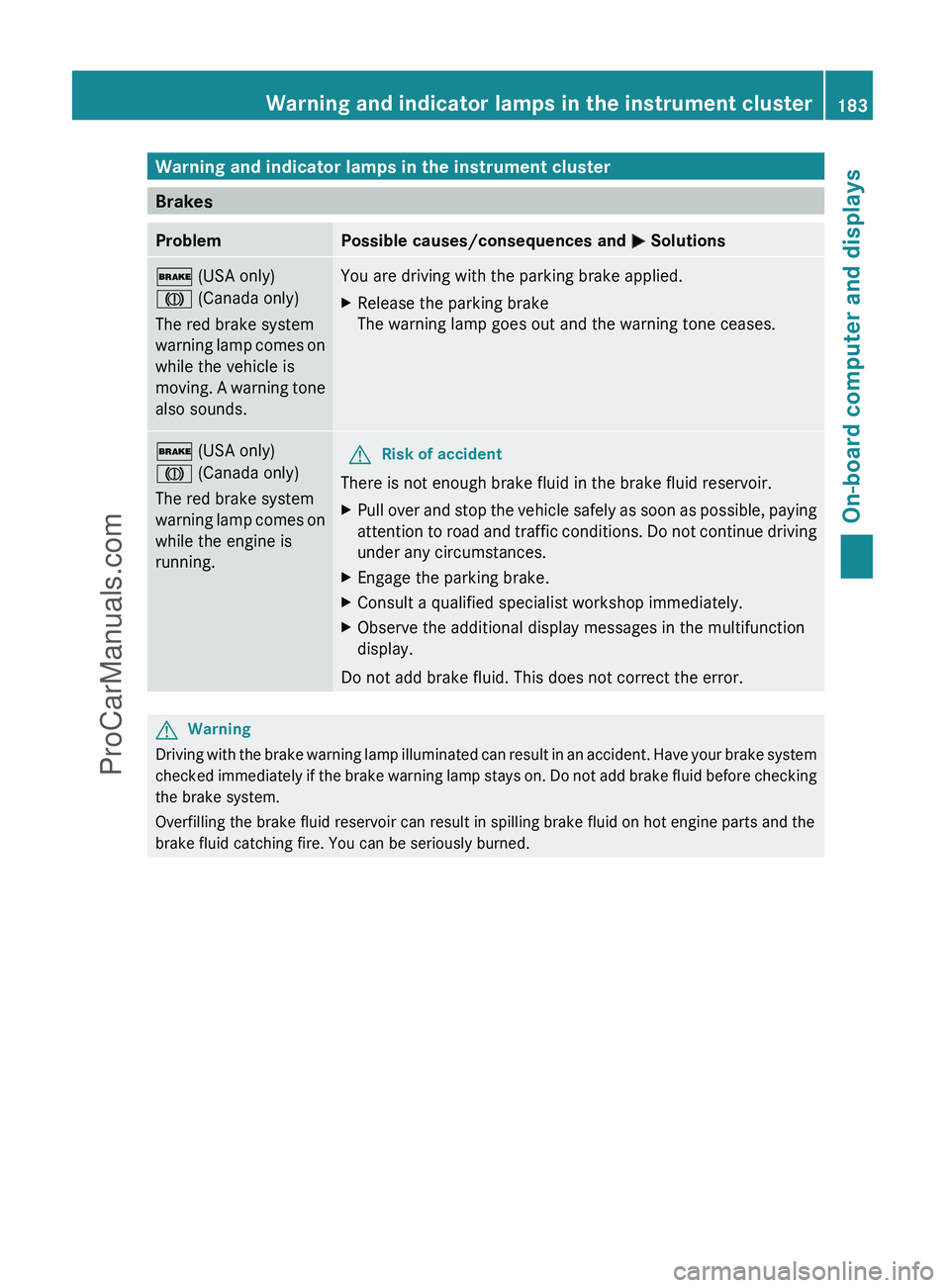
Warning and indicator lamps in the instrument cluster
Brakes
ProblemPossible causes/consequences and M Solutions$ (USA only)
J (Canada only)
The red brake system
warning lamp comes on
while the vehicle is
moving. A warning tone
also sounds.You are driving with the parking brake applied.XRelease the parking brake
The warning lamp goes out and the warning tone ceases.$ (USA only)
J (Canada only)
The red brake system
warning lamp comes on
while the engine is
running.GRisk of accident
There is not enough brake fluid in the brake fluid reservoir.
XPull over and stop the vehicle safely as soon as possible, paying
attention to road and traffic conditions. Do not continue driving
under any circumstances.XEngage the parking brake.XConsult a qualified specialist workshop immediately.XObserve the additional display messages in the multifunction
display.
Do not add brake fluid. This does not correct the error.
GWarning
Driving with the brake warning lamp illuminated can result in an accident. Have your brake system
checked immediately if the brake warning lamp stays on. Do not add brake fluid before checking
the brake system.
Overfilling the brake fluid reservoir can result in spilling brake fluid on hot engine parts and the
brake fluid catching fire. You can be seriously burned.
Warning and indicator lamps in the instrument cluster183On-board computer and displaysZProCarManuals.com