2011 MERCEDES-BENZ E-CLASS CABRIOLET Sport
[x] Cancel search: SportPage 269 of 353
Luggage nets
G
WARNING
Only place lightweight object sinthe luggage
net. Do not use it to transport heavy, sharp-
edged or fragile objects. The luggagen et can-
not secure the objectss ufficiently in the event
of an accident.
Luggage nets are located in the front-
passenger footwell and on the left-hand side
of the boot (Coupé) or left and right-hand
sides of the boot (Cabriolet). Through-loading facility in the rear
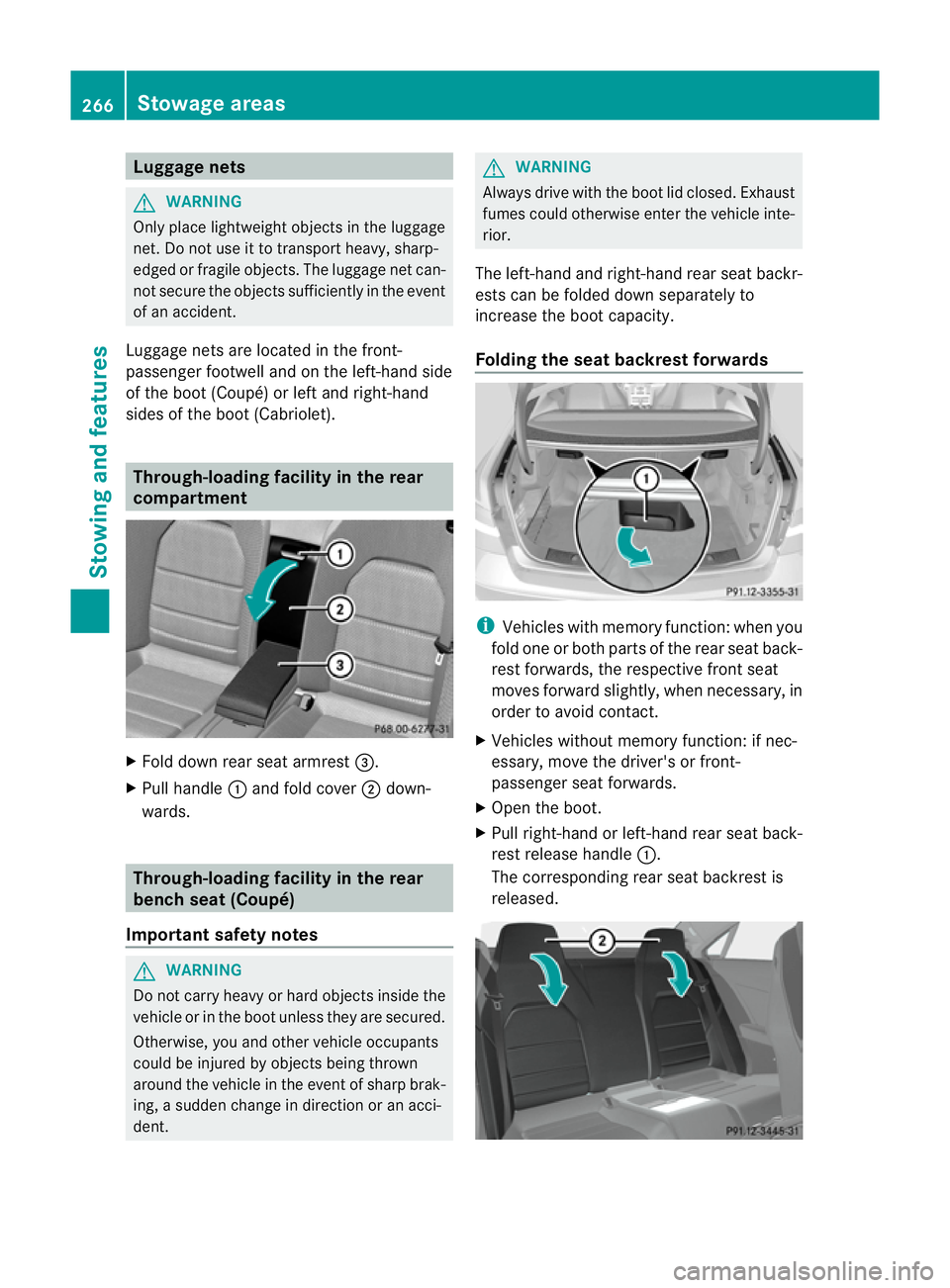
compartment X
Fold down rear seat armrest =.
X Pull handle :and fold cover ;down-
wards. Through-loading facility in the rear
bench seat (Coupé)
Important safety notes G
WARNING
Do not carry heavy or hard objectsi nside the
vehicle or in the boot unless they are secured.
Otherwise, you and other vehicle occupants
could be injured by objects being thrown
around the vehicle in the event of sharp brak-
ing, asudden change in direction or an acci-
dent. G
WARNING
Always drive with the boot lid closed. Exhaust
fumes could otherwise enter the vehicle inte-
rior.
The left-hand and right-hand rear seat backr-
ests can be folded down separately to
increase the boot capacity.
Folding the seat backrest forwards i
Vehicles with memory function :when you
fold one or both parts of the rear seat back-
rest forwards, the respective front seat
moves forward slightly, when necessary, in
order to avoid contact.
X Vehicles without memory function: if nec-
essary, move the driver's or front-
passenger seat forwards.
X Open the boot.
X Pull right-hand or left-hand rear seat back-
rest release handle :.
The corresponding rear seat backrest is
released. 266
Stowage areasStowing and features
Page 271 of 353
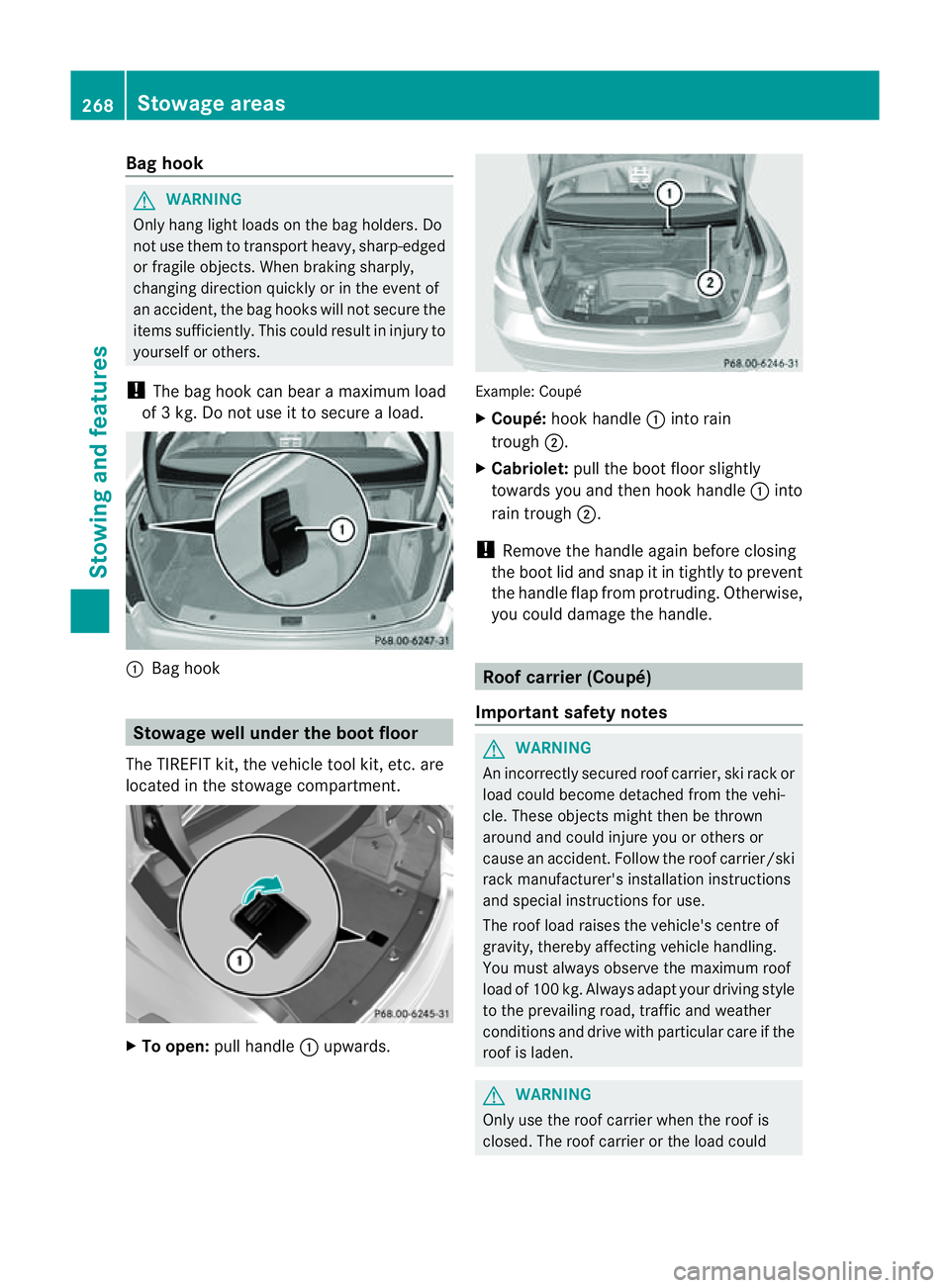
Bag hook
G
WARNING
Onl yhanglight load sonthe bagholders. Do
not us ethem to transport heavy ,sharp-edged
or fragile objects. Whe nbraking sharply,
changing directio nquickly or in the event of
an accident, the bag hooks willn ot secure the
items sufficiently. This could resul tininjury to
yoursel forothers.
! Theb aghoo kcan bear amaximum load
of 3k g.Do no tuse it to secure aload. :
Bag hook Stowage well under th
eboot floor
The TIREFI Tkit,t he vehicle tool kit ,etc. are
locate dinthe stowage compartment. X
To open: pull handle :upwards. Example: Coupé
X
Coupé: hook handle :into rain
trough ;.
X Cabriolet: pull the boot floo rslightly
towards you and the nhook handle :into
rain trough ;.
! Remove the handle again before closing
the boot lid and snap it in tightly to prevent
the handle flap from protruding. Otherwise,
you could damage the handle. Roof carrier (Coupé)
Important safety notes G
WARNING
An incorrectly secured roof carrier, ski rack or
load could become detached from the vehi-
cle. These object smight then be thrown
around and could injure you or others or
cause an accident .Follow the roof carrier/ski
rack manufacturer' sinstallation instructions
and special instructions for use.
The roof load raises the vehicle's centre of
gravity, thereby affecting vehicle handling.
You must alwayso bserve the maximum roof
load of 100 kg. Always adapt your driving style
to the prevailing road, traffic and weather
conditions and drive with particular care if the
roof is laden. G
WARNING
Only use the roof carrier when the roof is
closed. The roof carrier or the load could 268
Stowage areasStowing and features
Page 307 of 353
Fitting
anew wheel G
WARNING
Replac edamage dorcorrode dwheel bolts.
Never oil or greas ewheel bolts. This could
cause th eboltstol oosenint he wheel hub. G
WARNING
If aw heel hub thread is damaged, you must
not drive the vehicle any further. Consult a
qualified specialist workshop which has the
necessary specialist knowledge and tools to
carry out the work required. Mercedes-Benz
recommends that you use aMercedes-Benz
Service Centr eorService 24h for this pur-
pose. In particular, work relevant to safety or
on safety-related systems must be carried out
at aq ualified specialist workshop. G
WARNING
Only use wheel bolts that have been designed
for the wheel and the vehicle. For safety rea-
sons, Mercedes-Benz recommends that you
only use wheel bolts which have been
approved for Mercedes-Benz vehicles and the
respective wheel. Other wheel bolts could
work loose or damage the brake system.
Do not tighten the wheel bolts completely
while the vehicle is still jacked up. The vehicle
could topple off the jack.
X Clean the wheel and wheel hub contact
surfaces. X
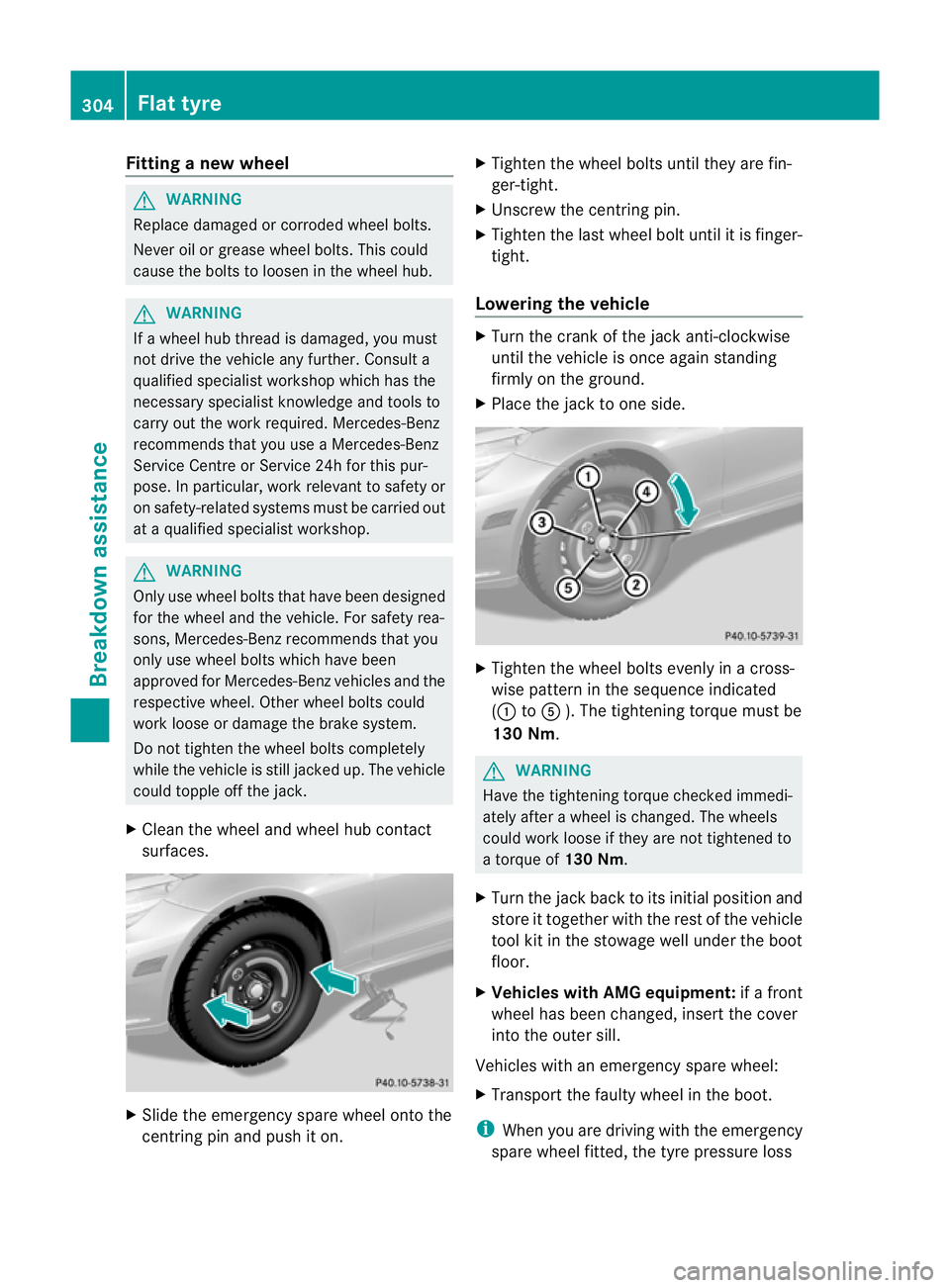
Slide the emergency spare wheel ontot he
centring pin and push it on. X
Tighten the wheel bolts until they are fin-
ger-tight.
X Unscrew the centring pin.
X Tighten the last wheel bolt until it is finger-
tight.
Lowering the vehicle X
Turn the cran kofthe jack anti-clockwise
until the vehicle is oncea gain standing
firmly on the ground.
X Place the jack to one side. X
Tighten the wheel bolts evenly in across-
wise patter ninthe sequence indicated
(: toA ). The tightening torque must be
130 Nm. G
WARNING
Have the tightening torque checked immedi-
ately after awheel is changed. The wheels
could work loose if they are not tightened to
at orque of 130 Nm.
X Turn the jack back to its initial position and
store it together with the rest of the vehicle
tool kit in the stowage well under the boot
floor.
X Vehicles with AMG equipment: ifaf ront
wheel has been changed, insert the cover
into the outer sill.
Vehicles with an emergency spare wheel:
X Transport the faulty wheel in the boot.
i When you are driving with the emergency
spare wheel fitted, the tyre pressure loss 304
Flat tyreBreakdown assistance
Page 314 of 353
R
the engine is not running.
R there is abrake syste mmalfunction.
R there is amalfunctio ninthe power supply
or the vehicle's electrical system.
The power assistance for the steering and the
brake force booster do not work when the
engine is not running. You will need more
force to steer and brake, you may have to
depress the brake pedal with maximum force.
Before towing away,m ake sure that the steer-
ing can be moved and is not locked.
If you tow or tow-start another vehicle, its
weight must not exceed the maximum per-
missible gross vehicle weight of your vehicle. G
WARNING
The vehicle is braked when the HOLD function
or DISTRONIC PLUS is activated. Therefore,
deactivate HOLD and DISTRONIC PLUS if the
vehicle is to be towed.
It is better to have the vehicle transported
than to have it towed.
! You may tow the vehicle for amaximum
of 50 km. Atowing speed of 50 km/h must
not be exceeded.
For towing distances over 50 km, the entire
vehicle must be lifted up and transported.
! Only secure the tow rope or towing bar to
the towing eyes. The vehicle may otherwise
be damaged.
! Do not use the towing eye for recovery,
as this could damage the vehicle. If in
doubt, recover the vehicle with acrane.
! Pull away smoothly when towing away or
tow-starting avehicle. If the tractive power
is too high, the vehicles could be damaged.
! On vehicles with KEYLESS-GO, use the
key instead of the Start/Stop button. Turn
the key to position 2in the ignition lock and
shift the automatic transmission to N.
Then, turn the key back to 0and leave it in
the ignition lock. When towing
avehicle with an automatic
transmission, the transmission must be in
position N.
The battery must be connected and charged.
Otherwise, you:
R cannot turn the key in the ignition lock to
position 2
R cannot shift the transmission to position
N on vehicles with automatic transmission
Vehicles with automatic transmission:
release the selector lever lock manually to
move it out of position P(Y page 160).
i Before the vehicle is towed, switch off the
automatic locking feature (Y page 78). You
could otherwise be locked out when push-
ing or towing the vehicle.
Deactivate tow-away protection
(Y page 68) before the vehicle is towed. Fitting/removing the towing eye
Fitting the towing eye Vehicles with
atrailer tow hitch: if you intend
to use the vehicle for towing, fold out the ball
coupling and connect the towbar to it
(Y page 206).
X Remove the towing eye from the vehicle
tool kit (Y page 295). G
WARNING
The exhaust tail pipe may be hot. You could
burn yourself if you touch the tail pipe. Be
particularly careful when removing the rear
cover.
The mountings for the removable towing eyes
are located in the bumpers. They are at the
front and at the rear, under the covers. Towing and tow-starting
311Breakdown assistance Z
Page 316 of 353
Transporting the vehicle
The towing eyes or trailer tow hitch can be
used to pull the vehicl eonto atrailer or trans-
porter if yo uwishtot ransport it.
X Vehicle swithm anual transmission:
shift to neutral.
X Vehicle switha utomatic transmission:
tur nthe key to position 2in the ignition
lock.
X Move the selector lever to N.
As soon as the vehicle is loaded:
X Prevent the vehicle from rolling away by
applying the parking brake.
X Vehicles with manualt ransmission:
shift to first gear or reverse gear.
X Vehicles with automatic transmission:
move the selector lever to P.
X Turn the key in the ignition lock to position
0 and remove the key from the ignition
lock.
X Secure the vehicle.
! Only lash the vehicle down by the wheels
or wheel rims, not by parts of the vehicle
such as axle or steering components. Oth-
erwise, the vehicle could be damaged. Tow-starting (emergency engine
starting)
When tow-starting, it is important that you
observe the safety instructions (Y page 310)
and the legal requirements in each respective
country.
! Vehicles with automatic transmission
must not be tow-started. The transmission
may otherwise be damaged.
Before tow-starting the following conditions
must be fulfilled:
R the battery is connected.
R the engine has cooled down.
R the catalytic converters have cooled down. X
Switch on the hazard warning lamps
(Y page 117).
X Fit the towing eye (Y page 311).
X Secure the rigid towing bar or the towing
rope.
X Depress and hold the brake pedal.
X Turn the key to position 2in the ignition
lock.
X Depress the clutch pedal and keep it
depressed.
X Shift to neutral.
X Release the brake pedal.
X Tow-start the vehicle.
X Engage second gear.
X Release the clutch pedal slowly;don ot
operate the accelerator pedal while doing
so.
The engine is started.
X Depress the clutch pedal and shift to neu-
tral.
X Stop at asuitable place.
X Apply the parking brake.
X Remove the rigid towing bar or towing rope.
X Remove the towing eye (Y page 312).
X Switch off the hazard warning lamps. Electrical fuses
Important safety notes
The fuses in your vehicle serve to close down
faulty circuits. If afuse blows ,all th ecom po-
nent sont hecircuit and their function sstop
operating. G
WARNING
Only use fuses that have been approve dfor
Mercedes-Ben zvehicles and which have the
correct fuse ratin gfor the systems con-
cerned. Do not attempt to repair or bridge
faulty fuses. Otherwise, acircuit overload
could cause afire. Have the cause traced and
rectified at aqualified specialist workshop,
e.g. aMercedes-Benz Service Centre. Electrical fuses
313Breakdown assistance Z
Page 325 of 353

is kept open continuously, which may lead to
air loss. G
WARNING
Should the tyre pressure drop repeatedly:
R chec kthe tyre for foreign bodies.
R check whether the wheel is losing air or the
valve is leaking.
R make sure that only avalve cap approved
by Mercedes-Ben zisfitted on the tyre
valve.
Tyre pressures that are too low have anega-
tive effect on vehicle safety, which could lead
you to cause an accident.
If possible, only correct tyre pressures when
the tyres are cold. The tyres are cold when
the vehicle has been parked for at least three
hours or has been driven less than 1.5 km.
Depending on the ambient temperature, the
speed you are driving at and the load on the
tyres, the tyre temperature and thus the tyre
pressure may change by approximately
10 kPa (0.1 bar/1.5 psi) per 10 †. Take this
into account when checking the pressure of
warm tyres and only correct it if it is too low
for the current operating conditions.
Driving with tyre pressure that is too high or
too low can:
R shorten the service life of the tyres
R cause increased tyre damage
R have anegative effect on handling charac-
teristics and thus the driving safety (e.g. by
causing aquaplaning)
i The tyre pressure values given for low
loads are minimum values which offer you
good ride comfort characteristics.
However, you can also use the values given
for higher loads. These are permissible and
will not adversely affect the running of the
vehicle. H
Environmental note
Check the tyre pressure regularly,atl east
every 14 days. Tyrep
ressur eloss warning system
Important safety notes While the vehicle is in motion, the tyre pres-
sure loss warning system monitors the set
tyre pressure using the rotational speed of
the wheels. This enables the system to detect
significant pressure loss in
atyre. If the speed
of rotation of awheel changes as aresult of
al oss of pressure, acorresponding warning
message will appearint he multifunction dis-
play. G
WARNING
The tyre pressure loss warning system does
not warn you of an incorrectly set tyre pres-
sure. The table on the inside of the fuel filler
flap will help you decide whether the tyre
pressures should be corrected.
The tyre pressure loss warning system does
not replace the need to regularly check your
vehicle's tyre pressures, since an even loss of
pressure on several tyres at the same time
cannot be detected by the tyre pressure loss
warning system.
The tyre pressure monitor is not able to warn
you of asudden loss of pressure, e.g. if the
tyre is penetrated by aforeign object.
In the event of asudden loss of pressure, bring
the vehicle to ahalt by braking carefully. Do
not make any sudden steering movements
when doing so.
The function of the tyre pressure loss warning
system is limited or delayed if:
R snow chains are fitted to your vehicle's
tyres.
R road conditionsa re wintry.
R you are driving on sand or gravel.
R you adopt avery sporty driving style (cor-
nering at high speeds or driving with high
rates of acceleration).
R you are towing avery heavy or large trailer.
R you are driving with aheavy load (in the
vehicle or on the roof). 322
Tyrep
ressureWheels and tyres
Page 329 of 353
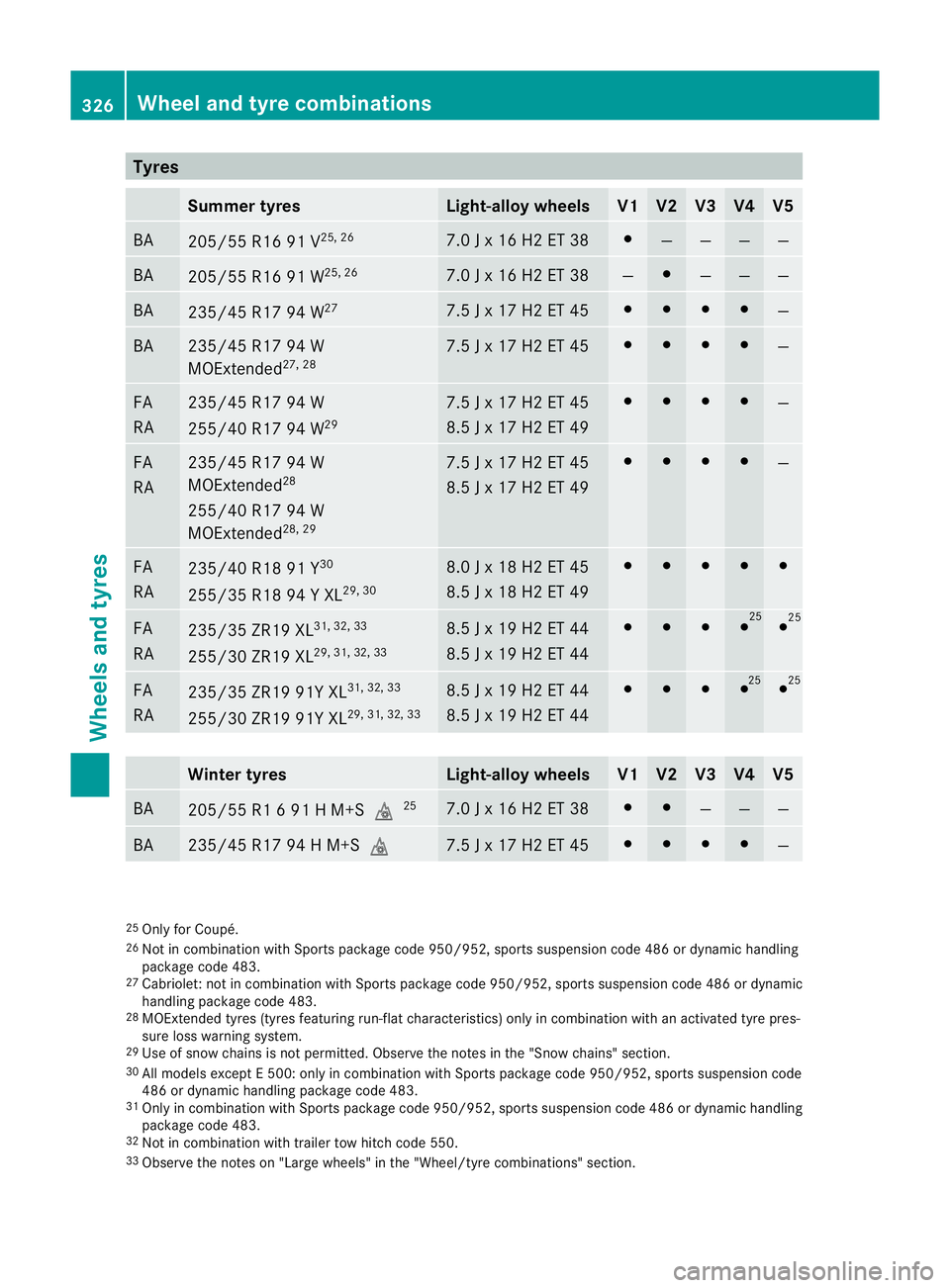
Tyres
Summe
rtyres Light-alloy wheels V1 V2 V3 V4 V5
BA
205/5
5R1691 V 25
,26 7.
0Jx16H2ET38 #
— — — —
BA
205/55 R1
691W25, 26 7.0
Jx16H2ET38 — #
— — —
BA
235/45 R1
794W27 7.5
Jx17H2ET45 # # # #
—
BA 235/45 R1
794W
MOExtended 27, 28 7.5
Jx17H2ET45 # # # #
—
FA
RA 235/45 R1
794W
255/40 R1 794W29 7.5
Jx17H2ET45
8.5 Jx17H2ET49 # # # #
—
FA
RA 235/45 R1
794W
MOExtended 28
255/40 R1 794W
MOExtended 28, 29 7.5
Jx17H2ET45
8.5 Jx17H2ET49 # # # #
—
FA
RA
235/40 R1
891Y30
255/35 R1 894YXL29, 30 8.0
Jx18H2ET45
8.5 Jx18H2ET49 # # # # #
FA
RA
235/35 ZR19 XL
31, 32, 33
255/30 ZR19 XL 29, 31, 32, 33 8.5
Jx19H2ET44
8.5 Jx19H2ET44 # # # # #
FA
RA
235/35 ZR19 91Y XL
31, 32, 33
255/30 ZR19 91Y XL 29, 31, 32, 33 8.5
Jx19H2ET44
8.5 Jx19H2ET44 # # # # #
Winter tyres Light-alloy wheels V1 V2 V3 V4 V5
BA
205/55 R1
691HM+Si 25 7.0
Jx16H2ET38 # #
— — —
BA 235/45 R1
794HM+Si 7.5
Jx17H2ET45 # # # #
—
25
Onl yfor Coupé.
26 Not in combinatio nwithS ports packag ecode9 50/952, sports suspension cod e486 or dynamic handling
packag ecode4 83.
27 Cabriolet: not in combinatio nwith Sports package code 950/952, sport ssuspension code 486 or dynamic
handlin gpackage code 483.
28 MOExtended tyres (tyres featuring run-flat characteristics) only in combination with an activated tyre pres-
sure loss warnin gsystem.
29 Use of snow chain sisnot permitted. Observe the notes in the "Sno wchains" section.
30 All models except E500:only in combination with Sports package code 950/952, sport ssuspension code
486 or dynamic handlin gpackage code 483.
31 Only in combination with Sports package code 950/952, sport ssuspension code 486 or dynamic handling
package code 483.
32 Not in combination with trailer tow hitc hcode 550.
33 Observe the notes on "Large wheels" in the "Wheel/tyre combinations" section. 326
Wheel and tyre combinationsWheels and tyres
25
25
25
25